

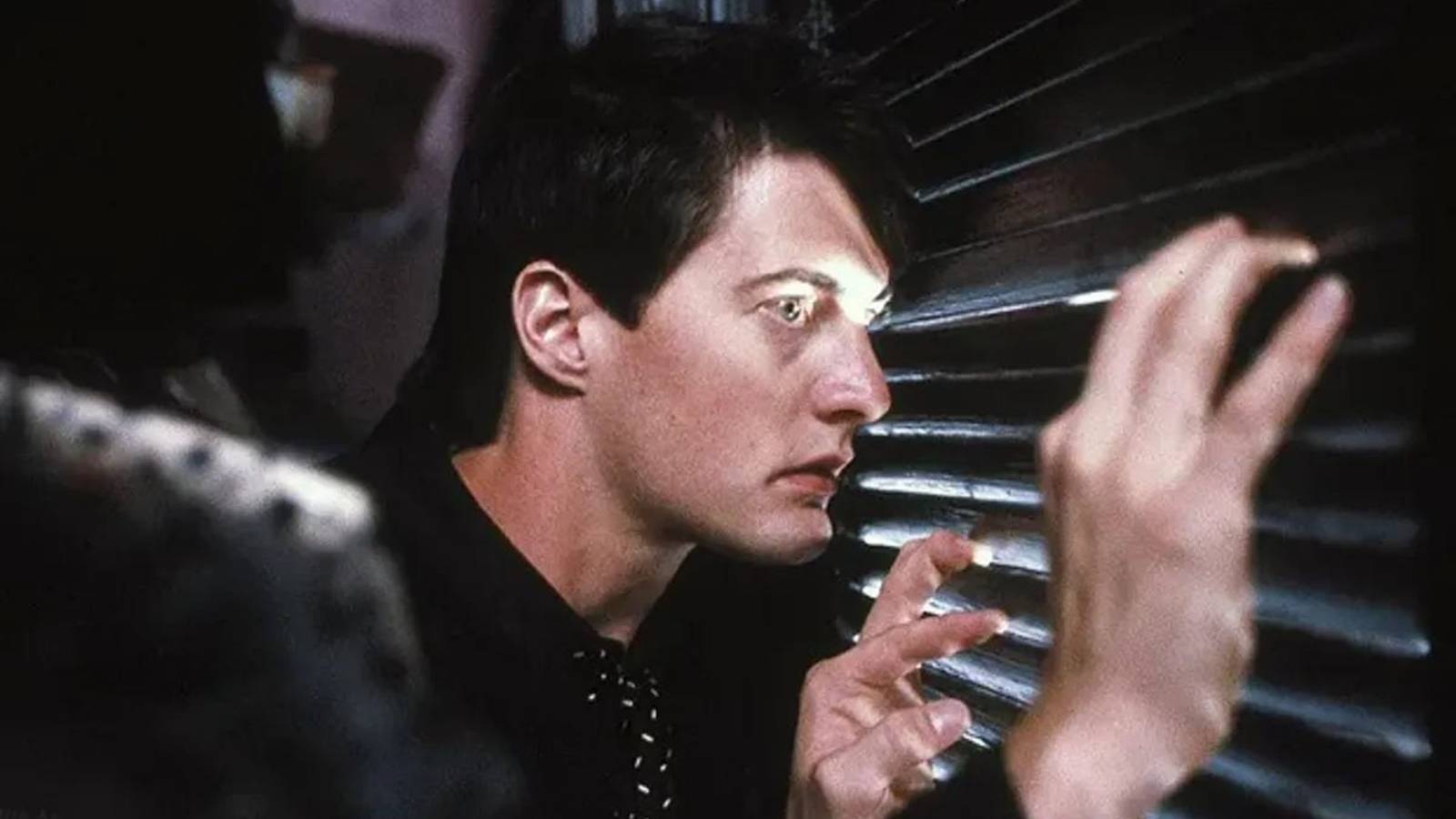
There will never be another filmmaker like David Lynch, and many of his movies and TV shows are like nothing else in the world of cinema. Appearing on the scene with his landmark indie hit, Eraserhead, Lynch was quickly pulled into the Hollywood system. However, his unorthodox style always made him an outsider, even when directing mainstream movies.
Noted for his use of surreal and dreamlike imagery, Lynch’s style was so unique that it spawned its own adjective. When something is described as Lynchian, it means it utilizes dreamy visuals and often contrasts seemingly mundane occurrences with nightmarish horror. One of Lynch’s favorite tropes was to dissect the idealism of American life.
Though he worked primarily on the big screen, Lynch made a few forays into television as well. No matter what medium he utilized, the artist was sure to deliver something wholly unique. Even when dabbling in painting or music, Lynch created pieces that couldn’t be replicated. All of his works are incomparable, but some stand out from the rest.
The Straight Story (1999)
Though David Lynch was a brilliant surrealist, The Straight Story proved he could tell a more conventional story as well. Learning that his estranged brother is ill, a retiree decides to ride his lawn mower from Iowa to Wisconsin in order to visit him one last time. Simple and compelling, The Straight Story lives up to its name.
Largely absent are the many dreamlike quirks of Lynch’s other films, but he still manages to make the story uniquely his. Alvin’s journey is an unorthodox odyssey, and he finds joy in the mundane things he encounters along the way. The Straight Story is the antithesis of a conventional David Lynch film, and in that way, it’s his strangest work.
Wild At Heart (1990)

Erotic thrillers were popular in the early 1990s, and David Lynch made his mark on the genre with Wild at Heart. The film concerns a young couple, Lula and Sailor, who go on the run from men hired by Lula’s mother to kill Sailor. The polarizing flick features stellar performances from Laura Dern, Nicolas Cage, and Willem Dafoe.
While weaving a typical thriller narrative, the movie peppers in surreal imagery that makes Wild at Heart a pseudo-parody of the genre’s conventions. Ultimately, it’s a tribute to The Wizard of Oz, a film that clearly inspired David Lynch’s entire catalog. It’s weird and wild, and turns the entire star-crossed lovers trope on its ear.
Twin Peaks: Fire Walk With Me (1992)

Made after the show’s cliffhanger ending, Twin Peaks: Fire Walk with Me didn’t answer many questions and mostly posed its own puzzling quandaries. The movie chronicles the final few days of Laura Palmer before her brutal murder that kicked off the events of the Twin Peaks franchise. Without the mediating influence of Mark Frost, the movie is pure Lynchian goodness.
Laura’s downward spiral is tragic, and Fire Walk with Me eschews the show’s goofy tone. Like many Lynch works, it features overt violence that intentionally contrasts the idyllic facade of Twin Peaks as a town. Many fans only knew Lynch from the TV series, so they were in for quite a shock when they saw the prequel movie.
Inland Empire (2006)

David Lynch’s last feature film, Inland Empire, was his deepest dive into surrealism and mind-bending imagery. An actress takes a role in a movie, but soon finds her own life intersecting with the violent events that take place on screen. Laura Dern reunites with Lynch once again, and gives the most startling performance of her career.
Lynch’s more surreal works are an acquired taste, but Inland Empire is the bitterest wine he ever produced. The movie has a documentary-like style because it was shot on consumer-grade equipment. Its three-hour running time is jam-packed with odd twists, and it is entirely indecipherable from beginning until the very end.
Lost Highway (1997)

Lost Highway was the first in a trilogy of films that also included Mulholland Drive and Inland Empire, but it still has its own identity. Two lives cross over when a musician is haunted by murder, and a mechanic has an affair with a mobster’s girl. Made with that distinctly ’90s flavor, Lost Highway is very much of its time.
It has all the hallmarks of a Lynch film, including foreboding imagery, genuinely horrific moments, and shocking violence, but it shuffles the pieces around so that nothing is ever clear. Dual identities are a common theme in the director’s work, but Lost Highway is really where he began to hammer it home. Lynch entered his unfiltered era with Lost Highway.
The Elephant Man (1980)

It’s hard to believe, but The Elephant Man was only the second feature film David Lynch ever directed. It loosely recounts the life of the actual historical figure, but focuses mostly on his relationship with Dr. Treves at the London Hospital. An effective story overall, The Elephant Man takes a page from the theater with its larger-than-life melodrama.
It could have been a flat affair, but Lynch’s touches make it much more. His black and white photography emphasizes the grit of Victorian-era London, and there is a motif of machinery that references the industrialization of the city. This sets the stage for a pair of amazing performances, with John Hurt and Anthony Hopkins bringing the house down.
Mulholland Drive (2001)

In a lot of ways, Mulholland Drive is David Lynch’s cinematic magnum opus because it combines his greatest assets into one project. An aspiring actress heads to Hollywood but quickly finds herself lost in a nightmarish and confusing world of stolen identities and betrayal. Though it’s true of all Lynch works, Mulholland Drive is without compare.
Naomi Watts gives a career-making performance, and she does so by essentially playing multiple characters. The movie’s tangled knot is engrossing, and it reveals enough to keep audiences trying to untie if forever. It features David Lynch’s unfiltered thoughts about the movie industry, but they are so cryptic that they force the viewer to lean in to learn more.
Eraserhead (1977)

Few directors made a bigger impact with their first film than David Lynch, and Eraserhead is a fully formed vision from start to finish. The surrealist masterpiece follows a young man who suddenly becomes a father, and must deal with the terrors of parenthood. Actively defying interpretation, Eraserhead blew minds in the late 1970s.
Bounding from surprise to surprise, there are only hints of reality in what is clearly a world of nightmare. Lynch crafts some of the most unique visuals ever imagined, and pulls them off with a fresh style that can only be imitated and not replicated. It’s the only film to blend midnight movie appeal with a genuine art-house sensibility.
Twin Peaks (1990-1991, 2017)

Arguably the greatest cult classic TV show of all time, Twin Peaks was like nothing television audiences had ever seen before when it debuted in 1990. An FBI agent is dispatched to a small town in Washington to investigate a series of murders, but nothing is as it seems. Twin Peaks is partly a tongue-in-cheek send-up to police procedurals.
However, it’s also a David Lynch fever dream that critiques the squeaky-clean image of small town America. The show was rushed to a conclusion during season 2, which left many viewers jilted. It took decades for season 3 to arrive, and The Return offered unfiltered Lynchian surrealism that was itself a jab at the audience’s expectations.
Blue Velvet (1986)

Offering the perfect mix of straightforward storytelling and Lynchian surrealism, Blue Velvet is the most accessible David Lynch film that’s also one of his signature creations. Returning home from college, an idealistic young man gets involved with a woman whose husband and child have been kidnapped by a vicious criminal.
Blending erotic thrills with an intentionally quirky style, Blue Velvet reflects both sides of Lynch’s personality. In one way, it yearns for the idealism of small town America, but can’t help but reveal the dark underbelly. There are no other films like Blue Velvet, mainly because there are no other filmmakers like David Lynch.

- Birthdate
-
January 20, 1946
- Birthplace
-
Missoula, Montana, USA
- Height
-
5 feet 10 inches
- Professions
-
Film Director, Screenwriter, Producer, Painter, Musician, Actor
Source link
