

A family film has to work on multiple emotional levels at once without showing the seams. That’s why perfect writing in a family movie is one of the hardest things to pull off. For instance, a child should be able to follow the danger, the comedy, the rhythm, the wonder. An adult should feel the ache underneath it, the parental fear, the regret, the loneliness, the moral choice, the little bruises of ordinary life. And the story still has to move cleanly. No dead air. No false note.
And that is what these ten do. The emotional machinery never slips. Every character wants something clear, every scene complicates that want, and the resolution feels less like a screenwriter wrapping things up than life itself snapping into place in the only shape it ever could have taken.
10
‘Willy Wonka & the Chocolate Factory’ (1971)
What I love about the writing here is that the movie understands greed at a child’s-eye level without ever becoming preachy sludge. It starts in deprivation. The film follows Charlie Bucket (Peter Ostrum) who lives in a house where warmth, food, and luck all feel scarce, and the screenplay never loses sight of that. That is why the golden ticket obsession, for Charlie, is the possibility that the world might briefly open instead of staying shut. Then the factory begins, and the writing gets meaner and smarter.
Each child is a specific appetite made visible. Augustus Gloop (Michael Bollner) consumes without limit. Veruca Salt (Julie Dawn Cole) treats desire as entitlement. Violet Beauregarde (Denise Nickerson) makes competition into identity. Mike Teevee (Paris Themmen) has been flattened by screen-fed arrogance. The brilliance is that the movie never stops being fun while it punishes them. It keeps the seduction of the factory alive even as it exposes what happens when appetite goes undisciplined. Wonka (Gene Wilder) himself is written perfectly because he never stabilizes. It’s this enchanting, almost bizarre take to fascinate and pull in viewers fascinated with chocolate.
9
‘Babe’ (1995)

There is something almost miraculous about how Babe is written. It takes a talking-animal setup that could have been cute and disposable, then builds a story with the moral clarity of a fable and the emotional precision of something much more mature. Babe (Christine Cavanaugh) is born into terror, separated from what should have been ordinary safety, and enters a farm where every creature already knows the role assigned to it. Dogs herd. Ducks scheme. Sheep are treated as stubborn property. Pigs get fattened up for death. The whole world is arranged around hierarchy and use.
And Babe’s innocence starts quietly disrupting that order. He speaks to sheep politely. That sounds small, though it is actually the film’s entire moral revolution. Farmer Hoggett (James Cromwell) is written just as beautifully. The film trusts us to notice the changing quality of his attention toward Babe. That is why their bond feels so profound. It’s a weirdly beautiful film and clean as it can be for a family watch.
8
‘The Wizard of Oz’ (1939)

The writing in The Wizard of Oz is so clean it almost feels immortal. Dorothy Gale (Judy Garland) is part of the genius. She starts in hurt, frustration, and the very old child-feeling that home no longer seems big enough to hold all the emotion inside you. Then the movie sends her into a fantasy world that looks at first like escape and slowly reveals itself as a map of inner need. The companions are a masterstroke because each one externalizes a lack people immediately understand.
The Scarecrow (Ray Bolger) thinks he has no brains, the Tin Man (Jack Haley) thinks he has no heart, the Cowardly Lion (Bert Lahr) thinks he has no courage. Dorothy loves and trusts them before any authority validates them, and that matters enormously. The screenplay is telling you, very gently, that people are often living inside false judgments about themselves long before the world starts naming them. Then the Wizard (Frank Morgan) turns out to be smaller than the myth, which is another beautiful writing decision. Authority disappoints. Performance gets exposed. And still the emotional truth survives.
7
‘Finding Nemo’ (2003)

This film is written with such ruthless emotional intelligence it almost irritates me. It takes one trauma, one terrified father surviving mass loss and overcorrecting into total control, and then lets every single part of the movie work on that wound from a different angle. The conflict with Nemo (Alexander Gould) is not generic family-movie friction. Nemo is a child who wants room to become himself. Marlin (Albert Brooks) is a father who hears “room” as a synonym for catastrophe. Both are right enough to make the hurt real.
And then the script does not only send Marlin on a rescue mission. It sends both father and son on mirrored growth tracks. Nemo, trapped in the tank, starts becoming resourceful, brave, and useful in exactly the ways Marlin has never allowed him to prove. Marlin, out in the ocean with Dory (Ellen DeGeneres), keeps meeting scenarios that punish fear as a worldview. She is a direct challenge to his entire philosophy. She keeps moving, trusting, improvising, living. That is what he cannot do. Scene by scene, the movie turns adventure into therapy without ever feeling clinical. Marlin, by the film’s end, learns that love cannot become a prison without damaging the very life it wants to protect. That is flawless writing.
6
‘Paddington 2’ (2017)

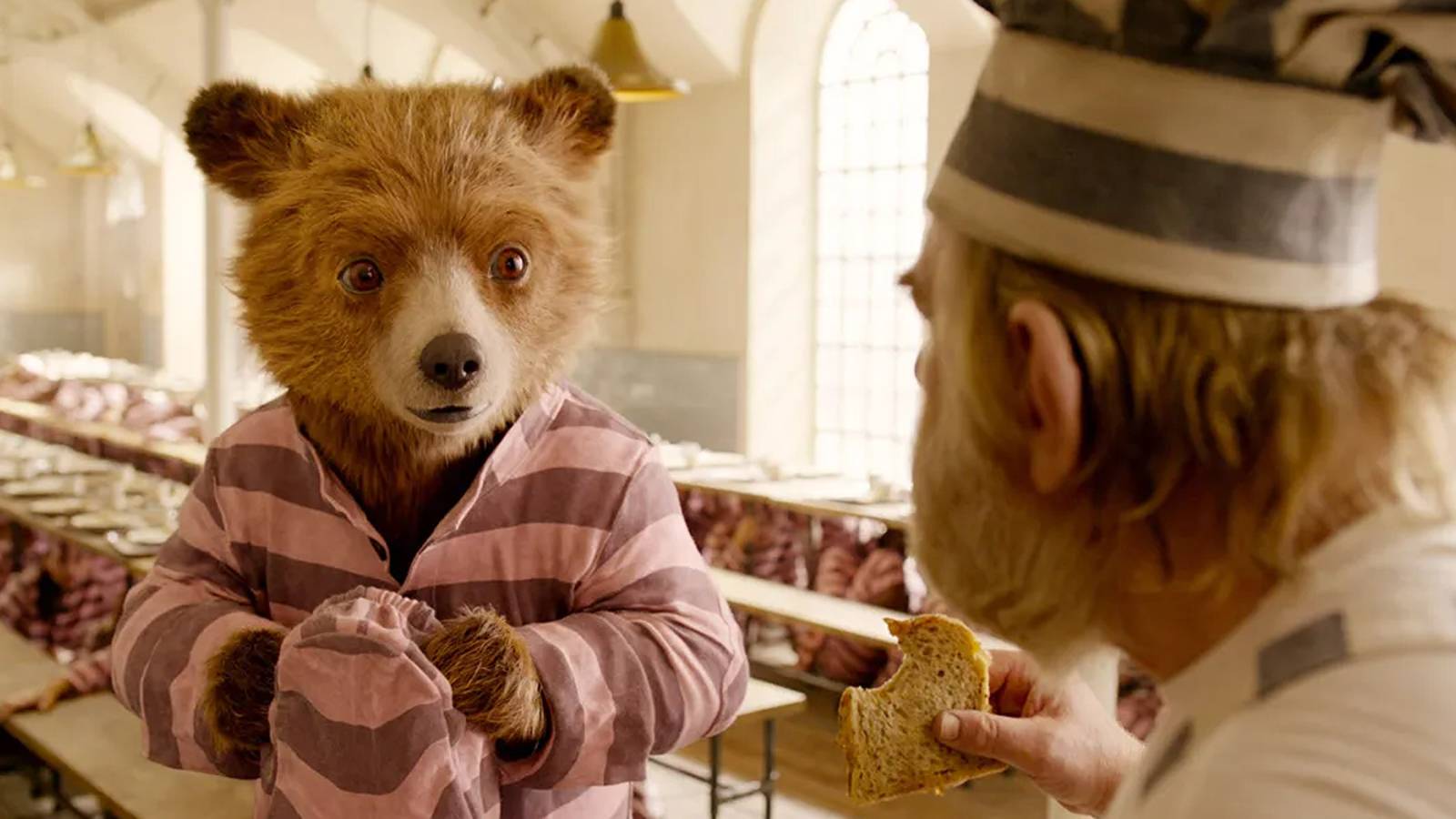
I think one of the reasons Paddington 2 feels so perfect on the page is that it commits, completely and without cowardice, to the idea that goodness can be dramatically powerful. Most movies get nervous about that. They start undercutting sincerity with irony because they do not trust warmth to hold a plot together. This one does the exact opposite.
Paddington Brown (Ben Whishaw) enters the story trying to buy a pop-up book for Aunt Lucy (Imelda Staunton), which is such a modest, tender objective that the screenplay instantly tells you what kind of moral universe you are in. Then it lets that simple desire spiral into theft, prison, escape, and public vindication without ever losing the emotional line. The prison stretch, Paddington’s survival and transformation, it’s all brilliant. Then Phoenix Buchanan (Hugh Grant) gives the whole thing a delicious opposite energy too, all performance with no moral center. So the climax does not just pit hero against villain. It pits substance against narcissistic showmanship.
5
‘The Princess Bride’ (1987)

The writing here is nimble in a way that should honestly be studied. This movie is doing so many things at once and never drops one. It is a fairy tale, a romance, a revenge story, a comedy, an adventure, a bedtime-story frame narrative, and a sly commentary on storytelling itself. Any one of those elements could have overpowered the others. Instead the screenplay keeps them in motion like a juggler who somehow knows exactly when to let one ball hang in the air half a second longer so the whole pattern feels effortless.
And emotionally, the smartest choice The Princess Bride makes is the framing device. The Grandfather (Peter Falk) reading to the Grandson (Fred Savage) changes the entire texture of the movie. It gives the fantasy warmth, intimacy, and permission to be openly sincere. Inside the story, every character is written with absurd economy and total life. Inigo Montoya (Mandy Patinkin)’s revenge plot is still one of the most satisfying emotional engines ever tucked inside a family film. It starts as stylish repetition, “You killed my father,” then accumulates grief, discipline, purpose, and finally catharsis. Westley (Cary Elwes) and Buttercup (Robin Wright)’s romance is archetypal on purpose, which lets the side characters bring all this eccentric texture without destabilizing the core. It is a movie that understands stories are not childish because they are idealized.

There is almost no wasted emotion in E.T. the Extra-Terrestrial. The screenplay understands childhood loneliness so deeply that the sci-fi premise ends up feeling secondary even though it drives the entire movie. Elliott (Henry Thomas) is not simply a kid who finds an alien. He is a child living in the after-image of family rupture. The adults are present, but not fully available. The house still functions, though the emotional ecosystem has been damaged. Elliott is small enough to feel that damage everywhere and powerless enough not to know what to do with it. So when E.T. appears, the connection is immediate on a level deeper than curiosity.
Elliott recognizes another stranded being. That is why the movie never has to overstate itself. The bond grows through hiding, protecting, sharing space, then through that extraordinary empathic link that turns E.T.’s vulnerability into Elliott’s. The suburban home feels like the center of a child’s cosmos, full of siblings, toys, secrets, clutter, and adult blind spots. Then the government intrusion arrives and it feels like mechanized reality breaking into a private emotional world. Elliott cannot stop that without destroying what he loves and that’s why to save him, he has to release it. It’s so good.
3
‘Back to the Future’ (1985)

Back to the Future is one of the most structurally perfect popular movies ever made. Every time I revisit it, I am annoyed by how little slack there is in the writing. Marty McFly (Michael J. Fox)’s dissatisfaction with his life, Doc Brown (Christopher Lloyd)’s dangerous ambition, George McFly (Crispin Glover)’s weakness, Lorraine Baines (Lea Thompson)’s romantic history, Biff Tannen (Thomas F. Wilson)’s bullying, the clock tower, the plutonium, the skateboarding agility, all of it is setup that will later pay off with absurd confidence.
But what makes the movie more than an engineering marvel is the emotional idea at the center: children rarely understand their parents as former young people until some shock forces that perspective open. That is where the time-travel gimmick becomes great writing. Marty goes back, disrupts the past and has to become an active participant in repairing the conditions that made his own life possible. That means seeing his parents as awkward, vulnerable, half-formed teenagers rather than fixed adult furniture. George in particular is the key, who is a man whose timidity hardened into a life. So when Marty starts helping him move toward courage, the story becomes emotionally richer than its high-concept hook suggests.
2
‘Toy Story’ (1995)

What makes Toy Story so brilliantly written is that it finds a premise children instantly adore and then builds a deeply adult emotional structure underneath it. Toys coming to life is the hook. The real story is about what happens when love feels finite. Woody (Tom Hanks) begins secure in his place as Andy’s favorite, and the screenplay is ruthless enough to let that security curdle into jealousy the second Buzz Lightyear (Tim Allen) arrives. That is the right choice. Woody does not become noble too early. He becomes threatened, petty, defensive, and embarrassed by how threatened he feels. The movie trusts that children can handle complicated feelings when they are dramatized clearly.
Buzz’s side of the writing is just as strong. His delusion is not a one-note joke. It gives the film a second, completely different identity crisis to play against Woody’s. Woody knows he is a toy and cannot bear being replaced. Buzz thinks he is a space ranger and cannot bear being reduced. Those two humiliations crash together beautifully. Then Sid Phillips (Erik von Detten)’s house enters and the movie changes texture again, becoming a horror-comedy zone where the fear of damage, disposal, and lovelessness gets externalized in physical form. Both characters have had to survive the collapse of the story they told themselves about who they were. That is why the final moving-truck rescue feels so exhilarating.
1
‘Mary Poppins’ (1964)

Mary Poppins disguises a film about emotional neglect, parental disconnection, classed domestic order, and the recovery of wonder as the most delightful family fantasy imaginable. The brilliance is that the movie never announces its depth like it wants credit for it. It just quietly builds a household in which the children are lively but unmoored, the mother loving but distracted, and the father so disciplined and self-serious that he has mistaken control for care. Then Mary Poppins (Julie Andrews) enters not like a therapist, not like a scold, but like an elemental correction.
Every magical episode matters structurally. The chalk drawing, Uncle Albert on the ceiling, the outing with Bert (Dick Van Dyke), the bank visit, the rooftop finale, all of it keeps pressing on the same hidden problem from a different side. The children need joy and attention, yes, but the real emotional project is Mr. Banks (David Tomlinson). That is the genius. The film slowly reveals that the house does not need better-managed children nearly as much as it needs a father who remembers that tenderness and wonder are not inefficiencies. That is perfect family-movie writing to me. It turns enchantment into moral and emotional repair without ever stopping being enchanting.

Mary Poppins
- Release Date
-
December 17, 1964
- Runtime
-
139 minutes
Source link
