

War movies are one of the oldest and most popular genres, and they include some of cinema’s greatest classics. At their best, these films reveal a lot about what happens when ordinary human beings are placed in extraordinary circumstances. American war filmmaking, in particular, has a strange dual identity: part myth-making machine, part moral reckoning.
With that in mind, this list looks at the very best of them, from the character study of Patton to the non-stop action of Black Hawk Down. For the purposes of this list, we’ll be looking at any movie that was produced by an American studio.
10
‘Patton’ (1970)
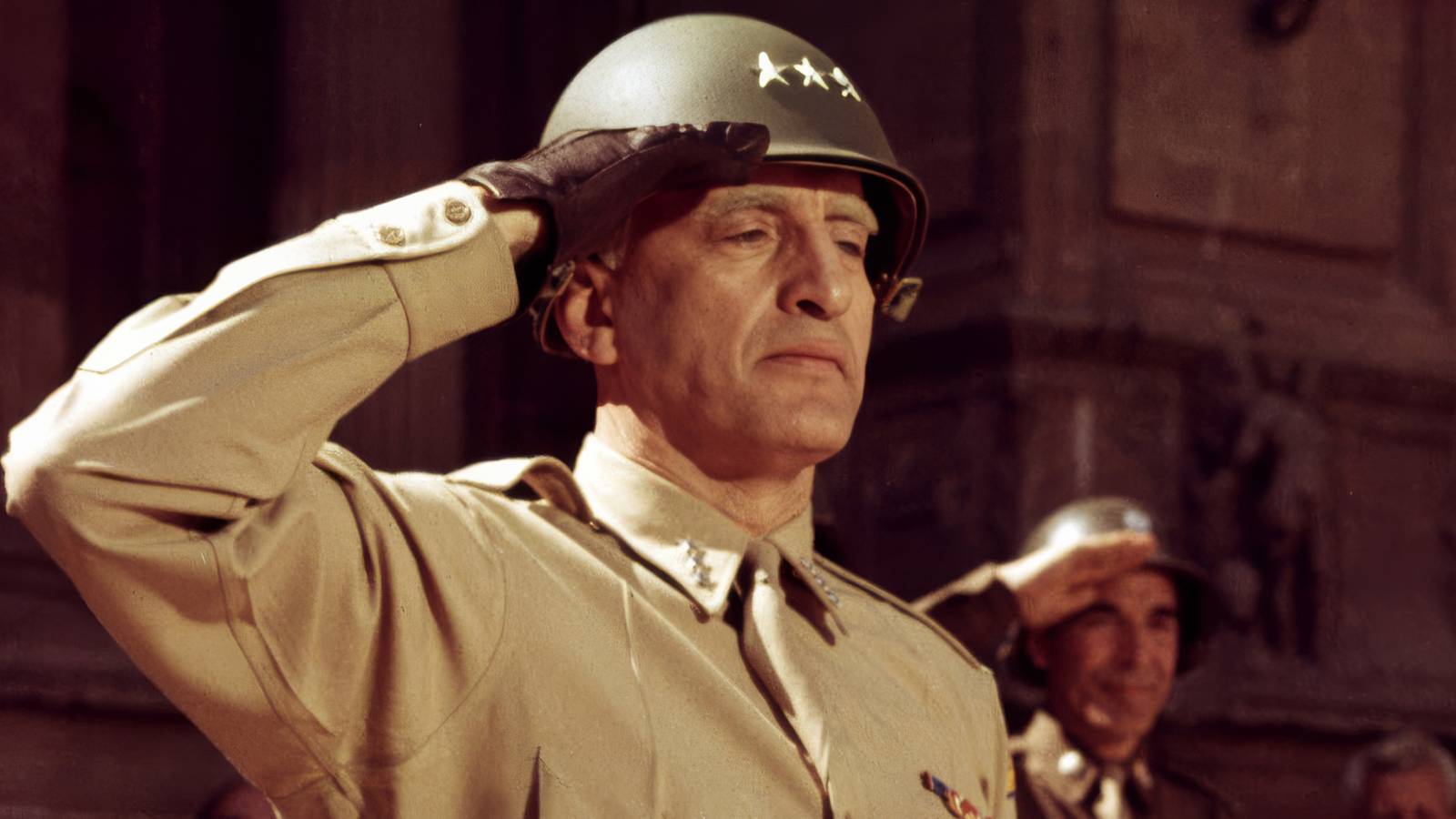
“No bastard ever won a war by dying for his country.” George C. Scott delivers a career-defining, Oscar-winning lead performance here as the titular general, who led campaigns across North Africa and Europe during World War II. The movie is incredibly audacious, beginning quite literally with a man addressing the audience, and by extension, history itself. It’s as much a character study as it is a war epic, fascinated by the contradictions of a man who was both a brilliant tactician and a deeply troubling human being.
A big part of what makes Patton so enduring is its refusal to reduce its subject to either hero or villain. He’s by turns inspiring and insufferable, disciplined and reckless, deeply patriotic and narcissistically self-absorbed. The film revels in his theatricality, his speeches, his ego, even his belief in reincarnation, all while quietly exposing the cost of that myth, too.
9
‘Letters from Iwo Jima’ (2006)

“This island will not fall, no matter how many Americans attack it.” A companion piece to Flags of Our Fathers, Clint Eastwood‘s Letters from Iwo Jima is a rare and remarkable inversion: an American war movie told almost entirely from the perspective of the enemy. Set during the brutal Battle of Iwo Jima in World War II, the film follows Japanese soldiers, most notably General Tadamichi Kuribayashi (Ken Watanabe), as they prepare for and endure the inevitable American invasion.
Rather than framing them as faceless antagonists, the film lingers on their humanity, their fears, and the quiet dignity of men facing certain death. Kuribayashi makes for an especially fascinating character. A leader educated in America, he now finds himself torn between duty to his country, an understanding of the enemy he must fight, and the knowledge that defeat is inevitable.
8
‘The Hurt Locker’ (2008)

“War is a drug.” The Hurt Locker was one of the first American movies to reckon with the Iraq War, and it remains one of the best. Here, Kathryn Bigelow strips away the usual grandeur of war storytelling and replaces it with tension and addiction. At the eye of the storm is Staff Sergeant William James (Jeremy Renner), a reckless and enigmatic soldier who seems almost drawn to danger. The plot is episodic, moving from one bomb disposal mission to the next, each sequence a masterclass in suspense.
Refreshingly, The Hurt Locker focuses on psychology over politics. The Iraq War is present, of course, but largely in the background, stripped of overt commentary. Instead, the film examines the internal cost of repeated exposure to extreme stress. James becomes a man who can function perfectly in war, but not in peace, culminating in the movie’s brilliant, Sisyphean ending.

“I am in a world of sh*t.” The Vietnam War genre was pretty saturated by the late ’80s, yet Stanley Kubrick still found something new to say with Full Metal Jacket, crafting one of the era’s starkest portraits of soldiers and their psychological transformation. The movie is famously split into two halves: the first set in a Marine Corps boot camp, the second unfolding during the Vietnam War.
The boot camp section, led by the unforgettable Gunnery Sergeant Hartman (R. Lee Ermey), is a brutal exercise in dehumanization, systematically breaking recruits down and reshaping them into instruments of war. The second half follows Joker (Matthew Modine), one of the recruits, as he navigates the chaos of Vietnam, working as a war correspondent while grappling with the contradictions of the conflict. Across both sections, Kubrick’s approach is cold, almost clinical, emphasizing the absurdity and horror of war rather than any sense of heroism.
6
‘The Thin Red Line’ (1998)

“What’s this war in the heart of nature?” The Thin Red Line is a sprawling, philosophical war epic from Terrence Malick. Set during the Battle of Guadalcanal in World War II, it follows a group of American soldiers (played by heavy hitters like Sean Penn, Adrien Brody, John Cusack, and George Clooney) as they move through the dense jungles of the Pacific, confronting both the enemy and themselves. But to describe it in purely narrative terms feels almost reductive. This is a film less concerned with plot than with mood and theme.
Malick’s signature style, defined by introspection, whispered voiceovers, and lyrical imagery, transforms the battlefield into something almost spiritual. The violence is real, often sudden and brutal, but it exists alongside moments of haunting beauty: sunlight filtering through trees, the quiet movement of animals, the strange indifference of nature to human conflict.
5
‘Black Hawk Down’ (2001)

“Nobody asks to be a hero. It just sometimes turns out that way.” Ridley Scott followed up Gladiator with this relentless war movie based on the real-life Battle of Mogadishu in 1993. It’s about a U.S. military mission that spirals disastrously out of control when two Black Hawk helicopters are shot down, trapping American soldiers deep within hostile territory. What begins as a routine operation becomes a desperate fight for survival.
Where Malick’s film is slower and introspective, Black Hawk Down is almost entirely defined by momentum. The structure is simple: get in, complete the mission, get out. The execution, however, is anything but. Scott throws the viewer into chaos and refuses to let up. The geography becomes disorienting, the noise overwhelming, the stakes constantly escalating, the danger omnipresent. And yet, amid the confusion, there is camaraderie, keeping us invested.
4
‘Inglourious Basterds’ (2009)

“Au revoir, Shosanna!” With Inglourious Basterds, Quentin Tarantino does something almost heretical: he turns World War II into a revenge fantasy. This banger (which might just be his masterpiece) serves up two parallel narratives: one centered on a group of Jewish-American soldiers hunting Nazis across occupied Europe, the other on a young Jewish woman, Shosanna (Mélanie Laurent), plotting her own act of vengeance against the Nazi high command. These threads converge in a gleefully ahistorical climax that rewrites the outcome of the war itself.
Tarantino’s approach is deliberately stylized, blending spaghetti western influences with sharp dialogue and explosive violence. The performances are electric, particularly Christoph Waltz‘s Oscar-winning turn as Hans Landa, turning conversations into battlegrounds as tense as any firefight. Beneath all the bullets, fire, and mayhem, Inglourious Basterds is a kind of cathartic myth, one where evil is not just defeated, but obliterated.
3
‘Dunkirk’ (2017)

“You can practically see it from here.” Sure, Dunkirk was directed by a Brit and tells a distinctly British story, but it was a UK-US co-production, and it’s brilliant, so it makes this list. The film transforms one of World War II’s most desperate evacuations into an exercise in pure cinematic tension. It interweaves three timelines across land, sea, and air, each unfolding at a different pace but converging toward a single moment of survival.
Soldiers are stranded on the beaches of Dunkirk, surrounded by enemy forces, waiting for a rescue that may never come. Nolan immerses the viewer in their experience: the sound of approaching planes, the panic of sinking ships, the quiet dread of waiting. Time itself becomes elastic, folding and overlapping to heighten the sense of urgency. Amid all the chaos, heroism emerges quietly, in small acts of courage and endurance.
2
‘Saving Private Ryan’ (1998)

“Earn this.” With Saving Private Ryan, Spielberg reshaped the language of war cinema, laying a blueprint that almost every WWII movie since has borrowed from. The movie opens with the now-iconic D-Day sequence, a brutal, immersive depiction of the Normandy landings that redefined realism on screen. From there, it follows Captain Miller (Tom Hanks) and his squad as they venture deep into enemy territory to find and bring home Private James Ryan (Matt Damon), the last surviving brother of four soldiers.
The premise is simple, almost mythic: risk many lives to save one. But the execution is anything but straightforward. However, the soldiers are not archetypes but individuals, each carrying fear, doubt, and a desperate desire to survive. Through them, the movie interrogates the very idea of sacrifice, forcing its characters (and the audience) to confront uncomfortable questions about duty, morality, and the value of human life.
1
‘Apocalypse Now’ (1979)

“I love the smell of napalm in the morning.” Apocalypse Now is less a war film than a descent into madness. Loosely based on Joseph Conrad’s Heart of Darkness, this phantasmagoric odyssey follows Captain Willard (Martin Sheen) as he journeys upriver into the jungles of Vietnam on a mission to assassinate Colonel Kurtz (Marlon Brando), a rogue officer who has established himself as a god-like figure among his followers. What begins as a military operation quickly dissolves into something far stranger and more surreal.
The further Willard travels, the more the boundaries between sanity and insanity blur. The set pieces feel like fragments from a fever dream: eerie, dreamlike encounters deep in the jungle, helicopter assaults scored to Wagner. The movie was absurdly ambitious and challenging to make, almost breaking its cast and crew in the process, but the finished product is one of the most towering achievements of ’70s cinema.
Source link