

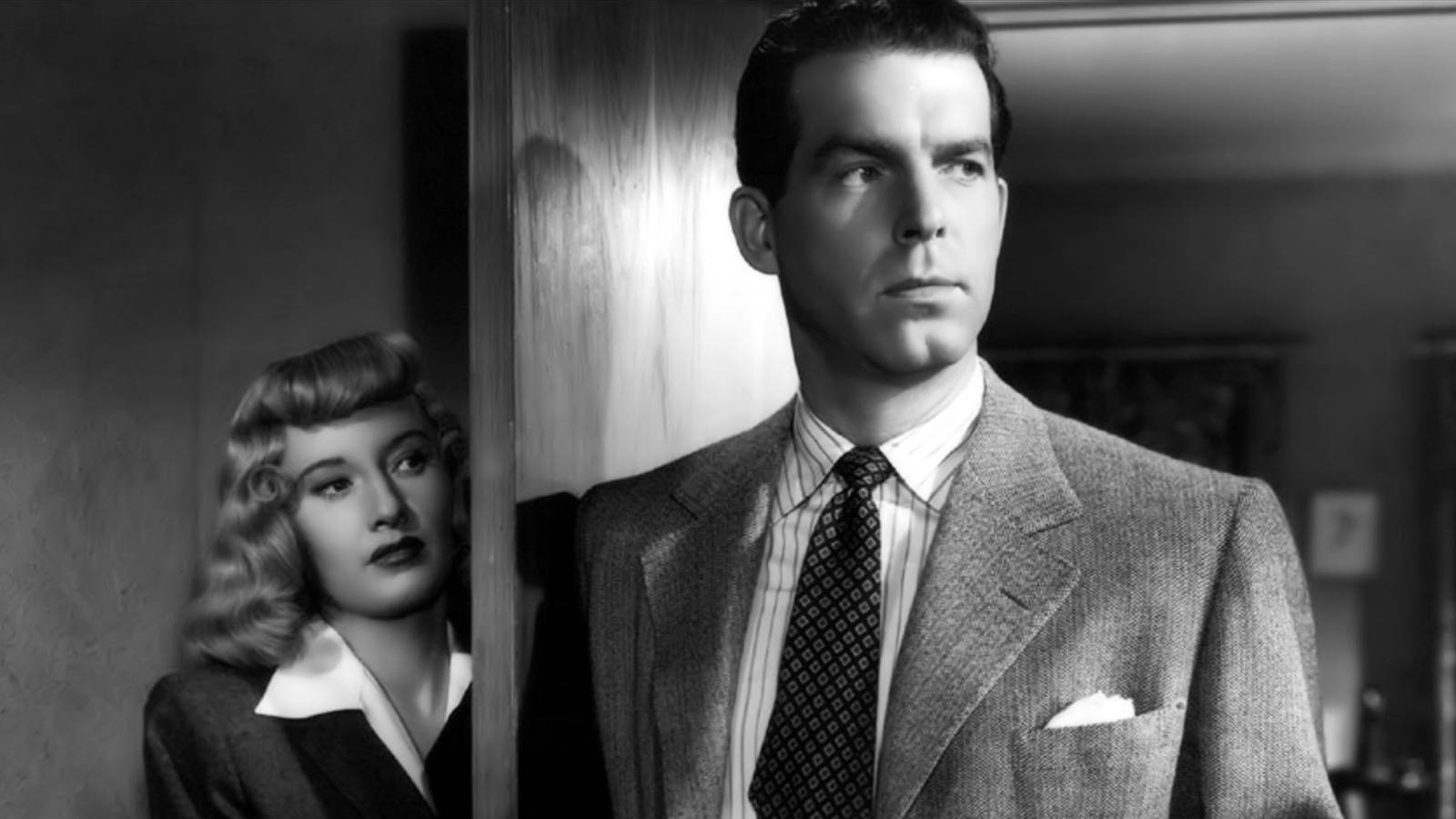
During World War II, right in the midst of the peak of the Golden Age of Hollywood (particularly the ’40s and ’50s), film noir came to be. Experts over the years haven’t been able to agree on whether this is a genre, a style, or a film movement, but there’s undeniably something linking together these dark films led by complex antihero protagonists in hard-boiled stories of intrigue.
Throughout the 20th century in particular, noir filmmakers cracked the code about what made this distinct genre sing. When mixed with the crime genre, noir could make for some of the most fascinating and deliriously entertaining films imaginable. From quintessential Golden-Age classics like Touch of Evil to darker, more modern neo-noirs like Taxi Driver, these are the greatest film noirs made throughout the 20th century.
10
‘Strangers on a Train’ (1951)
Though his Hollywood career was relatively young, Alfred Hitchcock was already a filmmaking veteran by the time the ’50s rolled in. His style immediately proved perfectly compatible with film noir, and in the years following Hollywood’s Golden Age, many of his best works came to be retroactively considered noirs, including what might be the best of the bunch: Strangers on a Train.
It’s one of Hitchcock’s best-made and most provocative films, as well as one of the most devilishly entertaining film noirs ever. Full of masterful performances and imbued by the kind of atmosphere of suspense that only Hitchcock knew how to flawlessly build, Strangers on a Train is one of the most taut and intelligent thrillers of the ’50s. It’s indeed high praise, considering it was a decade filled with those kinds of excellent films.
9
‘The Killing’ (1956)

Anyone who claims that Stanley Kubrick never made a bad or mediocre movie in his life has clearly not seen his debut or sophomore features, Fear and Desire and Killer’s Kiss. It was with his third directorial effort, the iconic noir The Killing, that he proved he had the sauce that would lead millions of people all over the world and throughout history to call him the greatest filmmaker ever.
This landmark picture in Kubrick’s career is also one of the most thrilling crime movies ever made, a masterfully crafted robbery film that shows the director’s uniquely detail-oriented vision and control in their full splendor. Every scene is rock-solid, and the way the final product connects both thematically and stylistically to the rest of Kubrick’s filmography is a treat even for those who aren’t Kubrick completionists.
8
‘Heat’ (1995)
Heat, the great Michael Mann‘s magnum opus, is as much of a multi-hyphenate as movies get. This slow-burning character-driven epic is not only one of the best crime noirs of the 20th century, but also one of the best action thrillers of the last 100 years, with a legendarily stacked cast led by Al Pacino, Robert De Niro, and Val Kilmer at the top of their games.
Heat is the ’90s neo-noir par excellence, a gripping character study about the isolating cost of obsession. It’s an engrossing, surprisingly human film, far more interested in the psyche and inner lives of its fascinating characters than in the external events of its plot, which is already entertaining enough. It’s smart, prestigious genre filmmaking at its greatest, and undeniably noir-ish in the best ways.
7
‘Touch of Evil’ (1958)

Many people’s favorite film noir, including filmmakers of the caliber of Edgar Wright, Touch of Evil was one of the last noirs made during Hollywood’s Golden Age, which is generally agreed to have ended around 1960. Fittingly, it’s also one of the era’s best, just as much of a pitch-black thriller as it is a perfectly innovative example of a noir.
Supported by Orson Welles (who also directed the movie) delivering one of the best performances of any noir, Touch of Evil has aged like fine wine, even in spite of Charlton Heston‘s infamous brownface performance. Following up on one of the best and most iconic opening scenes in film history was always going to be a tough task, but Welles and his team achieved that task wonderfully well.
6
‘White Heat’ (1949)

The ’40s were the defining decade for film noir, and Hollywood closed things off with one of the era’s best movies, White Heat. The Hays Code made it so that during the town’s Classical period, you couldn’t exactly delve deep into the psychology of criminals and deplorable characters, making White Heat‘s exploration of the deepest parts of a criminal’s psyche (one of the best movie gangsters from the era) all the more admirable.
With James Cagney delivering one of the genre’s best-ever performances and Raoul Walsh‘s sharp direction, this surprisingly gritty and realistic crime flick is a taut, hard-hitting melodrama of ahead-of-its-time proportions. To top it all off, its adrenaline-pumping climax is one of the most legendary and unexpectedly cathartic in the history of noir, with one of the most iconic final lines in all of cinema.
5
‘I Am a Fugitive from a Chain Gang’ (1932)

The thing about film noir is that it wasn’t something on filmmakers’ minds during Hollywood’s Golden Age. It wasn’t until 1946 that French critics first coined the term, retroactively looking back and applying the label to some then-recent Hollywood films. As such, the definition can sometimes be a little cloudy. Whether the pre-WWII crime tragedy I Am a Fugitive from a Chain Gang is a proto-noir or full-on noir is up for debate, but what’s definitive is that it’s one of the greatest films from the ’30s.
This incredible pre-Code masterpiece starring an incredible Paul Muni is legendary among prison movies.
The elements are there: a dark and cynical atmosphere, a doomed protagonist, and the distinct visual style that would characterize later noirs. This incredible pre-Code masterpiece starring an incredible Paul Muni is legendary among prison movies, full of social commentary about the penal system that still feels far ahead of its time. It’s a visionary, groundbreaking film that very much deserves to be counted among the best noir movies ever.
4
‘Taxi Driver’ (1976)

Martin Scorsese, arguably the best working filmmaker, has dipped his toes into all sorts of genres and styles throughout his illustrious career, including crime neo-noir, as seen in Taxi Driver. It’s a character study through and through, supported by Robert De Niro delivering one of the most chameleonic performances in all of cinema and Paul Schrader delivering one of the best screenplays in the history of the craft.
It’s one of the best neo-noir crime movies ever, touching on themes of urban decay, loneliness, and male alienation in ways that still feel timely. Its noir elements are stylish and sharply modern, very much in line with the groundbreaking style of the New Hollywood film movement that Scorsese was a big contributor to. Incredibly profound and philosophical, Taxi Driver is one of the strongest American films ever made.
3
‘The Maltese Falcon’ (1941)

The Maltese Falcon is one of those mystery masterpieces that became the blueprint out of sheer influence and reputation. In fact, this classic, based on Dashiell Hammett‘s 1930 pulp crime novel, is regarded by some experts as the very first film noir in history. Whether that’s the case or not is irrelevant, because, beyond a shadow of a doubt, this groundbreaking effort is one of the best noirs ever made.
The Maltese Falcon set the bar sky-high and was very rarely met up there. Delightfully pulpy and entertaining while remaining engaging and riveting, this hyper-influential classic benefits from a labyrinthine plot and some extraordinary acting. It’s mysterious, pulpy, rough around the edges in all sorts of perfectly calculated and irresistibly entertaining ways, and it’s a must-see for all fans of Hollywood cinema.
2
‘Chinatown’ (1974)

The neo-noir genre peaked in 1974, when Robert Towne wrote one of the best and most influential screenplays in movie history: Chinatown. Anything that anyone who loves movies could possibly want from one of them is here: strong acting led by career-defining performances by Jack Nicholson and Faye Dunaway, one of the most enrapturing atmospheres of any neo-noir, and one of the best endings in movie history are but a few of those elements.
Chinatown is certainly grim and cynical, just like any great noir masterpiece should be, but it’s also so much more. It’s shocking, politically razor-sharp, exquisitely unique in its plotting, and so elegant and stylish that it’s almost tempting to ignore the decay and corruption at the heart of its narrative to focus on the alluring visuals. Cinematic masterpieces have rarely been this absorbing.
1
‘Double Indemnity’ (1944)

Cinephiles, academics, and critics alike have throughout history called Double Indemnity the greatest film noir of all time, the movie that set the standard for these kinds of films going forward. It’s dark, yet not without its moments of humor, creatively structured, yet never confusing, dark and morally layered, yet not without characters for the characters to sympathize with. In other words, it’s a Billy Wilder film.
This one’s a noir that’s a true 10/10, no notes. The genre elements are all at the peak of their quality here, including one of the genre’s most memorable endings and its best-ever femme fatale in the form of Barbara Stanwyck‘s Oscar-nominated turn as the devious Phyllis Dietrichson. It’s about as perfect as film noirs get, with more than enough surprises to entertain the most demanding of viewers.
Source link
