

I did not put this list together by looking at influence, awards, or how often these films get cited in arguments about cinema. I kept thinking about the movies I watched after 2005 that quietly reset my expectations without announcing themselves. The ones that made me sit through the end credits without reaching for my phone. Over the years, I realized that these were the movies I measured everything else against, even when I did not mean to. These were the movies that I grew up with, even if I didn’t want to, or even if they were bad for me, in some ways.
Each one commits fully to its story, its characters, and its tone, and then stays there without hedging or trying to impress. They move forward with patience, allow scenes to breathe, and trust the audience to keep up. When I think about cinema since 2005, these are the films that still feel settled in place, as if nothing essential could be added or taken away.
10
‘Children of Men’ (2006)
The film is set in a near future where humanity has lost the ability to reproduce, and society has settled into quiet collapse rather than open chaos. Theo Faron (Clive Owen), lives in a Britain that has become hostile to refugees and numb to its own decline. When he is asked to help escort a young woman named Kee (Clare-Hope Ashitey), he slowly realizes that she carries something the world has not seen in decades.
The story works because of how ordinary everything feels despite the scale of the crisis. Theo is not driven by hope or heroism at first, but by exhaustion and reluctant responsibility. The film stays focused on movement and consequence, and lets long stretches unfold without explanation, which makes the future it imagines feel disturbingly close.
9
‘There Will Be Blood’ (2007)

Daniel Plainview (Daniel Day-Lewis), is introduced as a solitary prospector who believes that success comes from endurance and control. As he builds an oil empire in early twentieth-century California, his dealings with landowners, workers, and rivals reveal a man who treats relationships as transactions. His partnership with his adopted son H.W., (Dillon Freasier), appears functional on the surface but remains emotionally hollow.
Daniel’s rivalry with preacher Eli Sunday (Paul Dano), turns belief and capitalism into opposing performances of power. Each man claims moral authority while quietly feeding personal resentment. By the end, the film becomes about what happens when success removes every reason to pretend you need other people.
8
‘No Country for Old Men’ (2007)

Llewelyn Moss (Josh Brolin) stumbles upon a drug deal gone wrong in the Texas desert and walks away with a suitcase full of money. He believes he can outthink the people who will come looking for it, and for a while, his decisions feel careful and practical. Sheriff Ed Tom Bell (Tommy Lee Jones) tries to track the violence that follows, while Anton Chigurh (Javier Bardem) moves steadily from one location to the next with a strict and unsettling sense of order.
The story refuses to frame this as a contest that can be won through intelligence or courage. Moss makes reasonable choices, yet the danger keeps closing in because chance and timing matter more than intention. Bell’s role becomes more about witnessing a world that no longer behaves according to familiar rules.
7
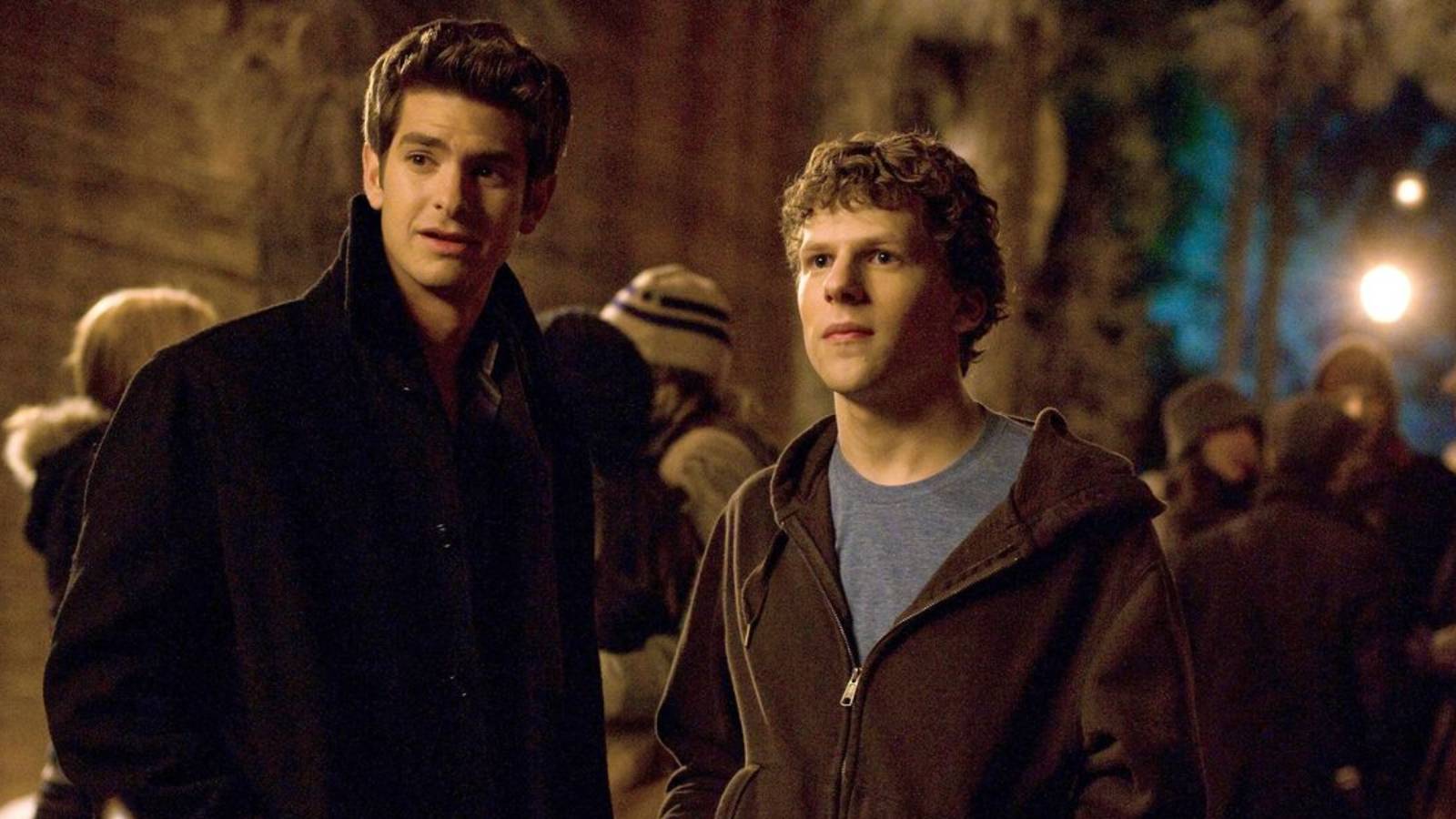
‘The Social Network’ (2010)

The film traces the early days of Facebook through Mark Zuckerberg (Jesse Eisenberg), a college student who builds a platform that spreads faster than his understanding of its impact. His partnership with Eduardo Saverin (Andrew Garfield) starts as a shared project between friends, shaped by long nights of coding and ambition. As the company grows, legal disputes and shifting alliances begin to define how the story is told.
With time, Mark’s decisions push the company forward, yet they quietly damage the relationships that helped make it possible. Conversations become colder, and loyalty turns into something that needs contracts to survive. The film treats innovation as a process that rewards focus while slowly stripping away patience, leaving behind a version of success that feels efficient but emotionally narrow.
6
‘Mad Max: Fury Road’ (2015)

Mad Max: Fury Road takes place in a desert world where fuel, water, and power are controlled by violent factions. Max Rockatansky (Tom Hardy) is captured by Immortan Joe’s group and used as a resource rather than treated as a person. At the same time, Imperator Furiosa (Charlize Theron) is tasked with leading a convoy across the wasteland, a mission that appears routine but quickly turns into an escape.
Once Furiosa breaks from the planned route, the group moves forward because stopping is not an option, and every decision is shaped by limited time and supplies. Max gradually becomes involved because cooperation becomes necessary. The film builds its momentum through continuous movement, and keeps the conflict clear and practical as the characters push toward a place that might offer safety.
5
‘Parasite’ (2019)

The Kim family lives in a small basement apartment and survives through temporary jobs and shared effort. When Ki-woo (Choi Woo-shik) is offered a tutoring position with a wealthy family, the Parks, he sees an opportunity to improve his situation. One by one, the rest of the family finds ways to enter the same household, each taking on a role without revealing their connection to one another.
As their presence in the Park home becomes more secure, the balance of control begins to shift. Small lies start to pile up, and moments meant to feel stable become tense. The story keeps moving by showing how quickly comfort can turn fragile when money and status shape every interaction. What begins as careful planning slowly turns into a situation where no one has full control over what comes next.
4
‘Moonlight’ (2016)

Moonlight is told in three chapters, each following Chiron at a different stage of his life as he grows up in a rough Miami neighborhood. As a child, he struggles to speak for himself and often retreats into silence, especially at home with his mother Paula (Naomie Harris), whose addiction shapes the space around him. Juan (Mahershala Ali), a local dealer, becomes an unexpected source of stability, offering Chiron moments of safety without trying to change who he is.
As Chiron grows older, the pressures around him become harder to avoid. School turns hostile, home offers little relief, and his sense of identity remains unresolved. The story keeps moving forward by showing how each version of Chiron carries the weight of the last one, even when he tries to appear different. By the final chapter, the film focuses on what it takes for him to let his guard down again, and how difficult it is to return to honesty after years of self-protection.
3
‘Whiplash’ (2014)

Andrew Neiman (Miles Teller) is a young jazz drummer who enters a competitive music conservatory with one clear goal: to be great. His talent earns him a place in the studio band led by Terence Fletcher (J.K. Simmons), whose teaching style relies on humiliation, pressure, and constant fear. Rehearsals revolve around precision, speed, and endurance, leaving little space for mistakes or rest.
As Andrew commits more time and energy to the band, his life outside music starts to shrink. Relationships feel like distractions, and physical limits are treated as obstacles to overcome. Fletcher’s influence pushes Andrew to test how far discipline can go before it turns destructive. The film continues by showing how ambition reshapes Andrew’s choices, until the line between dedication and obsession becomes almost impossible to separate.
2
‘The Tree of Life’ (2011)

The story of The Tree of Life centers on Jack O’Brien (Hunter McCracken as a child, Sean Penn as an adult) as he reflects on growing up in a Texas family during the 1950s. His father (Brad Pitt) believes discipline and ambition prepare a child for the world, while his mother (Jessica Chastain) offers patience and emotional openness. Their opposing approaches shape Jack’s childhood, creating confusion, resentment, and moments of tenderness that stay with him long after he leaves home.
As the film moves between past and present, Jack’s memories connect everyday family life to much larger questions about loss and meaning. Small moments, such as shared meals, arguments, and quiet walks, carry as much weight as the film’s more expansive sequences. The story continues by showing how childhood experiences settle into adulthood, not as clear lessons, but as feelings that resurface when a person tries to understand where they came from.
1
‘Portrait of a Lady on Fire’ (2019)

Marianne (Noémie Merlant) is hired to paint a portrait of Héloïse (Adèle Haenel) without her knowing, as the painting will be used to arrange a marriage. Marianne observes her subject during walks, meals, and long silences, slowly memorizing details she cannot sketch openly. Héloïse remains distant at first, still grieving her sister and resisting the future being planned for her.
As the days pass, the secrecy fades and the two women begin to speak honestly with one another. Their relationship grows through shared routines and careful attention, rather than dramatic gestures. The story continues by showing how intimacy forms when time is limited and choices are restricted. By the end, the film stays focused on memory and restraint, allowing the relationship to exist fully even as it becomes something that cannot last.
Source link
