

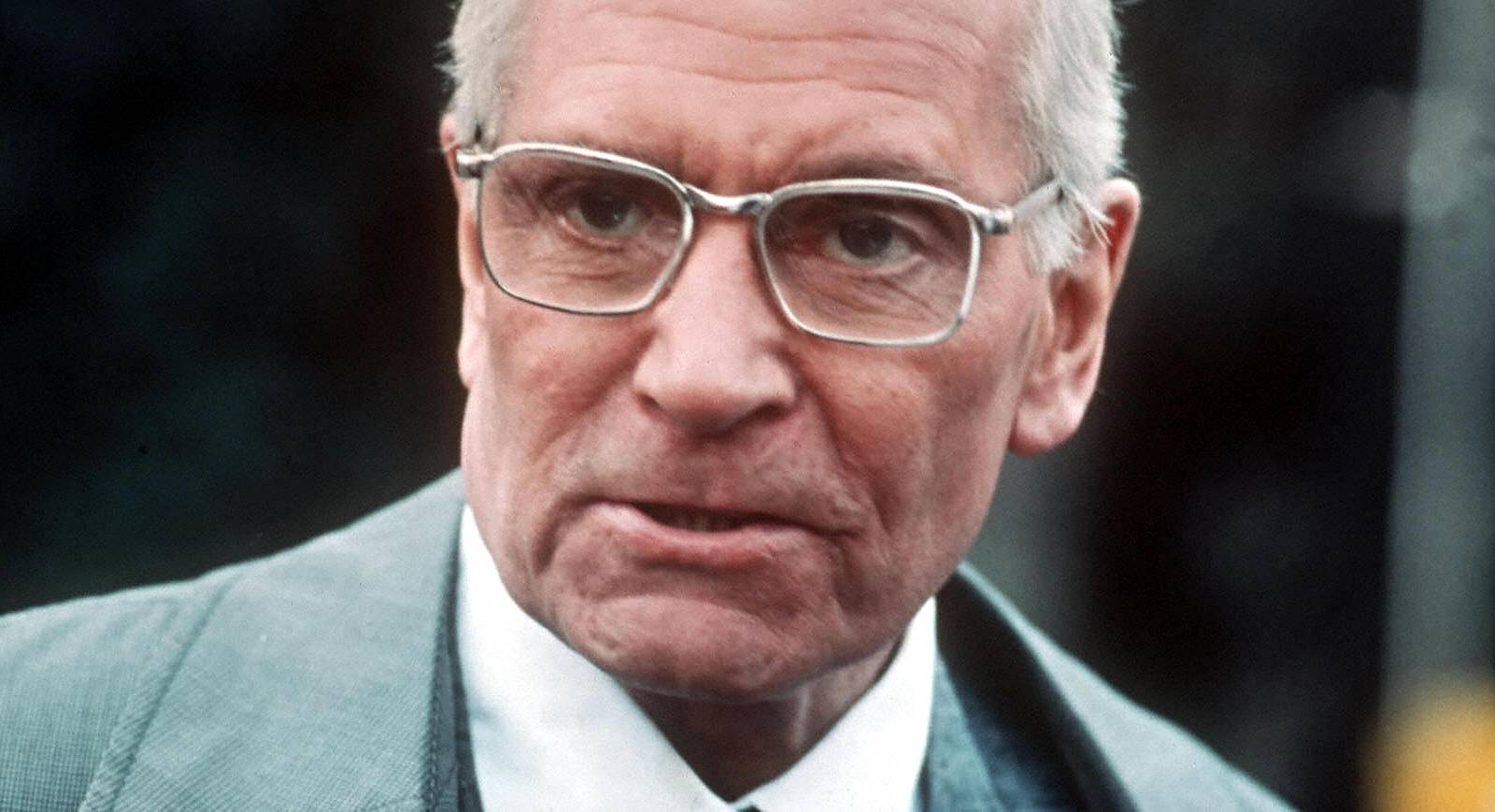
1976 now feels like one of those almost-mythical years in Hollywood history, a moment when the New Hollywood experiment was in full swing, and filmmakers were allowed to take real risks with tone, politics, and psychology. The country itself was still reeling from Vietnam, Watergate, and a broader crisis of trust in institutions, and that unease bled directly onto the screen.
The result is a strong selection of movies across an array of genres: paranoid thrillers, grim character studies, populist sports dramas, horror movies, and revisionist Westerns all reached new heights at once. Nearly fifty years later, the best of these films are still actively referenced, studied, quoted, and rewatched.
10
‘Logan’s Run’ (1976)
“There is no sanctuary.” Logan’s Run imagines a sleek, unsettling future where society maintains order through a brutal bargain: no one is allowed to live past the age of 30. In this enclosed, pleasure-obsessed world, Logan 5 (Michael York) is a “Sandman,” a police officer tasked with hunting down those who try to escape their mandatory death. When Logan himself is secretly programmed to seek out the mythical Sanctuary, he begins to question the system he’s enforced his entire life.
What starts as a glossy sci-fi adventure gradually becomes a more philosophical chase movie about mortality, control, and the price of comfort. The film’s production design, filled with domed cities and color-coded rituals, feels very much of its era, yet its core anxieties remain timeless. Beneath the special effects and futuristic spectacle is a surprisingly human statement on aging, disposability, and authoritarian systems disguised as benevolent caretakers.
9
‘Assault on Precinct 13’ (1976)

“I wanted vanilla twist.” John Carpenter’s Assault on Precinct 13 is a lean, ruthless siege film stripped down to its bare essentials. Set almost entirely in a nearly abandoned Los Angeles police station, it revolves around a small group of cops, civilians, and criminals forced to work together when a silent, relentless street gang surrounds the building. The plot is deceptively simple (drawing heavily on the classic Western Rio Bravo), but that simplicity is the point.
Carpenter directs with icy precision, using minimal dialogue, stark lighting, and his now-iconic synth score to create an atmosphere of constant dread. This was only his second feature, and yet his storytelling voice already feels confident and fully formed. In other words, this movie announced the arrival of a major filmmaker and helped redefine how tension could be built on a microscopic budget, paving the way for the more complex Carpenter classics to follow.
8
‘The Outlaw Josey Wales’ (1976)

“To hell with them fellas. Buzzards gotta eat, same as worms.” The Outlaw Josey Wales stands as one of the great revisionist westerns, and one of Clint Eastwood’s most important films as a director and star. The title character is a Missouri farmer whose family is murdered during the Civil War, pushing him into a life of violent retribution. As he drifts westward, Wales slowly gathers a surrogate family of outcasts and fellow survivors, complicating his desire for revenge.
The Outlaw Josey Wales is deeply morally ambiguous, hinting at themes its creator would explore more thoroughly in Unforgiven. In particular, Eastwood strips the Western of easy heroics, replacing them with weariness, bitterness, and reluctant compassion. The protagonist is both victim and killer, shaped by loss but never fully redeemed. Ultimately, rather than glorifying the myth of the lone gunman, this film interrogates it, suggesting that community and mercy are harder, braver choices.
7
‘Marathon Man’ (1976)

“Is it safe?” Few thrillers capture paranoia quite like Marathon Man. Dustin Hoffman turns in a typically strong lead performance as Babe Levy, a graduate student and avid runner whose quiet existence is shattered when he’s pulled into an international conspiracy involving Nazi war criminals and stolen diamonds. He’s just an ordinary guy, now hunted and manipulated by forces he barely understands. His character development over the course of the movie is compelling. He starts out naive and childish, but his ordeal forces him to grow up and, perhaps more importantly, toughen up.
All this builds up to one of the most infamous torture scenes in cinema history, a sequence that has retained its power to unsettle. The movie’s bleakness reflects the deep post-Watergate distrust of authority. Its pacing is deliberate, its violence shocking rather than cathartic, and its villains disturbingly plausible. Indeed, Laurence Olivier is brilliant as diamond-obsessed Nazi Christian Szell, a performance for which he received an Oscar nomination.
6
‘The Omen’ (1976)

“It’s all for you, Damien!” The Omen takes a juicy premise (a child who may be the Antichrist) and mines it for maximum chills. Gregory Peck leads the cast as diplomat Robert Thorn, who gradually comes to believe that his adopted son Damien (Harvey Spencer Stephens) is the source of a series of increasingly horrific deaths. This idea could’ve turned out pretty pulpy and melodramatic, but Richard Donner plays it straight and restrained. Rather than relying on constant scares, he lets paranoia seep in through atmosphere, ominous coincidences, and a growing sense of inevitability.
The violence, when it arrives, is shocking and often sudden, leaving a lasting impression. The Omen takes a serious approach to its themes, too. It treats the religious elements with gravity, grounding the terror in faith, prophecy, and the terrifying idea that evil can hide behind innocence. The finishing touch comes in Jerry Goldsmith’s Oscar-winning score, which adds the perfect sense of cosmic menace to every scene.
5
‘Carrie’ (1976)

“They’re all gonna laugh at you!” The original Carrie adaptation represented the formidable creative pairing of Stephen King and Brian De Palma, resulting in one of the most emotionally devastating horror movies ever made. Sissey Spacek is Carrie White, a shy, abused teenager raised by a fanatically religious mother (Piper Laurie) and relentlessly bullied at school. When she discovers she has telekinetic powers, Carrie’s longing for acceptance collides tragically with humiliation and cruelty, producing a bloody, fiery third act.
While there’s a lot of darkness and mayhem here, a big part of the movie’s power lies in its empathy. Rather than just portraying her as a monster, De Palma invites the audience to understand Carrie’s pain before unleashing the famous prom-night catastrophe. The high school setting, with its petty cruelty and social hierarchies, feels painfully authentic, in a way that most people can relate to at least a little bit. Arguably, no Carrie film since has quite recaptured that spirit.
4
‘Rocky’ (1976)

“It ain’t about how hard you hit. It’s about how hard you can get hit and keep moving forward.” The sequels would offer diminishing returns, but the original Rocky remains the ultimate underdog sports movie. Sylvester Stallone is in top form as our hero, a small-time Philadelphia fighter given an unlikely chance to face heavyweight champion Apollo Creed. On paper, it’s a classic rags-to-riches story, but what makes it resonate is its humility. Rocky isn’t driven by fame or wealth; he simply wants to prove he isn’t a bum.
Reflecting that central idea, the movie spends as much time on quiet character moments like awkward dates, lonely walks, and nagging self-doubt as it does on training montages (awesome though they are). Its final message isn’t about winning, but about dignity and self-respect. That balance grounds the climactic fight in genuine emotional stakes, something which most modern boxing movies lack. In the process, Rocky captured a moment in American culture hungry for sincerity and perseverance after years of cynicism.
3
‘All the President’s Men’ (1976)

“Follow the money.” All the President’s Men dramatizes the Washington Post’s investigation into the Watergate scandal, and the result is one of the best movies ever made about the fragility of democracy (and the need to defend it). Robert Redford and Dustin Hoffman play reporters Bob Woodward and Carl Bernstein, whose research into a seemingly minor break-in gradually unravels a vast web of political corruption. Their courage and doggedness sets off a chain reaction that eventually brings down a president.
Rather than sensationalizing the story, the film focuses on process: phone calls, late-night research, dead ends, and incremental breakthroughs. That attention to detail makes the conspiracy feel real and terrifyingly plausible. The atmosphere is one of constant unease, where truth is obscured, and power operates behind closed doors. And yet the protagonists don’t let this stop them. Through Woodward and Bernstein, All the President’s Men paints a picture of the best of journalism: patient, committed, and ethically serious.
2
‘Network’ (1976)

“I’m as mad as hell, and I’m not going to take this anymore!” Network is a savage satire that somehow feels more prophetic with every passing year. It’s about a failing television network that turns its unhinged news anchor, Howard Beale (Peter Finch), into a populist prophet of rage after he announces he’s going to kill himself on air. As ratings climb, executives exploit Beale’s breakdown, transforming genuine despair into marketable spectacle.
This premise feels radically ahead of its time, making a pointed statement on the commodification of emotion, outrage, and truth itself. It also explores how some media personalities can make a profit by peddling outrage and histrionics. Much of the credit for Nework’s success must go to screenwriter Paddy Chayefsky, whose script is cynical but smart, crackling with monologues that feel theatrical yet disturbingly accurate. He rightly took home the Best Original Screenplay Oscar for his efforts.
1
‘Taxi Driver’ (1976)

“You talkin’ to me?” Taxi Driver is the most unsettling character study ever put on film, and possibly Scorsese‘s masterpiece. At the heart of it, Robert De Niro turns in a legendary performance as Travis Bickle, a lonely Vietnam veteran working as a night-time taxi driver in New York City, slowly drifting deeper into alienation and violent obsession. Through Travis’s eyes, the city becomes a nightmarish landscape of filth, corruption, and moral decay. He becomes gripped by a misguided desire to cleanse it.
What makes the film so powerful is its refusal to explain or excuse its protagonist. Travis is both pitiable and terrifying, a man whose desire for purity curdles into brutality. Through him, the movie captures the psychological fallout of war, isolation, and urban decay. It’s incredibly personal, and yet its observations ring true for an entire psychological archetype, a spirit that continues to haunt the edges of society today.

- Release Date
-
February 9, 1976
- Runtime
-
114 minutes
Source link
