

In 1988, cinema was quietly expanding in many directions simultaneously. Studio comedies reached absurdist perfection, action movies locked in new formulas, animation crossed cultural and formal boundaries, and international filmmakers produced emotionally rich gems.
Some of these movies were dismissed on release as genre exercises, some as populist entertainment, and some as niche or foreign curiosities. Yet decades later, their staying power has proven extraordinary. Without further ado, here are some of 1988’s most enduring classics.
10
‘They Live’ (1988)
“I have come here to chew bubblegum and kick ass… and I’m all out of bubblegum.” They Live is one of John Carpenter’s most purely enjoyable movies. It features wrestler Roddy Piper as Nada, a drifter who stumbles upon a pair of sunglasses that reveal a hidden reality: society is secretly controlled by alien elites using mass media to enforce obedience. Over 94 action-packed minutes, this pulpy sci-fi premise gradually becomes one of the most blunt political allegories in ’80s cinema. Carpenter strips metaphor down to its bones, using slogans, billboards, and consumer imagery as literal instruments of control.
The story unfolds simply, but its implications are expansive, touching on capitalism, conformity, and false consciousness. It’s a clear rebuke to Reaganomics. Over time, They Live has been reappraised as eerily prescient, its critique of advertising and media manipulation feeling even sharper in the digital age. All in all, what this movie lacks in subtlety, it makes up for in conviction and attitude.
9
‘The Naked Gun: From the Files of Police Squad!’ (1988)

“Nothing to see here! Please disperse.” The Naked Gun is still alive and kicking now, in large part thanks to the solid foundation laid by the original. The Naked Gun: From the Files of Police Squad! is a relentless assault of visual gags, wordplay, and deadpan absurdity disguised as a police procedural. Leslie Nielsen carries much of it singlehandedly as Lt. Frank Drebin, a catastrophically incompetent detective attempting to foil an assassination plot. While there is a plot, it basically exists as a delivery system for jokes.
The humor comes from sincerity pushed to idiotic extremes, with Nielsen leaning hard into character-based absurdity. He’s just good at this particular style of comedy, his timing and delivery making everything ten times funnier. He’s helped out by David Zucker‘s masterful visual storytelling, leading to some truly phenomenal visual gags (only surpassed by his own earlier movie Airplane!). Unsurprisingly, this movie was a massive box office smash.
8
‘A Fish Called Wanda’ (1988)

“Apes don’t read philosophy.” John Cleese stars in and wrote this quirky heist comedy. He plays Archie Leach, the lawyer to London gangster George Thomason (Tom Georgeson). After George and his gang of thieves pull off a heist, con artist Wanda (Jamie Lee Curtis) hatches a scheme to swindle him. Plenty of double-crossing follows, with shifting alliances driven by desire (and more than a little stupidity). From here, the movie blends farce, romance, and crime into a tightly wound comedy about greed, deception, and sexual power games.
The name of the game here is controlled chaos. Every betrayal and misunderstanding tightens the knot rather than loosening it. This kind of movie lives or dies on the quality of the acting, and the leads are all great across the board. Each performance is calibrated to a different comedic register, creating friction that fuels the laughs. Kevin Kline, in particular, repeatedly steals scenes and walked away with the Best Supporting Actor Oscar for his efforts.
7
‘Who Framed Roger Rabbit’ (1988)

“I’m not bad. I’m just drawn that way.” Who Framed Roger Rabbit is a technical marvel built around a noir mystery, a major leap forward for animation techniques, as well as simply a compelling story in its own right. Set in a world where animated characters coexist with humans, it follows a hard-boiled detective (Bob Hoskins) hired to clear a cartoon rabbit (voiced by Charles Fleischer) framed for murder. It’s humorous and wacky, but also serious, blending tones seamlessly. What makes Who Framed Roger Rabbit endure is how seamlessly it blends tones.
The slapstick and colorful visuals conceal a surprisingly dark story about corruption, urban development, and exploitation. The movie refuses to treat animation as childish, using cartoons to explore greed and institutional decay. Most importantly, Robert Zemeckis treats the animated characters as physical beings, grounding the fantasy in tactile reality. This oddball mixture shouldn’t work, but somehow does, wildly pivoting between fun, tense, scary, and touching.
6
‘Rain Man’ (1988)

“I’m an excellent driver.” Rain Man follows a self-centered businessman (Tom Cruise) who discovers he has an estranged brother (Dustin Hoffman) with autism, leading to an unexpected road trip and emotional reckoning. The journey becomes a catalyst for character development and a gradual shift from exploitation to understanding. The story is occasionally a little melodramatic, but it compensates with sturdy direction and winning performances. Hoffman, especially, is excellent and won the Best Actor Oscar for the role. He’s handed an exceptionally challenging part and does something extraordinary with it.
The movie is at its best when it embraces complexity. Fundamentally, it acknowledges how limited empathy can be, and how meaningful even incremental progress is. In other words, Rain Man‘s staying power lies in its refusal to pretend that love instantly cures selfishness, or that real problems can simply be wished away. This message still holds up, all this time later.
5
‘The Vanishing’ (1988)

“Because you love her.” The Vanishing is one of the most devastating psychological thrillers ever. It centers on Rex (Gene Bervoets), a man obsessed with discovering what happened to his girlfriend Saskia (Johanna ter Steege) after she vanished during a roadside stop years earlier. In parallel, we follow the wealthy psychopath Raymond (Bernard-Pierre Donnadieu) as he plots to abduct a woman, between work and time with his family.
Most thrillers in this subgenre use the mystery to generate suspense, but The Vanishing unleashes most of its terror through knowledge. Questions are answered, but not in a way that brings any catharsis. Some answers are worse than uncertainty, it tells us. At the same time, the film makes sharp statements on human darkness. Specifically, it presents evil as banal, methodical, and terrifyingly rational. This makes the story all the more believable and all the more frightening, anchored by the complex, chilling performance by Donnadieu.
4
‘Die Hard’ (1988)

“Yippee-ki-yay, motherf—.” Simply put, one of the greatest action blockbusters of all time. Bruce Willis turns in one of his defining performances in Die Hard as John McClane, an off-duty police officer trapped in a Los Angeles skyscraper during a meticulously planned hostage takeover. The plot unfolds with clockwork precision, each obstacle escalating stakes rather than resetting them. While the action is propulsive and hard-hitting, what makes Die Hard truly endure is its character focus. The protagonist is vulnerable, exhausted, and improvising rather than dominating.
At the same time, McClane’s worries play out on a human scale. He isn’t saving the world, but rather simply trying to survive and reconnect with his family. At the time, that was a nice change of pace for this type of movie. Opposite Willis, Alan Rickman delivers a fantastic villain performance (in his feature debut!) that showed off the talents he would later bring to bear on his role as Severus Snape.
3
‘My Neighbor Totoro’ (1988)

“Let’s go see Totoro!” One of Miyazaki’s many masterpieces, My Neighbor Totoro follows two young sisters (voiced by Noriko Hidaka and Chika Sakamoto) who move to the countryside and encounter gentle forest spirits while coping with anxiety about their mother’s illness. The plot is minimal, built around small discoveries rather than conflict, yet the whole thing is bursting at the seams with emotional intelligence. There is no villain, no climactic battle; only attentiveness to mood, environment, and care.
In a medium often driven by noise and color, My Neighbor Totoro trusts stillness and softness. Like all great children’s stories, it treats imagination not as escapism, but as a tool for processing uncertainty and fear. The world-building is rich, and the animation is gorgeous, lovingly crafted by hand. Not for nothing, it has become an animation touchstone and an international treasure, frequently ranked among the greatest animated films ever made.
2
‘Akira’ (1988)

“Kaneda!” 1988 also gifted us with Akira, another hugely influential animated masterpiece. It’s a dystopian epic set in a decaying neo-Tokyo, following teenage bikers whose lives are shattered by government experiments and psychic power. The plot escalates from street violence to apocalyptic spectacle, but its core is about alienation and uncontrolled transformation. Director Katsuhiro Otomo fuses political paranoia, body horror, and adolescent rage into a singular vision of collapse.
At the time, all this was unusually ambitious for an anime movie. So were the visuals: the striking compositions and cyberpunk aesthetics massively reshaped both animation and live-action, their DNA living on in everything from Ghost in the Shell to The Matrix. And that’s without even mentioning the “Akira slide”, which has since been copied to death. All in all, this movie was a cultural watershed, painting a vivid portrait of a world where progress is unstable and dangerous, shaped by forces humans barely understand.
1
‘Cinema Paradiso’ (1988)

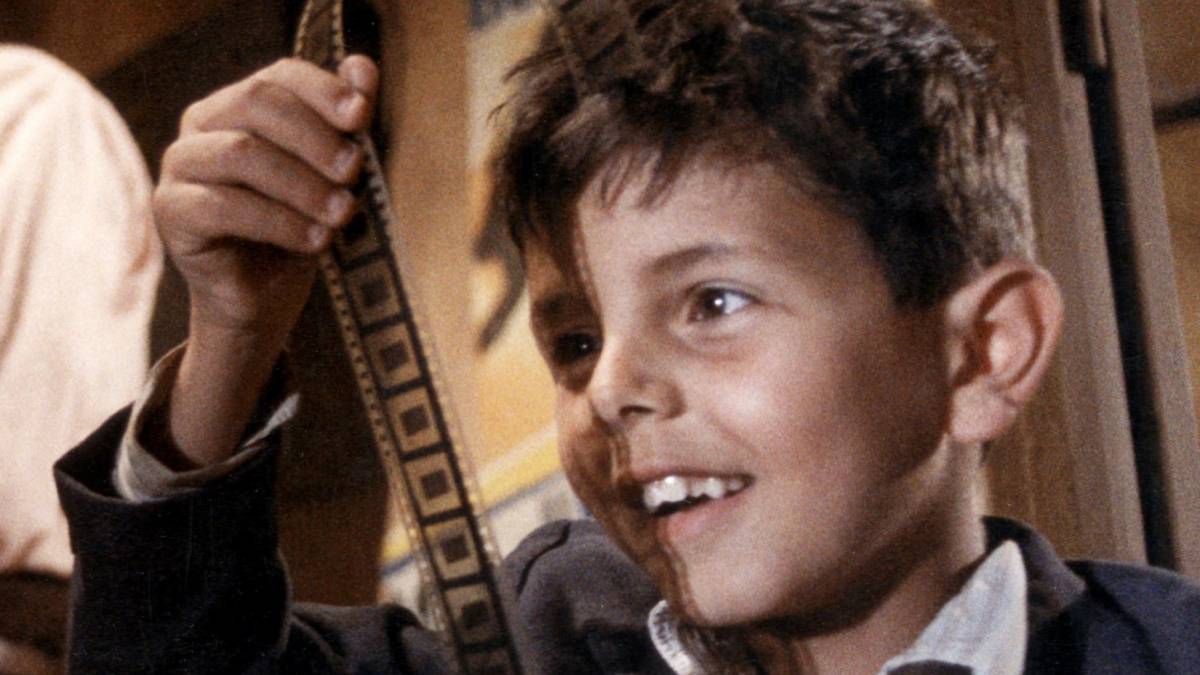
“Life isn’t like in the movies.” Cinema Paradiso is a love letter to the movies framed as a story of memory and loss. In it, a successful filmmaker (played at different ages by Salvatore Cascio, Marco Leonardi, and Jacques Perrin) reflects on his childhood friendship with a projectionist (Philippe Noiret) in a small Italian town. What follows is a vibrant coming-of-age comedy-drama and a moving statement on art itself.
This film is sincere to the core. It argues that movies aren’t just escapism, real tools of emotional education, places where people learn how to feel, desire, and remember. At the same time, Cinema Paradiso is never saccharine or try-hard. It’s bittersweet: the joy it celebrates is inseparable from the sadness of time passing. It captures the paradox of nostalgia: how the things that shape us are also the things we must eventually leave behind. Honest, touching, and life-affirming; cinema for cinephiles.

Cinema Paradiso
- Release Date
-
February 23, 1990
- Runtime
-
174 Minutes
-

-
Enzo Cannavale
Spaccafico
-
Antonella Attili
Maria Di Vita – Younger
-
Source link
