

1995 was a bit of a crossroads for movie-making. It was a year where old Hollywood craft, serious ’70s-style filmmaking, and a newly confident independent cinema all overlapped. Studios were still willing to bankroll challenging mid-budget films aimed at adults, while quirky auteur voices were being absorbed into the mainstream rather than pushed to the margins.
The result was a very varied collection of bangers. Philosophical sci-fi sat next to romantic minimalism, violent crime epics alongside family films that refused to talk down to children. Here are the most enduring of them.
10
‘Crimson Tide’ (1995)
“We’re here to preserve democracy, not to practice it.” Crimson Tide is a tightly wound thriller set almost entirely aboard a U.S. nuclear submarine. The crux of the story is a confrontation between the commanding officer (Gene Hackman) and his executive officer (Denzel Washington) after an incomplete message raises the question of whether to launch nuclear missiles. The plot is deceptively simple, but the stakes are apocalyptic.
This could easily have been mid-tier genre fare, but Crimson Tide stands out because it refuses to frame the conflict as good versus evil. Both men are intelligent, principled, and terrifyingly convinced they are right. Through them, the movie asks some genuinely thoughtful questions around bureaucracy and duty. It helps that both stars are great in their roles. On the directing side, Tony Scott keeps the film claustrophobic and relentless throughout, using the submarine setting to amplify every raised voice and pause. The action is largely verbal, but the tension never slackens.
9
‘Dead Man’ (1995)

“Do you have any tobacco?” Dead Man is an acid Western by the great Jim Jarmusch, and it plays like a funeral dirge for the genre itself. The movie strips the Western of heroism, replacing it with fatalism, surreal encounters, and quiet existential dread. At its heart is William Blake (Johnny Depp), an accountant who travels west for work and instead finds himself wounded, drifting through the frontier toward death. His story unfolds like a dream (or a death vision) where cause and effect matter less than atmosphere and spiritual reckoning. Here, the American frontier is not a place of opportunity, but of exploitation and annihilation.
Not everyone will get on board with the movie’s slow pace, monochrome cinematography, and psychedelic vibe, but those who do will find it rewarding. Fundamentally, Dead Man engages with deep themes, particularly around the scars left by industrial progress and the nation’s inheritance of brutality and intolerance. One of the most unique Westerns in the canon.
8
‘Babe’ (1995)

“That’ll do, pig. That’ll do.” Whereas Dead Man took years to be embraced, Babe was a big hit back in 1995 both critically and commercially, even getting a Best Picture nomination. It’s not hard to see why. It’s both entertaining and touching, and boasts fantastic special effects that still hold up today. The plot follows the titular pig (voiced by Christine Cavanaugh) as he navigates life on a farm where animals are assigned rigid roles: some valued, some disposable.
On the surface, it’s a gentle, quirky story about a pig who learns to herd sheep. Yet beneath that simplicity lies a surprisingly thoughtful meditation on kindness, identity, and chosen purpose. The movie treats compassion as a strength and curiosity as a virtue, all while never mocking or talking down to its audience. Basically, this is family entertainment done right, with an important message tucked inside an engaging, compelling plot.
7
‘Heat’ (1995)

“Don’t let yourself get attached to anything you are not willing to walk out on in thirty seconds flat.” Heat is the definitive ’90s crime epic. It features Robert De Niro and Al Pacino at the height of their powers, playing a master thief and a relentless detective whose lives mirror one another as they move toward an inevitable collision. Both characters are defined by what they give up to remain excellent at what they do. Love, family, and stability are all treated as liabilities.
Heat practically towers over most gangster movies of its era with its scope and seriousness. The action sequences, especially the famous downtown shootout, are staged with brutal realism (the crew closely researched real robberies and armed showdowns). That said, the quiet moments arguably hit harder. All in all, Heat isn’t just a great thriller, but a smart film about identity and isolation, anchored by brilliant performances.
6
‘12 Monkeys’ (1995)

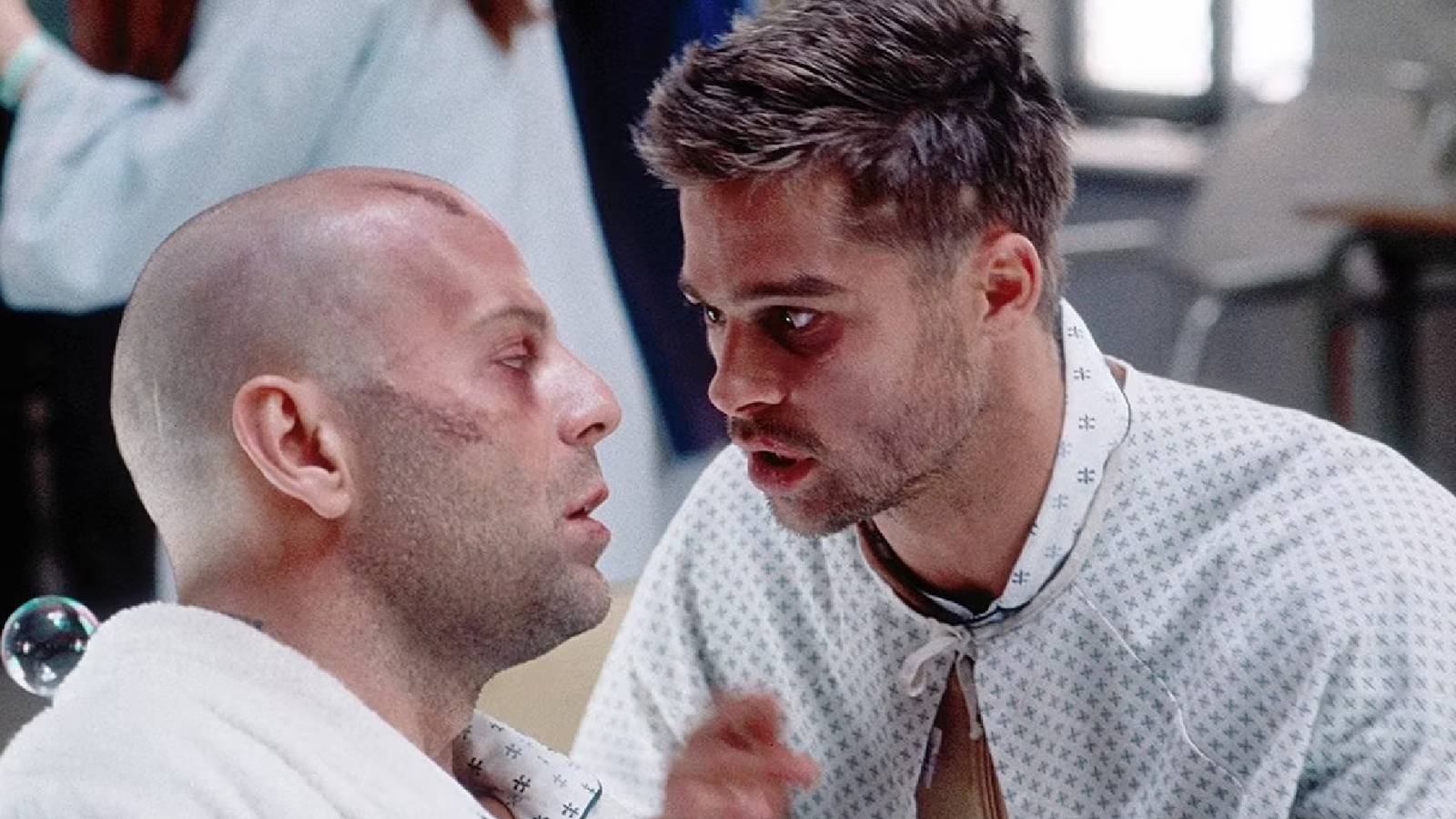
“The future is already written.” 12 Monkeys is one of the strangest and most entertaining time-travel movies ever made. Bruce Willis leads the cast as James Cole, a prisoner living in the year 2035 sent back in time to prevent a global pandemic, only to find himself trapped in a web of memory, madness, and inevitability. The story resists clean explanations, forcing viewers to question whether its protagonist is a savior, a pawn, or simply insane.
Indeed, the plot repeatedly circles itself (all while serving up twist after juicy twist), reinforcing the idea that knowledge does not equal control. In the process, the speculative elements become tools to explore around surveillance, destiny, and institutional collapse. For instance, the movie frames the future as authoritarian and grotesque, while the past is unstable and unreliable. In short, 12 Monkeys is a wild, endlessly creative film; Terry Gilliam at his best.
5
‘The Usual Suspects’ (1995)

“The greatest trick the Devil ever pulled was convincing the world he didn’t exist.” This talky, twisty crime gem is iconic at this point, its twists and revelations well-known, but, on release, it was bold, inventive stuff. The dialogue and structure were especially boundary-pushing. The plot unfolds using an interrogation as its framing device, as a small-time criminal (Kevin Spacey) recounts how a group of crooks were drawn into a disastrous job involving a legendary underworld figure.
Flashbacks and narration seem to slowly piece it all together, only to misdirect the audience the whole way through. The mysteries are carefully constructed, and the clues are hidden in plain sight, all building up to that big final twist. The reveal might have been a little hard to believe with a lesser actor at the helm, but Spacey’s performance is terrific here. Thanks to him, we totally buy that the meek Verbal Kint could truly be the enigmatic Keyser Söze.
4
‘Before Sunrise’ (1995)

“I feel like this is a once-in-a-lifetime thing.” Before Sunrise is the first entry in Richard Linklater‘s brilliant trilogy. It introduces us to Jesse (Ethan Hawke) and Céline (Julie Delpy), two young strangers who meet on a train and spend a single night walking through Vienna, talking about life, love, and uncertainty. There is no traditional plot, no external conflict, and no dramatic climax. Instead, there’s just conversation that feels real. Linklater allows moments to breathe, letting awkwardness, curiosity, and vulnerability coexist.
In the process, Before Sunrise captures a fleeting moment when possibility feels infinite, even as reality looms. It taps into something universal. The romance is fragile and beautiful precisely because it’s unforced. The performers rise to the challenge, turning in layered, moving performances that they would build on perfectly in the subsequent installments. All this adds up to one of the very best romance movies of all time, a modern classic.
3
‘Se7en’ (1995)

“Ernest Hemingway once wrote, ‘The world is a fine place and worth fighting for.’ I agree with the second part.” Se7en is police procedural meets philosophical horror. Two detectives (Brad Pitt and Morgan Freeman) hunt a serial killer whose murders are structured around the seven deadly sins. While some of the plot mechanics had been done before, the movie’s worldview is much more serious and cynical than your typical thriller. Here, evil is pervasive, fed by apathy, cruelty, and self-righteousness.
All this darkness culminates in a truly harrowing ending, one of the bleakest of the decade. David Fincher makes sure that the visual world the characters inhabit is as dark as the plot itself. The aesthetic is one of grey skies and decay. The city is a moral wasteland. For all these reasons, in the decades since, Se7en has become a defining text for modern thrillers, influencing tone, pacing, and thematic ambition.
2
‘Toy Story’ (1995)

“To infinity… and beyond!” Toy Story crushed the box office, launched a decade of Pixar dominance and, in several ways, reshaped animation itself. The premise is straightforward but colorful, spinning a tale of toys that come to life into a brisk, engaging adventure. However, alongside the humor and entertaining set pieces, Toy Story also has a lot to say about obsolescence, jealousy, and the fear of being replaced. The characters may be toys, but they are real emotional beings grappling with purpose and self-worth.
Toy Story was also groundbreaking on a technical level. Its use of computer animation was unprecedented, paving the way for so many animated classics that would follow in its wake. Fundamentally, John Lasseter and his team had both a compelling new vision and the skills to realize it. In the process, Toy Story broke open new possibilities for the medium, and its influence today can be seen in countless kids’ shows and movies.
1
‘Casino’ (1995)

“Here’s the truth about the truth.” Ranking among Scorsese‘s very best movies, Casino is a sprawling autopsy of power, greed, and institutional rot. The story charts the rise and fall of a mob-run Las Vegas casino, seen through the eyes of a meticulous operator (Robert De Niro), his volatile enforcer (Joe Pesci), and a self-destructive hustler (Sharon Stone). Through these characters, the movie depicts Las Vegas as both spectacle and machine, dazzling on the surface while quietly corroding everyone involved. What makes Casino a classic is its density.
In this world, every relationship is transactional and every loyalty conditional. In this regard, the film is less romantic than Goodfellas, more bitter in its outlook. The result is a ruthless portrait of capitalism and crime merging seamlessly. While Casino wasn’t as warmly received on release as some of Marty’s other movies, its reputation has grown over the years, and it’s now widely considered to be one of his crowning achievements.
cas

Casino
- Release Date
-
November 22, 1995
- Runtime
-
179 minutes
Source link
