

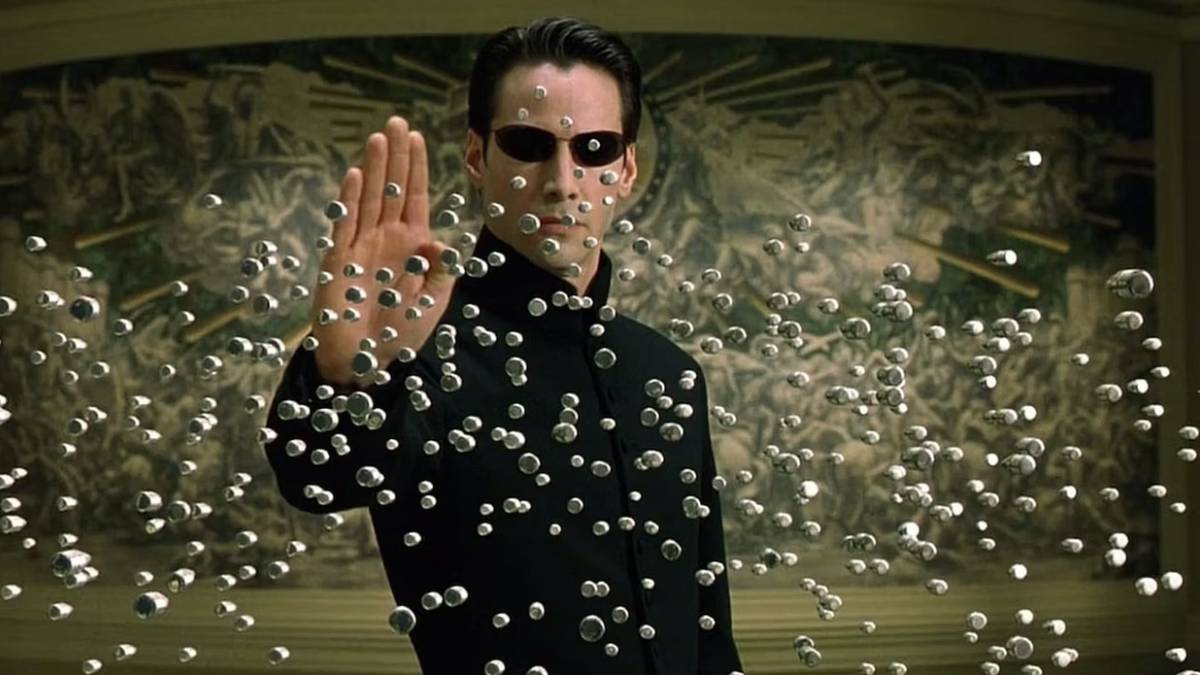
When it comes to action flicks, audiences love a juicy fight scene. Often a major part of the conflict, the fight scenes provide the adrenaline rush that keeps you engaged. Within the world of action movies, there are, of course, subgenres, one of which is sci-fi kung fu. Throughout the spectrum of film, kung fu has often been used as a central part of sci-fi stories.
Chinese martial arts, the umbrella term that includes kung fu or wushu, have appeared in some of the best action-packed sci-fi movies we’ve adored over the years. From mind-blowing Oscar-winning films to campy action comedies, we’re here to celebrate some of the best sci-fi kung fu movies of all time. And, for the record, we’ll be sticking solely to live-action.
12
‘Ultraviolet’ (2006)
To kick us off, we begin with the 2006 sci-fi action thriller by Kurt Wimmer, Ultraviolet. Starring action diva Milla Jovovich, the story follows Violet Song Jat Shariff, a woman infected with hemoglophagia, who lives in a future dystopia where anyone infected with the contagious vampire-like disease is immediately sentenced to death. With her advanced martial arts skills, a group of rebel hemophages, and a boy named Six (Cameron Bright), whose blood may contain a cure, go on a mission to overthrow the futuristic government and defeat Vice-Cardinal Ferdinand Daxus (Nick Chinlund). With a big twist that might leave you shocked, Ultraviolet is action first, story second.
The slick, high-octane film poses a major threat to many of its action competitors in the fight sequence department. Mixing kung fu, gunplay, and swordsmanship in its combat moments, Ultraviolet is masterful in getting audiences excited. With Jovovich, Ultraviolet is in capable hands as she continues to prove her dominance in the action industry. Critics may have panned it, but Ultraviolet is a damn good time.
11
‘Big Trouble in Little China’ (1986)

Who says you can’t have a little fun? Just look at the cult classic Big Trouble in Little China. An ’80s blend of action, fantasy, comedy, and martial arts, the love-it-or-hate-it film follows hard-boiled truck driver Jack Burton (Kurt Russell), who gets caught in a bizarre conflict within (and underneath) San Francisco’s Chinatown. An ancient Chinese prince and Chinatown crime lord has kidnapped a beautiful green-eyed woman, Gracie Law (Kim Cattrall), who is the fiancée of Jack’s best friend, Wang Chi (Dennis Dun). Jack must help his friend rescue the girl before the evil Lo Pan (James Hong) uses her to break the ancient curse that keeps him a fleshless and immortal spirit. Packed with cheeky humor and endless energy, Big Trouble in Little China is high-camp fantasy with a punch.
Mixing Western tropes with Chinese mythology, the John Carpenter-directed action film layers in supernatural elements for an atypical action hero story. With skilled warriors and sorcerer characters like Egg Shen (Victor Wong) bringing the classic kung fu compared to the action of the renegade trucker cowboy, the film falls into the genre-blending concept of mystical martial arts. There has never been another film quite like Big Trouble in Little China.
10
‘Timecop’ (1994)

Though it’s certainly not a traditional martial arts film, Timecop is rooted in the art form, blending clear-cut sci-fi elements for an exciting ’90s thrill. When mankind perfects time travel, the government establishes the Time Enforcement Commission to thwart criminal attempts to alter the timeline. Police officer Walker (Jean-Claude Van Damme) is recruited by TEC Commander Matuzak (Bruce McGill), but soon finds his investigation of Senator Aaron McComb (Ron Silver) being thwarted by elements within the government. When Walker’s wife, Melissa (Mia Sara), is attacked, he must travel across time to rescue her and save the future. Dropping one of the world’s greatest action heroes into a slick sci-fi film with worthy action sequences, Timecop became an instant guilty pleasure.
With fast-paced direction from Peter Hyams and quintessential Van Damme action, the film, based on the Dark Horse Comics, launched a franchise. Many critics considered the film a “low rent” version of Terminator, but the action sequences pushed it into a new direction, thanks in part to its leading man. If anything, Timecop is martial arts escapism. Come for the time travel elements — very few films have truly been capable of creating more distinct and capable worldbuilding.
9
‘The One’ (2001)

As we will mention a little later, we could easily make a list of Jet Li’s greatest kung fu entries, but for this list, we’ll discuss The One. An expansive and non-traditional work from Li, The One follows rogue Multiverse agent Gabriel Yulaw (Li), who hunts down alternate versions of himself across parallel universes, absorbing their life force to become a godlike being, forcing a parallel-universe police officer (also Li) to stop him. A story about the battle of good and evil, The One is a science fiction martial arts explosion.
A bit of a complex adventure thriller with an illogical plot, The One is a film you watch to see Li take on Li. Only in a multiverse-style movie can you see the best battle the best. Simplifying the plot to a good versus evil trope allows the action to shine. As revealed in the documentary Jet Li Is ‘The One,’ Gabriel Yulaw and “Gabe” Law use martial arts that represent their personalities. For Yulaw, it’s Xingyiquan, which is characterized by aggressive linear movements. For Gabe, it’s Baguazhang, which uses subtle, circular movements. This subtle detail is a brilliant touch that explores the depth of kung fu and its subtleties. The One walked so Loki could run.
8
‘The Forbidden Kingdom’ (2008)

A genuine classic kung fu film starring two of the greatest in the genre, The Forbidden Kingdom is a Western celebration of Eastern art. The film follows Jason Tripitikas (Michael Angarano), a modern-day American teenager who, while rummaging around for some bootleg kung fu DVDs in a pawn shop in Boston’s Chinatown, discovers an ancient golden staff. He finds himself magically transported back to ancient China, where he is tasked with freeing the fabled warrior, the Monkey King, accompanied by Lu Yan (Jackie Chan), Silent Monk (Li), and Golden Sparrow (Liu Yifei). On their journey, they must try to avoid the minions of the evil Jade Warlord (Collin Chou) and the White-Haired Witch (Bingbing). If he doesn’t succeed, he may be trapped deep in the past forever. A love letter to kung fu films of yore, The Forbidden Kingdom was one of the first co-productions helmed by an American director to make a primarily English-language wuxia genre film set in ancient China for a global audience.
The major draw to the film was seeing Li and Chan together. In a manner, the action within the film was what many viewers wished they could experience — having two legends teach a novice. The action sequences were choreographed by Yuen Woo-ping. Though some might consider it Kong fu light, it’s a family fantasy film that utilizes Chinese myth and lore to create a remarkable work. It’s by no means groundbreaking, but it is a perfect entry point into the genre.
7
‘The Tuxedo’ (2002)

We could put a plethora of Jackie Chan films on kung fu lists, but it’s important to honor the Venn diagram of kung fu and comedy. So, here is The Tuxedo. The spy comedy follows Chan as taxi driver Jimmy Tong, who becomes an unwitting secret agent after he’s forced to wear a high-tech tuxedo that grants him incredible martial arts skills and other abilities, teaming up with an inexperienced partner, CSA Agent Delilah “Del” Blaine (Jennifer Love Hewitt), to stop a terrorist from poisoning the water supply. A light-hearted romp, The Tuxedo expertly blends spy tropes with Chan’s signature fighting and physical comedy.
If you’re a Chan enthusiast, The Tuxedo’s ability to showcase how kung fu can infuse different essences and auras rooted in comedy serves as a reminder of how vast the art form can be. While he wasn’t necessarily a fan of the high-tech elements in the creation of the film, it was a departure from his previous films. At the same time, Chan filmed The Medallion, a more traditional martial arts movie, to help balance out The Tuxedo experience.
6
‘Equilibrium’ (2002)

To begin, we must acknowledge that Equilibrium is not an entirely authentic kung fu film. Equilibrium employs gun kata, a stylized, fictional martial art that uses sophisticated close-quarters gunfight, resembling a martial arts combat that combines firearms with hand-to-hand combat and traditional melee weapons at an approximately 50/50 ratio. With that, let’s discuss the film. Directed by Kurt Wimmer, the film tells the story of a future society where emotions are outlawed to prevent war, with citizens forced to take a drug called Prozium to suppress feelings, focusing on an elite enforcer, John Preston (Christian Bale), who begins to experience emotions after missing a dose, leading him to question and fight the oppressive regime that eliminates art, literature, and love as crimes. Equilibrium explores themes of humanity, freedom, and the necessity of emotion, contrasting the cold, controlled world experience of feeling alive.
The futuristic thriller, which also stars Emily Watson, Sean Bean, and Taye Diggs, helped to honor the history of the art form by exploring a new evolution. Angus Macfadyen‘s character, Vice-Counsel DuPont, discusses gun kata in the film by saying, in part, “The gun kata treats the gun as a total weapon, each fluid position representing a maximum kill zone, inflicting maximum damage on the maximum number of opponents, while keeping the defender clear of the statistically-traditional trajectories of return fire. By the rote mastery of this art, your firing efficiency will rise by no less than 120 percent. The difference of a 63 percent increased lethal proficiency makes the master of the gun katas an adversary not to be taken lightly.” Though the fight choreography does blend Chinese and Japanese elements, its roots date back to Hong Kong filmmaker John Woo, marrying kung fu with gangster films, helping to make gunplay more popular.
5
‘Shang-Chi and the Legend of the 10 Rings’ (2021)

Easily the most underrated yet most important Marvel film is Shang-Chi and the Legend of the 10 Rings. The MCU marvel follows Shang-Chi (Simu Liu), a martial arts master who must confront the powerful, villainous father, Xu Wenwu (Tony Leung), he left behind, forcing him to face his past, family trauma, and the legacy of the mystical Ten Rings organization to prevent his father from unleashing a demonic evil from another dimension. Blending extraordinary martial arts with Chinese mythology, Shang-Chi and the Legend of the 10 Rings celebrates identity, family, and finding one’s true self through the ideals of balance.
A lesser-known character, the decision to elevate the character to MCU lead hero level was important for visibility and to incorporate martial arts into the MCU. Drawing heavily on Hong Kong cinema and other influential mainstream films, Shang Chi and the Legend of the 10 Rings formed its own superhero identity. To help bring the fight choreography to life, the film relied on some of Jackie Chan’s fight team, including legendary stunt coordinator Brad Allan, to make the action happen. By filling the cast with martial arts actors, including Michelle Yeoh and Leong, the authenticity shone through. Missing this incredible character? You’re in luck. Shang-Chi will appear in Avengers: Doomsday.
4
‘Mortal Kombat’ (2021)

Yes, this is not the first time Mortal Kombat has turned into a feature film, but the 2021 edition is a much better overall film and a much stronger martial arts wonder. The reboot, directed by Simon McQuoid, follows Cole Young (Lewis Tan), a washed-up mixed martial arts fighter who is unaware of his hidden lineage or why the assassin Sub-Zero (Joe Taslim) is hunting him down. Concerned for the safety of his family, he seeks out a clique of fighters who were chosen to defend Earthrealm against Outworld. A film of complete fan service, Mortal Kombat is a martial arts knockout.
While you may not care for the over-the-top blood and violence, the fight sequences are a central element to the story and what makes Mortal Kombat a solid game-to-film adaptation. One of the interesting elements of the film is balancing practical martial arts with signature fight moves from the game. Further, the characters span multiple Asian cultures, allowing for a variety of martial arts and kung fu styles. With Sub-Zero being a Chinese assassin, and played by an actual martial artist, the character leans into new, extraordinary places of authenticity.
3
‘The Matrix Reloaded’ (2003)

Without the original, we wouldn’t have the sequel. And as far as sequels go, The Matrix Reloaded is a solid follow-up. The Matrix Reloaded follows Neo (Keanu Reeves), Trinity (Carrie-Ann Moss), and Morpheus (Laurence Fishburne) as they race to save Zion from an impending machine invasion, discovering Zion has only 72 hours before 250,000 Sentinels arrive. Neo learns he’s part of a cycle, the sixth iteration of the One, tasked by the Architect (Helmut Bakaitis) to reboot the Matrix. After capturing the excitement of introducing martial arts into a cyberpunk world in the first film, The Matrix Reloaded took the baton and bolted.
Though the film explores more heady and philosophical conversations, the fight sequences are still top-notch. Perhaps one of the best moments in the film that captures the action style is when Neo fights against an army of Agents. The story gets expanded from the original to the sequel, and while both films are individually strong, The Matrix Reloaded has to fall behind because the product wasn’t as novel. Still, it’s a popcorn-friendly thrill ride and visual stunner.
Source link
