

Fantasy movies are often, by their very nature, epic. While there are plenty of fantasy movies that deal with simpler magical realism or low-fantasy elements that don’t require a grand scale to accomplish, the biggest and best fantasy movies write their stories across the widest canvas possible. These are the high fantasy movies set in far-off lands where amazing beasts and magical creatures live together, or those that expand our world with magic existing right underneath or alongside it. Either way, they transport audiences to a world that, even when it might resemble their own, is wondrous and unbelievable and could only exist on the silver screen.
Fantasy films have been an integral part of cinema since the earliest days of silent film, and as budgets and effects technology have grown and advanced, so too have the worlds that filmmakers have been able to bring to life on screen. These movies are so big, grand and full of fantasy that the standard list of ten simply couldn’t contain them all. So instead, here’s a baker’s dozen of the greatest epic fantasy films ever made.
13
‘Wicked’ (2024)
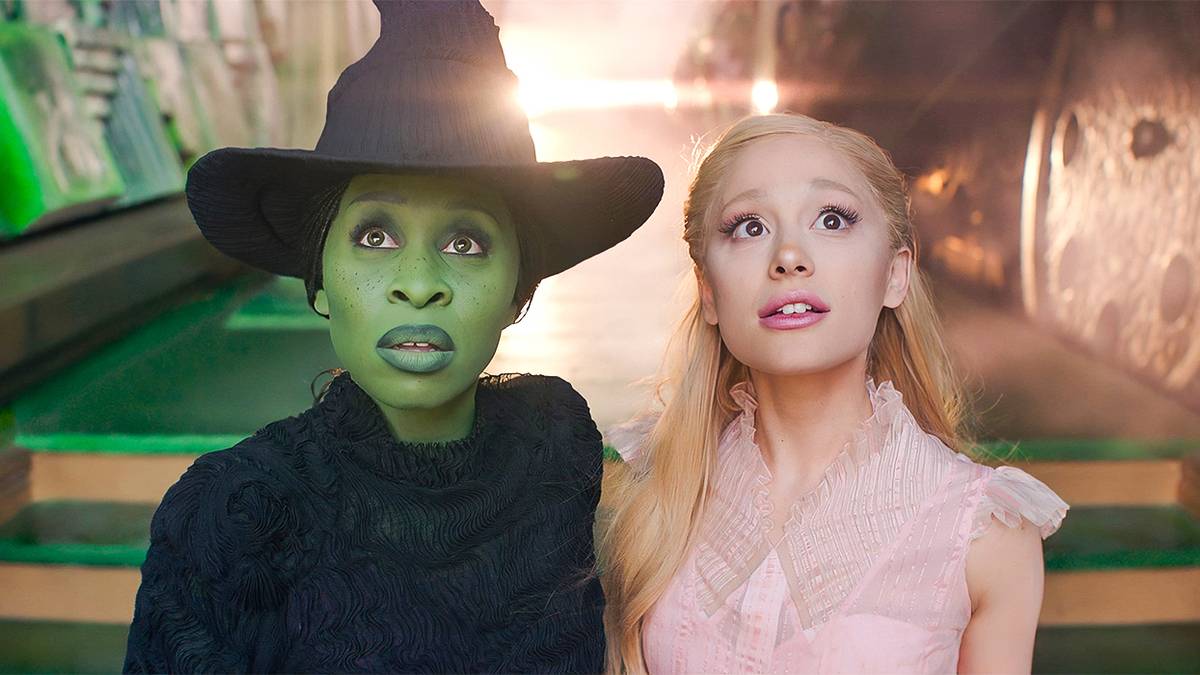
The most recent fantasy epic to sweep audiences off their feet is also one tethered inexorably to the long-standing history of fantasy filmmaking. L. Frank Baum‘s novel The Wonderful Wizard of Oz became the iconic classic, The Wizard of Oz became the basis of the novel Wicked: The Life and Times of the Wicked Witch of the West, became a smash hit on Broadway and finally led to the pop-cultural phenomenon that is Wicked. Energetically directed by Jon M. Chu and with a pair of perfect, Oscar-nominated performances from Ariana Grande and Cynthia Erivo, it’s an epic musical that truly defied gravity and left audiences walking on air.
Hyperbole and internet popularity aside, Wicked reinterprets the land of Oz for modern audiences by turning its lens on the time before Dorothy ever landed, focusing on witches Elphaba and Glinda as they attend university, contending with the prejudice and discrimination that exists beneath the brightly-colored exterior of their world. With engaging musical numbers, large-scale sets, and a star-studded cast, Wicked is designed to get your widen your eyes while your toes get tapping.
12
‘Legend’ (1985)

Fantasy movies took a dark turn in the ’80s, with even studios like Disney reaching back to the less family-friendly origins of fairytales to craft some pure nightmare fuel for audiences. These films also took advantage of the major advancements in practical effects to accomplish some of the most visually outstanding fantasy films ever made. These were grand productions like Conan the Barbarian, Dragonslayer, The Dark Crystal and, most of all, Ridley Scott‘s epic fairytale Legend. As the director’s follow-up to the one-two sci-fi punch of Alien and Blade Runner, Scott decided to take the same visually arresting approach to the fantasy genre with a simplistic tale of good versus evil realized with the most visually elaborate techniques available.
The film follows the forest-dwelling Jack (Tom Cruise) as he must contend with the Lord of Darkness and his attempts to plunge the world into the shadows by killing the last unicorns. Shot entirely on soundstages, Legend has a visual language all its own, existing on an entirely different plane of its own reality. The makeup effects, by the legendary Rob Bottin, breathe life into some of the most vividly realized fantasy creatures, most of all in Tim Curry as Darkness. Never has there been a more epic portrayal of the Devil put on screen, and Curry, under pounds of makeup and fiberglass horns, eats every square inch of scenery within chewing distance. Legend notoriously has two different cuts available with vastly different musical scores and scene arrangements, but no matter which version you prefer, they both deliver a singular visual experience.
11
‘Zu Warriors from the Magic Mountain’ (1983)

Wuxia films don’t always combine their martial arts action with fantasy storytelling, but those that do are some of the most gloriously entertaining epics ever made. Films like Journey to the West and The Bride with White Hair engage with their fantastical elements openly, while Crouching Tiger, Hidden Dragon or Hero are more subdued in their approach, but if there’s one film that really scratches that fantasy epic itch with high-flying acrobatic combat, it’s Tsui Hark‘s Zu Warriors of the Magic Mountain.
Based on the 1932 novel Legend of the Swordsmen of the Mountains of Shu, the plot follows a Chinese soldier who deserts his army and quickly finds himself embroiled in a battle between supernatural entities as he becomes the apprentice to a master warrior who wants to combine legendary dual swords in order to defeat an evil Blood Monster. It’s a bonkers plot steeped in mythology and blown up by Hark’s kitchen sink approach, where wild scenes careen off each other. The director would revisit the material again years later for the less successful The Legend of Zu, but nothing can quite appropriate the unfiltered madness of his original fantasy epic.
10
‘Harry Potter and the Prisoner of Azkaban’ (2004)
In the 2000s, fantasy movies became a hot commodity again, thanks to a couple of major film franchises that took full advantage of modern visual effects technology to create fully immersive fantasy worlds on a scale never seen before. One of those franchises was Harry Potter, based on the eponymous book series. The epic-sized film adaptations of those books reached a whole new legion of fans, and the greatest of them all was Prisoner of Azkaban.
Based on the third book in the series, this more mature film progresses the characters and themes of the previous two movies with a shift in visuals and tone. This change is certainly in line with the source material, but also due greatly to the change in directors, with Oscar winner Alfonso Cuarón taking over from Chris Columbus. Cuaron finds a deeper emotional well to explore as Harry and his friends face greater challenges in their third year at Hogwarts, along with the escape of Sirius Black. By streamlining the lengthy plot of the novel, the film actually improves upon it in many ways, and Prisoner of Azkaban set a new tone that would serve the franchise well until its very end.
9
‘The Fall’ (2006)

Given a limited release a full two years after it was finished and being completely unavailable on streaming until 2024, Tarsem Singh‘s The Fall inspired a very devoted cult following of fans who would sing its visual praises any time they could, including the late critic Roger Ebert. Now more widely available than ever before, if you haven’t seen this absolutely jaw-dropping film, which was shot over four years and in 24 different countries, it’s high time you rectified that. It’s a sumptuous fantasy epic that has very few visual equals.
Inspired by the 1981 film Yo Ho Ho, the film follows Lee Pace as a stuntman in the early 20th century who has been hospitalized after an accident and who bides his time contemplating suicide and telling stories to a young female patient. These stories are realized in vivid detail by Singh, who began his career directing music videos. While all the films of his career are visual feasts, including the psychological horror film The Cell and the less successful fantasy epic Immortals, The Fall is easily Singh’s most narratively satisfying as the visuals are in service of, and elevate, this tale of tales that examines how we interpret the stories we tell.
8
‘The Green Knight’ (2021)

Arthurian legends have lent themselves to dozens of modern film interpretations, some more fantastical than others. David Lowery‘s adaptation of Sir Gawain and the Green Knight leans fully into its fantasy elements while also deconstructing its heroic mythology. Dev Patel stars as Gawain, still a young and impetuous knight in search of a legend of his own. Opportunity knocks in the form of the mythic Green Knight, played with gravel-voiced intent by Ralph Ineson, who issues a challenge of a beheading game that Gawain accepts. One clean blow cleaves the Knight’s head from his shoulders, which he simply picks up and promises the same blow for Gawain in one year.
Gawain’s episodic journey to fulfill his end of the bargain sees him travel across the countryside, encountering bandits, phantoms, giants and other temptations which test his mettle as he seeks to earn his legacy. The Green Knight is a revisionist fantasy that grounds its hero in mortal ambiguities and misgivings even while the world around swirls with the supernatural. From the gorgeous visuals to the often haunting atmosphere, Lowery’s fantasy epic lingers long after heads roll.
7
‘Excalibur’ (1981)

Of course, no mention of Arthurian fantasies writ large on the big screen can go by without praising the most essential of them all: John Boorman‘s Excalibur. Based primarily on Le Morte d’Arthur by Sir Thomas Malory, the most well-known piece of Arthurian literature, the film recounts the rise of Arthur, the pulling of the fabled sword from the stone, the formation of the knights of the Round Table and beyond in gloriously gory detail.
Unsurprisingly, the film is a beauty to behold, with Oscar-nominated cinematography by Alex Thomson, who also shot Legend and Labyrinth. The battle sequences are appropriately epic, and the casting is well-rounded. Besides Nigel Terry, Nicol Williamson, and Helen Mirren as Arthur, Merlin and Morgan le Fay, respectively, the film also features prominent early work from later stars including Ciarán Hinds, Patrick Stewart, Gabriel Byrne, and Liam Neeson. The stars shine as brightly as their armor, and Boorman and Thomson created the definitive visual style for sword-and-sorcery epics to follow for decades after.
6
‘How to Train Your Dragon’ (2010)

Fantasy epics aren’t limited to the live-action medium. Plenty of animated films use the full might of their animators’ imaginations to conjure up some of the most wondrous fantasy worlds in cinema. Disney is often considered the standard-bearer in this category, with Sleeping Beauty perhaps their crowning fantasy achievement, but for an even more epic-sized adventure, it’s hard to beat DreamWorks’ soaring How to Train Your Dragon franchise.
Based on the book series by Cressida Cowell, the first installment sees young Viking Hiccup trying and failing to live up to the standard set by his fearless dragon-slaying father. His status as an outcast becomes even more complicated when he befriends a dragon and begins to question the very way of life he has been raised with. Incredibly animated with breathtaking aerial sequences and battles, How to Train Your Dragon is a fantasy epic suitable for the whole family, but it’s the surprisingly mature themes and emotional depth that help it land with such grace.
5
‘Princess Mononoke’ (1997)

There’s a world beyond the animated fantasy epics made by American studios, and while movies like Wolfwalkers and The Adventures of Prince Achmed are well worth praising, it’s impossible to ignore the giant white wolf in the room that is Hayao Miyazaki and his animated masterpiece, Princess Mononoke. Taking cues from fairytales and Japanese folklore, this epic adventure about the clash between humanity and nature made major strides towards anime being given more recognition by American audiences. Its impact can still be felt in numerous other pieces of media, including the most successful film of all time, Avatar.
Though its influences are clear, Miyazaki’s movie doesn’t paint with as broad a brush in its tale of a cursed prince who finds himself caught in the middle of a war between the industrialized Iron Town and the spirits of the forest. This war, and the violence it brings, is never depicted in as simple terms as one might think. There is questionable morality and conflict on both sides, and Miyazaki isn’t interested in a simple good versus evil parable. Princess Mononoke is thematically complex, depicting how the progress of humanity can come at the cost of the world around them and how the devastation of war leaves deep scars. It’s a brilliant fantasy epic that’s every bit the equal of its live-action counterparts.
4
‘The Wizard of Oz’ (1939)

There may be no fantasy film more influential than 1939’s The Wizard of Oz. An icon of cinema for its set design, costumes, makeup, music and casting, almost every single fantasy film made since has some small element of this Technicolor classic within it. Everyone, old and young, has some knowledge of Dorothy’s adventures from Kansas to the wonderful world of Oz, whether they’ve seen the film or not. While its legacy is complicated, as many films’ are, due to the abuse that star Judy Garland suffered during production, it has not minimized its impact or Garland’s legacy in giving one of the most iconic fantasy film performances of all time.
No matter how many renditions of the classic story are produced, 1939’s The Wizard of Oz will always remain the definitive version, with every subsequent reimagining or connected story somehow indebted to it, from Return to Oz to Wicked. For all the memorable moments and iconic lines that have been cemented into pop culture history, there may be none more quintessential to the fantasy genre as a whole than the breathtaking transition from black and white cinematography to Technicolor majesty. The Wizard of Oz is about as magical as movies can get.
Source link
