

We all know the classics of South Korean cinema, such as Oldboy, A Bittersweet Life, I Saw the Devil, and the likes. With the appearance and skyrocketing success of Parasite, the world has been seeing a surge in the popularity of South Korean movies in particular. Where K-dramas have been steadily building a lasting fanbase, movies still have a wide audience to win over, and the struggle still exists to push some of the lesser-known filmmakers and movies.
With some research and understanding of the kind of movies you enjoy, there’s a vast world of South Korean films to discover. If you’re interested in some more underrated but great movies from the peninsula, here are six forgotten South Korean movies that are incredible. If you can find somewhere to watch them, you’ll understand their art and cinema a lot more.
6
‘The President’s Last Bang’ (2005)
If you’re used to the bleakness of some of the country’s best-known movies, you’ll love their satire, too. Physical comedy tends to be a part of Korean feature films (if you’ve seen Memories of Murder, a gag is developed around a flying kick), but intellectual humor that criticizes, satirizes, and analyzes society is just as present and punching. The President’s Last Bang is one such film, a movie that became so controversial in South Korea because of its real-life topic that the filmmakers got sued. The verdict was overruled in favor of free speech, but Im Sang-soo and co. were still required to show a censored version in theaters. This is still a leap in filmmaking, a bold, cynical, and hilarious deconstruction of a pivotal moment in modern Korean history.
The President’s Last Bang is a black comedy/political thriller that recreates the hours leading up to the assassination of South Korean President Park Chung-hee on October 26, 1979. The film centers on Kim Jae-gyu (played by Baek Yoon-sik), the director of the Korean Central Intelligence Agency (KCIA) and a once-loyal friend to the dictator. Frustrated by Park’s corruption and violent methods, as well as his impact on his own life, Kim plans a coup. The controversial thesis of the film is that the murder was a chaotic, last-ditch decision rather than a heroic act of revolution. Im directs with a mischievous Coen Brothers-esque energy, employing gallows humor to expose the absurdity and incompetence of political power. The translation is “The President’s Last Bang,” but the original title sounds more like “The People of Those Days,” referring to a song by singer Sim Soo-bong, who is also referenced in the film. It is a one-of-a-kind, provocative, and unforgettable film.
5
‘Nowhere to Hide’ (1999)

Although Nowhere to Hide came four years before Oldboy, it was still overshadowed by Park Chan-wook‘s magnetic thriller when the Korean New Wave exploded globally in the early 2000s. Nowhere to Hide may be in the shadow of its successor, but it deserves all the attention because it can easily solidify a true fan’s love of South Korean action thriller cinema. Writer and director Lee Myung-se pulled out every stylistic trick to make it feel like a feature-length music video. The film is a frenzy of variable frame rates, freeze frames, and dizzying editing that feels reminiscent of John Woo‘s Hard Boiled in many ways.
Nowhere to Hide follows Chang Sung-min (Ahn Sung-ki), a slick and ruthless killer who walks the streets and murders his victims with brutal precision, and Woo Young-min (Park Joong-hoon), an obsessive, violent detective, is determined to stop him. Woo’s pursuit of Chang becomes a stylized, rain-soaked chase through Seoul’s back alleys and markets. The plot is a simple game of pursuit, but its execution is anything but. Nowhere to Hide‘s true legacy is its style-over-substance action sequences that embrace a chaotic, visceral style. This had a huge influence on a generation of Korean filmmakers, and it’s still considered a New Wave landmark because of its visual audacity.
4
‘Save the Green Planet!’ (2003)

Image via CJ Entertainment
If you’ve seen Yorgos Lanthimos‘ Bugonia, you may have heard that it’s a remake of Jang Jun-hwan‘s Save the Green Planet! Jang himself worked tirelessly to achieve an English-language remake on his own, but when things were about to materialize, Lanthimos replaced him as director; Jang is listed as an executive producer on Bugonia. Save the Green Planet! is one of those films that feel uniquely South Korean, defying categorization as a genre-bending masterpiece. It’s a pitch-black comedy, a heartbreaking tragedy, a police procedural, and a science fiction epic all in one. More than anything, it employs its outrageous premise as a red herring, eventually delivering a devastating critique of modern society and a portrait of profound psychological trauma. Shin Ha-kyun is outstanding in this film, and fans might recognize him from Sympathy for Mr. Vengeance and even the thriller series Beyond Evil.
Save the Green Planet! follows Lee Byeong-gu (Shin), a mentally ill man with a grudge who kidnaps Kang Man-shik (Baek Yoon-sik), a powerful pharmaceutical executive. He believes that Kang is an extraterrestrial prince sent to Earth to enslave humanity and tortures him in a basement using increasingly bizarre and elaborate methods in the hopes of forcing a confession. In the meantime, a detective investigates the disappearance. While films like Bugonia are standard viewing for fans of today’s art cinema, Save the Green Planet! During the 2000s, marketing Save the Green Planet! proved challenging, yet it remained a quintessential South Korean masterpiece that continued to overshadow other films. Over the years, it has become a word-of-mouth sensation that has yet to reach the audience it deserves—but Bugonia might help with that.
3
‘Peppermint Candy’ (1999)

Peppermint Candy is a film you might have heard of but can’t quite put your finger on where and how. If the name Lee Chang-dong sounds familiar, he’s the director of the highly acclaimed drama/thriller Burning starring Steven Yeun that went around the world in 2018. Peppermint Candy is his second feature film, and despite being a massive critical success in Korea, it was overshadowed internationally by Lee’s more accessible later films. Its dark, politically charged narrative and unconventional structure may have prevented it from finding a more global audience, but it’s often cited as one of the best Korean films ever made and one of the best you’ve never seen.
Peppermint Candy begins in 1999 with a group of old friends enjoying a picnic by a river when their former classmate, Kim Young-ho (Sol Kyung-gu), approaches them disheveled. He steps onto the train tracks and expresses a desire to return, and the narrative then shifts back in time, revealing the events of his life in reverse chronological order. We see him as a failed businessman, a brutal police officer, a young soldier, and, finally, an idealistic student with a bright future. It’s a devastating, reverse-chronological dissection that uses its unique structure to connect Young-ho’s personal demise to the turbulent history of modern South Korea, from the Gwangju massacre to the IMF crisis. Sol gives a raw, visceral performance, transitioning from a pathetic monster to a hopeful young man as the film plays backwards. Peppermint Candy will always be regarded as a milestone in Korean cinema.
2
‘Time to Hunt’ (2020)

Moving into the 2020s, there is a lean, stylish, and brutal genre thriller, Time to Hunt, which was, unfortunately, a casualty of the COVID-19 pandemic in many ways. The film was set to be released in South Korea in February 2020, following its premiere at the 70th Berlin International Film Festival. However, cinemas quickly got closed due to COVID-19. Netflix then acquired international rights to the film and released it digitally in the spring, but due to the increasingly crowded streaming landscape (especially during lockdown), Time to Hunt never found an audience—but we can try to change that right now. Fans of modern Korean dramas and films will recognize the cast, from Lee Je-hoon, Ahn Jae-hong, and Choi Woo-shik to Park Jeong-min and Park Hae-soo, who plays a terrifying hitman. The film’s long takes, practical car chases, and exceptional fight choreography set the standard for meticulous modern action in South Korean film and television.
Time to Hunt is set in a dystopian South Korea devastated by economic collapse; the city has become a lawless wasteland and a small group of young men—Jun‑seok (Lee), Jang‑ho (Ahn), Ki‑hoon (Choi), and the hot‑headed Sang‑soo (Park)—plan a daring heist to escape their miserable lives. They steal a fortune from an underground gambling den, but their success is short-lived as they are pursued by Han (Park Hae-soo), a cold and relentless hitman sent to retrieve the money. What follows is a brutal cross‑city chase that will make you hold your breath more often than not; there’s a particular pursuit scene that feels so intense and nightmarish that it alone deserves a shout-out. You won’t be sorry for increasing this film’s viewership; it deserved far more than it received.
1
‘Castaway on the Moon’ (2009)
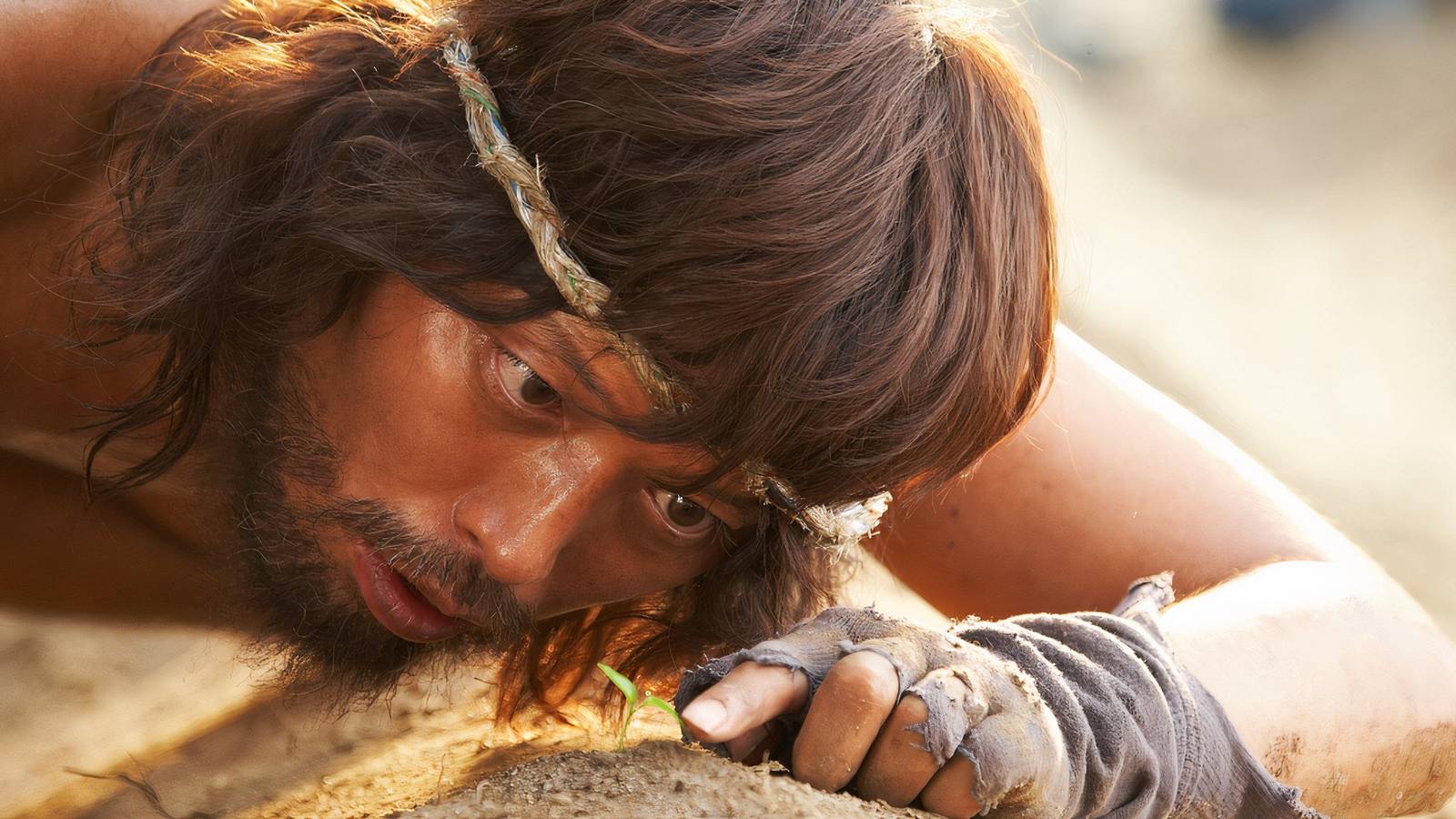
The unique rom-com Castaway on the Moon is one of the coolest movies you’ll ever get to see. It’s a beautiful, whimsical, and surprisingly profound film about modern loneliness directed by Lee Hae-jun, who manages to balance absurdist comedy with genuine emotional payoff and resonance. Both Jung Jae-young and Jung Ryeo-won, who share their surname in the film, too, deliver compelling performances, with Jung Jae-young’s physical transformation anchoring the absurd premise in emotion and reality. Castaway on the Moon‘s gentle, quirky tone made it a tough sell for fans of the violent Korean thrillers that were popular at the time, but its upbeat ending and heartwarming payoff still deserve attention; if you wish to see an unconventional rom-com, it’s time to draw Castaway on the Moon out of obscurity.
Castaway on the Moon follows Kim Seung-geun (Jung Jae-young), a man drowning in debt and terrible life circumstances, as he attempts suicide by jumping off a bridge into Seoul’s Han River, but instead ends up on an uninhabited, overgrown island just beneath the massive bridge. Trapped, he decides to survive by learning to forage for food and cook “homemade meals” while on the deserted island (“After 7 years of saving up for a house, I finally got my own place”). He doesn’t realize that he is being watched by Kim Jung-yeon (Jung Ryeo-won), a reclusive, agoraphobic woman whose apartment overlooks the island and who photographs the Moon at night. As they establish a remote, wordless connection, the film evolves into a quirky and heartwarming exploration of isolation and hope, transforming their story into one of coming together regardless of circumstances. To motivate you to watch the film further, here’s an interesting quote from it: “It’s not for health reasons. After putting on 10,000 steps, I feel like I had a good, busy day. It’s an all-too-healthy way of escapism.”

Castaway on the Moon
- Release Date
-
May 14, 2009
- Runtime
-
119 minutes
- Director
-
Lee Hae-jun
- Writers
-
Lee Hae-jun
-

-
Jung Ryeo-won
Kim Jung-yeon
-
Yang Mi-kyung
Seung-geun’s Mother
-
Lee Sang-hun
Seung-geun’s Father
Source link
