

7,000 GPUs Simulate Quantum Microchip in Unprecedented Detail

Using the Perlmutter supercomputer, researchers achieved a record-scale simulation of a quantum microchip to refine and validate next-generation quantum hardware designs.
Researchers from Lawrence Berkeley National Laboratory (Berkeley Lab) and the University of California, Berkeley have completed one of the most detailed simulations ever performed on a quantum microchip. The project marks an important advance in refining the hardware needed for quantum technologies.
To carry out the work, the team relied on more than 7,000 NVIDIA GPUs running on the Perlmutter supercomputer at the National Energy Research Scientific Computing Center (NERSC), a U.S. Department of Energy (DOE) user facility.
Simulating quantum chips before they are physically built allows scientists to evaluate how they will function and identify potential design flaws early. By testing performance in a virtual environment, researchers can improve reliability and reduce costly fabrication iterations. Zhi Jackie Yao and Andy Nonaka of the Applied Mathematics and Computational Research (AMCR) Division at Berkeley Lab, both part of the Quantum Systems Accelerator (QSA), develop advanced electromagnetic models to analyze how these chips behave, a crucial step toward building more capable quantum hardware.
“The computational model predicts how design decisions affect electromagnetic wave propagation in the chip,” said Nonaka, “to make sure proper signal coupling occurs and avoid unwanted crosstalk.”
For this project, the team employed ARTEMIS, their exascale modeling platform, to simulate and refine a chip developed through a partnership between Irfan Siddiqi’s Quantum Nanoelectronics Laboratory at the University of California, Berkeley, and Berkeley Lab’s Advanced Quantum Testbed (AQT). Yao will present the technical results at the International Conference for High Performance Computing, Networking, Storage, and Analysis (SC25).
Creating quantum chips requires combining established microwave engineering techniques with the demands of ultra-low temperature quantum physics. Because of this blend of classical and quantum considerations, ARTEMIS, originally developed under the DOE’s Exascale Computing Project initiative, provides an effective framework for modeling the complex electromagnetic behavior within these devices.
A large simulation for a tiny chip
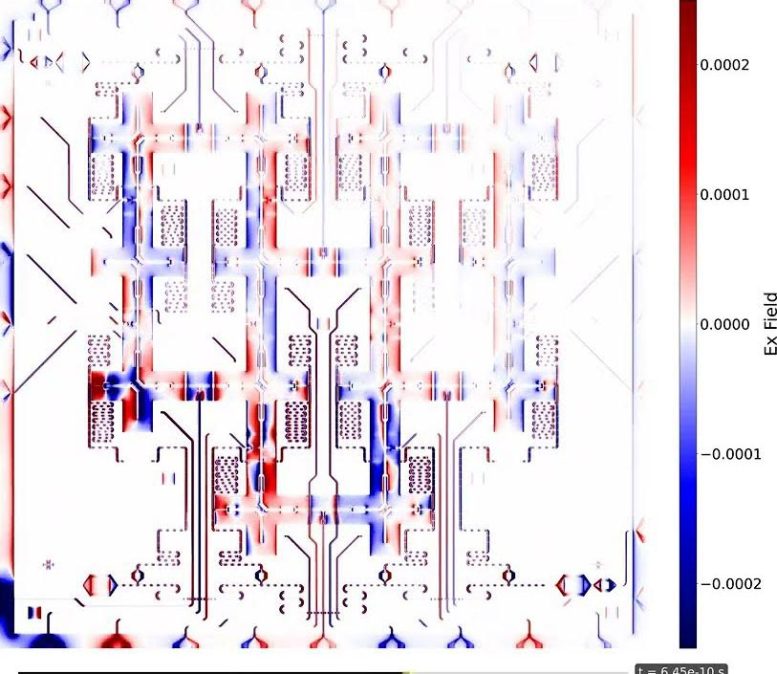
Not every quantum chip simulation calls for so much computing capacity, but modeling the minuscule details of this tiny, extremely complex chip required nearly all of Perlmutter’s power. The researchers used almost all of its 7,168 NVIDIA GPUs over a period of 24 hours to capture the structure and function of a multi-layered chip measuring just 10 millimeters square and 0.3 millimeters thick, with etchings just one micron wide.
Computer-Generated Etchings of a Microchip
“I’m not aware of anybody who’s ever done physical modeling of microelectronic circuits at full Perlmutter system scale. We were using nearly 7,000 GPUs,” said Nonaka. “We discretized the chip into 11 billion grid cells. We were able to run over a million time steps in seven hours, which allowed us to evaluate three circuit configurations within a single day on Perlmutter. These simulations would not have been possible in this time frame without the full system.”
It’s this level of detail that makes this simulation unique. Where other simulations tend to treat chips as “black boxes” due to constraints on modeling capability, using Perlmutter’s massively parallel GPUs gave Yao and Nonaka the compute power to lean into the physical details and show the chip’s mechanism at work.
“We do full-wave physical-level simulation, meaning that we care about what material you use on the chip, the layout of the chip, how you wire the metal – the niobium or other type of metal wires – how you build the resonators, what’s the size, what’s the shape, what material you use,” said Yao. “We care about those physical details, and we include them in our model.”
In addition to its fine-grained view of the chip, the simulation mimicked the experience of experiments in the lab – how qubits communicate with each other and with other parts of the quantum circuit.
The power of the Perlmutter supercomputer enabled researchers to simulate a quantum microchip in unprecedented detail, mimicking the experience of testing this next-generation hardware in a lab. Credit: Zhi Jackie Yao, Berkeley Lab
Combining these qualities – a focus on the physical chip design and the ability to simulate in real time – is part of what made the simulation unique, said Yao: “The combination is instrumental, because we use the partial differential equation, Maxwell’s equation, and we do it in the time domain so we can incorporate nonlinear behavior. All this adds up to give us one-of-a-kind capability.”
NERSC has supported many quantum information science projects through the Quantum Information Science @ Perlmutter program, which grants Director’s Discretionary Reserve hours on Perlmutter to promising quantum projects. Still, staff say tackling a simulation of this size was an exciting challenge.
“This effort stands out as one of the most ambitious quantum projects on Perlmutter to date, using ARTEMIS and NERSC’s computing capabilities to capture quantum hardware detail over more than four orders of magnitude,” said Katie Klymko, a NERSC quantum computing engineer who worked on the project.
Modeling the next step
Next, the team plans to do more simulations to strengthen their quantitative understanding of the chip’s design and see how it functions as part of a larger system.
“We’d like to do a more quantitative simulation so that we can do a post-process and quantify the spectral behavior of the system,” said Yao. “We’d like to see how the qubit is resonating with the rest of the circuit. In the frequency domain, we’d like to benchmark it with other frequency-domain simulations to give us greater confidence that, quantitatively, the simulation is correct.”
Eventually, the simulation will take the ultimate test: comparison with the physical world. When the chip is fabricated and put through its paces, Yao and Nonaka will see how their model measured up and make adjustments from there.
Nonaka and Yao emphasized that a successful simulation of this technology at this level of detail would not have been possible without strong collaboration across the Berkeley community, from AMCR to QSA and AQT to NERSC, which supported the simulation with staff expertise in addition to compute power. The collaboration has yielded important results for the advancement of science, said QSA director Bert de Jong. “This unprecedented simulation, made possible by a broad partnership among scientists and engineers, is a critical step forward to accelerate the design and development of quantum hardware,” he said. “More powerful, more performant quantum chips will unlock new capabilities for researchers and open up new avenues in science.”
Never miss a breakthrough: Join the SciTechDaily newsletter.
Follow us on Google and Google News.
Source link
