

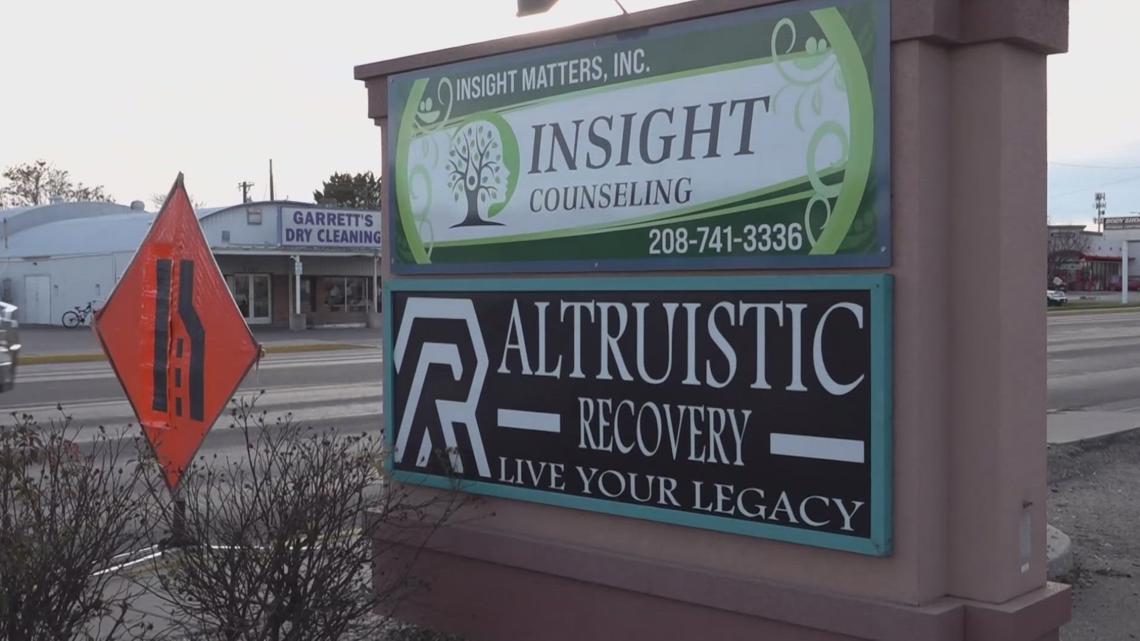
A policy change will force 800 Malheur County Medicaid patients to switch mental health providers or go without care starting Jan. 1, clinic directors warn.
MALHEUR COUNTY, Ore. — Nearly 800 mental health patients in Malheur County will lose access to their counselors starting Jan. 1 under a new policy requiring Medicaid recipients to see only contracted providers.
On Nov. 12, Greater Oregon Behavioral Health Inc. (GOHBI), who distributes Medicaid dollars for mental health in eastern Oregon, sent a letter to the four mental health providers in Malheur County. The four providers include Altruistic Recovery, Insight Counseling and Therapy, Four Rivers Recovery, and Lifeways Recovery Center.
Malheur County has more than 50% of its residents on Medicaid — the highest rate in Oregon. Approximately 8,000 people in the county receive Medicaid benefits.
KTVB obtained a copy of the letter, where GOBHI writes, “as part of our ongoing efforts to ensure sustainable access to care for our members, we are making an important update to our standards for non-contracted behavioral health providers serving Eastern Oregon Coordinated Care Organization (EOCCO) members in Harney, Baker, and Malheur counties. These counties have been determined to have sufficient outpatient behavioral health services available within our contracted network.
“Beginning January 1, 2026, EOCCO will require that new routine Medicaid outpatient mental health and substance use disorder services be received from a contracted participating provider, unless an exception applies,” the letter continued. “Members who are currently receiving routine care from a non-contracted (out-of-network) provider will be able to complete their course of treatment with that provider.”
Greater Oregon Behavioral Health Inc. in the letter claimed the reason for the change is due to GOBHI “navigating an increasingly challenging financial environment shaped by rising health care costs and potential reductions in Medicaid funding. These realities require us to find new ways to do more with less.”
Out of the four providers in Malheur County, only one is considered an in-network or contracted provider, which is Lifeways. After the new year, all patients on Oregon Medicaid seeking any new mental health treatments will need to seek those services at Lifeways only.
The change will leave patients at three clinics with what providers tell KTVB is a single local option for routine outpatient mental health and substance use treatment.
“I’m scared. I mean, absolutely terrified,” said Rachelle Odle, who has been receiving treatment at Altruistic Recovery for three years.
Ann Ford, who is the executive director of GOHBI, provided further explanation of the change to KTVB. She pushed back on the change limiting clients to just one option, and said patients can seek care at other in-network providers in the surrounding counties, if they choose to.
“With recent Medicaid funding changes in place, this shift was implemented as a way to support the ask from (Oregon Health Authority) that CCOs enable a more sustainable Medicaid structure,” Ford said in an email to KTVB. “Shifts, such as this in-network requirement help keep costs low, while still providing quality care to everyone.”
Odle goes to Altruistic Recovery each week.
“I’ve been in counseling most my life,” said Odle, who struggles with bipolar disorder, self-harm, suicidal ideation and hearing voices.
She has been to about 20 different counselors across 14 years. But her three years with Altruistic felt different.
“We’re not just a number to them,” Odle said. “I was hospitalized every two years until I found Altruistic. So, this is the longest I’ve been out of the hospital.”
Altruistic and Insight sit in the same multi-level building in Ontario.
Becky Wolery, executive director of Insights, is sounding the alarm on how this change will be harmful to its current clients. She said 95% of Insights’ clientele are on Oregon Medicaid, and it’s about the same at Altruistic.
“Since the first of the year, we’ve served 300 (people),” Wolery said. “It really puts us in a very horrific situation.”
She said in the past Insight, and the other out of network providers, have tried to get contracts with GOBHI to become an in-network provider, but it’s never happened.
When asked why other networks have been denied contracts, Ford with GOBHI said. “Network contracting decisions are based on documented needs within the CCO’s service areas.”
“… When network assessments indicate additional capacity is required, GOBHI initiates contracting outreach to expand the provider network,” Ford said.
Altruistic and Insight both told KTVB the majority of their clients are on Medicaid, estimating that to be about 95% of their clientele on Oregon Medicaid. Wolery said without new clients coming in, both Altruistic and Insight face closing doors within months, and staff members will lose their jobs.
“You just see the progress that they’ve (patients) made, and you know that they’re not going to be able to continue seeing you. And that’s really hard,” Wolery said.
Odle said it would terrify her if Altruistic had to close.
“I’ve tried other counseling places, and it didn’t work out,” Odle said. “I didn’t have connection with my counselor. If we lose Altruistic, I’m afraid that I’ll go back and I don’t want to be in the hospital.”
Wolery said eliminating choice is dangerous because successful therapy depends on the connection between a patient and their counselor.
“When they can feel confident and trust in their counselor, then the healing starts to happen,” Wolery said.
Emma Wilber said after trying other providers, they found the right counselor at Altruistic for her 7-year-old grandson, who had been separated from his parents due to addiction.
“He suffered a lot of separation anxiety. He would lie, he would steal,” Wilber said.
“The change came when we came here,” she said, becoming emotional. “They’ve done so much for him. I’m so sorry. Done so much for him and our family. Can’t thank them enough.”
Both Odle and Wilber said when the change takes place, they will most likely not seek treatment at Lifeways, because they have tried their programs in the past and it wasn’t the right fit for them. Wolery warned that could be the same story for many of their current clients, and she worries people will decide to go without care.
Wolery said that typical program approvals for patients range from three to six months. Current patients on Oregon Medicaid will be able to finish those already approved treatments, even if it runs after Jan. 1. But if those same patients needed additional care, or another service, it would not be guaranteed for them to receive that with their current noncontracted providers at Altruistic, Insight or Four Rivers.
“Members who are currently in treatment may continue their services with their existing provider. There is no disruption to active care,” Ford with GOBHI told KTVB. “Only members seeking a new episode of routine outpatient treatment will be directed to an in-network provider. This approach supports continuity of care while ensuring long-term network stability.”
KTVB asked Ford to further explain in what scenarios that a current client would be able to get a treatment extension to stick with their out of network provider:
“Once a member has completed their current episode of treatment, the updated requirements will apply. For clarity, ‘completion’ means the member may finish their full episode of care with their current provider, including any medically necessary extensions approved as part of that episode,” Ford said. “If a member completes or discontinues services and later begins a new episode of treatment on or after Jan. 1, 2026, they will need to see an in-network provider. This does not have to be Lifeways—any in-network provider is acceptable.”
Wolery said Altruistic and Insight each serve about 300 patients. She estimated Four Rivers serves roughly another 180 patients.
Wolery worries Lifeways, or just one provider, can’t handle nearly 800 additional patients flooding into a facility needing services, and if that leads to wait lists or delay in care, or limiting services meant to be preventative could cause a cycle of crisis.
“There’s an increase in hospitalizations, there’s an increase in substance use, there’s an increase in suicidality, there’s just a huge increase in all the things we don’t want,” Wolery said.
GOBHI said network contracting decisions are based on documented needs within the service areas, and when network assessments indicate additional capacity is required, the organization initiates contracting outreach to expand the provider network. Which means, if it’s later deemed that Lifeways gets to a place where they serve everyone, GOBHI will be required to seek additional contracts and allow mental health care for those on Medicaid to seek care at the out of network providers.
Wolery said the metrics GOBHI is using to deem Lifeways fit to handle all Medicaid patients seeking mental health services is based on current numbers seen at Lifeways, which deem not at capacity. Wolery warned that doesn’t give an accurate depiction on them being capable to take on hundreds of more clients.
KTVB reached out to Lifeways seeking additional information about capacity concerns and did not receive a response at the time of publication.
Andy Walsh, senior health policy advisor for the Children’s Institute, said cuts to out-of-network mental health providers are happening across Oregon, with rural communities hit hardest.
“They’re the ones facing the biggest cuts,” Walsh said.
Malheur County is classified as a rural frontier area with severe workforce shortages in both mental health and health care. Walsh warned of consequences when preventive mental health services are eliminated.
While Wolery believes this change is happening because of money, she also raised concerns about potential conflicts of interest in the decision-making process, noting that Lifeways’ CEO serves on GOBHI’s board of directors.
When asked about the controversy, Ford said, “it’s important to note that Lifeways is the Community Mental Health Program for Malheur County.”
“CMHPs are selected by Local Mental Health Authority and per OHA regulations, CCOs must contract with the local CMHP,” Ford said. “It’s also important to note that network management decisions are made by an independent internal committee that operates separately from the board of directors.
“… GOBHI’s board is advisory in nature and does not participate in network contracting or provider selection decisions,” Ford added. “This structure ensures impartiality and compliance with governance requirements.”
Wolery and the other out of network providers have asked Malheur County commissioners to intervene or use their voice that has influence.
KTVB reach out to the two county commissioners for comment. Commissioner Ron Jacobs confirmed he is aware of the concerns being raised.
“The County Court does not have any authority over EOCCO, OHA or GOBHI. The County’s role is to continue to work with the community, our CMHP and providers to meet the health needs of our citizens. Provider choice may not be possible for OHP clients because funding is limited,” Jacobs said. “I favor mental health provider options. Please note Lifeways can contract with other providers and clients can see in-network providers within the 12 EOCCO counties or by telehealth.”
Providers are urging patients to contact GOBHI and county commissioners before the Jan. 1 deadline.
A community meeting hosted by the out of network providers is taking place Dec. 16 for those wanting to hear more.
news/local/eastern-oregon-mental-health-providers-face-closure-new-medicaid-structure/277-c8c1d6af-37c9-4362-bf9b-a9b99b05d151″>Source link
