

Growing up in London in the 00s, I was surrounded by suits. On City boys darting around the Square Mile. In Hyde Park, where Arab dads in baggy suits kicked footballs with their children in honeyed light. At school, where cheap grey suits were our uniform. The suit has always been a costume of seriousness that signals powerfulness and performance; all the things I was apparently supposed to want if I ever intended to become a “man”. But until recently, my generation seemed to wear them less and less, and they had all but disappeared from my consciousness.
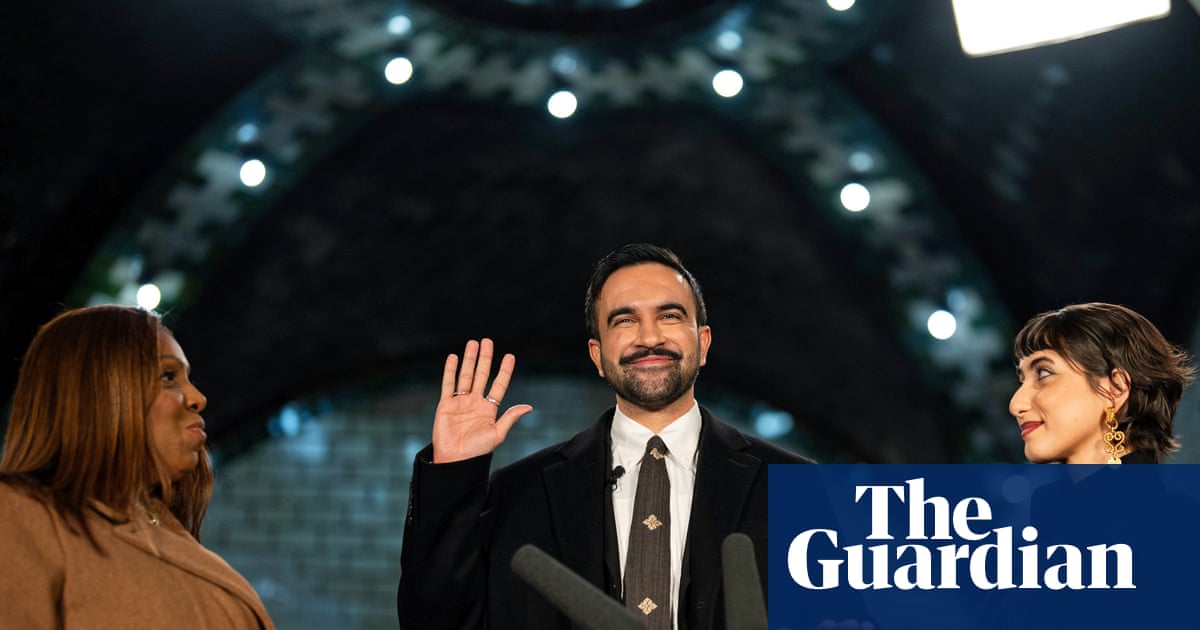
Then came the newly elected New York City mayor, Zohran Mamdani, who was sworn in at a private ceremony dressed in a sober black overcoat, crisp white shirt and an Eri silk tie from New Delhi-based designer Kartik Kumra of Kartik Research – styled by US fashion editor, Gabriella Karefa-Johnson. Buoyed up by an ingenious campaign, he caught the imagination of the world like no other New York mayoral candidate of recent times. But whether he was throwing his hands in the air at a hip-hop club or at a premiere party for the film Marty Supreme, one thing on his campaign trail rarely changed: he was almost always in a suit. Loosely tailored, modern with soft shoulders, yet conventional and ordinary, his is a typically middle-class millennial suit – well, as typical as it can be for a generation that rarely bothers to wear one.
“The suit is in this weird position,” says men’s fashion writer Derek Guy (AKA Twitter’s “the menswear guy”) over the phone from California. “It’s been dying a slow death since the end of the second world war,” with the real dip arriving in the 1990s with “the rise of business casual”.
“It’s basically only worn in the most formal locations: weddings, funerals, to some extent, court appearances,” Guy says. “It’s sort of like the kimono in Japan,” in that it “essentially represents a tradition that has long ceded from daily life.” Many politicians “wear a suit to say: ‘I am a politician, you can trust me. You should vote for me. I have authority.’” But while the suit has historically signalled this, today it performs authority in the hope of winning public confidence. As Guy explains: “Since we’re also living in a liberal democracy, politicians want to seem relatable, because they’re trying to get your votes.” In many ways, a suit is just a subtle form of drag, in that it performs masculinity, authority and even proximity to power. Or at least how politicians are expected to look.
Guy’s words stayed with me. On the rare occasions I need a suit – a wedding or formal occasion – I dust off the one I bought from a Tokyo department store (from high-street brand Global Work, which is like Gap) several years ago. When I first picked it up off the rack, it made me feel sophisticated and expensive, but the slim cut now feels passé. I imagine this will be only too familiar for many of us in the diaspora whose parents come from somewhere else, particularly global south countries.
It’s no surprise the working man’s suit has fallen out of fashion. Like a pair of jeans, a suit’s silhouette goes through cycles; a particular cut can therefore define an era – and feel quickly outdated. Take now: looser-fitting suits, reminiscent of Richard Gere’s famous Armani one in American Gigolo, might be in vogue, but given the cost, it can feel like a considerable investment for something that’s likely to fall out of fashion within five years. Yet the appeal, at least in some quarters, endures: in the past year, John Lewis says it has seen tailoring sales increase more than 20% as customers “move away from the suit being everyday wear towards an appetite to invest in something special”.
Mamdani’s preferred suit is from Suitsupply, a Dutch label that retails in the £400-£1,200 range, placing it firmly in the mid-market bracket. “Mamdani is very much a product of his background,” says Guy. “A relatively young person in his 30s, he’s neither poor nor exceptionally wealthy.” To that end, his mid-level suit will resonate with the demographic most likely to support him: people in their 30s and 40s, college graduates making middle-class incomes, often frustrated by the cost of housing. It’s exactly the kind of suit they might wear themselves. Not cheap but not extravagant, Mamdani’s suits arguably don’t contradict his proposed policies – a rent freeze; building 200,000 permanently affordable, union-built, rent-stabilised homes; fare-free public buses; and universal early-childhood care.
“You could never imagine Donald Trump wearing Suitsupply; he’s a Brioni person,” says Guy, referring to the luxurious Italian suits that Trump wears, which cost from£3,480-£10,600 off the rack: “He’s extremely wealthy and grew up in that New York real-estate world. A power suit fits naturally with that tycoon class, just as more accessible brands fit naturally with Mamdani’s cohort.”
The history of suits in politics is long and storied: from Obama’s “shocking” tan suit, now infamous enough to have its own Wikipedia page, to Justin Trudeau’s and Emmanuel Macron’s suspiciously polished, tailored sheen, and the “Merkel rainbow” of colourful jackets and slacks worn by the former German chancellor. As Jeremy Corbyn learned, the suit doesn’t just dress the politician; it has the potential to define them.
Perhaps the point is what Dr Matthew Sterling Benson-Strohmayer, an economic historian at the London School of Economics, refers to as the “performance of banality”, summoning the suit’s long career as a uniform of political power, with Mamdani’s particular choice tapping into a studied modesty, neither shabby nor showy – “respectability politics” in an inconspicuous suit – to help him appeal to as many voters as possible. But Benson-Strohmayer thinks Mamdani would be aware of the suit’s military and colonial legacy: “The suit isn’t neutral; historians of empire have long noted that its contemporary origins lie in military or colonial administration.” He also sees the suit as a form of protective armour: “I think if you’re Brown, you aren’t going to get taken as seriously in these white spaces.” The suit becomes a way of signalling legitimacy, perhaps especially to those who might question said legitimacy.
This kind of sartorial “code-switching” is hardly a new phenomenon. Even Mohandas Gandhi, whose most iconic image was him cross-legged in a hand-spun dhoti with a shawl draped over his shoulder, once donned a three-piece suit as he trained as a young barrister in London. These days, the Ukrainian president, Volodymyr Zelenskyy, has started swapping his usual fatigues for a black suit, albeit one without the tie.
The suit Mamdani chooses, according to David Kuchta, the author of The Three-Piece Suit and Modern Masculinity, is symbolic/significant. “As a Muslim child of immigrants of Indian descent and a democratic socialist, he is under pressure to conform to what many American voters look for as a sign of leadership,” he says, while simultaneously needing to walk a tightrope by “not looking like an elitist selling out his non-mainstream roots and values”.
But Kuchta is acutely aware of the double standards applied to who wears suits and what is read into it when they do. “That may come in part from Mamdani being a millennial, able to adopt different identities to fit the occasion, but it may also be part of his multicultural background, where code-switching between languages, customs and clothing styles is common,” he says. “White males can remain unnoticed,” but when women and ethnic minorities “attempt to gain the power that suits represent,” they must carefully navigate the codes associated with them.
In every seam and stitch of Mamdani’s public persona, the tension between somewhere and nowhere, insider and outsider, is visible. I know well the awkwardness of trying to fit into something not built for me, be it an inherited tradition, or the culture I was born into, or even a suit. What Mamdani’s sartorial choices make clear, however, is that in politics, appearance is never neutral.
