

Donald Trump’s Venezuela attack stuns Europe’s far right – DW – 01/10/2026
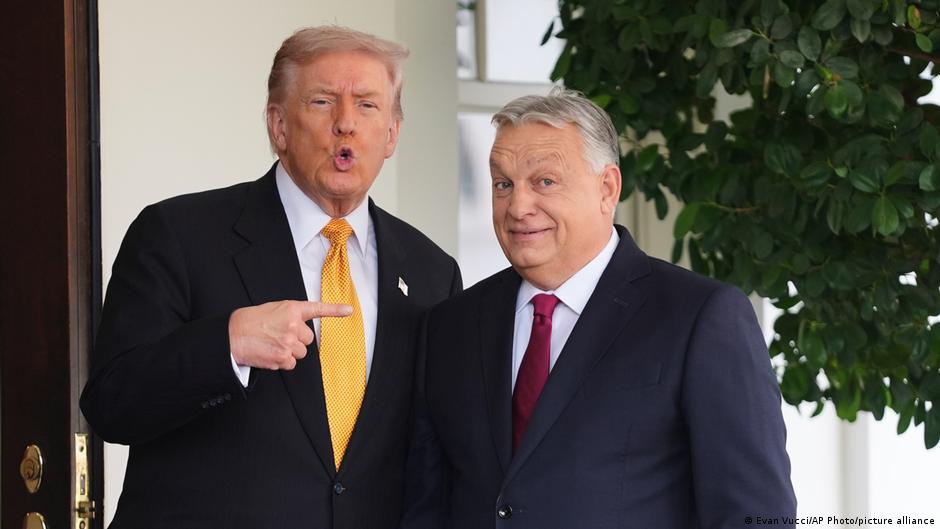
For years, Hungarian Prime Minister Viktor Orban has tirelessly praised Donald Trump as a “man of peace.” He sang the president’s praises for brokering the ceasefire between Israel and Hamas. Orban also repeated Trump’s claims that, if he had been US president in 2022, Russia would never have started its war against Ukraine. This is all part of Orban’s “peace rhetoric” — a cornerstone of the Hungarian prime minister’s current election campaign.
But, when the “man of peace” attacked Venezuela on January 3 and kidnapped its leader, Nicolas Maduro, Orban’s channels went silent for hours. In the evening, two terse sentences appeared on the prime minister’s Facebook page: There were “no Hungarian casualties or injuries” following the military action in Venezuela. Contact had been made with Hungary’s embassies in the region to ensure that no Hungarians were in danger.
It was not until two days later, at his regular press conference at the beginning of the year, that Orban found a way to explain Trump’s attack on Venezuela. It was about “eliminating a narco-state,” he said, adding that this was “good news” for Hungary.
Later, the prime minister posted a short video on Facebook showing Hungarian police officers conducting an anti-drug raid. Orban has not yet made any statements relating to the international legality of the US military intervention.
Trump allies caught off guard
Trump’s attack on Venezuela and Maduro’s arrest caught the countries of Central and Southeastern Europe, most of which are considered friendly to the US, off guard — especially those where populists and authoritarian Trump supporters are in power. Although many of the latter rule by circumventing existing legal systems at will, the attack on Venezuela plunged them into tight-lipped silence, with some even expressing horror.
In the weekly magazine HVG, Hungarian journalist Imre Para-Kovacs highlighted how there is a growing risk that other leaders could suffer a similar fate: “Venezuela is the first country. But even the thick-headed politicians of Europe could quickly find themselves in a New York prison.”
Other observers point out that Russia is now the main threat to Central and Southeastern Europe in Trump’s new world order. For Poland, journalist Artur Bartkiewicz sees “very dark clouds gathering on the horizon,” as he wrote in the newspaper Rzeczpospolita. Polish security expert Justyna Gotkowska posted on Facebook that Russia will “put the US and its willingness to defend the borders it has maintained so far to the test.”
The silence of the populists
Poland’s right-wing populist leader, President Karol Nawrocki, meanwhile, has not yet made his position clear. To date, he has said nothing about the US attack on Venezuela. In general, Polish right-wing populists and right-wing extremists have tended to be extremely cautious about responding to the attack.
Foreign Minister Radoslaw Sikorski took a sarcastic tone on X: “Another day goes by without our nationalists defending Venezuela’s national sovereignty. Does it only apply to the European Union, which poses no threat?”
In Czechia, right-wing populist Andrej Babis, who has been back in office as head of government for a few weeks, also reacted cautiously and with a concerned undertone. “Let’s hope that all this will lead to the citizens of Venezuela being able to enjoy freedom and democracy and that they will elect a democratic government.”
Babis, a billionaire, is sometimes referred to as the “Czech Trump” and is known for quickly adjusting his stance depending on the political climate or his interests. He has been under investigation for years for subsidy fraud and has also been criticized for conflicts of interest between politics and business activities.
Fico voices outrage
Unlike his Central European allies in Poland, Czechia, and Hungary, Slovak Prime Minister Robert Fico reacted to the news. “International law no longer applies, military power is being used without a UN mandate, and anyone who is big and strong does whatever they want to assert their own interests,” Fico wrote on Facebook hours after the US attack on Venezuela. “As prime minister of a small country, I must resolutely reject such a violation of international law. I am curious to see how the EU will respond to the attack on Venezuela, which deserves to be condemned.”
A day later, Fico softened his tone slightly, saying he would do everything in his power to ensure that Slovakia “never gets involved in military adventures.”
Unlike Nawrocki, Babis, and Orban, Fico has a rather distant relationship with Trump. The Slovak prime minister is technically a social democrat, but in recent years he has increasingly shifted toward nationalist right-wing populism. He is currently trying to transform Slovakia along the lines of Orban’s model. He increasingly claims that any criticism of this agenda is an anti-Slovak conspiracy, especially after an assassination attempt on him in May 2024, which he narrowly survived.
Serbian president’s power under fire
Serbian President Aleksandar Vucic also reacted in shock to the US attack on Venezuela. “The international legal order and the UN Charter no longer work,” Vucic said at a meeting of the National Security Council in Belgrade on January 3. “The world is ruled by the law of force, the law of the strongest, and that is the only principle of modern politics that exists in the world today.”
These words sound cynical coming from the Serbian leader, a nationalist and right-wing populist, and a former information minister under dictator Slobodan Milosevic. He has ruled the largest country in the Western Balkans autocratically for over ten years, often operating on the edge of legality. He has tried to curry favor with Trump in various ways, most recently with a controversial real estate project in Belgrade led by Trump’s son-in-law Jared Kushner, which ultimately failed. Serbia’s oil industry is currently under severe pressure due to US sanctions against the Russian energy sector. In addition, ongoing civil protests have been challenging Vucic’s power for over a year.
Isolated nationalist rulers
Overall, Trump’s policies reveal how politically isolated Central and Southeastern Europe’s nationalist and populist rulers actually are. This is particularly true of Viktor Orban, who for years has been trying to forge an alliance of populists and right-wing extremists — with limited success.
Orban could now also become the biggest victim of the policies of the man he has been flattering vigorously for years. Hungary’s prime minister has long boasted that he is the US president’s closest ally in Europe. He has pushed the narrative that he, alongside Trump, stand for peace in Europe and the world — while “warmongers” are in power in Brussels. This line of argument collapsed overnight with Trump’s military intervention.
Orban seems aware how this could rattle parliamentary elections in April. On January 9, he posted a personal letter from Trump (dated from early December) on Facebook. In it, the US president thanks Orban for an invitation to Hungary, but leaves open whether or not, and when, he will come. His post underscores how, for Orban, a visit by Trump during the election campaign would represent a huge boost.
This article was originally written in German.
Source link
