

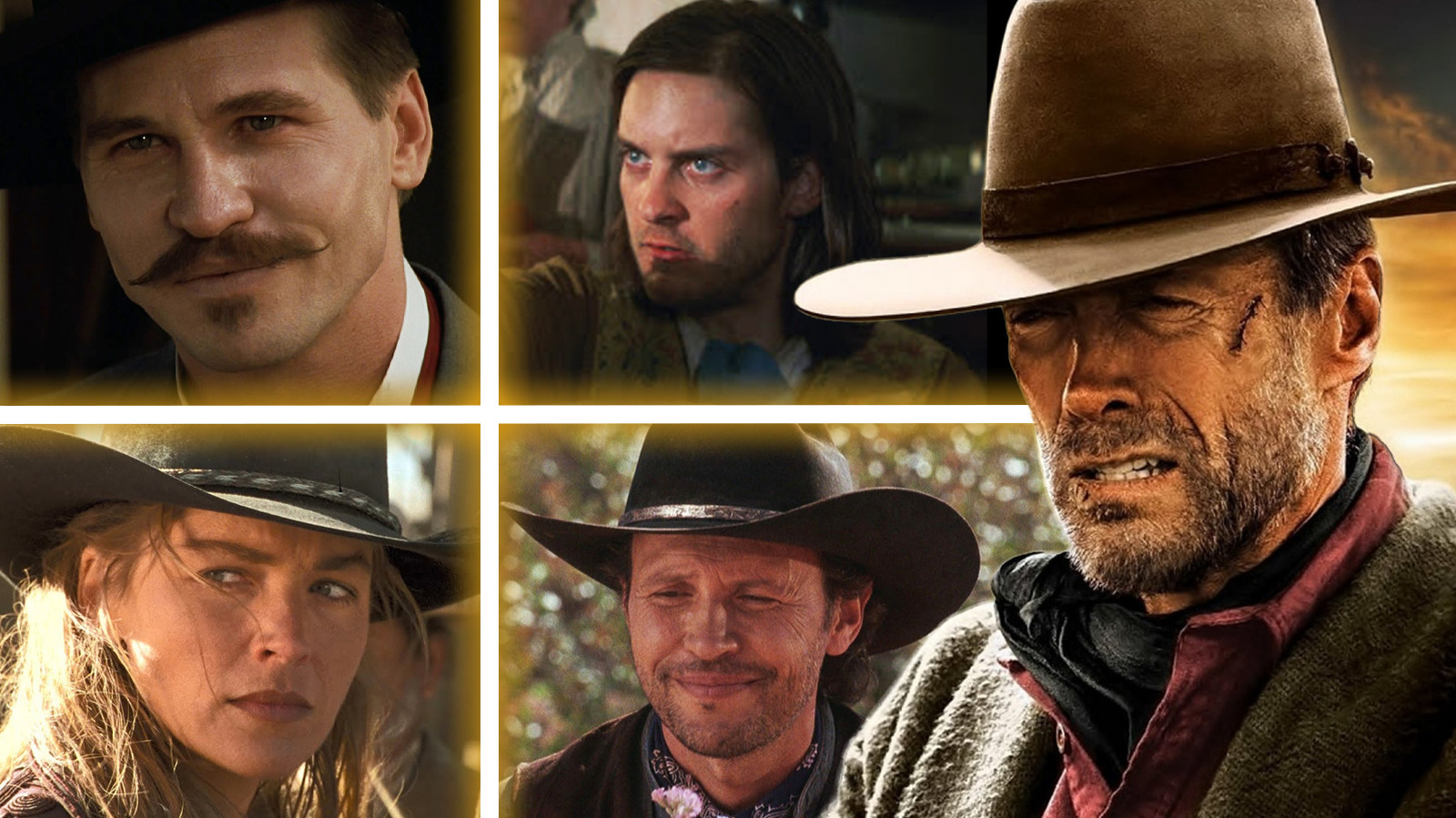
By the ’90s, the Western genre was far from the culturally relevant powerhouse it had been in the ’50s and ’60s. What Westerns did appear throughout the 1990s were often revisionist or postmodern takes on its familiar tropes, rather than straight-laced tales of gunslingers in the Wild West. Other movies in the genre began actively modernizing it, weaving stories in present-day but retaining the tried-and-true story beats for contemporary settings. Westerns also saw an increasing number of other genres blending with it, including science fiction, horror, and comedy.
Even if Westerns weren’t as commonplace or commercially viable as they had been in decades prior, the ’90s produced some truly stellar movies in the genre. Indeed, some of the best Western movies of all time were made and released in the ’90s. Westerns didn’t die out in the ’90s, they just evolved and changed with the times without compromising what they were all about.
Here are the 12 best Western movies of the 1990s ranked, keeping the rustic genre alive for modern audiences.
12. Legends of the Fall
Jim Harrison’s 1979 novella “Legends of the Fall” was adapted for the big screen with a 1994 movie of the same name. The movie follows three brothers living on a remote ranch in Montana in the early 20th century, with their father William Ludlow (Anthony Hopkins). The brothers enlist in the Canadian military to join in World War I before the United States’ eventual entry, resulting in one of their deaths. The eldest brother, Tristan (Brad Pitt), becomes involved in several complicated romances and bootlegging, putting him in conflict with the authorities during Prohibition.
To be fair, “Legends of the Fall” is a very unorthodox Western, with the Wild West already well into its twilight at the start of the movie. But a lot of that untamed frontier spirit still carries on into the movie, right to its epilogue with an older Tristan. The movie is very much powered by a magnetic performance by Pitt, at once the tortured heartthrob and vengeful brother. A revisionist Western, “Legends of the Fall” is an elegiac blend of nature, family, and love marred by external pressures.
11. Ride with the Devil
Even before 2000’s “Crouching Tiger, Hidden Dragon,” Taiwanese filmmaker Ang Lee was already making a name for himself in Hollywood. One of Lee’s most underrated movies is 1999’s “Ride with the Devil,” a revisionist Western based on Daniel Woodrell’s novel “Woe to Live On.” Set during the height of the American Civil War, the movie revolves around the conflict between Confederate bushwackers and Union jayhawks. As the war escalates and begins to turn towards the Union’s favor, the bushwackers find themselves hunted by the Union Army.
The wartime transposition of usual Western tropes work well for “Ride with the Devil,” with its tale of hunted outlaws on a grander historical scale. True to his creative strengths, Lee really hones in on his main characters’ raw emotions, complex and conflicting, even among friends and allies. This sense of intimacy carries over the movie’s action, which adds a real viscerally personal nature to the carnage. One of the best Civil War movies, or at least one of the most overlooked, “Ride with the Devil” is Lee’s meditative Western masterpiece.
10. The Quick and the Dead (1995)
While filmmaker Sam Raimi may be best known for his horror and superhero work, he directed the supremely underrated 1995 Western “The Quick and the Dead.” The movie follows a gunslinger (Sharon Stone), known simply as the Lady, who arrives in the 19th century frontier town of Redemption. The town is run by its cruel mayor John Herod (Gene Hackman), who oversees a quickdraw tournament, with Herod himself participating. Joining the lethal contest are the cocky young gunfighter, the Kid (Leonardo DiCaprio), and a mysterious preacher named Cort (Russell Crowe), each with their own motivations.
Sharon Stone’s one condition to star in “The Quick and the Dead” was to have Raimi as the project’s director, and her eye for talent was sharp. Raimi brings his usual knack for visual flair to proceedings, giving the Western genre a stylistic energy that keeps the movie riveting. This culminates in the movie’s final shootout, one of the best action scenes ever, in a slickly staged showdown. One of the most visually striking Westerns of the decade, featuring memorable early Hollywood performances from Leonardo DiCaprio and Russell Crowe, “The Quick and the Dead” deserves far more love.
9. Back to the Future Part III
The original “Back to the Future” was an ’80s movie that everyone should watch at least once, while its subsequent trilogy ended at the dawn of a new decade. 1990’s “Back to the Future Part III” concludes the time-traveling saga of Marty McFly (Michael J. Fox), who travels to 1885 to save his stranded friend Doc Brown (Christopher Lloyd). As the reunited duo work on a way to get back to 1985 with 19th century technology, Doc falls in love with local schoolteacher Clara Clayton (Mary Steenburgen). These plans are complicated by Marty and Doc attracting the murderous ire of notorious outlaw Buford “Mad Dog” Tannen (Thomas F. Wilson).
Some argue that “Back to the Future Part III” is the best movie in the entire time-bending trilogy. I’m of the mind that it’s certainly the best of the two sequels, enormously underrated, and uses its Western tropes well. The movie is more tonally even-keeled than its immediate predecessor and tells a straight-forward science fiction story primarily set within the Wild West, poking fun at familiar genre elements. Marty and Doc’s last ride into the sunset, at 88 mph, of course, is a rollicking adventure full of crowd-pleasing moments with an emotional send-off.
8. Maverick
After working together on the first three “Lethal Weapon” movies, filmmaker Richard Donner and actor Mel Gibson reunited to adapt the ’50s Western television series “Maverick.” The 1994 movie also starred the show’s original lead actor James Garner and Jodie Foster, who had recently won her second Academy Award. Gibson plays Bret Maverick, a gambler who plans to enter a high-stakes poker tournament, putting him at odds with rival con artist Annabelle Bransford (Foster) and lawman Zane Cooper (Garner). Because of Maverick’s card-shark ways and his own con jobs, he finds himself pursued by dangerous gunslingers as he makes his way to the tournament’s Wild West location.
“Maverick” is just a lot of fun, with so much of the movie derived from Gibson’s irascible charm and his chemistry with Foster. Donner packs in plenty of classic Western actors, of course including Garner, into the movie while leaning into the genre’s iconography. What results is a movie that doesn’t take itself too seriously, but instead sets out to provide audiences with a freewheeling good time. One of the best Richard Donner movies, “Maverick” celebrates all the usual Wild West tropes while gently subverting a few of them along the way.
7. Dead Man
Filmmaker Jim Jarmusch always brings an offbeat perspective to his stories, often from a counterculture and postmodern point-of-view. These qualities are visible in his 1995 acid Western “Dead Man,” starring Johnny Depp as William Blake, an unassuming accountant who takes a job in a 19th century frontier town. Ostracized by the locals, Blake is shot, with the bullet lodged too close to his heart to remove, effectively making him a walking dead man until it finally kills him. Wanted for killing one of his attackers, Blake goes on a journey with his indigenous friend Nobody (Gary Farmer), learning about Native American culture and perspectives as he’s pursued.
“Dead Man” is the quintessential acid Western movie, revisionist in its approach, while blending genres and bringing a healthy dose of psychedelia to the proceedings. Filmed in monochrome, Jarmusch retains his arthouse bonafides, fueling his Western odyssey with moody cinematography. At the center of it all is Depp, whose character stands as a witness to injustices against Native Americans and the environment perpetuated by western expansion and modernization. An offbeat Western that has to be experienced at full attention to be appreciated, “Dead Man” is a ponderous exploration of the lost frontier.
6. El Mariachi
The movie that put filmmaker Robert Rodriguez on the map, 1992’s “El Mariachi” kicked off his “Mexico” trilogy, following a nameless guitar player simply known as El Mariachi (Carlos Gallardo). After being mistaken for a heavily armed crook Azul (Reinol Martínez), El Mariachi is targeted by local drug lord Moco (Peter Marquardt). This is complicated when the Mariachi strikes up a romance with Moco’s girlfriend Dominó (Consuelo Gómez), who shelters him from Moco’s gunmen. This leads to the three men being caught in a bullet-ridden collision course in the dusty Mexican town with Dominó in the middle.
Rodriguez directed, wrote, produced, shot, and edited “El Mariachi,” exemplifying his DIY filmmaking aesthetic with his feature-length debut. Made on a shoestring budget, “El Mariachi” also took low-budget filmmaking to new heights, with its success not only kickstarting Rodriguez’s career but spawning two sequels. Even with its spartan approach, Rodriguez’s signature stylish flair is present, particularly in its action sequences. A south of the border neo-Western, “El Mariachi” is an action-packed low-budget darling that joined indie cinema’s ’90s resurgence.
5. City Slickers
The untamed West serves as the perfect cure for a shared midlife crisis in the 1991 Western comedy “City Slickers.” Friends Mitch Robbins (Billy Crystal), Phil Berquist (Daniel Stern), and Ed Furillo (Bruno Kirby) all feel trapped in their lives back in New York City, caught in middle-aged ennui. Looking for a fresh perspective to reinvigorate their lives, the trio joins a cattle drive from New Mexico to Colorado, headed by the surly cowboy Curly Washburn (Jack Palance). The cattle drive proves more arduous than the men anticipated, emerging changed as they endure the challenges of the open trail.
“City Slickers” was a huge hit with critics and at the box office, relatably addressing middle-aged malaise with its modern Western perspective. The movie’s enjoyment comes from the fish-out-of-water interplay between its three lead actors and a comically gruff Palance as their wise but no-nonsense leader. Palance went on to win the Oscar, despite his short amount of screen time, for Best Supporting Actor, an award well-deserved. More emotionally charged than one might expect from what could’ve been a rustically slapstick comedy, “City Slickers” hits all right notes.
4. Lone Star (1996)
Another indie Western gem released in the ’90s is 1996’s “Lone Star,” written, directed, and edited by filmmaker John Sayles. The movie opens with the discovery of the remains of corrupt sheriff Charlie Wade (Kris Kristofferson), who was reputedly run out of town by his successor Buddy Deeds (Matthew McConaughey). 30 years after Buddy replaced Wade, Buddy’s adult Sam (Chris Cooper) becomes the town’s new mayor, investigating what happened to Wade. As Sam rekindles his relationship with his childhood sweetheart Pilar Cruz (Elizabeth Peña), he uncovers disturbing truths about the community and his place in it.
“Lone Star” is a border town neo-noir story full of dark secrets and shocking plot twists that gradually come to light. There is a meditative mood that settles over the entire story, informed by its deliberate pace and moments of introspection. At the same time, the movie is an engrossing murder mystery, one positioned precariously in a community ready to go off like a gunpowder keg. Maturely executed with a tone that’s somehow both unassuming and powerful, “Lone Star” is Sayles’ definitive masterpiece.
3. Tombstone
The gunfight at the O.K. Corral in 1881 has taken on a mythic status in terms of Wild West history. A heavily dramatized account of the showdown and its surrounding events is depicted in the 1993 Western “Tombstone.” The movie follows Wyatt Earp (Kurt Russell) and his brothers as they relocate to Tombstone, Arizona, reuniting with Wyatt’s old, eccentric friend Doc Holliday (Val Kilmer). Despite retiring from law enforcement, the group strikes up a lethally protracted feud with a gang of outlaws led by the sadistic Curly Bill Brocius (Powers Boothe).
Like most cinematic depictions of the gunfight at the O.K. Corral, one shouldn’t watch “Tombstone” for its historical accuracy, or lack thereof. Instead, just sit back and enjoy one of the most slickly entertaining Westerns of the ’90s, with cool archetypes posturing and clashing against each other. Russell and co-star Sam Elliott bring a reliably steady hand to the proceedings, but it’s the over-the-top Kilmer who steals the show as Holliday. A more conventional take on the genre than had been done in years, or since, “Tombstone” embraces the larger-than-life genre tropes for unabashed myth-making.
2. Dances with Wolves
When it comes to sweeping historical epics, there are few ’90s movies of any genre that can stand on equal ground with “Dances with Wolves.” The 1990 movie adapts Michael Blake’s novel of the same name, with Blake writing the screenplay and Kevin Costner producing, directing and starring in the film. Costner plays Union officer John Dunbar, who requests to be assigned to a remote post in Colorado to experience the frontier before it disappears to westward expansion. Dunbar befriends the Sioux indigenous to the area, putting him at odds with the army when they begin expanding on his initial post.
Though Kevin Costner’s first day directing “Dances with Wolves” reportedly didn’t get off to a perfect start, Costner clearly locked in as production continued. Just as Dunbar wanted to appreciate the disappearing frontier, the movie takes advantage of its gorgeous natural landscape. With grandeur-inspiring presentation, the movie moves at a meditative pace, taking its time to set up the inevitable conflict and its fallout. An American tragedy about what the world lost as settlers continued to push back the frontier and those living in it, “Dances with Wolves” is still Costner’s untouchable magnum opus.
1. Unforgiven
After Westerns gave his acting career its true start in television and film, Clint Eastwood crafted a requiem to the genre with “Unforgiven.” Eastwood stars as William Munny, a notorious gunfighter who has retired in his advancing age to peacefully raise his children as a single father. With his farm failing, Munny reluctantly agrees to accept a bounty to hunt down two cowboys who viciously attacked a sex worker. The situation escalates violently when Little Bill Daggett (Gene Hackman), places the cowboys under his iron-fisted protection, leading to his murderous showdown.
Clint Eastwood’s career had hit rock bottom before “Unforgiven” rescued it, with Eastwood directing and producing the movie in addition to starring in it. The movie celebrates the hallmarks of the genre while gently deconstructing it, particularly with its approach to Wild West myth-making. This sensibility also makes the violence much more grounded than other Westerns, reflecting on its full implications rather than cavalierly brushing them aside. Many fans believe that “Unforgiven” is the best Clint Eastwood movie, and that distinction is well-earned as one last celebration to the genre that put him on the map.
Source link
