

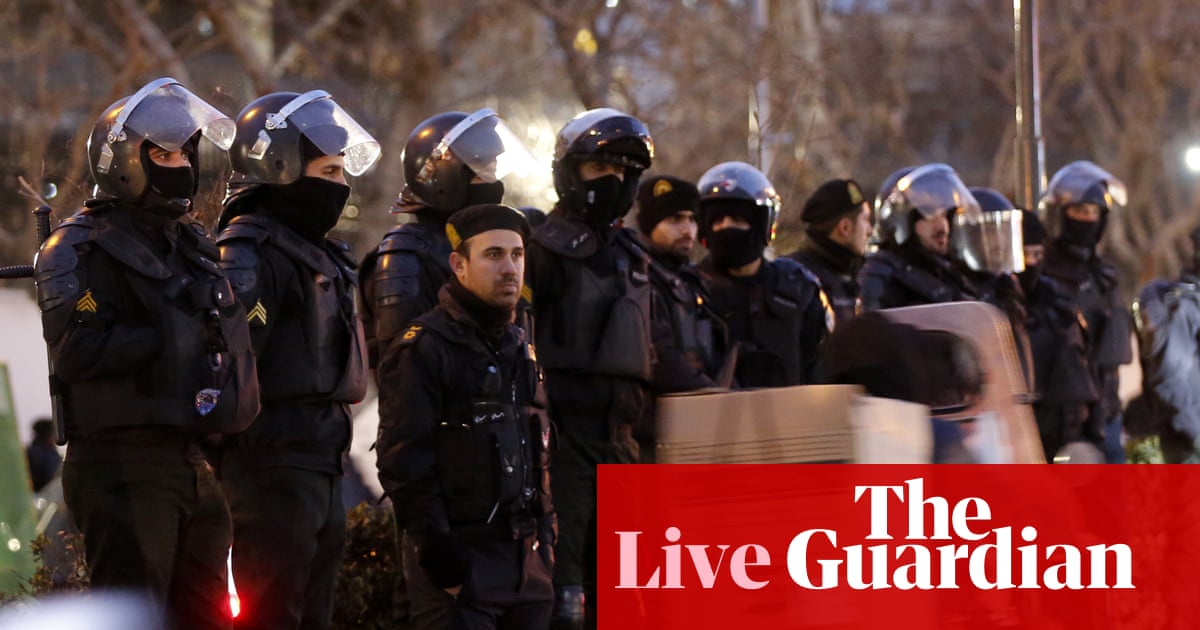
Iranian judiciary says protester Erfan Soltani not sentenced to death
Iran’s judiciary says Erfan Soltani has not been sentenced to death, according to Iranian state media.
Soltani, 26, was the first Iranian protester given a death sentence since the current unrest began.
His family said earlier that it had been told his execution had been postponed.
We’ll bring you more on this latest development – reported just now by Reuters – as it comes to hand.
Soltani, a clothing shop employee, was arrested north-west of Tehran last Thursday after participating in protests and was due to be executed on Wednesday, according to rights groups.
Donald Trump said at the White House that “very important sources on the other side” had assured him that Iran’s killing of protesters had now been halted and that planned executions would not go ahead.
He also said when asked about whether the US’s threatened military action was now off the table that he would “watch it and see”.
Key events
UN security council schedule emergency meeting on Iran for Thursday afternoon
The UN security council have scheduled an emergency meeting on Iran for Thursday afternoon at the request of the United States.
Tehran appeared to make conciliatory statements in an effort to defuse the situation after US President Donald Trump threatened to take action to stop further killing of protesters, including the execution of anyone detained in Tehran’s bloody crackdown on nationwide protests.
Meanwhile, some personnel at a key US military base in Qatar were advised to evacuate. The US embassy in Kuwait also ordered its personnel to “temporary halt” travel to the multiple military bases in the small Gulf Arab country.
New Zealand’s foreign minister Winston Peters said on Thursday that his government was “appalled by the escalation of violence and repression” in Iran.
Posting on X, Peters wrote:
We condemn the brutal crackdown being carried out by Iran’s security forces, including the killing of protesters.
Iranians have the right to peaceful protest, freedom of expression, and access to information – and that right is currently being brutally repressed.
Peters said his government had expressed serious concerns to the Iranian embassy in Wellington.

Patrick Wintour
The Guardian’s diplomatic editor, Patrick Wintour, has written an analysis on why western diplomats are wary of predicting end days for Iran’s regime:
When asked to predict whether fissures are appearing at the top of the Iranian state that may imply Ayatollah Ali Khamenei’s days as supreme leader are numbered, western diplomats adopt a haunted demeanour, perhaps recalling one of western diplomacy’s greatest collective disasters.
Before the fall of the Shah of Iran in January 1979, insouciant diplomats based in Tehran were sending cables to their capitals offering total reassurance that Mohammad Reza Pahlavi’s hold on power was utterly secure. In September 1978, the US Defence Intelligence Agency, for instance, reported that “the shah is expected to remain actively in power over the next 10 years”. A state department report suggested “the shah would not have to stand down until 1985 at the earliest”.
Sir Anthony Parsons, then the UK ambassador in Tehran, sent a message to the Foreign Office dated May 1978 saying:
I do not believe there is a serious risk of an overthrow of the regime while the shah is at the helm.
Parsons later wrote an anguished book asking whether as British ambassador he could “have anticipated that the forces of opposition to the shah – the religious class, the bazaar, the students – would combine to destroy him”. He concluded that his inability to predict an event that he compared in import to the French Revolution was not due to a lack of information, but from a failure to interpret the information correctly.
The experience of 1979 means the intelligence assessments now coming out of western embassies will be starting with a caveat and probably ending with a question mark.
In contrast, academic experts on Iran do not see much indication today of the kind of mass defections from the regime that Reza Pahlavi, the former shah’s son, has been predicting. He recently claimed that 50,000 officers in the Islamic Revolutionary Guard Corps (IRGC) were preparing to desert, a claim he has since had to revise.
Additionally, Turkey’s foreign minister Hakan Fidan said that Turkey opposes a military operation against Iran.
Fidan told reporters in Istanbul:
We’re against a military operation against Iran. We believe the authentic problems of Iran should be resolved by themselves.
He claimed that Iran’s economic grievances were “misunderstood as an uprising against” the Islamic Republic.
Turkey’s top diplomat on Thursday called for dialogue to the crisis in Iran.
“We absolutely want problems to be resolved through dialogue,” foreign minister Hakan Fidan told journalists in Istanbul.
According to Agence France-Presse (AFP), Fidan said:
Hopefully, the United States and Iran will resolve this issue among themselves – whether through mediators, other actors, or direct dialogue.
We are closely following these developments.
Germany’s air traffic control authority said Thursday it was recommending planes avoid Iranian airspace after the United States has in recent days warned of a possible military intervention in Iran.
A spokesperson for Germany’s flight safety office told Agence France-Presse (AFP) in a statement it had issued a recommendation “that Iranian airspace not be overflown … until 10 February,” adding that the advice had been issued “on the instruction of the transport ministry”.
Iran crisis explained: what we know so far
We also have a brief explainer on the Iran protests outlining what we know so far:
In the most recent episode of Today in Focus: The Latest, Lucy Hough speaks to journalist Deepa Parent about what she is hearing from those inside Iran. You can watch and listen here:
Iran closed its airspace to commercial flights for hours without explanation early on Thursday as tensions remained high with the United States over Tehran’s crackdown on nationwide protests.
The closure ran for more than four hours, according to pilot guidance issued by Iran, which lies on a key east-west flight route. International carriers diverted north and south around Iran, but after one extension, the closure appeared to have expired and several domestic flights were in the air just after 7am, reports the Associated Press (AP).
Around midday, Iranian state television carried a statement from the country’s Civil Aviation Authority saying that the nation’s “skies are hosting incoming and outgoing flights, and airports are providing services to passengers.” It did not acknowledge the closure.
Tens of thousands of mourners attend mass funeral in Tehran
Tens of thousands of mourners thronged the streets near Tehran University for the funeral of more than 300 security forces and civilians on Wednesday, reports the Associated Press (AP).
Many held Iranian flags and identical photos of Ayatollah Ali Khamenei and their relatives. The caskets, covered in Iranian flags, were stacked at least three high in the backs of trucks and covered with red and white roses and framed photographs of people who were killed, reports the AP.
According to the news agency, one man in the crowd held up a photo of US President Donald Trump during the Pennsylvania assassination attempt, emblazoned with: “The arrow doesn’t always miss!”
The crowd chanted and beat their chests in response to a master of ceremonies speaking from a stage. The presenter, his voice booming across the crowd, blamed the US for the unrest and, additionally, the country’s economic problems on “American sanctions”.
A bit more detail on the news that Erfan Soltani has not been sentenced to death, as we reported earlier (see 6.37am GMT).
The Iranian judiciary said on Thursday that Soltani has “not been sentenced to death” and if he is convicted, “the punishment, according to the law, will be imprisonment, as the death penalty does not exist for such charges”.
Soltani is imprisoned in Karaj outside Tehran after his arrest and is facing charges of propaganda against Iran’s Islamic system and acting against national security, the judiciary said in a statement carried by state TV.
French President Emmanuel Macron convened an emergency defence cabinet in Paris on Thursday to discuss US President Donald’s Trump’s stated intent to acquire Greenland and the forceful crackdown on nationwide protests in Iran.
The crisis meeting, confirmed by a French official, was scheduled to begin at 7am GMT, reports Reuters.
Source link
