

By Jon Huang
On Jan. 12, a group of more than 50 farmers, ranchers, food hub personnel, health care administrators, county public health officials, health care providers and grant officers active in community philanthropy in the San Luis and Upper Arkansas Valley region gathered at Rio Grande Hospital in Del Norte, Colorado, to learn about and discuss how Food is Medicine initiatives could support local agriculture to address chronic disease in their local rural communities.
According to the Centers for Disease Control and Prevention, the United States spends $4.9 trillion on health care yearly, with around 90% of that accounting for chronic disease. The U.S. ranks first in the world in health care costs but 49th out of 227 countries in life expectancy, according to 2024 data from the CDC.
In recent years, there has been a push to promote “Food is Medicine” to address nutritional causes of chronic disease with a greater focus on growing quality local food and environmental care.
For event organizer Patrick O’Neill, an agronomist and soil scientist in Alamosa, Colorado, the meeting was a culmination of his work with farmers. Studying the close relationship between healthy plants and healthy soil, he also saw a similar relationship between healthy food and healthy people.
“I’m not trying to make an argument that I’m a plant, but I am convinced that we have much more alike with things that are alive than probably we give credit to,” he said.
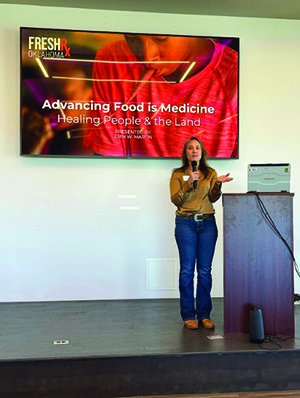
During the event, clinical gerontologist Erin Martin shared about her work in Tulsa, Oklahoma. Martin worked in nursing homes and with the elderly, where she met many who were on copious amounts of medication and experiencing side effects. Through her connections within the local food community, she met Dr. Kent Farish, a family physician.
“My patients are dying, and they’re coming to the doctor,” Farish told her. “They’re taking their medications. They’re doing what standard of care is, they’re compliant, they’re getting worse — and it’s the food.”
From this need, Martin started the FreshRx program.
The year-long program enrolls people with chronic conditions like obesity and diabetes, providing them local and regeneratively grown produce in addition to nutrition and culinary instruction. Regenerative farming refers to practices, many tied to traditional farming methods tracing back to indigenous peoples. Those practices minimize soil disruption while increasing its nutrient density as well as moisture retention — avoiding synthetic pesticide and fertilizer use. Martin’s sourcing was intentional. Research shows that farming practices that promote healthier soil lead to more nutrient-dense plants and livestock. Local sourcing also minimizes nutrient loss from transport and storage times (delivering within 24 hours of harvest) while also keeping money in the community for local people and businesses. The program diversifies market sources for small, local farms serving their local community while also providing an opportunity to grow their operations.
The following statistics were included with the Food is Medicine presentations. In the first three years, the program enrolled 311 participants and sourced from 27 farmers. There was a significant improvement in hemoglobin A1C (average loss of 2.2), which measures a three-month blood sugar average. Actuarial studies estimated about $3.9 million in health care cost savings along with a local economic impact of $1.5 million. The program is currently funded by federal, philanthropic grants and private donations. Martin hopes to partner with private businesses for more long-term payment models, including local physician practices, insurance companies and health care organizations.
Martin is not alone in her efforts.
At the recent 2025 Think Regeneration Advancing Food is Medicine conference in Edmond, Oklahoma, two primary care physicians shared their work with more than 200 people in health care, food distribution and agriculture and science.
Culinary medicine
Dr. Jaclyn Albin was a primary care physician at the University of Texas Southwestern Medical Center in Dallas for a decade and felt burnt out. Despite her best efforts caring for patients with chronic disease, she regularly struggled to give her patients what she felt they really needed. She told her husband that she was either going to kill herself trying to do the right thing for her patients and neglect her family or that she would simply become a mediocre physician.
Albin’s aunt and grandfather, who were farmers, got cancer related to chronic pesticide exposure — adding to a growing body of evidence linking neurological diseases like Parkinson’s and various cancers to chemical exposures in agricultural workers. When her husband was diagnosed with celiac disease, a dietary-related inflammatory gastrointestinal condition, he came home with a diagnosis but told her they hadn’t told him what to make for dinner.
“I have a complex relationship with the way that we’ve conventionally farmed in this country … I started asking questions that I didn’t see a lot of other people asking,” she said.
Albin’s personal experiences led her to develop a culinary medicine program, which combines the expertise of chefs and nutrition science with medical practice. The program incorporated dietary consultations for patients with lifestyle-driven illnesses like diabetes, hypertension and heart disease. It also included food preparation instruction in local churches and community kitchens and community volunteers to provide hands-on teaching on how to cook nutritious meals.
Albin saw how food access alone was insufficient for many patients with chronic disease. She found 90% of her patients with diabetes and food insecurity also experienced depression and social isolation. Many had stories centering around unhealthy relationships with food, and many believed they didn’t deserve to be better. Meeting people where they were, Albin saw how a community-based experience could lead to more lasting changes in addressing chronic disease.
“If you make this about the beautiful nourishing food that we’re going to enjoy together, you can get people on board … if we make it about deliciousness and about a human experience, we can get more people engaged in this work,” she said.
Federal qualified health centers and local farms
Dr. Steven Chen is a family physician and chief medical officer for the Recipe4Health program that serves Alameda County, California. As a second-generation Taiwanese American whose grandfather was a farmer, Chen’s immigrant roots informed a more communal approach to medicine.
“Many of us went into medicine not just to deal with the patient in front of us but to move upstream and work in community,” he said.
At home, his own children’s school-provided lunches were often heavy in ultra-processed foods. In the clinic, he saw how the results of a food system that promotes the unhealthiest foods at the lowest prices.
“We have to ask this question — where does the food come from … we have to create the policy change and the guardrails to center this, otherwise we may go down this pathway,” he said. Pathway refers to the economic incentives in the current system to sell hyper-processed food at the lowest price point.
Chen designed and implemented Recipe4Health, a county program that serves a region of over 800 square miles with 1.65 million residents speaking 57 languages.
The program offers behavioral health coaching in group medical visits and a food “Farmacy” providing produce boxes from local regenerative farms at renewable three-month intervals. All these programs complement the care provided in safety net health clinics. Today, the program serves 18 clinics across five federally qualified health centers and is funded with a combination of state (including Medicaid funds), federal and philanthropic grants.
At the heart of these initiatives are local citizens coming together to build diverse partnerships to serve the unique needs of the local community. To combat lifestyle-driven chronic disease today, Food is Medicine is pushing for communities to reconnect with the land and with one another to promote human, economic and ecological health.
O’Neill summarized these efforts.
“If we can sort out how to give value to those farmers, to those ranchers … that are promoting life and promoting health in a positive way, that’s the kind of thing we’d love to see everybody who’s got any kind of health condition have access to, and so that’s been the passion that’s got me going to work really hard in trying to get you guys together to begin this conversation and carry it forward.”

Source link
