

Marco Rubio Is Deliberately Blocking Trump From Cuba Talks
A crisis is rapidly developing in Cuba, as the Trump administration’s efforts to block fuel from reaching the island have become increasingly effective since an executive order threatened tariffs on any country trading with Cuba. Mexican President Claudia Sheinbaum has buckled under the pressure and halted oil deliveries to Cuba. Drop Site’s José Luis Granados Ceja reports on the catastrophic consequences of the energy starvation.
Read his dispatch here.
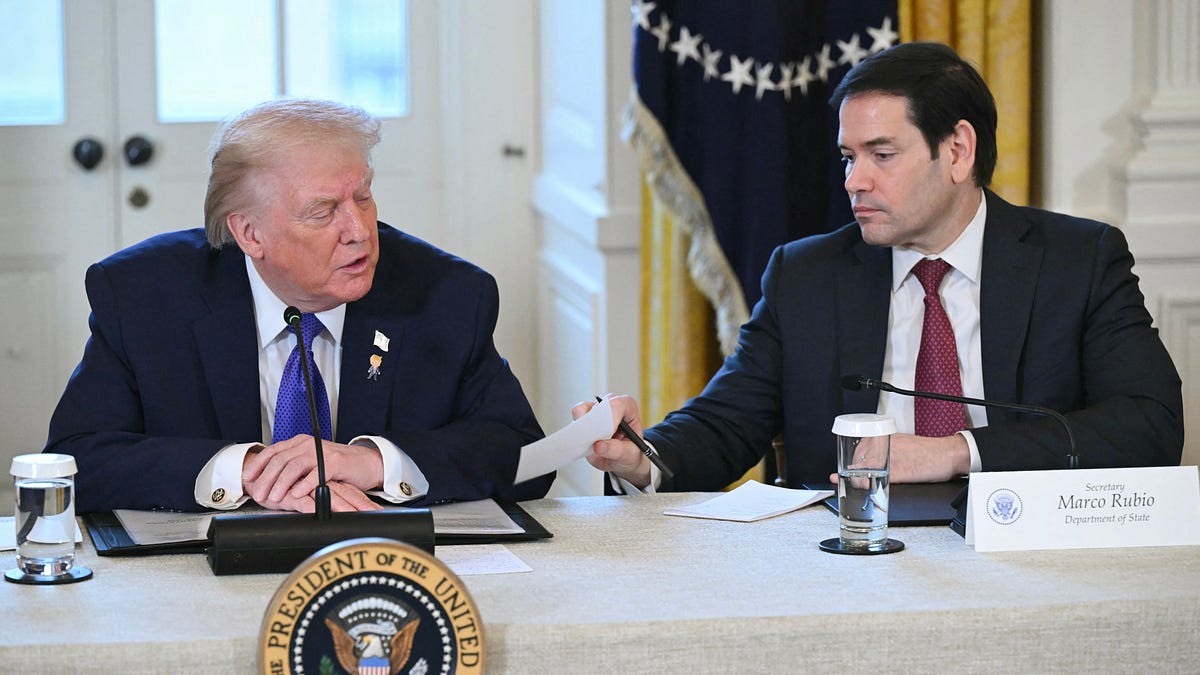
Meanwhile, back in Washington, President Trump claims that negotiations are underway to resolve the standoff. That, it turns out, is simply false—a lie being told to him by Secretary of State Marco Rubio as part of his ambitious play to overthrow the Cuban government.
The story below is written by Noah Kulwin, who reported from Havana; Granados Ceja, who reported from Mexico City; and myself. This kind of reporting isn’t cheap, but is made available to the public for free thanks to readers who fund Drop Site News.
Help us keep pushing by making a tax-deductible donation today.
To hear President Donald Trump tell it, the United States is deep in negotiations with Cuban government officials as the U.S. applies maximum pressure to the island. “We’re talking to the people from Cuba, the highest people in Cuba, to see what happens,” Trump told reporters at his Mar-a-Lago resort on Sunday, February 1. “I think we’re going to make a deal with Cuba.”
Cuban leaders, meanwhile, have said they are open to negotiations on everything from human rights to democracy to tourism and direct foreign investment. Cuban President Miguel Díaz-Canel said in a recent press conference that Cuba is willing to engage in dialogue with the United States on any issue, provided talks take place without pressure or preconditions, on the basis of respect for Cuban sovereignty. Senior Cuban leaders reiterated to Drop Site that the government is serious about being open to wide-ranging talks. And Trump is no stranger to the island’s potential for American companies, having himself long held a registered trademark for a Trump Havana property that he has annually renewed.
All the evidence would seem to suggest that the opportunity for Trump to strike a historic deal is at hand. But, despite the president’s claims, there are and have been no negotiations involving high-level officials between Havana and Washington, according to five Cuban and American officials, all of whom asked for anonymity given the sensitivity of the Cuba-U.S. relationship.
When it comes to Trump’s claims of those talks, it turns out he isn’t lying. Instead, sources tell Drop Site, he’s being lied to. “He’s saying that because that’s what Marco is telling him,” said a senior Trump official, referring to an internal effort by Secretary of State Marco Rubio to make Trump believe that the U.S. and Cuba are engaged in serious negotiations without ever doing so. The idea, the source said, is that in a few weeks or months, Rubio will be able to claim that the talks were futile because of Cuban intransigence. With diplomatic off-ramps being blocked, this would make Rubio’s vision of regime change the only path forward for an administration loath to reverse course on anything.
Asked about the fact that Rubio is misleading Trump about talks that aren’t going on, the State Department’s press office stood by the claim that such negotiations are indeed happening, forwarding along comment from an administration official: “As the President stated, we are talking to Cuba, whose leaders should make a deal. Cuba is a failing nation whose rulers have had a major setback with the loss of support from Venezuela and with Mexico ceasing to send them oil.” The statement offered no evidence the talks are taking place, named no officials participating, no dates of any meetings, nor did it identify a location where the supposed talks are happening.
Trump, meanwhile, has indicated he isn’t interested in an ideological confrontation with Cuba. This, sources suggest, is one way to understand why, after kidnapping Venezuelan President Nicolás Maduro, the U.S. has made Venezuela roll back key Chávez-era oil legislation via a reform that opens up the country to foreign investment instead of changing its regime. Rubio, meanwhile, pushed hard internally for a full regime change in Venezuela, but had to settle for merely removing Maduro. Ultimately, though, for Rubio, the real prize has always been Cuba.
The Cuban-American Rubio answers to a political base in south Florida that would revolt if he struck any deal normalizing relations with the communist government—and who, ultimately, would have the power to undo him. Rubio’s rise through Florida and national politics — which now has him on the cusp of the Oval Office — has been accompanied by a string of corruption scandals, yet with unified support back home, he has managed to emerge with a relatively clean reputation nationally. If Trump successfully lands a deal with the Cuban government that Rubio would have to sign off on, Rubio would be left to either betray his life’s cause and that of his backers in Miami, or resign in protest.
For Rubio’s opponents inside the administration, the moment represents an opportunity to make Cuba into his Waterloo.
In the wake of Trump’s claims of high-level talks, confused Cuban officials insisted to Drop Site that no such talks were then underway, but that they were eager for them to start. Misinformation in the media, however, has muddied the situation.
On February 2, the day after Trump’s comments, Politico highlighted a report that the son of Raúl Castro had traveled to Mexico City for talks with the Central Intelligence Agency and asked in a headline: “Could a Castro become our man in Havana?”
The article, however, is sourced to 14YMedio, a news outlet run by Havana-based dissident blogger Yoani Sánchez, which itself based its reporting on a single, fantastical Facebook post made by a Spain-based Cuban journalist. Yet the Politico report began circulating in Washington and has been accepted as fact. Senior Cuban officials tell Drop Site there are no talks going on in Mexico or anywhere else.
“At the moment, we’ve had some exchanges of messages, but we cannot say we have set a bilateral dialogue at this moment,” Cuba’s Deputy Minister of Foreign Affairs Carlos Fernandez de Cossio affirmed in a CNN interview this past Wednesday. “Most things in Cuba dealing with the United States are linked to the highest level. It’s a large issue for us, so there’s no decision, no action taken that doesn’t involve the high level of government in Cuba.”
A “senior State Department official” told the New York Times recently that contact between the Cuban and U.S. government was “not substantive” and merely discussed migrant repatriation. Elaborating, a senior Cuban official told Drop Site that the contacts are purely technical, with the U.S. telling Cuban officials when flights with deported migrants would be heading to Havana, and Cuban officials acknowledging receipt of the message.
An article on Wednesday in the Spanish outlet ABC Internacional added to the confusion, claiming that Mexican official Efraín Guadarrama is facilitating the talks. A well-placed source with direct knowledge tells Drop Site Guadarrama is doing no such thing.
In the wake of the abduction of Venezuelan President Nicolas Maduro, top Cuban government officials have become increasingly interested in wide-ranging talks with the Trump administration—talks that could even include Rubio, a longtime foe of the government, multiple Cuban officials tell Drop Site. The only red line, they said, is that the island’s sovereignty is not up for negotiation.
Havana’s desire for talks, bordering on desperation, has been signaled to the United States through a variety of channels, including through press statements and recent interviews with the Associated Press and CNN. “Cuba reiterates its willingness to sustain a respectful and reciprocal dialogue with the Government of the United States,” the Cuban foreign ministry said in a February 1 release, “directed toward concrete outcomes, grounded in mutual interest and international law.”
The ministry added that Cuba was willing to “broaden” the scope of talks, saying the country “firmly rejects being portrayed as a threat to the security of the United States. It has never engaged in hostile actions against that country, nor will it permit its territory to be used against any other nation. Cuba, on the contrary, is prepared to resume and broaden bilateral cooperation with the United States in addressing shared transnational threats, while unwaveringly defending its sovereignty and independence.”
In an interview with Newsweek, Cuban Permanent Representative to the U.N. Ernesto Soberón Guzmán said Cuba would be happy to work with Trump on immigration, drug interdiction, health research—he noted Trump’s praise for Cuba’s relatively lower rates of autism—and other areas.
In addition to the ongoing economic crisis, the proximate cause for Cuban concern is an executive order issued on January 29 by President Donald Trump threatening heavy tariffs on “any other country that directly or indirectly sells or otherwise provides any oil to Cuba.”
Though not mentioned by name, the tariff threat is aimed at Mexico, whose state oil company has in recent years been the primary supplier of oil to the small island nation located 90 miles off the southern coast of Florida. In response, Mexico’s state oil company, PEMEX, has reportedly suspended at least one planned shipment of oil to its Cuban ally, leaving Cuba with an estimated two to three weeks’ worth of oil to keep the country running.
Overburdened, underfueled, and obsolete, Cuba’s electricity grid is barely hanging on, while the Cuban government publicly says it is preparing to administer life in the country with almost zero power. On Friday, ministers began to roll out a nationwide energy rationing plan. The measures include cutting mass transit, slashing individual gasoline allotments, and reducing in-person days for secondary school students. While Americans sat down for Super Bowl Sunday, Cuban authorities told airlines there was only one day’s supply of aviation fuel left in the country. On Monday, the U.S. intercepted an oil tanker as far away as the Indian Ocean for allegedly planning to ship fuel to Cuba.
Read more from Drop Site on Cuba’s oil crisis here.
At a lengthy press conference this past Thursday, Cuban President Miguel Díaz-Canel reiterated his country’s emphatic openness to negotiation with the United States without “pressure” or “preconditions.” Broadcasted on TV and radio around the world, Díaz-Canel’s comments were made, as one Wall Street Journal reporter observed, “with an audience of one in Washington”—Donald Trump.
“We are a country of peace,” Díaz-Canel said. “We are not a threat to the United States.”
Noah Kulwin reported from Havana, José Luis Granados Ceja reported from Mexico City, and Ryan Grim reported from Washington, D.C.
Source link
