

Supreme court rules against Trump’s sweeping global tariffs
The supreme court has issued a sharp rebuke against the Trump administration and ruled against the legality of the president’s sweeping global tariffs.
In a 6-3 decision, the court holds that International Emergency Economic Powers Act (IEEPA) – a 1977 statute which grants the president authority to regulate or prohibit certain international transactions during a national emergency – does not authorize the president to impose the tariffs.
Justices Clarence Thomas, Samuel Alito, and Brett Kavanaugh dissented.
Key events
Lisa O’Carroll
Reporting on international trade
The EU has said it is analysing the supreme court ruling while continuing its drive to work towards reducing the tariffs the US imposed on European exports.
The EU agreed a blanket 15% tariff rate with the US at Trump’s Scottish golf course last July but 50% tariffs are still imposed on steel.
“We take note of the ruling by the US Supreme Court and are analysing it carefully.
“We remain in close contact with the U.S. Administration as we seek clarity on the steps they intend to take in response to this ruling.
“Businesses on both sides of the Atlantic depend on stability and predictability in the trading relationship. We therefore continue to advocate for low tariffs and to work towards reducing them,” it said.

Lisa O’Carroll
Reporting on international trade
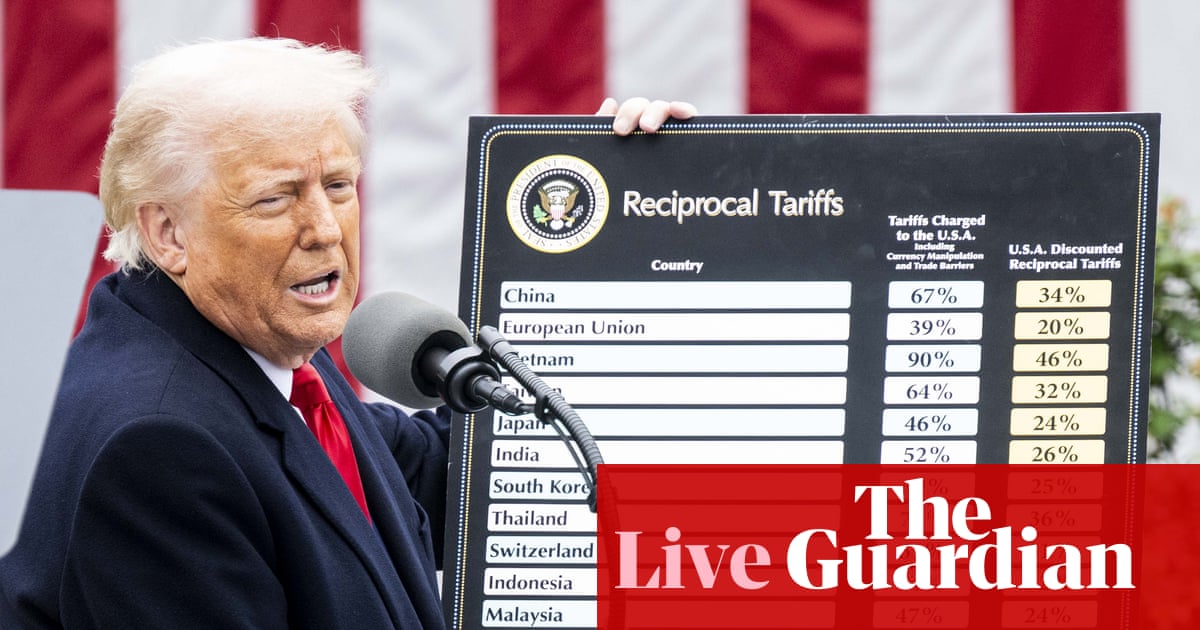
The supreme court ruling drives a coach and horses through Donald Trump’s “liberation day” tariffs last April – which led to trade deals with 20 countries including the UK, EU, China and other countries including Vietnam, Switzerland and Lesotha, a country Trump said “nobody had ever heard of”.
While the supreme court has ruled that Trump did not have authority to impose these tariffs unilaterally, it does not mean the end of the road of tariffs from the US president.
He may continue to impose tariffs on grounds of national security.
The 25% steel tariffs on the UK and 50% on the EU along with punitive extra tariffs on produces that contain an element of steel, known as steel derivatives may well. be justified as part of Trump’s section 232 investigations.
They have been deployed to justify tariffs on products that are deemed at threat to the US’ national security.
The court ruled that the Trump administration’s interpretation of the International Emergency Economic Powers Act (IEEPA) to impose tariffs intruded on the powers of Congress and violated a legal principle called the “major questions” doctrine.
Lawmakers react to supreme court ruling against Trump’s tariffs
We’re starting to see members of Congress react to the supreme court ruling that many of Donald Trump’s global tariffs are illegal.
Democratic senator Elizabeth Warren, said that no decision can “undo the massive damage that the Trump tariffs have done to small businesses, to American supply chains, and especially to American families forced to pay higher prices on everything from groceries to housing”.
She added that there is “no legal mechanism for consumers and many small businesses to recoup the money they have already paid”.
“Giant corporations with their armies of lawyers and lobbyists can sue for tariff refunds, then just pocket the money for themselves. It’s one more example of how the game is rigged,” said Warren, who is the ranking member on the Senate banking committee. “Any refunds from the federal government should end up in the pockets of the millions of Americans and small businesses that were illegally cheated out of their hard-earned money by Donald Trump.”
One note, the ruling on Trump’s tariffs is the only decision we can expect from the supreme court today.
In the court’s ruling today, chief justice John Roberts wrote:
When Congress has delegated its tariff powers, it has done so in explicit terms and subject to strict limits.
Against that backdrop of clear and limited delegations, the Government reads IEEPA to give the President power to unilaterally impose unbounded tariffs and change them at will. That view would represent a transformative expansion of the President’s authority over tariff policy.
Supreme court rules against Trump’s sweeping global tariffs
The supreme court has issued a sharp rebuke against the Trump administration and ruled against the legality of the president’s sweeping global tariffs.
In a 6-3 decision, the court holds that International Emergency Economic Powers Act (IEEPA) – a 1977 statute which grants the president authority to regulate or prohibit certain international transactions during a national emergency – does not authorize the president to impose the tariffs.
Justices Clarence Thomas, Samuel Alito, and Brett Kavanaugh dissented.
Supreme court issues decision in highly anticipated case on Trump’s sweeping tariffs
The court has issued a decision in a case challenging the legality of Donald Trump’s sweeping global tariffs. We’ll bring you the latest as we parse through the opinion.
According to reporters at the supreme court, one box of opinions has been brought out.
Typically, this means we can expect two decisions from the court.
Supreme court could also rule on the future of Voting Rights Act
Another eagerly anticipated decision from the supreme court is the future of section 2 of the Voting Rights Act. The justices are poised to make a decision on whether to keep the provision, which prohibits electoral maps that dilute the voting power of minority groups, in tact.
Lawyers for the state of Louisiana, a group of “non-African American voters” and the Trump administration say that the court needs to do away with the 2024 state map. If the court agrees, it would ultimately set a precedent that makes it considerably harder to bring redistricting lawsuits on the basis of race.
Supreme court could issue decision on legality of Trump’s global tariffs today
We’re keeping a close eye on the supreme court today, and a possible decision on the legality of Donald Trump’s sweeping global tariffs.
A reminder, the justices will decide whether the administration lawfully relied on the International Emergency Economic Powers Act (IEEPA) – a 1977 statute which grants the president authority to regulate or prohibit certain international transactions during a national emergency – to justify the tariffs.
A reminder that the word “tariff” isn’t actually included in the law, and Congress is typically the branch of government which has the power to implement taxes.
We’ll bring you the latest lines as we get them.
US economic growth slowed in Q4 2025

Graeme Wearden
Growth in the US economy has slowed sharply, new data shows.
US gross domestic product (GDP) increased at an annual rate of 1.4% in the fourth quarter of 2025, the US Bureau of Economic Analysis (BEA) has reported – the equivalent of expanding by 0.35% in the quarter.
The BEA says:
The contributors to the increase in real GDP in the fourth quarter were increases in consumer spending and investment.
These movements were partly offset by decreases in government spending and exports. Imports, which are a subtraction in the calculation of GDP, decreased.
That’s down from annualised growth of 4.4% in the third quarter of last year, and may be a sign that the US government shutdown at the end of last year hit growth.
My colleague, Graeme Wearden, is covering the latest developments on GDP figures:
Donald Trump is in Washington today. We’re expected to hear from him at 9.45am when he hosts a working breakfast for several US governors in the State Room of the White House. It’s part of two events traditionally hosted at the White House, which includes a dinner on Saturday, as part of the National Governors Association’s (NGA) annual conference.
The NGA normally facilitates the bipartisan events, but backed out after claiming that Trump initially invited only Republican governors to the weekend’s events at the White House, as part of the conference’s itinerary.
However, Trump said that the NGA chair, governor Kevin Stitt of Oklahoma, had “incorrectly stated” the president’s position over the “very exclusive” breakfast meeting and dinner. Trump added that he invited all governors bar Democrats Wes Moore of Maryland and Jared Polis of Colorado – who he feels “are not worthy of being there” amid ongoing feuds with the leaders.
Several other Democratic governors have since pulled out of the events at the White House in response to the move.
The Trump administration announced on Friday it will roll back air regulations for power plants limiting mercury and hazardous air toxics at an event in Kentucky, a move it says will boost baseload energy but that public health groups say will harm public health for the US’s most vulnerable groups.
Donald Trump’s EPA has said that easing the pollution standards for coal plants would alleviate costs for utilities that run older coal plants at a time when demand for power is soaring amid the expansion of data centers used for artificial intelligence, Reuters reported.
But environmental groups have said that weakening standards for mercury, a neurotoxin that can impair babies’ brain development, and other air toxics will lead to higher health-related costs.
The Biden-era Mercury and Air Toxics Standards, which updated standards set in 2012 under the Obama administration, had still been in force after the supreme court declined to put the rules on hold after a group of mostly Republican states and industry groups led a legal challenge to suspend it.
Jamie Wilson
A rookie congressional candidate in a nine-way Texas primary has received the imprimatur of wealthy hard-right donors including tech billionaire Peter Thiel, Claremont Institute board chair Thomas Klingenstein and Charles Haywood, who once expressed a desire to be a “warlord”, according to new Federal Election Commission filings showing early donations to his campaign.
In a recent candidate forum, Jace Yarbrough unapologetically staked out a series of extremist positions, saying that critics may call his approach to politics “bigoted and backward and oppressive and Nazi-ish”, but that he is “past trying to placate that in any way, shape or form”.
Following the flood of donations in December, Yarbrough was endorsed by Donald Trump on Truth Social.
Yarbrough’s remaining donors include others with ties to the Claremont Institute and the secretive far-right Society for American Civic Renewal (SACR), including Nate Fischer, a venture capitalist with documented links to JD Vance; and Andrew Beck, Claremont’s vice-president for communications and an admitted SACR member.
Current and former employees of Beck-founded agency Beck & Stone are also among the donors.
John Bellamy Foster, professor of sociology at the University of Oregon, said: “Jace Yarbrough is among the most militant figures in the Maga political movement in the United States, and a major recipient of Maga-billionaire donations in his run for a congressional seat in North Texas.”
Foster added: “If it can be said that there is a neofascist political movement in the United States, Yarbrough is certainly one of its chief would-be ‘lawgivers’.”
Rubio to meet UK foreign minister amid tensions over joint air base
Secretary of state Marco Rubio will meet with Britain’s foreign minister Yvette Cooper today, after Donald Trump renewed his criticism of London for ceding sovereignty of the Chagos Islands, which is home to a US-UK air base.
Last year British prime minister Keir Starmer agreed a deal to transfer sovereignty of the Indian Ocean islands to Mauritius, while keeping control of one – Diego Garcia – through a 99-year lease that preserved US operations at the base.
Washington last year gave its blessing to the agreement, but Trump has since changed his mind several times. In January, Trump described it as an act of “great stupidity“, but earlier this month said he understood the deal was the best Starmer could make, before then renewing his criticism this week.
The Diego Garcia base has recently been used for operations in the Middle East against Yemen’s Houthis and in humanitarian aid to Gaza.
Although on Tuesday Rubio’s state department said it backed the Chagos accord, the next day Trump said Britain was making a big mistake.
“DO NOT GIVE AWAY DIEGO GARCIA!” Trump wrote in a post on Truth Social, saying the base could be called upon in any future military operation to “eradicate a potential attack” from Iran.
Under the conditions for using the joint base, Britain would need to agree in advance to any operations out of Diego Garcia.
Second carrier strike group heads for region as US weighs up early attack

Dan Sabbagh
Experts say there are already sufficient US military assets in the Middle East to begin an aerial bombing campaign against Iran, potentially in conjunction with Israel, though it is less clear what this would achieve.
The USS Abraham Lincoln aircraft carrier and other warships in a strike group have been in the Arabian Sea for nearly a month, with nine squadrons of aircraft including F-35 Lightning IIs and F/A-18 Super Hornets.
A second carrier strike group, led by the USS Gerald R Ford, was last confirmed to be in the Atlantic west of Morocco on Tuesday. It is expected to head through the strait of Gibraltar and towards the eastern Mediterranean, a voyage of several days.
The Ford, the world’s largest aircraft carrier, sailed from the Caribbean Sea, where last month the warship was involved in the seizure of Venezuela’s Nicolás Maduro from a fortified compound in a night raid.
Together, the carrier strike groups could generate “several hundred strike sorties a day for a few weeks, an intensity greater than during the 12-days war”, said Matthew Savill, the director of military sciences at the Royal United Services Institute.
Even without the Ford, planes flying from the Lincoln could fly 125 or more bombing missions a day, giving the US the means to start attacking government and military sites in Iran in an aerial campaign if Trump chooses to attack.
Aviation experts have tracked a large movement of military planes to the Middle East as the US ramps up pressure on Iran. Six E-3 Sentry Awacs, critical for real-time command and control operations, are now deployed at Prince Sultan airbase in Saudi Arabia, having been moved from the US and Japan.
Read the full story here:
Trump weighing up an early, limited strike, reports say, after giving Iran two week deadline
Hello and welcome to the US politics live blog. I’m Tom Ambrose and I’ll be bringing you all the latest news lines over the next few hours.
We start with reports that Donald Trump is considering an early strike to force the Iranians to the negotiating table. An early strike could likely target specific government buildings or military sites and may be limited enough so as not to provoke a full-scale retaliation from Iran, according to the Wall Street Journal.
One unnamed official told the Journal that aides had also discussed large-scale operations, which could involve increasingly larger strikes with an eventual aim of ending the Iranian regime’s nuclear work or the collapse of the government.
The reports come after Trump publicly told Iran that it has “10 to 15 days” to cut a deal over its nuclear program, as the US continues its vast military build up in the region.
“We’re either going to get a deal, or it’s going to be unfortunate for them,” Trump told reporters on board Air Force One yesterday.
He added that negotiations could be allowed to continue for another 10 to 15 days, a deadline the president described as “pretty much” the “maximum”.
“I would think that would be enough time,” Trump said.
The US has kept the option of military action against Iran on the table, as it continues to amass the greatest buildup of forces since the Iraq invasion 23 years ago, Bloomberg reported.
It has moved two aircraft carriers, fighter jets and refueling tankers in the region since the start of the year, giving the US the option of a sustained campaign last several days in co-operation with Israel.
In other developments:
-
Donald Trump, who is definitely not mad that his more popular predecessor Barack Obama got a lot of attention for saying last weekend that aliens “are real, but I haven’t seen them”, announced that he is directing the defense department and other agencies to release whatever files they have on the search for alien life.
-
Sky Roberts, the brother of the late Virginia Giuffre, told CNN that Trump “is potentially implicated” by the Epstein files, “and he may have to answer some questions”. The US president has denied any wrongdoing and yesterday claimed he was “exonerated” by the Epstein filed.
-
The English far-right activist Tommy Robinson, who was repeatedly denied entry to the US in the past, spent Thursday in Washington DC, meeting people close to Trump according to images and video posted on his social media accounts.
-
FBI director Kash Patel has jetted off to Italy to watch the men’s ice hockey medal matches, sticking taxpayers with a bill as high as $75,000, according to multiple reports.
-
The husband of Trump’s labor secretary, Lori Chavez-DeRemer, has reportedly been barred from the labor department’s headquarters in Washington DC after at least two female staff members accused him of sexually assaulting them, the New York Times reports.
-
Trump told supporters in Georgia that there had been less media coverage of the cost-of-living crisis in the past weeks “Because I’ve won, I’ve won affordability.”
