

Superbugs Have a Hidden Weak Spot and Viruses Just Revealed It
Antibiotic resistance is rising fast, killing tens of thousands each year in the U.S. alone—and scientists are racing to find new ways to stop deadly bacteria. Now, researchers have uncovered how tiny viruses that infect bacteria, called phages, use specialized “protein antibiotics” to shut down a crucial bacterial machine known as MurJ. This protein acts like a molecular gatekeeper, flipping key building blocks needed to construct the bacteria’s protective cell wall.
The new research appears in the February 26 issue of Nature. The study was led by Yancheng Evelyn Li, a graduate student in the laboratory of Bil Clemons at Caltech. Clemons, the Arthur and Marian Hanisch Memorial Professor of Biochemistry, served as the corresponding author.
The Growing Threat of Antibiotic Resistance
Antibiotic resistance continues to escalate worldwide. As Clemons explains, “Evolution is powerful, and in bacteria, resistance to antibiotics develops quickly. This means that we now deal with bacteria that are resistant to all the medicines that we have.” He adds, “In the USA alone, tens of thousands of people die every year from antibiotic-resistant bacterial infections, and that number is rising rapidly. We need new antibiotics to combat this.”
Because bacteria adapt so rapidly, researchers are searching for entirely new weak points to target.
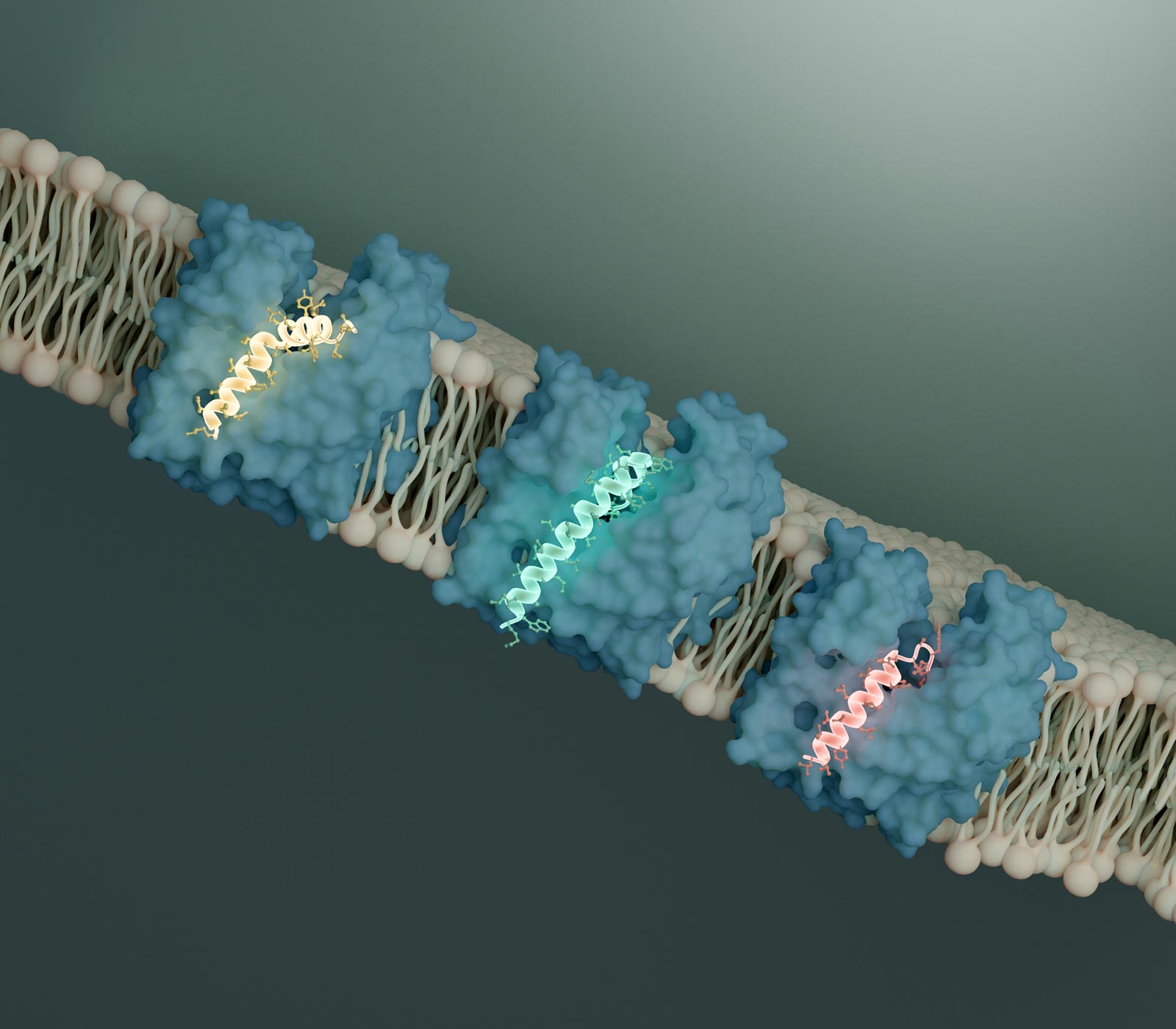
Here, MurJ from E. coli transitions from an inward to an outward-facing state, where it is locked by a Sgl protein from one of these bacteria-killing viruses. Credit: Yancheng Evelyn Li
Targeting the Bacterial Cell Wall
One promising focus is the process bacteria use to build peptidoglycan, a rigid material that forms their protective cell wall. This construction process is known as the peptidoglycan biosynthesis pathway. Since peptidoglycan exists in bacteria but not in human cells, it presents an appealing antibiotic target. As Clemons notes, “Peptidoglycan is a unique feature of bacteria, and that makes it an attractive antibiotic target.”
Scientists have already exploited parts of this pathway. Penicillin, discovered by Alexander Fleming in the mid-20th century, disrupts a late stage of peptidoglycan biosynthesis. Related drugs such as amoxicillin work in a similar way.
Three Essential Proteins: MraY, MurG, and MurJ
Building the bacterial cell wall depends on three critical proteins: MraY, MurG, and MurJ. These proteins move peptidoglycan building blocks from inside the cell across the inner membrane, where they are assembled into the cell wall. If any one of these proteins stops working, the cell wall cannot form properly, and the bacterium dies. That makes all three attractive drug targets.
Although scientists understand much about these proteins, Clemons points out that key mechanistic details are still unclear.
At present, no approved medicines directly target these three proteins. Still, Clemons says there is reason for optimism. “We do know that we can find small molecules, either derived from nature or synthesized in chemical libraries, that will inhibit these proteins. Excitingly, recent discoveries have shown that bacteriophages have figured out how to target this pathway.”

How Bacteriophages Break Through Bacterial Defenses
Bacteriophages, or phages, are viruses that infect bacteria. To survive, they must enter a bacterial cell, replicate, and then escape to infect new cells. Escaping is not easy because the peptidoglycan layer acts as a tough barrier. Clemons explains, “Getting back out means that they have to get past the peptidoglycan layer. Because it acts like chainmail, the phages get stuck if they can’t break through it.”
The Clemons lab studies small phages that carry either single-stranded DNA or RNA. These viruses have compact genomes and rely on streamlined strategies to kill bacteria. In 2023, the team reported in Science on φX174, a historically important phage at Caltech.
Viral Proteins That Shut Down MurJ
Small phages kill bacteria using specialized protein antibiotics known as single-gene lysis proteins, or Sgls (pronounced like “sigils”). Li and Clemons have focused on Sgls that interfere with MurJ, one of the three key cell wall proteins.
MurJ functions as a flippase. Its job is to move peptidoglycan precursors across the inner membrane so they can be incorporated into the growing cell wall. Earlier research from collaborators showed that two unrelated Sgls, SglM and SglPP7, both kill bacteria by blocking MurJ.
To understand how this happens, Li used cryo-electron microscopy at Caltech’s Beckman Institute Biological and Cryogenic Transmission Electron Microscopy (Cryo-EM) Resource Center. Flippases such as MurJ operate by alternately exposing their cargo to one side of the membrane and then the other, without forming an open channel. When MurJ binds its peptidoglycan precursor inside the cell, it changes shape to move the molecule outward.
Li discovered that both SglM and SglPP7 attach to a groove in MurJ, preventing the structural shift required for flipping.
“It is clear that both of these Sgls bind to MurJ in an outward-facing conformation, locking it into this position,” Li says. This outward-facing state is exposed to the surrounding environment, which could make it more accessible to drugs than a conformation facing inward.
Convergent Evolution Points to a Prime Antibiotic Target
Clemons highlights another striking aspect of the discovery. “These peptides, which have no evolutionary links to each other, have both figured out how to target MurJ in a very similar way. These are two examples of convergent evolution, in which different evolutionary paths arrive at the same solution. We were surprised!”
The team reasoned that if two unrelated phages evolved similar strategies, others might have done the same. Viruses mutate and diversify rapidly, creating a vast reservoir of potential Sgls. Because phages are relatively easy to isolate and analyze, their genomes offer a rich source of new biological insights and possible antibiotic targets.
In the Nature study, the researchers examined another phage genome with the help of a collaborator. They identified a new Sgl called SglCJ3 (from a genome sequence that is predicted to be a phage and is called Changjiang3). Using cryo-EM, Li determined the structure of SglCJ3 bound to MurJ and found that it also locks the protein in the same outward-facing conformation.
“This is a third genome that evolved a distinct peptide to inhibit the same target in a similar way,” Clemons says. “It is the first strong evidence that evolution identifies MurJ as a great target for killing bacteria, which means we should follow evolution’s lead and develop therapeutics that target MurJ. This demonstrates the power of basic biology to help us solve problems in medicine. Our path is set on leveraging Sgl discovery, and we hope to continue to be supported to turn these concepts into realities.”
Reference: “Convergent MurJ flippase inhibition by phage lysis proteins” 25 February 2026, Nature.
DOI: 10.1038/s41586-026-10163-w
In addition to Clemons and Li, co-authors include Caltech graduate student Grace F. Baron and Francesca S. Antillon, Karthik Chamakura, and Ry Young of Texas A&M University. Funding was provided by the Chan Zuckerberg Initiative, the National Institutes of Health, the G. Harold and Leila Y. Mathers Foundation, and the Center for Phage Technology at Texas A&M, jointly sponsored by Texas A&M AgriLife.
Never miss a breakthrough: Join the SciTechDaily newsletter.
Follow us on Google and Google News.
Source link
