

New “Hell Heron” Spinosaurus Discovered in the Sahara With Giant Blade Crest
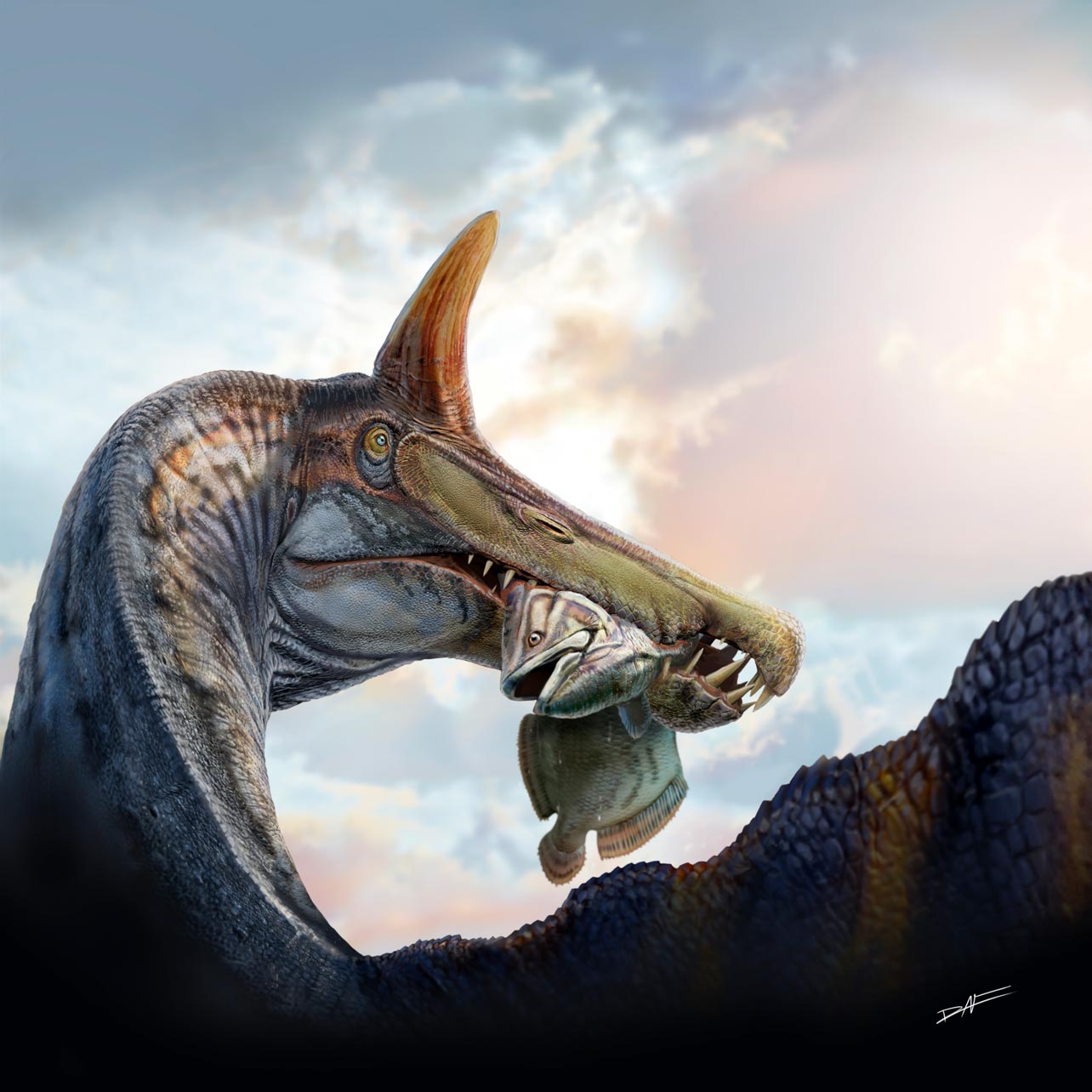
A blade-crested Spinosaurus discovered in the Sahara is rewriting the final chapter of dinosaur evolution.
A study published in Science reports the discovery of Spinosaurus mirabilis, a newly identified spinosaurid species from Niger. The fossils were uncovered in a remote part of the central Sahara by a 20-member team led by Paul Sereno, PhD, Professor of Organismal Biology and Anatomy at the University of Chicago. The find provides important new insight into the final phase of spinosaurid evolution.
Giant Scimitar Crest and Fish Trapping Teeth
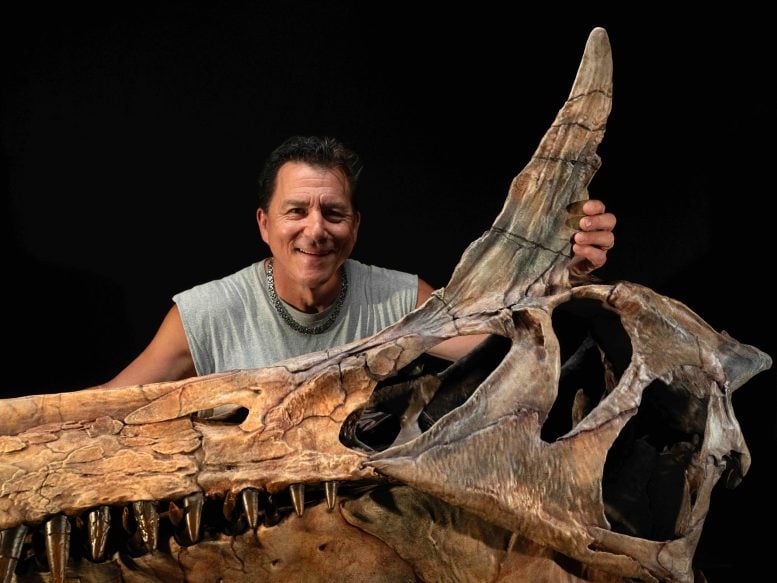
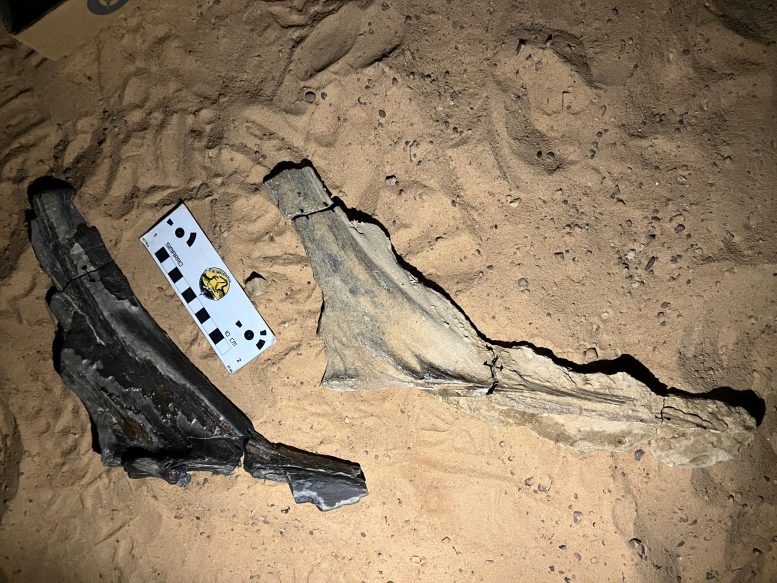
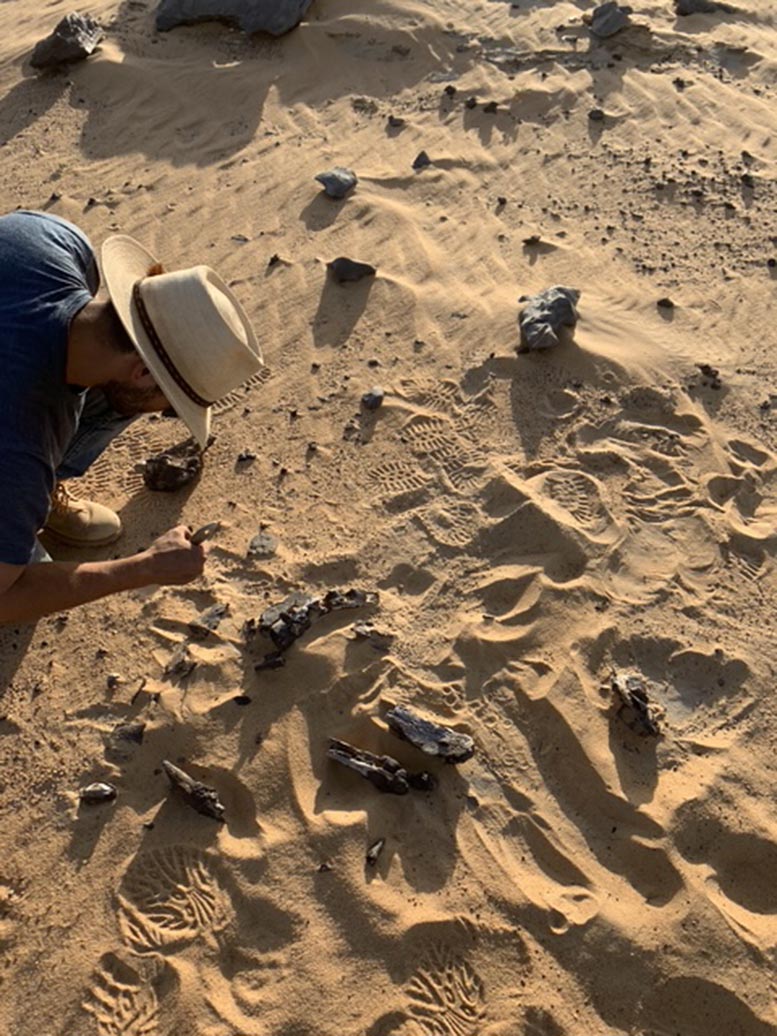
One of the most striking features of S. mirabilis is its enormous scimitar-shaped crest. When researchers first spotted the crest and nearby jaw fragments on the desert surface in November 2019, they did not immediately understand what they had found. After returning in 2022 with a larger group and uncovering two additional crests, it became clear they were looking at a species previously unknown to science.
The crest’s surface texture and internal blood vessel channels suggest it was covered in keratin. Scientists believe it may have been brightly colored in life and curved upward like a blade, possibly serving as a visual display structure.
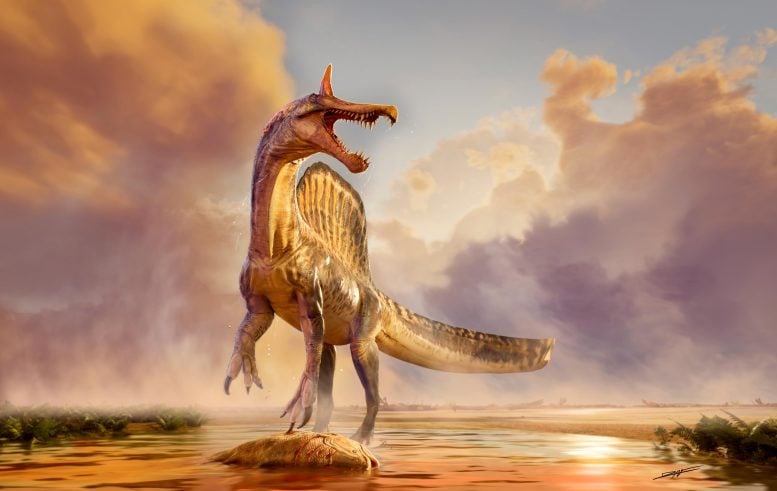
The skull also reveals tightly interlocking upper and lower teeth that would have formed an effective trap for slippery fish. In this arrangement, teeth from the lower jaw extend outward between those of the upper jaw when the mouth closes. Similar tooth patterns are seen in other fish-eating animals in the fossil record — including aquatic ichthyosaurs, semi-aquatic crocodiles, and airborne pterosaurs. Among dinosaurs, however, this adaptation distinguishes Spinosaurus and its closest relatives.
“This find was so sudden and amazing, it was really emotional for our team,” Sereno said. “I’ll forever cherish the moment in camp when we crowded around a laptop to look at the new species for the first time, after one member of our team generated 3D digital models of the bones we found to assemble the skull — on solar power in the middle of the Sahara. That’s when the significance of the discovery really registered.”
Inland Sahara Habitat Challenges Aquatic Theory
Before this discovery, most spinosaurid fossils had been recovered from coastal sediments near ancient shorelines. That pattern led some researchers to propose that these fish-eating theropods may have been fully aquatic hunters that pursued prey underwater.
The new site in Niger paints a different picture. The fossils were found 500-1000 km from the nearest marine shoreline. Nearby were partial skeletons of long-necked dinosaurs preserved in river deposits, indicating a forested inland environment crossed by waterways.
“I envision this dinosaur as a kind of ‘hell heron’ that had no problem wading on its sturdy legs into two meters of water but probably spent most of its time stalking shallower traps for the many large fish of the day,” Sereno said.
A 70-Year-Old Clue Sparks the Expedition
The path to this discovery began with a brief mention in a 1950s monograph. A French geologist had noted a single saber-shaped fossil tooth that resembled those of the giant predator Carcharodontosaurus, first identified in Egypt’s Western Desert at the turn of the last century.
“No one had been back to that tooth site in over 70 years,” Sereno said. “It was an adventure and a half wandering into the sand seas to search for this locale and then find an even more remote fossil area with the new species. Now all of the young scholars who joined me are co-authors on the report gracing the cover of Science.”
During the search, the team met a Tuareg man who guided them by motorbike into the center of the Sahara, where he had seen large fossil bones. After nearly a full day of travel and uncertainty, he brought them to a fossil-rich area. With limited time before returning to camp, the researchers collected teeth and jaw bones belonging to the new Spinosaurus species.
“I was attracted to the Sahara like a magnet once I set foot there 30 years ago,” Sereno said. “There’s nowhere else like it. It’s as beautiful as it is daunting.” After excavating more than 100 tons of fossils over the years, he added, “If you can brave the elements and are willing to go after the unknown, you might just uncover a lost world.”
Expanding Niger’s Paleontology and Museum Legacy
The discovery strengthens Niger’s standing in paleontology and archaeology, fields in which Sereno has long been involved. He has led an award-winning international effort to build the world’s first zero-energy museum, the Museum of the River, located on an island in the center of Niamey, Niger’s capital. The museum will highlight the country’s fossil heritage, including this remarkable spinosaur, as well as artifacts from Stone Age cultures that once lived in a Green Sahara.
“The local people we work with are my lifelong friends, now including the man who led us to Jenguebi and the astonishing spinosaur. They understand the importance of what we’re doing together — for science and for their country,” Sereno said.
Digital Reconstruction and Paleoart Bring the Dinosaur to Life
At the University of Chicago’s South Side Fossil Lab in Washington Park, the team cleaned and CT-scanned the fossils, then created a digital reconstruction of the skull for publication. Using that model, Sereno collaborated with paleoartist Dani Navarro in Madrid to produce a dynamic scene showing flesh reconstructions of the dinosaur competing over a coelacanth carcass. Navarro also constructed a detailed 3D physical model of S. mirabilis by adding muscle and skin over a skeletal framework.
Other paleoartists in Chicago (Jonathan Metzger) and Italy (Davide la Torre) animated Navarro’s model, recreating the action featured on the cover of Science. Advances in software, imaging tools, cameras and drones have transformed how paleontologists document discoveries in both the field and the lab.
Inspiring the Next Generation of Scientists
As part of the reconstruction effort, the team created a replica of the skull along with a colorful, touchable model of the curved crest.
Beginning March 1, following publication of the Science paper, both replicas will be added to Sereno’s Dinosaur Expedition exhibit at the Chicago Children’s Museum. Children will be among the first to see and handle representations of this newly described dinosaur.
“Letting kids feel the excitement of new discoveries — that’s key to ensuring the next generation of scientists who will discover many more things about our precious planet worth preserving,” Sereno said.
Reference: “Scimitar-crested Spinosaurus species from the Sahara caps stepwise spinosaurid radiation” by Paul C. Sereno, Daniel Vidal, Nathan P. Myhrvold, Evan Johnson-Ransom, María Ciudad Real, Stephanie L. Baumgart, Noelia Sánchez Fontela, Todd L. Green, Evan T. Saitta, Boubé Adamou, Lauren L. Bop, Tyler M. Keillor, Erin C. Fitzgerald, Didier B. Dutheil, Robert A. S. Laroche, Alexandre V. Demers-Potvin, Álvaro Simarro, Francesc Gascó-Lluna, Ana Lázaro, Arturo Gamonal, Charles V. Beightol, Vincent Reneleau, Rachel Vautrin, Filippo Bertozzo, Alejandro Granados, Grace Kinney-Broderick, Jordan C. Mallon, Rafael M. Lindoso and Jahandar Ramezani, 19 February 2026, Science.
DOI: 10.1126/science.adx5486
Never miss a breakthrough: Join the SciTechDaily newsletter.
Follow us on Google and Google News.
Source link
