


For 26-year-old Austin Tattersall, every exit from his Victorian home requires a silent check of an essential companion he can never leave behind.
It’s a bit bulky, so he usually puts it in his girlfriend’s handbag or a backpack, or places it in his pants pocket if they’re “deep enough”.
Tattersall, 26, lives with severe food allergies, also known as anaphylaxis, and he carries two EpiPen devices with him wherever he goes.
An EpiPen is an autoinjector that administers life-saving adrenalin for anaphylaxis, a severe allergic reaction.
“They’ve never really changed since I was a child,” Tattersall told nine.com.au, “My main ones are egg, nuts and dairy.”
He can’t recall the last time he’s had to administer an EpiPen, describing himself as having been “very, very fortunate”.
That good fortune has been due to extreme vigilance around food, something taught to him since he was a child.

His parents would use separate pots and pans for his meals. If they had bacon and eggs for breakfast, he’d have bacon on toast.
Now he is responsible for his own food, he is even more cautious.
“I check labels. If I’m picking up a packet of sausages, I just make sure I know which one that I can have,” he explained.
Tattersall’s family and friends know all about his allergies and are sure not to share food and keep things away from him.
“Everyone’s so understanding, which is amazing. We’ve been educated early on about cross-contamination and not cooking some meals around where I’m going to be.”
When he eats out, he usually picks spots he’s been to in the past.
“I’ve looked at the menu before I go or even call up the restaurant to say I am coming in and I ask if they would be able cater for me.”
Tattersall is a “very sporty person” and has been studying sports science and nutrition, so puts a lot of thought into his diet, cooking his own meals and thinking about healthier options.
Knowing exactly what he is eating is even more important considering the severity of his food allergies, and avoiding pre-made meals means not having to constantly monitor them for ingredients changes.
If food does appear, Tattersall will simply say he doesn’t have his EpiPens with him and won’t be eating anything.
“I’ll wait until I get home. I’m not going to take the risk.”

He doesn’t mind the discomfort of carrying two large EpiPens in his pants pocket: “At least I know that I have them on me. I know where they are and I don’t have to feel like I’m reaching for them in a weird way to find them.”
Now, there’s a new treatment that is smaller and doesn’t require an autoinjector function, providing an alternative to anaphylaxis sufferers.
neffy is an adrenaline-based, TGA-registered nasal spray that is now available in in pharmacies in Australia with a private prescription.
Professor Mimi Tang, an immunologist allergist Murdoch Children’s Research Institute and an advisory board member for CSL Seqirus, the makers of neffy, told nine.com.au Australia continues to have one of the “highest rates allergy problems in the developed world and in particular emerging data around anaphylaxis hospital admissions, we clearly are having the highest rates and these rates continue to increase”.
“They have been increasing for several decades and they continue to increase.”

While there several theories as to why this is the case, the exact cause is yet to be determined.
“We still have no curative therapies, so we need to be sure that our patients understand how to recognise a severe reaction, how to manage that severe reaction and what to do after they’ve treated that in the community setting,” Tang said.
“Education is absolutely critical.”
Allergy & Anaphylaxis Australia describes anaphylaxis as difficulty or noisy breathing, swelling of the tongue, swelling or tightness in the throat, a wheeze or persistent cough, difficult talking or a hoarse voice, persistent dizziness or collapse, and younger children may become pale or “floppy”. Insect anaphylaxis may include abdominal pain and vomiting.
Maria Said AM, Health Strategy and Advocacy Manager at Allergy & Anaphylaxis Australia, said having a new treatment option will give those living with anaphylaxis a choice of life-saving treatments.

“Having a new treatment option which does not require injection will offer people at risk of anaphylaxis, and their treating doctor, the ability to choose an adrenaline device that best suits their needs from the range available,” she said.
“We know that people have to be extremely mindful of everyday things – such as eating at restaurants, attending social events, travelling or enjoying time outdoors.
“For parents of children with allergies, normal life experiences need to be planned for, including sleepovers, play dates, parties, air travel and school camps.
“Despite safety strategies being in place, accidents happen and people need to recognise an allergic reaction and respond quickly.”
Not only does neffy not require an injection, it is smaller than the more common EpiPen.
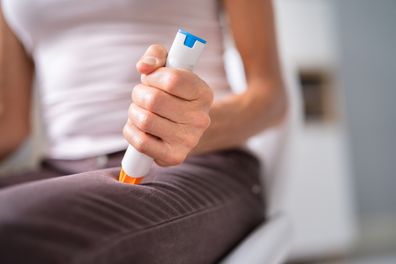
Dr Nick Coatsworth told Today he expects the option to be popular with kids and said it is claimed to be as effective as auto-injected adrenalin.
”It’s been around in the US, the FDA (Food and Drug Administration) approved it a couple of years ago,” he said.
Dr Coatsworth noted that, like with any medication using “powerful” adrenalin, people need to be “educated in how to use it”.
“People with anaphylaxis are educated by their immunologists, by their practitioner, to know the signs of anaphylaxis.”
While Tattersall is curious about the new treatment, he said he feels comfort from the size and feel of his EpiPens.

“I think it’s good that there’s something else on the market. Whether it’s suitable for myself is another question, obviously, and I’m probably going to have a chat to my GP,” he said.
“I think it also comes down to personal preference.”
neffy isn’t currently listed on the Pharmaceutical Benefits Scheme (PBS) but a submission has been made and will be considered in March 2026.
Until then, the recommended retail price of one boxy of neffy, 1mg or 2mg, containing two nasal sprays, is $194.
The cost of a single neffy on private prescription is expected to be approximately $97, however the price will depend on the pharmacy, Allergy & Anaphylaxis Australia explains.
EpiPen Jr and EpiPen can be bought over the counter from any pharmacy without a prescription. The cost is about $80 to $120 for one device.

EpiPen Jr and EpiPen purchased on private prescription will also cost $80-$120 for one device.
An EpiPen, which is on the PBS in Australia, typically costs $25.00 with a prescription, or $80 to $120 without a prescription.
Alternative autoinjector Anapen® Junior 150 and Anapen® 300 are no longer available in Australia. Anapen® 500 is currently out of stock in Australia.
The information in this article is general in nature. Please consult your GP or other healthcare profession for advice that is tailored to your specific health needs.
FOLLOW US ON WHATSAPP HERE: Stay across all the latest in celebrity, lifestyle and opinion via our WhatsApp channel. No comments, no algorithm and nobody can see your private details.
Source link
