

Scientists Turn DNA Origami Into a Powerful New Vaccine Platform

Scientists have developed a new DNA origami–based vaccine platform called DoriVac that could rival mRNA vaccines while being easier to manufacture and store. Early studies show it can trigger strong immune responses against viruses like SARS-CoV-2, HIV, and Ebola.
The COVID-19 pandemic pushed messenger RNA (mRNA) vaccines into the spotlight of global health. After completing clinical trials, the first COVID-19 mRNA vaccine was administered on 8 December 2020. Modeling studies later estimated that these vaccines prevented at least 14.4 million deaths from COVID-19 during their first year of use.
Their strong performance against the virus also sparked efforts to apply mRNA technology to other diseases. Clinical trials are now underway for vaccines targeting influenza virus, Respiratory Syncytial Virus (RSV), HIV, Zika, Epstein-Barr virus, and tuberculosis bacteria. At the same time, research conducted during the pandemic has revealed several limitations of mRNA vaccines that point to the need for alternative strategies.
Limitations of Current mRNA Vaccine Technology
The immune protection generated by COVID-19 mRNA vaccines can differ widely among individuals, and the protection tends to decline over time. The challenge becomes even greater because the SARS-CoV-2 virus continually evolves, producing new variants that can partially evade immune defenses. As a result, COVID-19 vaccines often need periodic updates.
Additional drawbacks exist as well. Manufacturing these vaccines can be complex and expensive, and scientists have limited control over the number of mRNA molecules packaged inside the lipid nanoparticles used for delivery. These vaccines also require cold storage and may sometimes cause unintended off-target effects. Addressing these issues could open the door to improved prevention, faster response, and better preparedness for a wide range of infectious diseases.
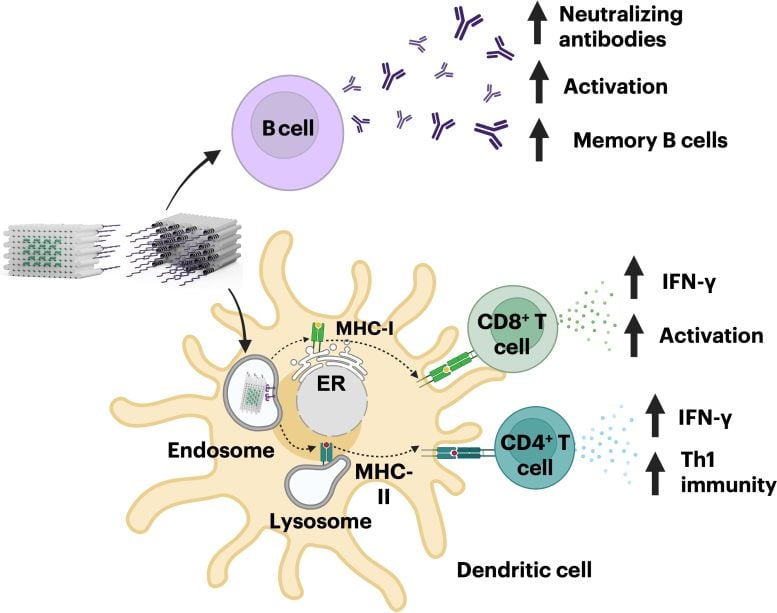
A DNA Origami Vaccine Platform Called DoriVac
A multidisciplinary team from the Wyss Institute at Harvard University, Dana-Farber Cancer Institute (DFCI), and collaborating institutions has explored a different approach. They used a recently developed DNA origami nanotechnology platform called DoriVac that functions as both a vaccine and an adjuvant.
In their experiments, DoriVac vaccines targeted a peptide region (HR2) that is conserved within the spike proteins of several viruses, including SARS-CoV-2, HIV, and Ebola. In mice, the SARS-CoV-2 HR2 version of the vaccine triggered strong immune activity. This included antigen-specific antibody responses (humoral immunity) and T cell responses (cellular immunity).
The researchers also evaluated the vaccine using an advanced preclinical system that models the human immune system. Using the Wyss Institute’s microfluidic human Organ Chip technology, they created an in vitro model of the human lymph node. Within this system, the SARS-CoV-2 HR2 vaccine also produced strong antigen-specific immune responses in human cells.
In a direct comparison with SARS-CoV-2 mRNA vaccines delivered in lipid nanoparticles, a DoriVac vaccine carrying the same spike protein variant produced a similarly strong activation of the human immune system. However, the DNA origami vaccine proved to be more stable and easier to store and manufacture. The findings were published in Nature Biomedical Engineering.
“With the DoriVac platform, we have developed an extremely flexible chassis with a number of critical advantages, including an unprecedented control over vaccine composition, and the ability to program immune recognition in targeted immune cells on a molecular level to achieve better responses,” said co-corresponding author and Wyss Institute Core Faculty member William Shih, Ph.D., whose group pioneered the new vaccine concept. “Our study demonstrates DoriVac’s versatility and potential by taking a close look at the immune changes that are required to fight infectious viruses.” Shih is also Professor at the Harvard Medical School and DFCI.
Bringing Viral Antigens Into the Fold
In 2024, Shih’s group at the Wyss Institute and Dana-Farber introduced DoriVac as a broadly applicable vaccine platform based on DNA nanotechnology. Yang (Claire) Zeng, M.D., Ph.D., who led the project with collaborators, showed that the technology could present immune-boosting adjuvant molecules to cells with nanometer-level precision.
In earlier work involving tumor-bearing mice, DoriVac vaccines produced stronger immune responses than versions that lacked the DNA origami structure. The vaccine design relies on small self-assembling square nanostructures made of DNA. One side of the structure displays adjuvant molecules arranged at carefully optimized nanometer spacing. The opposite side presents selected antigens such as peptides or proteins derived from tumors or pathogens.
“While we were developing the platform for cancer applications, the COVID-19 pandemic was still moving with full force. So, the question quickly arose whether DoriVac’s superior adjuvant activity could also be leveraged in infectious disease settings,” said Zeng as a first and co-corresponding author on the new study, and now cofounder and CEO/CTO of DoriNano, leading the translation of this technology into clinical applications.
To explore that possibility, Zeng and co-first author Olivia Young, Ph.D., a former graduate student in Shih’s group, collaborated with Donald Ingber’s team at the Wyss Institute. Ingber’s group focuses on developing antiviral therapies using AI-driven and multiomics approaches alongside microfluidic human Organ Chip technology. Working with co-first author Longlong Si, Ph.D., a former postdoctoral researcher in Ingber’s lab, the researchers created DoriVac vaccines targeting SARS-CoV-2, HIV, and Ebola. These vaccines display HR2 peptides, which serve as conserved antigens within the spike proteins of several viruses.
“Our analysis of the immune responses provoked by these first DoriVac vaccines in mice led to several encouraging observations, including significantly greater and broader activation of humoral and cellular immunity across a range of relevant immune cell types than what the origami-free antigens and adjuvants could produce,” said Zeng. “We found that the numbers of antibody-producing B cells, activated antigen-presenting dendritic cells (DCs), and antigen-specific memory and cytotoxic T cell types that are vital for long-term protection were all increased, especially in the case of the SARS-CoV-2 HR2,” explained Zeng.
Moving From Mouse Models Toward Human Systems
Immune responses in mice can differ significantly from those in humans. Because of this, many treatments that appear promising in mouse studies fail during human clinical trials. To bridge that gap, the researchers tested their vaccines in a more human-like system.
They used a human lymph node-on-a-chip (human LN Chip), an engineered microfluidic system that mimics aspects of the human immune system. This platform allows scientists to predict immune responses in humans more efficiently during early-stage testing.
Developed by co-first author Min Wen Ku and co-corresponding author Girija Goyal, Ph.D., Director of Bioinspired Therapeutics at the Wyss Institute, the system showed that the SARS-CoV-2-HR2 DoriVac vaccine activated human DCs and significantly increased the production of inflammatory cytokine molecules compared with origami-free vaccine components. The number of CD4+ and CD8+ T cells with multiple protective functions also rose in the human LN Chips, further supporting the potential of DoriVac vaccines for human use.
“The predictive capabilities of human LN Chips gave us an ideal testing ground for DoriVac vaccines and the induced, antigen-specific immune cell profiles and activities very likely reflect those that would occur in human recipients of the vaccines. This convergence of technologies enabled us to dramatically raise the chances of success for a new class of vaccines and create a new testbed for future vaccine developments,” said co-corresponding author Ingber, M.D., Ph.D. who is also the Judah Folkman Professor of Vascular Biology at Harvard Medical School and Boston Children’s Hospital, and the Hansjörg Wyss Professor of Biologically Inspired Engineering at Harvard John A. Paulson School of Engineering and Applied Sciences.
Comparing DNA Origami Vaccines With mRNA Vaccines
The researchers also studied a DoriVac vaccine displaying the full SARS-CoV-2 spike protein. Led by Zeng and co-author Qiancheng Xiong, the team compared it directly with Moderna and Pfizer/BioNTech mRNA lipid nanoparticle (LNP) vaccines that encode the same spike protein.
In mice that received a standard booster protocol, the DNA origami vaccine generated antiviral T cell responses and antibody-producing B cell responses that were comparable to those produced by the mRNA vaccines.
“This underscored DoriVac’s potential as a DNA nanotechnology-enabled, self-adjuvanted vaccine platform. But DoriVac vaccines have a number of other advantages: they don’t have the same cold-chain requirements as mRNA-LNP vaccines do and thus could be distributed much more effectively, especially in under-resourced regions; and they could overcome some of the enormous manufacturing complexities of LNP-formulated vaccines, to name two major ones,” said Shih. Recent studies at DoriNano have also demonstrated that DoriVac exhibits a promising safety profile.
Reference: “DNA origami vaccine nanoparticles improve humoral and cellular immune responses to infectious diseases” 11 March 2026, Nature Biomedical Engineering.
Other authors on the study are Sylvie Bernier, Hawa Dembele, Giorgia Isinelli, Tal Gilboa, Zoe Swank, Su Hyun Seok, Anjali Rajwar, Amanda Jiang, Yunhao Zhai, LaTonya Williams, Caleb Hellman, Chris Wintersinger, Amanda Graveline, Andyna Vernet, Melinda Sanchez, Sarai Bardales, Georgia Tomaras, Ju Hee Ryu, and Ick Chan Kwon. The study was supported by funding from the Director’s Fund and Validation Project program of the Wyss Institute; Claudia Adams Barr Program at DFCI; National Institutes of Health (U54 grant CA244726-01); US-Japan CRDF global fund (grant R-202105-67765); National Research Foundation of Korea (grants MSIT, RS-2024-00463774, RS-2023-00275456); Intramural Research Program of the Korea Institute of Science and Technology (KIST); and Bill and Melinda Gates Foundation (INV-002274).
Never miss a breakthrough: Join the SciTechDaily newsletter.
Follow us on Google and Google News.
Source link
