

Scientists Solve 2,700-Year-Old Eclipse Mystery – and Uncover Evidence About the Sun’s Activity

An ancient Chinese eclipse record helped scientists refine Earth’s rotation data and confirm rising solar activity after a prolonged quiet phase.
An international team combined historical geography with modern astronomical modeling to reassess what is considered the earliest precisely datable record of a total solar eclipse. By reconstructing how the Sun would have appeared from Qufu, the ancient capital of the Lu Duchy in China, the researchers were able to better estimate Earth’s changing rotation speed in 709 BCE.
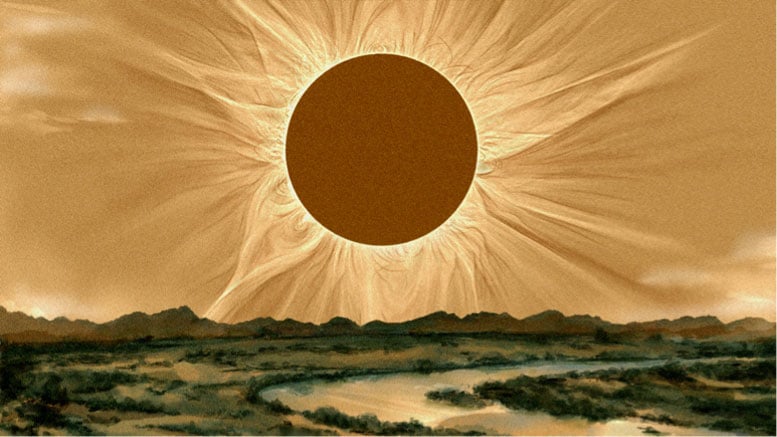
Using these reconstructions, the team also examined a historical description believed to refer to the solar corona, the Sun’s faint outer atmosphere that can be seen with the naked eye only during a total solar eclipse. The shape described in the ancient record appears consistent with modern reconstructions of solar activity in the 8th century BCE.
The results, published in Astrophysical Journal Letters, provide improved data on Earth’s rotation during this period. The findings also indicate that the Sun was entering a more active phase after an extended quiet interval. This conclusion independently supports other studies that rely on radiocarbon measurements.
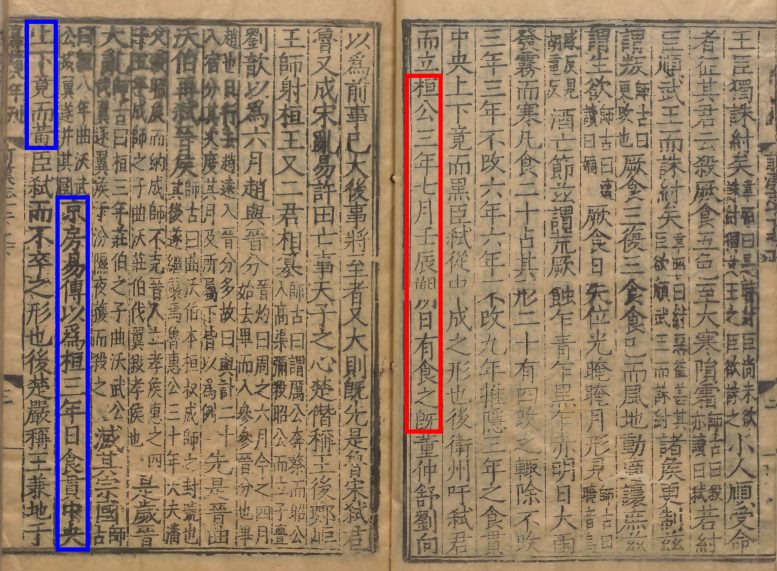
The 709 BCE Eclipse Record in Chinese Chronicles
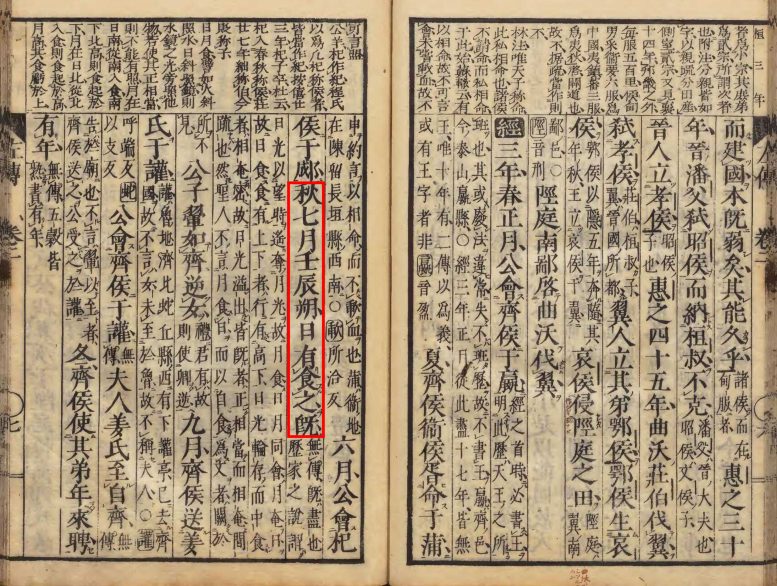
Historical records indicate that the total solar eclipse took place on 17 July 709 BCE and was observed at the court of the Lu Duchy. The event was later documented in a historical text called the “Spring and Autumn Annals,” compiled roughly 2-3 centuries after the eclipse. The chronicle simply recorded that “the sun was totally eclipsed.”
“What makes this record special isn’t just its age, but also a later addendum in the ‘Hanshu’ (Book of Han) based on a quote written seven centuries after the eclipse. It describes the eclipsed Sun as ‘completely yellow above and below.’ This addendum has been traditionally associated with a record of a solar corona. If this is truly the case, it represents one of the earliest surviving written descriptions of the solar corona,” lead author Hisashi Hayakawa, Assistant Professor from the Institute for Space-Earth Environmental Research and Institute for Advanced Research at Nagoya University, explained.
When the researchers tested the record using modern eclipse calculations and models of Earth’s rotational history, the results initially suggested that a total eclipse would not have been visible from the Lu court in Qufu. This discrepancy led the team to suspect that earlier studies may have used incorrect coordinates for the ancient city.
Correcting the Ancient Location of Qufu
To resolve the issue, the researchers turned to historical geography and archaeological reports describing excavations of the ancient city. These sources showed that the coordinates used in previous research were about eight kilometers away from Qufu’s actual historical location.
“This correction allowed us to accurately measure the Earth’s rotation during the total eclipse, calculate the orientation of the Sun’s rotation axis, and simulate the corona’s appearance,” explained Hayakawa, who holds PhDs in both solar physics and oriental history.
China has an exceptionally rich tradition of recording astronomical phenomena. Ancient dynasties employed specialists to observe celestial events for omenological purposes, which refers to interpreting unusual sky events as warnings or signs related to political leadership.
Because rulers believed celestial anomalies could signal wrongdoing by emperors, astronomers carefully recorded eclipses, auroras, and other unusual phenomena. These systematic records across many dynasties have left historians and scientists with some of the most detailed ancient eclipse observations in the world.
Reliability Questions About the Corona Description
Although the 709 BCE eclipse represents the earliest clear written reference to a total solar eclipse, and possibly the earliest description of a solar corona, the researchers note some uncertainty regarding the corona account. The description appears only in the Hanshu as a quotation written about seven centuries after the eclipse itself.
Even with these uncertainties, the timing of the eclipse is widely accepted by scientists. This makes the event a valuable reference point for refining calculations of Earth’s rotation and for comparing results with recent research on historical solar activity.
Earth rotates slightly more slowly today than it did 2,700 years ago. This gradual slowdown occurs for several reasons, including friction caused by ocean tides generated by the Moon’s gravity. By correcting the location of Qufu, the researchers were able to produce more precise estimates of Earth’s rotation speed between the 8th and 6th centuries BCE.
Delta T Measurements Improve Ancient Earth Rotation Data
The study found that delta T (ΔT), a measurement used to track variations in Earth’s rotation speed, was between 20,264 and 21,204 seconds during the eclipse. “This new dataset fixes coordinate errors in previous Earth rotation studies. Additionally, it improves the accuracy of dating and reconstructing historical astronomical events,” Mitsuru Sôma, coauthor from the National Astronomical Observatory of Japan, said.
The research also strengthens recent studies of solar cycles based on radiocarbon measurements from tree rings. “This unique historical addendum for the possible solar coronal structure is critical for providing a spot reference on solar activity reconstructions from tree rings and ice cores, as well as providing independent validation of solar activity models,” Mathew Owens, coauthor and professor of space physics at the University of Reading, explained.
Trees naturally absorb carbon during photosynthesis, including radiocarbon. This radioactive form of carbon becomes preserved within each annual growth ring. Because radiocarbon levels reflect the intensity of cosmic rays reaching Earth, and cosmic rays decrease when solar activity increases, scientists can analyze tree rings to reconstruct changes in the Sun’s activity over long periods.
Solar Cycles and the End of the Neo Assyrian Grand Minimum
The Sun typically moves through cycles of higher and lower activity roughly every 11 years. Occasionally, these cycles are disrupted by extended quiet phases known as grand minima, during which sunspots become rare. The eclipse in 709 BCE occurred shortly after the end of a prolonged low activity interval called the “Neo Assyrian Grand Minimum” or “Homer Grand Minimum,” which lasted from 808 to 717 BCE.
Descriptions of the Sun’s likely coronal structure in the historical record suggest that solar activity had already recovered by 709 BCE and may have been near the peak of its normal 11-year cycle. This interpretation agrees with reconstructions of solar activity derived from tree ring data.
The study highlights the value of combining historical observations with modern scientific analysis. “Some of our ancestors were very skilled observers,” Dr. Meng Jin, coauthor from the Lockheed Martin Solar and Astrophysics Laboratory, noted. “When we combine their careful records with modern computational methods and historical evidence, we can potentially find new information about our planet and our star from thousands of years ago.”
Reference: “Analyses of the Ancient Chinese Report on the Total Solar Eclipse in 709 BCE: Implications for the Contemporaneous Earth’s Rotation Speed and Solar Cycles” by Hisashi Hayakawa, Mathew J. Owens, Meng Jin, Mitsuru Sôma and Mike Lockwood, 2 December 2025, The Astrophysical Journal Letters.
DOI: 10.3847/2041-8213/ae0461
Never miss a breakthrough: Join the SciTechDaily newsletter.
Follow us on Google and Google News.
Source link
