

Sign up for Executive Dysfunction, a weekly newsletter that surfaces under-the-radar stories about what Trump is doing to the law—and how the law is pushing back.
On Monday, the Supreme Court did something surprising: With no noted dissents, the justices refused to let the Trump administration immediately revoke Temporary Protected Status for more than 350,000 immigrants from Haiti and Syria. Instead, the court allowed these immigrants to continue living and working in the United States legally while it reviews the government’s arguments that it can strip them of protections overnight. The justices, in other words, will decide this case the proper way—with full briefing, oral arguments, deliberation, and an opinion—rather than over the shadow docket, with little or no explanation. And hundreds of thousands of law-abiding noncitizens will remain protected from deportation in the meantime.
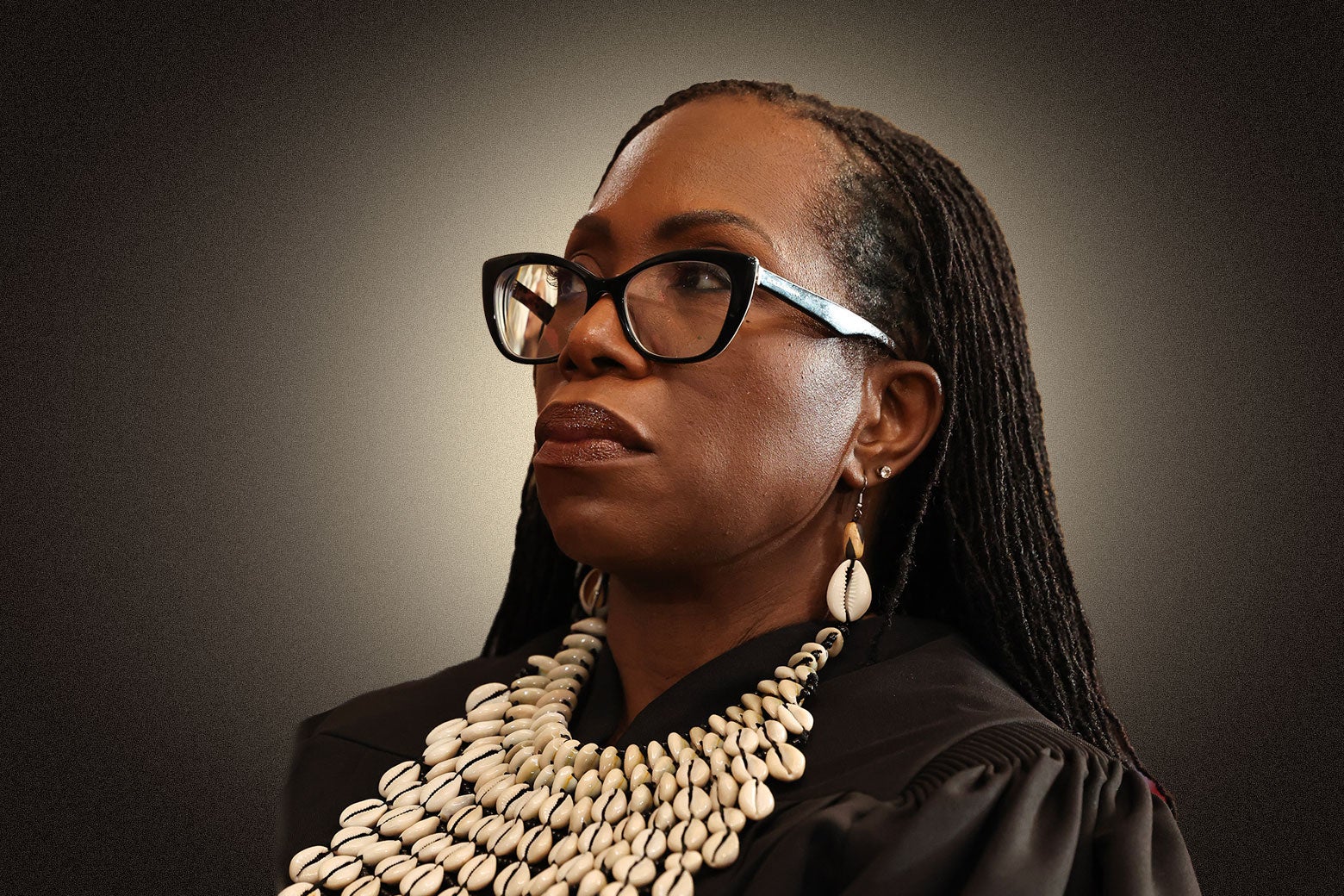
No one is more vindicated by this unusual exercise of judicial restraint than Justice Ketanji Brown Jackson. For 10 months, Jackson has been fighting her colleagues’ callous treatment of immigrants whose legal status was abruptly terminated by the Trump administration. At times, she has been the lone justice willing to speak out. In one extraordinary dissent, she alone castigated the conservative supermajority for its “grave misuse” of the shadow docket to privilege the “bald assertion of unconstrained executive power over countless families’ pleas for the stability our government has promised them.” These condemnations may well have shamed the court into doing exactly what Jackson urged: resolve this dispute through the ordinary process—while maintaining the status quo for immigrants—rather than issuing another snap judgment for the administration that upends hundreds of thousands of lives.
President Donald Trump’s attack on TPS is one of the most far-reaching nativist policies of his second term. The program, which Congress created in 1990, allows immigrants already living in the U.S. to remain and work here legally when dangerous conditions in their country, like armed conflict and natural disasters, make it unsafe to return. When Trump returned to office, the Department of Homeland Security had designated 17 countries for TPS, covering about 1.3 million immigrants. These designations can last for up to 18 months, and may then be renewed or “terminated.” Upon her confirmation, then–Secretary of Homeland Security Kristi Noem sought to end TPS for many countries. But some of the previous administration’s designations were not set to expire for months, with some running into 2026. So Noem claimed the power to “vacate” TPS for these countries—that is, to instantly repeal protections without notice.
The chief problem for Noem, as Georgetown Law professor Steve Vladeck has explained, is that federal law does not say that DHS can “vacate” an existing TPS designation. (That may be why no previous secretary had ever tried to do it.) And if such a move is allowed, the law would require reasoned decisionmaking, including a non-pretextual explanation for the action. Noem did not provide any of this. So lower courts began blocking her “vacatur” of TPS for several countries, among them Venezuela, Haiti, and Syria. (Some also cited the president’s racist comments as proof of unconstitutional animus.) The Trump administration objected, insisting that the power to “terminate” TPS encompassed the authority to end it prematurely. And it argued that federal law bars judicial review of any TPS “termination,” so courts may not even decide whether Noem’s actions complied with the law.
Although lower courts roundly rejected these claims, the Supreme Court appeared to buy them. Last May, over the shadow docket, the justices froze a district court order that had barred Noem from “vacating” the 2023 TPS designation for Venezuela. They did not explain their decision, which revoked legal status for 350,000 immigrants in one stroke. Only Jackson noted her dissent; Justices Sonia Sotomayor and Elena Kagan did not join her.
At the time, Jackson did not explain her vote. But 11 days later, the court issued another unexplained shadow docket decision allowing Noem to end a similar program that covered Cuba, Haiti, Nicaragua, and Venezuela. This time, Jackson wrote a blistering dissent—joined by Sotomayor—that seemed to explain her earlier vote, as well. She focused on a factor that should be critical when the government seeks emergency relief: Which party would face “irreparable harm” if the Supreme Court failed to act immediately? Here, Jackson explained, the government failed to identify a single “concrete or irreparable injury” that it would suffer by allowing immigrants to remain until the court had the opportunity to hear the case in full and issue its ruling. The immigrants, by contrast, would face “devastation” and “chaos” by losing lawful status. Her argument applied equally to TPS: Rather than allow immigrants’ lives to “unravel all around us,” the Supreme Court should keep these protections in place while the Trump administration defends its prerogative to end them.
Jackson expanded on this message in October when the Supreme Court, over the shadow docket, halted another lower court order preserving TPS for Venezuela. This time around, Sotomayor, Kagan, and Jackson all dissented. But Sotomayor and Kagan declined to join Jackson’s opinion excoriating the conservative justices for hasty intervention. Once again, the justice criticized the majority for disregarding the harms that would now befall immigrants, including “job loss, family separation, and deportation.” But she also assailed her colleagues for failing to explain themselves. The lower courts, Jackson wrote, justified their decisions against the Trump administration in “reasoned and thoughtful written opinions.” Now SCOTUS chose to “wordlessly override” their “considered judgments,” disregarding its “opinion-writing capacity” in a rush “to allow this administration to disrupt as many lives as possible, as quickly as possible.”
This dissent marked an escalation in Jackson’s crusade against shadow docket abuses. The justice did more than accuse her colleagues of misapplying the law; she also spotlighted their refusal to defend their actions, suggesting that they stayed silent because they had no defense. Her rhetoric came off as a challenge to the conservative supermajority to put up or shut up: If it had a good reason to keep short-circuiting the appeals process so Trump could persecute immigrants, it should say so. And if it had no good reason—as she strongly implied—it ought to step aside and let the lower courts do their work.
Yet even as she threw down the gauntlet, Jackson sounded pessimistic about a course correction. Her objection to the court’s “repeated, gratuitous, and harmful” actions sounded like a warning to the public that the court would continue to run interference for the Trump administration’s quest to turn legal immigrants into undocumented outlaws. Sure enough, when lower courts ruled against Noem’s effort to “vacate” TPS for Syria (6,000 beneficiaries) and Haiti (350,000 beneficiaries), the Trump administration raced to the justices for emergency relief. Solicitor General John Sauer even accused these lower courts of effectively defying the Supreme Court’s earlier orders. All signs pointed to the same result: SCOTUS would freeze their decisions without explanation, allowing the administration to rip away TPS all at once.
But it didn’t. Instead, the Supreme Court “deferred” judgment in the cases, then moved them off the shadow docket and onto the merits docket, setting oral arguments for April. In the interim, the court preserved the lower courts’ orders, keeping TPS in place for Syria and Haiti until it hands down a decision. There were no noted dissents.
This turnabout looks a lot like a concession to Jackson’s critiques. It addresses her two biggest complaints by sparing immigrants from an “irreparable injury” while setting the stage for a fully fleshed-out opinion on the merits in June. And for that reason, it carries real upside for TPS holders whose lives hang in the balance. The court can no longer ignore their (strong) arguments against the legality of Noem’s actions; it will have to address the lack of authority to “vacate” a TPS designation as well as whether racial animus appears to have tainted the government’s decisions.
Does this mean the Supreme Court will ultimately side against the Trump administration? Absolutely not. It is still more likely that the conservative supermajority will concoct a reason to rubber-stamp Noem’s unprecedented “vacatur” of TPS. There are, however, still tangible benefits to this deliberative approach. It means that hundreds of thousands of immigrants will benefit from TPS for at least several more months. It gives them notice that they may need to seek another path to lawful status, like asylum—notice that the administration sought to deny them. It requires the court to hold oral arguments, deliberate, and issue an opinion that will draw public attention to this issue months before the midterms.
These may sound like small wins, but they are wins nonetheless. And they may well be a result of Jackson’s relentless (and frequently solo) denunciation of her colleagues’ corner-cutting complicity with the Trump administration’s nativist agenda. Jackson is widely seen as less tactical than Sotomayor and Kagan, more willing to call out the conservatives’ mischief at the cost of collegiality. But Monday’s surprise suggests that sometimes blunt truths are worth more than pulled punches.
Source link
