

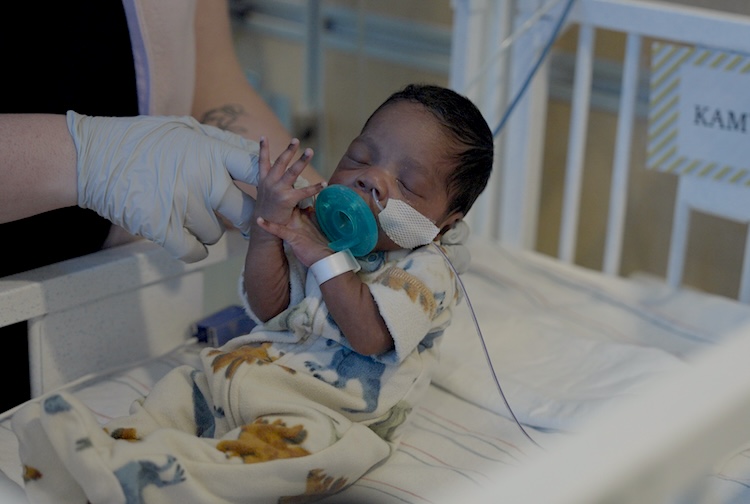
By Shea Wright
When Danielle Hayes made the decision to head to VCU Health Community Memorial Hospital (CMH), the snow and ice falling across the region were the furthest thing from her mind.
She was originally scheduled to be admitted for observation at 31-weeks pregnant following a diagnosis of placenta previa, a condition in which the placenta completely blocks the opening of the cervix, often leading to excessive bleeding in the second half of pregnancy.
But a week before, on Jan. 25, 2026, Danielle was bleeding and didn’t want to take any chances. She was admitted and prepped for an emergency c-section.
“At the time they told us a transfer wasn’t possible right away because of the storm, but that they could stabilize him and take care of him,” Danielle said. “When they explained that an ambulance would be coming the next day to transport him, I felt comfortable with that, and that he would be safe.”
Amid an incredibly uncertain moment, Danielle, the baby’s father and grandmother found themselves surrounded by a team that extended beyond the bedside and into Richmond, providing a level of care that would ensure baby Kamyrn had the best chance at a healthy outcome.
Even in the middle of a winter storm, everyone was focused on one thing — providing the best possible care for this family.
Jennifer Hargrave, RN, VCU Health Community Memorial Hospital
One in 10 babies worldwide are born before 37 weeks of pregnancy. Premature babies often face health complications related to low birth weight, such as respiratory distress, feeding challenges, and increased risk of infection.
Balancing the challenges of a high-risk delivery and deteriorating weather conditions from Winter Storm Fern, physicians and nurses from across VCU Health mobilized immediately.
“We’ve dealt with other premature babies before. Usually when they’re born, we get them up to Richmond within a couple of hours. This was different, in that we wanted to keep the baby here and do more than just stabilize,” said Ahmad Ali, M.D., the attending physician on duty that night.
Neonatal transport was unsafe by ground or air until the storm passed, so teams in South Hill and at Children’s Hospital of Richmond at VCU (CHoR) – an hour apart from each other – began coordinating care virtually. The coordinated teamwork between CHM’s Labor and Delivery team by Danielle’s bedside and neonatal specialists in Richmond helped baby Kamyrn make it through the night and ultimately thrive weeks later.
Now considered full-term, both Danielle and Kamyrn are doing well, thanks to the collective effort of dedicated VCU Health care teams in both South Hill and Richmond. (Enterprise Marketing and Communications)
Access to specialized care
As weather conditions worsened that evening, Monica Brakefield, NNP, a neonatal nurse practitioner from CHoR’s Level 4 NICU volunteered to provide in-person support. Brakefield lives nearby and, with special emergency permissions from her supervisors, she was able to go to South Hill to ensure Kamyrn received consistent, expert care while they waited for the storm to let up.
“A drive that would normally take an hour and twenty minutes took two hours, but nothing fell from the sky during that time,” Brakefield said. “Mary Hardin, chief nursing officer at CMH, was waiting for me at the door after I parked. And when she walked me onto the unit, it felt like everybody kind of just exhaled. His vital signs were stable, and he was doing well. But the CMH team was awesome. That’s really all I can tell you, is they went above and beyond what they’re trained to do. It could not have gone any smoother than it did.”
They weren’t surrounded by just a single care team; they were surrounded by the entire VCU Health community.
Sheldon Barr, president of VCU Health Community Memorial Hospital
By early morning, CHoR’s dedicated neonatal transport team was safely able to transfer Kamyrn from South Hill to its Level 4 NICU in Richmond for ongoing specialized care. Brakefield, who remained with the infant throughout the night, completed the handoff to the neonatal transport nurse who accompanied him back to Richmond.
The experience underscores what integrated care across a health system means for rural communities: seamless access to specialized expertise without sacrificing the strength and capability of local teams.
“Kamyrn’s first moments of life were witnessed by a team, including myself, that had come together across departments and campuses,” said Jennifer Hargrave, RN, a labor and delivery nurse at CMH. “Even in the middle of a winter storm, everyone was focused on one thing — providing the best possible care for this family.”
As rural maternal landscape changes, integration remains key
As maternity services continue to decline in many rural communities along Virginia’s southern border, CMH has become the trusted destination for expectant mothers across the region. With some families traveling more than 50 miles for delivery, the hospital’s role in supporting mothers and newborns has never been more important.
In this environment, integration is not simply an advantage – it is essential. CMH’s ability to care for mothers and infants locally is strengthened by its connection to the broader VCU Health System, ensuring timely access to advanced care when needed.
“In maternity care, situations can change quickly,” said Sarah Carlton, MSN, RNC-OB, LCCE, nurse manager in CMH’s Labor and Delivery department. “We prepare for a wide range of possibilities, but having immediate access to colleagues across VCU Health gives us an added layer of support when cases become more complex.”
“I am extremely proud of the CMH team. They stepped forward with extraordinary professionalism and compassion,” said Sheldon Barr, president of VCU Health Community Memorial Hospital. “What makes moments like this possible is our connection to the broader VCU Health system. When we combine local expertise with system-wide support, our patients, and ultimately the community, benefit from both.”
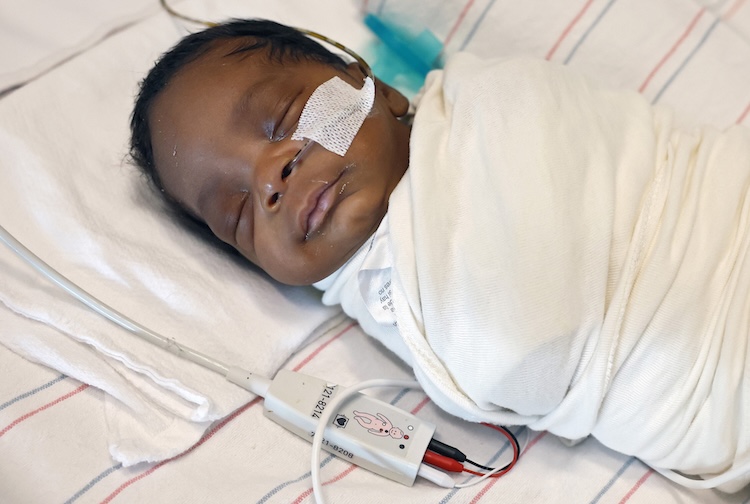 According to the World Health Organization, one in 10 babies are born prematurely worldwide. (Enterprise Marketing and Communications)
At CHoR’s Level 4 NICU, Kamyrn has continued to make steady progress. Born at 30-weeks and weighing 3 pounds and 9 ounces he has since met early milestones and is improving each day under the care of a specialized neonatal team.
CHoR recently expanded its neonatal intensive care unit within the Children’s Tower, increasing capacity to care for premature and medically complex newborns. The expansion strengthens VCU Health’s ability to serve rural communities when advanced neonatal resources are required.
“When devoted hospitals like CMH and CHoR operate seamlessly as one coordinated system, we can ensure the very best care and outcomes for our most vulnerable patients and families who are counting on us,” said Elias Neujahr, MHA, MBA, CHoR president.
Now considered full-term, both Danielle and Kamyrn are doing well, thanks to the collective effort of dedicated care teams in both South Hill and Richmond. Together, the collaboration between CMH and CHoR reflects a model of care designed not just for one winter storm, but for the evolving needs of rural families across the commonwealth.
In the hours that followed, the entire hospital rallied around the family. Staff from across departments stepped in with small acts of kindness — moments the family says they will never forget.
One of those moments came from Gloria Baskerville with the food and nutrition team, who prepared Danielle and Kamyrn’s father Cameron Coleman a homemade bowl of Brunswick stew.
“You don’t realize how much something like that means in a moment like that,” Coleman said. “That hot cup of soup meant everything to me.”
“This was truly an act of compassion and care from people across the health system,” Barr said. “I’ve never seen anything like it. There was such reverence for this family at that moment. They weren’t surrounded by just a single care team; they were surrounded by the entire VCU Health community.”
Watch Kamyrn’s VCU Health team reflect on the seamless, cross‑campus collaboration required to care for the 30‑week‑old baby and his mother. (Taylor MacKillop and Will Sidaros, Enterprise Marketing and Communications)
How is Kamyrn doing now? Mom says he’s grown and meeting big milestones! Check in on Kamyrn’s progress at CHoR’s Level 4 NICU.
Get more inspiring stories from our patients and care teams every month. Subscribe to VCU Health’s e-mail newsletter.
news/from-rural-delivery-to-level-4-nicu-30week-preemie-born-during-winter-storm-fern/”>Source link
