

When you walk into the Eastern Shoshone Tribal Health office, there’s a big white vending machine right inside the door. But it’s not your ordinary vending machine: no chips or Sprite or chocolate bars.
Joceyln Dewey pointed to packages of red cables attached to a lock and key in the first three spots in the top row of the machine.
Hannah Habermann
/
Wyoming Public Media
“We have a gun lock there that is for someone that may be dealing with suicide risk,” she said. “What it basically does is slow down that person and give them time to think through what they’re going through,” she said.
Dewey is the community health educator at Eastern Shoshone Tribal Health. She teaches people of all ages about suicide prevention, adverse childhood experiences and how to recognize intimate partner violence.
“ Even though you may not see it much or people don’t talk about it, a lot of people go through mental health challenges,” she said. “I provide adult and youth mental health first aid [trainings], which helps to give people tools and education on how to help themselves.”
In the world of public health, harm reduction is an approach that focuses on giving people the knowledge and tools to minimize harm in their own lives – think bike helmets, seat belts or even sunscreen.

Hannah Habermann
/
Wyoming Public Media
It’s also a big part of overdose prevention and is the guiding principle behind two new harm reduction vending machines getting set up by the Eastern Shoshone Tribe. They’ll be open to the public in April.
“The next thing on there is a cessation kit,” Dewey said, pointing to a small zip-close bag on the top row, filled with aromatherapy essential oils and fidget toys. “It’s to help someone to stop smoking.”
Next to that are some fentanyl test strips: little pieces of paper to detect the highly-dangerous opioid in different drugs. And there’s condoms, with information about HIV and other sexually transmitted diseases.
“Then we have Deterra. Deterra is for medication and drugs that you no longer need,” said Dewey. “You can put the meds into those with a little bit of water, shake ’em, dissolve them, throw ’em out.”

Hannah Habermann
/
Wyoming Public Media
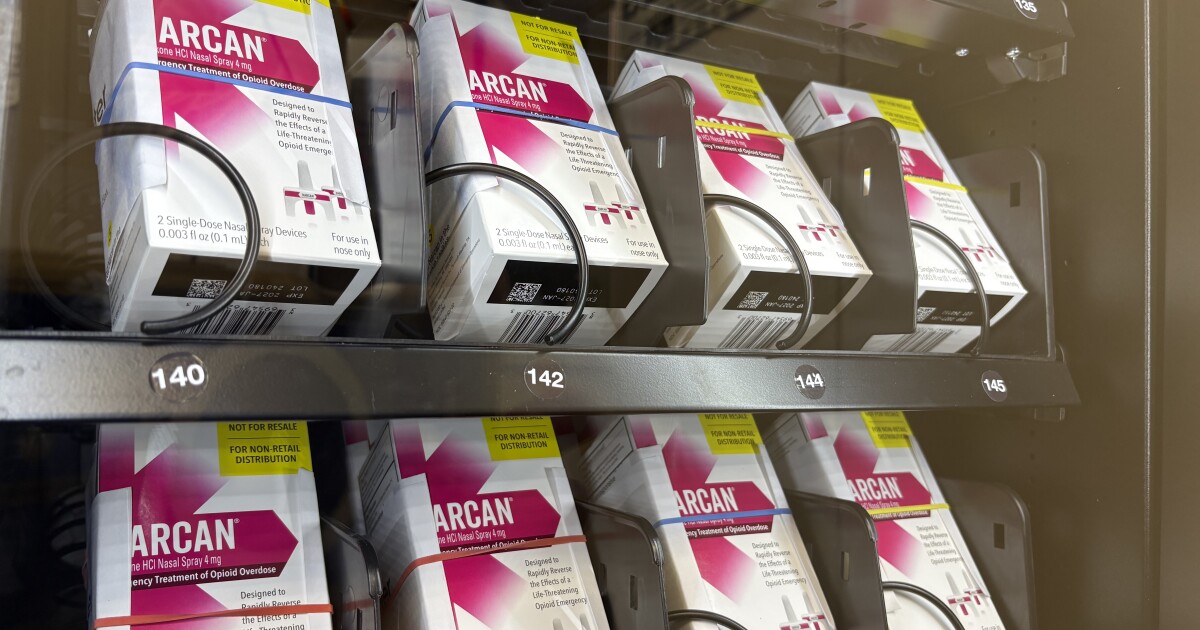
The bottom two rows of the machine are filled up with identical white boxes: Narcan.
“This is what we have to help our people that we’re not going to get them to stop, but we can help them to live through their overdose,” said Dewey, shaking one of the boxes in her hand.
Narcan is a nasal spray that rapidly reverses opioid overdoses. It’s the brand name for naloxone, which temporarily blocks opioid receptors in the brain and can be a lifesaver.
A few years ago, Dewey said there was a big uptick in overdose deaths on the Wind River Reservation.
“We were losing parents. We were losing young people in their 20s and 30s,” she said.
Community elders raised the alarm. Fentanyl turned out to be the main culprit. The drug’s been around for decades, but overdose deaths involving synthetic opioids, like fentanyl, have skyrocketed in the last 10 years.

U.S. Centers for Disease Control and Prevention
“I started going around to find out if Narcan was available, and that’s when we figured out that it was not,” said Dewey.
She started bringing Narcan along when she would table at public health department outreach events and tried to get her finger on the pulse of the community.
“I would just take their name down and then tell them it’s not going to be reported to anybody. It’s just for my information because I have to account for where I’m getting the Narcan and where it’s going,” she said. “They were honest. They said that we need it and we don’t want to have to have our name on there, [like] how a prescription is given out.”

Hannah Habermann
/
Wyoming Public Media
Narcan became available over-the-counter in 2023. With that barrier gone, Dewey and the Eastern Shoshone Tribal Health team turned their focus to getting the vending machines to address another obstacle: social stigma.
“It helps in a way that they’re not having to face anybody,” she said about the vending machine model. “They’re not having to worry about having their name on it, and they’re able to walk in and get it.”
Mike Selick is the director of capacity building and community mobilization at the National Harm Reduction Coalition. He said this approach is relatively new and becoming more popular.
“Harm reduction vending machines allow people who might not feel comfortable talking about their drug use to even a harm reduction worker to get access to lifesaving supplies, and that’s really where their value comes in,” he said.

Selick said, in some places, it can allow people to get access to what they need 24/7. But his hope is that they’re the first step in getting comfortable with reaching out for help.
“At the end of the day, the thing that is going to help people the most is human connection, talking to somebody who has gone through similar experiences, knowing where they can access various different ways to get support,” said Selick.
Instead of trying to shift behavior through negative consequences or shame, Selick said that harm reduction instead recognizes that change will come from “within a person.”
“What people actually need for behavior change is to be treated with value. So much of society treats people who use drugs as worthless and terrible, and that makes you want to do more drugs about it,” he said. “Helping people find that they are humans deserving of respect and dignity, helping them connect to things to keep themselves safe and spaces where they can actually have life-affirming experiences, helps people work towards behavior change and eventually make sustainable change.”
The Wyoming Department of Health partnered with the Eastern Shoshone Tribe to provide the funding for the machines, through the U.S. Centers for Disease Control and Prevention’s (CDC) Overdose Data to Action in States grant.
Wyoming State Health Officer Alexia Harrist said the grant has two goals.
“The first is to improve the types of data that we collect about both fatal and non-fatal overdose, and then to use those data to inform prevention activities in order to prevent overdose and, specifically, focusing on opioids and stimulants,” she said.

Wyoming State Health Officer Dr. Alexia Harrist
/
Wyoming Department of Health
Wyoming first received funding from the grant in 2023, which “funds 49 state health departments and the District of Columbia to expand drug overdose surveillance and prevention efforts,” according to the CDC.
“It is our understanding, too, that the two vending machines that the Eastern Shoshone Tribe purchased are the first two in the state,” said Harrist.
Harrist said there’s no one-size-fits all approach when it comes to addressing overdoses in Wyoming. Some towns are using grant funding to invest in peer navigators to help people connect with resources. Others are reviewing overdose fatalities and holding trainings for clinicians to learn more about pain management tools.
“We really, of course, leave it up to those local communities to make those decisions in terms of what’s best for their community members,” said Harrist.
From 2020 to 2024, 60% of overdose deaths in Wyoming involved opioids and another 38.5% of overdose deaths involved stimulants, according to Harrist. She advocated for continuing to address both drug types and emphasized that Narcan is a lifesaving medication.

Wyoming Department of Health
“I carry naloxone in my backpack wherever I go, just in case” she said. “We want folks to know that it’s accessible and everyone can have it and anyone can assist someone who might be experiencing an overdose.”
Back at Eastern Shoshone Tribal Health, Jocelyn Dewey gave a crash-course in how the vending machine will work once it’s up and running in April.

Hannah Habermann
/
Wyoming Public Media
People will have to come to the office once to get set up with an individual pin number. But Dewey emphasized that any data gathered by the machine will be kept internally and will only be used to track what the organization is providing.
“When you get a pin, then you’ll enter it into there and whatever you want or need is there,” she said.
In addition to the machine at the office, there’s another one getting set up at Rocky Mountain Hall, the local community center. That one’s open all day, even after work.
“And then you just go to checkout and there you go,” said Dewey, as a box of Narcan dropped from its row to the slot at the bottom of the machine.
Everything in the machines is free. The Eastern Shoshone Tribal Health team plans to add toiletry kits, Plan B pills, wound kits and even blood sugar test kits, and to adapt to what the community needs going forward.
