

Middle East crisis live: Iran launches strikes on US bases in Gulf; oil prices drop after Trump ‘peace plan’ report | US-Israel war on Iran
Opening summary
Welcome to our ongoing coverage of the US-Israeli war on Iran and its wider repercussions in the Middle East and globally.
More American troops are prepared to head to the Middle East. At least 1,000 troops from the 82nd Airborne Division will be sent in the coming days, three people with knowledge of the plans told the Associated Press. The 82nd airborne is an elite infantry division that can typically be deployed on short notice and specialises in forcible entry parachute assaults. Donald Trump has reportedly approved the deployment.
Meanwhile, crude oil prices fell sharply in early Wednesday trading after Trump sent a peace plan to Iran and voiced optimism about ending nearly a month of war.
After rising in Europe and the US on Tuesday, Brent crude was down 6% at $98.30, and the contract, West Texas Intermediate, was down 5% at $87.72.
Early on Wednesday, Iran’s Revolutionary Guards said it had launched a new wave of attacks against locations in Israel including Tel Aviv and Kiryat Shmona, as well as US bases in Kuwait, Jordan and Bahrain, according to Iranian state media.
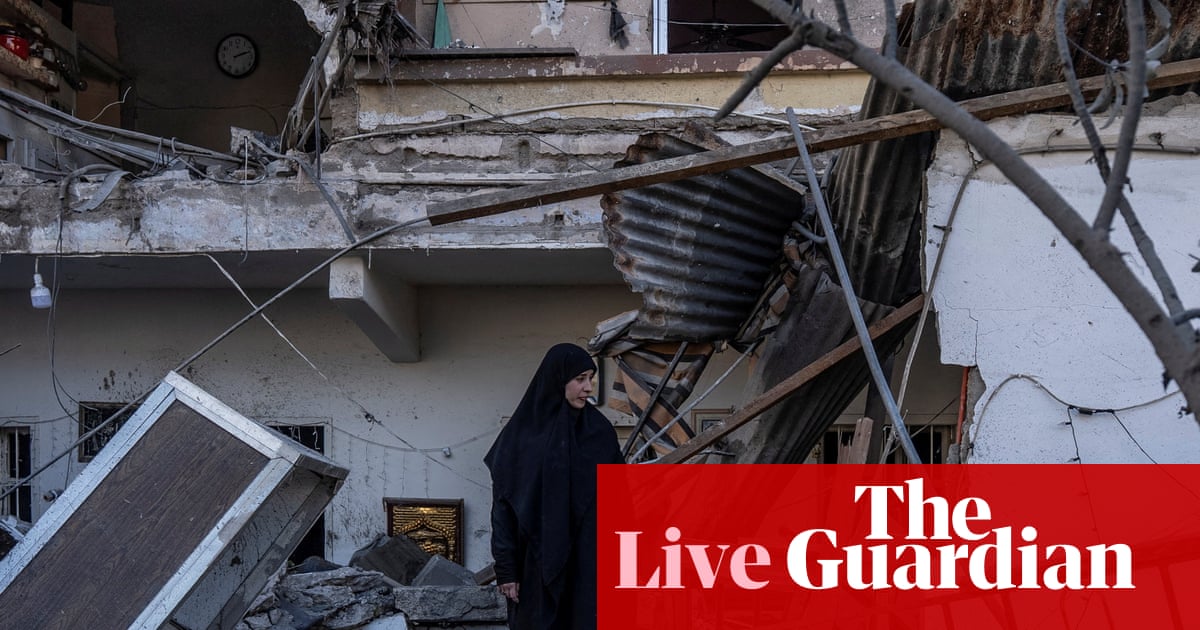
In Lebanon, state media reported Israeli strikes had killed at least six people in a town and a Palestinian refugee camp in the southern Sidon area, and three more in another town. In addition, Israel, which occupied southern Lebanon for nearly two decades until 2000, has said its military would take control of the border area up to the Litani river, around 30km (20 miles) from the frontier.
The Israeli campaign has killed at least 1,072 people in Lebanon, with more than one million people displaced, according to Lebanese authorities.
Here are the key developments:
-
The US has sent Iran a 15-point plan to end the war, sources told Reuters, with the New York Times saying the plan was delivered by way of Pakistan. It is unclear if Israel is on board with the proposal, nor if Iran is likely to accept it as a basis for negotiations.
-
Donald Trump claimed negotiations to end the Iran war are happening “right now” and that Tehran had agreed to “never” have a nuclear weapon, declaring that “we’ve won this war” to reporters in the Oval Office. He further claimed Tehran gave him a “gift” which was “oil and gas-related” which involved the strait of Hormuz, without giving further details.
-
This comes a day after Iranian officials denied any contact with the US had taken place and called claims of such talks “fake news” designed to “manipulate” oil markets.
-
News that Trump had also approved the deployment of more than 1,000 soldiers from the 82nd Airborne Division to the Middle East further undermined the US president’s repeated claims of successful peace talks. The extra troops have not yet left the US but will be sent overseas in the coming days, sources told AP. Iran has previously threatened to mine the gulf surrounding the island if the US appeared to be landing troops.
-
Iran’s Revolutionary Guards have fired missiles at Israel and US forces in bases in Kuwait, Jordan and Bahrain, state media reported. Kuwaiti officials reported a fire at the airport after a drone hit a fuel tank.
-
Approximately 290 US troops have been wounded so far, CNN reports, with 13 soldiers killed in action. Over 1,500 Iranians have been killed, Iran’s state broadcaster said on 21 March.
-
Lebanon faces an “existential crisis” after Israel announced plans to seize and occupy large swathes of the country’s south to create a so-called “security zone”, officials say. Many Lebanese fear that IDF plans to create a “buffer” south of the Litani River — 20 miles from the current Israel-Lebanon border — will become a long-term occupation.
-
A projectile has hit the premises of the Bushehr nuclear power plant, according to the International Atomic Energy Agency, who were informed of the strike by Iran. There was no damage to the facility or staff and conditions at the plant remain normal, the IAEA said on X.
Key events
Iranian strikes bombard Gulf states overnight as frustration with war mounts
Hannah Ellis-Petersen
Even as Donald Trump claimed productive negotiations to end the war were ongoing with Tehran, Iran’s relentless bombardment of the Gulf states showed no sign of relenting.
Kuwait and Bahrain were both hit with damaging strikes on Tuesday night and into Wednesday morning, as the patience of the Gulf states after rebuffing constant attacks for almost a month begun to wear thin.
A fire broke out at Kuwait International Airport after a drone hit a fuel tank, once again bringing air travel to a halt. Firefighters were called to the scene but initial reports said the damage was “limited”.
Air sirens were heard over Bahrain on Wednesday as more Iranian missiles and drones were headed their way. On Tuesday, a Moroccan national who was a contract worker for the United Arab Emirates (UAE) was killed in a drone strike in Bahrain and five members of the UAE defencemMinistry were also injured in the attack.
Saudi Arabia said it had also intercepted at least four drones overnight.
The Gulf states had worked very hard to prevent Trump from declaring war in Iran and there is mounting frustration, both at the US and Iran, as the conflict has continued to drag on.
In a reversal of their previous positions, Saudi Arabia is reported to have given the US permission to use one of their air bases to launch attacks on Iran, as they push for the Trump administration to completely debilitate the Iranian regime.
In a press briefing on Tuesday night, Qatar’s foreign minister said they were not among the states currently involved in any of the mediation efforts between the US and Iran, adding: “if they exist”.
“Our focus at this time is entirely dedicated to defending our country and addressing the losses resulting from the various attacks that the state of Qatar has endured,” said Qatar’s foreign ministry spokesman, Majed al-Ansar.
Al-Ansar said Qatar was ready to help in any process that would bring the conflict to an end. However, he emphasised that it would be a complex process to rebuild a relationship between the Gulf states and Iran.
“It’s now up to the Iranians, post this war of course, to decide how they’re going to rebuild the trust that was lost due to their attacks on our sovereignty,” he said.
Indonesia mulls cutting back free student meals to save money – reports
Indonesia is considering cutting the distribution of free student meals from six days a week to five, in a bid to save its budget amid the the Middle East conflict, Reuters reports.
The finance minister, Purbaya Yudhi Sadewa, said on Wednesday the measure could save 40tn rupiah ($2.37bn).
The proposal came from the head of Indonesia’s national nutrition agency and would need to be approved by president Prabowo Subianto, the minister said.
On Saturday, a spokesperson for the president said Indonesia was seeking an estimated 80tn rupiah ($5bn) in budget savings to help cope with the impact of the war.
Some recent photographs taken around the region, as the US-Israeli war on Iran continues into a fourth week of violence.
Photograph: Ronen Zvulun/Reuters
Following on from earlier reports, Lebanese state media said the latest round of Israeli strikes had now killed nine people.
Earlier on Wednesday, Lebanon’s official National News Agency, said strikes had killed four people in the town of Adloun and two people in a Palestinian refugee camp in the southern Sidon area.
The agency, citing the health ministry, later said another said another three people were killed and 18 wounded in the town of Habboush.
Israel has killed at least 1,072 people in Lebanon, with more than one million people displaced, according to Lebanese authorities.
In northern Israel, where repeated air raid sirens have sent residents to shelters, a woman was killed on Tuesday following rocket fire from Lebanon, Israeli authorities said.
Iran mocks US attempts at ceasefire – reports
An Iranian military spokesperson has mocked US attempts at a ceasefire deal, insisting Americans were only negotiating with themselves, Associated Press reported.
In a prerecorded video aired on Wednesday on state television, Lt. Col. Ebrahim Zolfaghari claimed the US’s strategic power had turned into “strategic failure”.
The one claiming to be a global superpower would have already gotten out of this mess if it could. Don’t dress up your defeat as an agreement. Your era of empty promises has come to an end.
Have your internal conflicts reached the point where you are negotiating with yourselves?
Zolfaghari’s statement came shortly after the Trump administration sent a 15-point ceasefire plan to Iran through Pakistan.
“Our first and last word has been the same from day one, and it will stay that way: Someone like us will never come to terms with someone like you,” Zolfaghari said. “Not now, not ever.”
Oil prices fall, Asian shares gain after Trump claims progress in Iran talks
Oil prices fell nearly 6% and Asian shares gained on Wednesday, after reports Donald Trump had sent a peace plan to Iran.
At 0030 GMT, a barrel of Brent crude was down 5.92% at $98.30. Benchmark US oil contract, West Texas Intermediate, was down 5.01% at $87.72.
In Asia, Trump’s claims fuelled optimism in the markets: Tokyo’s Nikkei 225 was up 2.8% in early trading, and South Korea’s Kospi gained 3.1%. Hong Kong’s Hang Seng rose 1.2%, while the Shanghai Composite index was 0.9% higher.
Elsewhere, Australia’s S+P/ASX 200 climbed 2.2%, and Taiwan’s Taiex was up 3%.
The market movements came after news the US had reportedly sent Iran a 15-point plan to end the war.
News of the development, reported first by the New York Times, said the plan was delivered by way of Pakistan.
Per the NYT’s report, it is unclear how widely the plan had been shared among Iranian officials and whether Iran was likely to accept it as a basis for negotiations.
WTO fertiliser warning over strait of Hormuz closure: ‘Harvests shrink and prices rise’
Disruptions to international fertiliser supplies caused by the closing of the strait of Hormuz will cause food scarcity and high prices, the World Trade Organisation’s deputy director general, Jean-Marie Paugam, told Agence France-Press.
A third of the world’s fertilisers normally transit the strait, which has been virtually closed by Iran since the start of the war.
Paugam said there would be an impact on both quantity and prices. “The effect compounds the following year: harvests shrink and prices rise,” he said.
The gulf has ample supplies of natural gas, a key ingredient in artificial fertilisers, but production has been severely impeded by the war, with several facilities forced to shut down.
Major food exporters like India, Thailand and Brazil depend on exports of urea, a nitrogen-based fertiliser. There is currently no fertiliser shortage, Paugum said, but as the conflict drags on “we will feel a direct impact on supplies to major producer countries just as planting season begins for the crops that will be harvested next year”.
Countries which import most of their food would be in a very bad position, according to Paugum, including parts of west and north Africa. The effect would be amplified if countries begin stockpiling, as occurred during the Covid pandemic.
Opening summary
Welcome to our ongoing coverage of the US-Israeli war on Iran and its wider repercussions in the Middle East and globally.
More American troops are prepared to head to the Middle East. At least 1,000 troops from the 82nd Airborne Division will be sent in the coming days, three people with knowledge of the plans told the Associated Press. The 82nd airborne is an elite infantry division that can typically be deployed on short notice and specialises in forcible entry parachute assaults. Donald Trump has reportedly approved the deployment.
Meanwhile, crude oil prices fell sharply in early Wednesday trading after Trump sent a peace plan to Iran and voiced optimism about ending nearly a month of war.
After rising in Europe and the US on Tuesday, Brent crude was down 6% at $98.30, and the contract, West Texas Intermediate, was down 5% at $87.72.
Early on Wednesday, Iran’s Revolutionary Guards said it had launched a new wave of attacks against locations in Israel including Tel Aviv and Kiryat Shmona, as well as US bases in Kuwait, Jordan and Bahrain, according to Iranian state media.
In Lebanon, state media reported Israeli strikes had killed at least six people in a town and a Palestinian refugee camp in the southern Sidon area, and three more in another town. In addition, Israel, which occupied southern Lebanon for nearly two decades until 2000, has said its military would take control of the border area up to the Litani river, around 30km (20 miles) from the frontier.
The Israeli campaign has killed at least 1,072 people in Lebanon, with more than one million people displaced, according to Lebanese authorities.
Here are the key developments:
-
The US has sent Iran a 15-point plan to end the war, sources told Reuters, with the New York Times saying the plan was delivered by way of Pakistan. It is unclear if Israel is on board with the proposal, nor if Iran is likely to accept it as a basis for negotiations.
-
Donald Trump claimed negotiations to end the Iran war are happening “right now” and that Tehran had agreed to “never” have a nuclear weapon, declaring that “we’ve won this war” to reporters in the Oval Office. He further claimed Tehran gave him a “gift” which was “oil and gas-related” which involved the strait of Hormuz, without giving further details.
-
This comes a day after Iranian officials denied any contact with the US had taken place and called claims of such talks “fake news” designed to “manipulate” oil markets.
-
News that Trump had also approved the deployment of more than 1,000 soldiers from the 82nd Airborne Division to the Middle East further undermined the US president’s repeated claims of successful peace talks. The extra troops have not yet left the US but will be sent overseas in the coming days, sources told AP. Iran has previously threatened to mine the gulf surrounding the island if the US appeared to be landing troops.
-
Iran’s Revolutionary Guards have fired missiles at Israel and US forces in bases in Kuwait, Jordan and Bahrain, state media reported. Kuwaiti officials reported a fire at the airport after a drone hit a fuel tank.
-
Approximately 290 US troops have been wounded so far, CNN reports, with 13 soldiers killed in action. Over 1,500 Iranians have been killed, Iran’s state broadcaster said on 21 March.
-
Lebanon faces an “existential crisis” after Israel announced plans to seize and occupy large swathes of the country’s south to create a so-called “security zone”, officials say. Many Lebanese fear that IDF plans to create a “buffer” south of the Litani River — 20 miles from the current Israel-Lebanon border — will become a long-term occupation.
-
A projectile has hit the premises of the Bushehr nuclear power plant, according to the International Atomic Energy Agency, who were informed of the strike by Iran. There was no damage to the facility or staff and conditions at the plant remain normal, the IAEA said on X.
Source link
