

Middle East crisis live: Trump says he is ‘not at all’ worried about possible war crimes as his deadline nears | US-Israel war on Iran
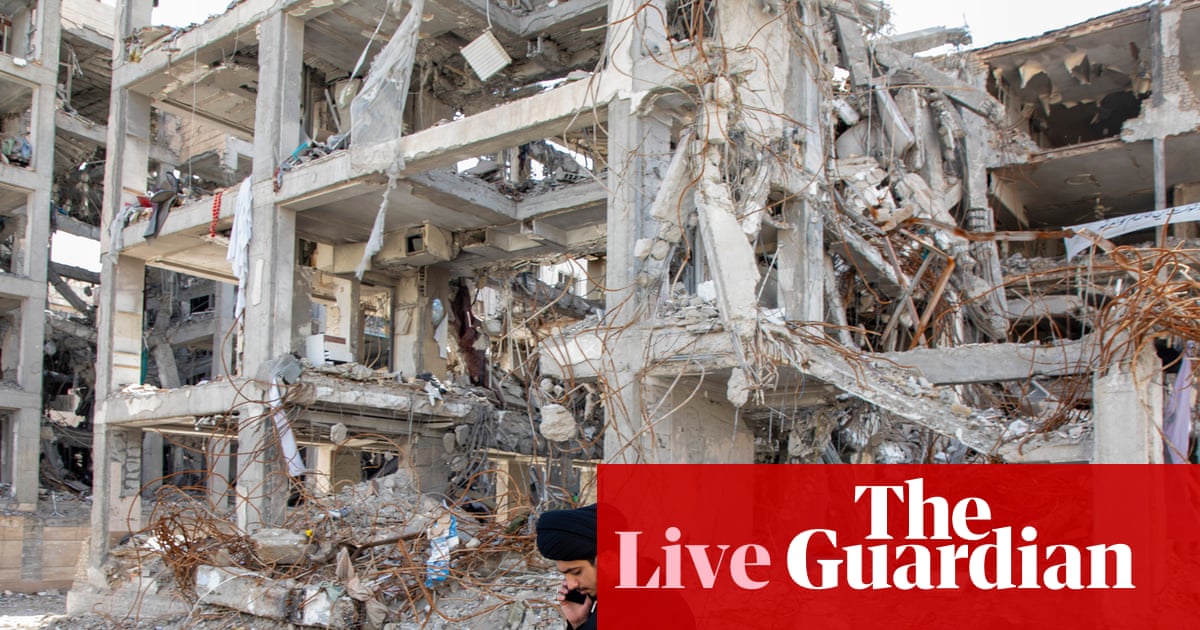
Opening summary
Hello and welcome to our continuing live coverage of the US-Israel war on Iran and its consequences for the region, the world and the global economy.
Donald Trump said he was “not at all” concerned about committing possible war crimes as he again threatened to destroy Iran’s bridges and power plants if Tehran does not meet his Tuesday 8pm ET deadline to reopen the strait of Hormuz.
“I’m not worried about it,” the US president said. “You know what’s a war crime? Having a nuclear weapon.”
Speaking at the White House, Trump refused to say whether any civilian targets would be off-limits. Iran on Monday rejected a 45-day ceasefire proposal and said it wanted a permanent end to the conflict.
“We only accept an end of the war with guarantees that we won’t be attacked again,” Mojtaba Ferdousi Pour, the head of the Iranian diplomatic mission in Cairo, told the Associated Press.
At a news conference, Trump said all of Iran could be “taken out” in one night “and that night might be tomorrow night”, referring to Tuesday. Without an agreement with Tehran, he said, “every bridge in Iran will be decimated” by midnight ET (0400 GMT) on Wednesday and “every power plant in Iran will be out of business, burning, exploding and never to be used again”.
Israel and the US carried out a wave of attacks on Iran on Monday, killing more than 25 people. Iran responded with missile fire on Israel and its Gulf Arab neighbours.
In other key developments:
-
The UN security council is expected to vote on Tuesday on a resolution to protect commercial shipping in the strait of Hormuz but in significantly watered-down form after veto-wielding China opposed authorising force, Reuters is reporting, citing diplomats.
-
The Israeli military said early on Tuesday it had completed an “air strike wave” aimed at damaging Iranian regime infrastructure in Tehran and additional areas across Iran. It said soon after that missiles were launched at Israel from Iran and defensive systems were operating to incept them.
-
Israel’s military also said it carried out strikes on three airports in Tehran, targeting several Iranian planes and helicopters.
-
The World Health Organisation suspended medical evacuations from Gaza to Egypt via the Rafah crossing after a contract worker for WHO was killed in Gaza on Monday. Separately, an Israeli airstrike killed at least 10 people outside a school housing displaced Palestinians in central Gaza, health officials said. Before the strikes some Palestinians had clashed with members of an Israeli-backed militia who they said attacked the school, Reuters cited medics and residents as saying.
-
Oil prices extended their rises on Tuesday amid Trump’s heightened rhetoric against Iran. The head of the IMF, meanwhile, said the war would lead to “higher inflation and slower global growth”.
-
The head of International Committee of the Red Cross said that “deliberate threats … against essential civilian infrastructure and nuclear facilities must not become the new norm in warfare”. Mirjana Spoljaric said, without singling out any country or leader: “Any war fought without limits is incompatible with the law.”
-
Israel said it struck Iran’s largest petrochemical complex on Monday. Israeli prime minister Benjamin Netanyahu said the facility had been “destroyed” and his country was “systematically eliminating the Revolutionary Guards’ money machine”.
-
The intelligence chief of Iran’s Revolutionary Guards, Maj Gen Majid Khademi, was killed in US-Israeli strikes at dawn on Monday, the Guards said.
-
Saudi Arabia intercepted seven ballistic missiles launched towards its eastern region and debris fell in the vicinity of energy facilities, the defence ministry of said on Tuesday.
-
Two blasts were reportedly heard near the Erbil airport – which hosts advisers from the US-led anti-jihadist coalition – in Iraq’s northern Kurdistan region, an Agence France-Presse journalist said.
Key events
In Philippines, inflation jumped dramatically in March, government figures showed on Tuesday, hitting a nearly two-year high on the back of historically high fuel prices driven by the Middle East war.
The spike to 4.1% – the highest since July 2024 and well up from 2.4% in February – comes as the import-dependent archipelago struggles with a declared “national energy emergency”.
The past month has seen the Philippines open supply chains with non-traditional partners such as Russia to secure desperately needed oil, while instituting measures ranging from cash handouts for transport workers to a four-day work week for civil servants, AFP is reporting.
The economic planning department said on Tuesday that a surge in transport prices was largely responsible for the March rise.
Australian prime minister Anthony Albanese says he will fly to Singapore this week to help secure petroleum imports as oil prices surge during the Middle East war.
Australia relies on imports for an estimated 90% of its refined petroleum products and Singapore is its largest single supplier.
Albanese said on Tuesday he would visit Singapore from Thursday to Saturday to discuss trade in “essential supplies” such as diesel and liquefied natural gas with prime minister Lawrence Wong.
Together, we share concern over the situation in the Middle East, including the consequences for both of our nations.
Agence France-Presse also reports that Australia and Singapore committed in a joint statement last month to keep fuel flowing between both countries and to work together to strengthen energy supply chain resilience.
Service station outages of diesel and unleaded petrol in Australia are falling, the government said.
Saudi Arabia-Bahrain bridge closed amid Iranian attack threat
The King Fahd Causeway, a key bridge linking Saudi Arabia to the island kingdom of Bahrain, closed early on Tuesday over threats from Iranian attacks.
The King Fahd Causeway Authority made the announcement in a post on X.
It said vehicle movements had been “suspended as a precautionary measure” over Iranian attacks targeting Saudi Arabia’s Eastern Province.
The 25km (15.5 mile) bridge is the only connection by road for Bahrain – home to the US Navy’s 5th Fleet – to the Arabian Peninsula, the Associated Press reports.
South Korea has said that it will send officials to Kazakhstan, Oman and Saudi Arabia to secure supplies of crude oil amid disruptions to shipping through the strait of Hormuz.
A special envoy will hold talks with governments, energy firms and ship operators to ensure cargoes reach domestic ports and to support stable supplies of key goods, including medical products, he said.
South Korea relies on the Hormuz route for about 61% of its crude oil, the country’s president told a press briefing.
Presidential chief of staff Kang Hoon-sik said shipments of crude oil secured last month from the United Arab Emirates under a 24m-barrel supply deal had already started arriving at South Korean ports.
The government was also working with international partners to ensure the safe passage of 26 South Korean-flagged vessels currently waiting inside the strait of Hormuz, he said.
Malaysia’s foreign ministry has said that one of seven Malaysian commercial vessels stranded in the strait of Hormuz has been allowed to pass and is now heading to its destination.
The ministry said this followed diplomatic talks with Iranian officials led by Malaysian prime minister Anwar Ibrahim. It didn’t give further details.
Malaysia reaffirmed its support for safe and open sea routes under international law and called for continued dialogue to maintain peace and stability in the region.
Iran has rejected a proposed ceasefire deal, state media has reported, confirming earlier reporting that diplomatic negotiations appeared to be faltering a day before Donald Trump’s deadline, in which he has threatened to destroy Iran’s bridges and attack its power plants.
“Iran has conveyed to Pakistan its response to the American proposal to end the war,” the news agency Irna said, without revealing its source or what the US offer contained.
Several countries have been acting as mediators to try to halt more than five weeks of fighting sparked by US-Israeli strikes on Iran.
“In this response – set out in ten points – Iran … has rejected a ceasefire and insists on the need for a definitive end to the conflict,” the Iranian state news agency added.
Irna also said Tehran’s demands included “an end to conflicts in the region, a protocol for safe passage through the Strait of Hormuz, reconstruction, and the lifting of sanctions”.
The New York Times, citing two unnamed senior Iranian officials, reported that Tehran was also seeking guarantees it would not face future attacks, and that Israeli strikes against its ally Hezbollah in southern Lebanon would cease.
Oil prices rose on Tuesday while equities were mixed as investors assessed Donald Trump’s latest deadline for Iran to reopen the strategic strait of Hormuz or be “decimated”.
The US president warned Tehran that its civilian infrastructure would be destroyed if it did not let ships through the waterway, through which a fifth of global crude and gas passes.
Both main oil contracts rose Tuesday, with West Texas Intermediate topping $115 – its highest in a month – and Brent sitting around $111.
Equity markets fluctuated, with Tokyo, Singapore, Manila and Jakarta down while Shanghai, Sydney, Seoul, Wellington and Taipei rose.
That followed a positive start to the week on Wall Street.
“Financial markets are oscillating in a narrow, uneasy range as traders sized up the countdown to Donald Trump’s Iran deadline,” wrote Stephen Innes at SPI Asset Management.
Tentative ceasefire optics [were] offering brief relief but never fully offsetting the lingering risk of escalation.
Opening summary
Hello and welcome to our continuing live coverage of the US-Israel war on Iran and its consequences for the region, the world and the global economy.
Donald Trump said he was “not at all” concerned about committing possible war crimes as he again threatened to destroy Iran’s bridges and power plants if Tehran does not meet his Tuesday 8pm ET deadline to reopen the strait of Hormuz.
“I’m not worried about it,” the US president said. “You know what’s a war crime? Having a nuclear weapon.”
Speaking at the White House, Trump refused to say whether any civilian targets would be off-limits. Iran on Monday rejected a 45-day ceasefire proposal and said it wanted a permanent end to the conflict.
“We only accept an end of the war with guarantees that we won’t be attacked again,” Mojtaba Ferdousi Pour, the head of the Iranian diplomatic mission in Cairo, told the Associated Press.
At a news conference, Trump said all of Iran could be “taken out” in one night “and that night might be tomorrow night”, referring to Tuesday. Without an agreement with Tehran, he said, “every bridge in Iran will be decimated” by midnight ET (0400 GMT) on Wednesday and “every power plant in Iran will be out of business, burning, exploding and never to be used again”.
Israel and the US carried out a wave of attacks on Iran on Monday, killing more than 25 people. Iran responded with missile fire on Israel and its Gulf Arab neighbours.
In other key developments:
-
The UN security council is expected to vote on Tuesday on a resolution to protect commercial shipping in the strait of Hormuz but in significantly watered-down form after veto-wielding China opposed authorising force, Reuters is reporting, citing diplomats.
-
The Israeli military said early on Tuesday it had completed an “air strike wave” aimed at damaging Iranian regime infrastructure in Tehran and additional areas across Iran. It said soon after that missiles were launched at Israel from Iran and defensive systems were operating to incept them.
-
Israel’s military also said it carried out strikes on three airports in Tehran, targeting several Iranian planes and helicopters.
-
The World Health Organisation suspended medical evacuations from Gaza to Egypt via the Rafah crossing after a contract worker for WHO was killed in Gaza on Monday. Separately, an Israeli airstrike killed at least 10 people outside a school housing displaced Palestinians in central Gaza, health officials said. Before the strikes some Palestinians had clashed with members of an Israeli-backed militia who they said attacked the school, Reuters cited medics and residents as saying.
-
Oil prices extended their rises on Tuesday amid Trump’s heightened rhetoric against Iran. The head of the IMF, meanwhile, said the war would lead to “higher inflation and slower global growth”.
-
The head of International Committee of the Red Cross said that “deliberate threats … against essential civilian infrastructure and nuclear facilities must not become the new norm in warfare”. Mirjana Spoljaric said, without singling out any country or leader: “Any war fought without limits is incompatible with the law.”
-
Israel said it struck Iran’s largest petrochemical complex on Monday. Israeli prime minister Benjamin Netanyahu said the facility had been “destroyed” and his country was “systematically eliminating the Revolutionary Guards’ money machine”.
-
The intelligence chief of Iran’s Revolutionary Guards, Maj Gen Majid Khademi, was killed in US-Israeli strikes at dawn on Monday, the Guards said.
-
Saudi Arabia intercepted seven ballistic missiles launched towards its eastern region and debris fell in the vicinity of energy facilities, the defence ministry of said on Tuesday.
-
Two blasts were reportedly heard near the Erbil airport – which hosts advisers from the US-led anti-jihadist coalition – in Iraq’s northern Kurdistan region, an Agence France-Presse journalist said.
Source link
