

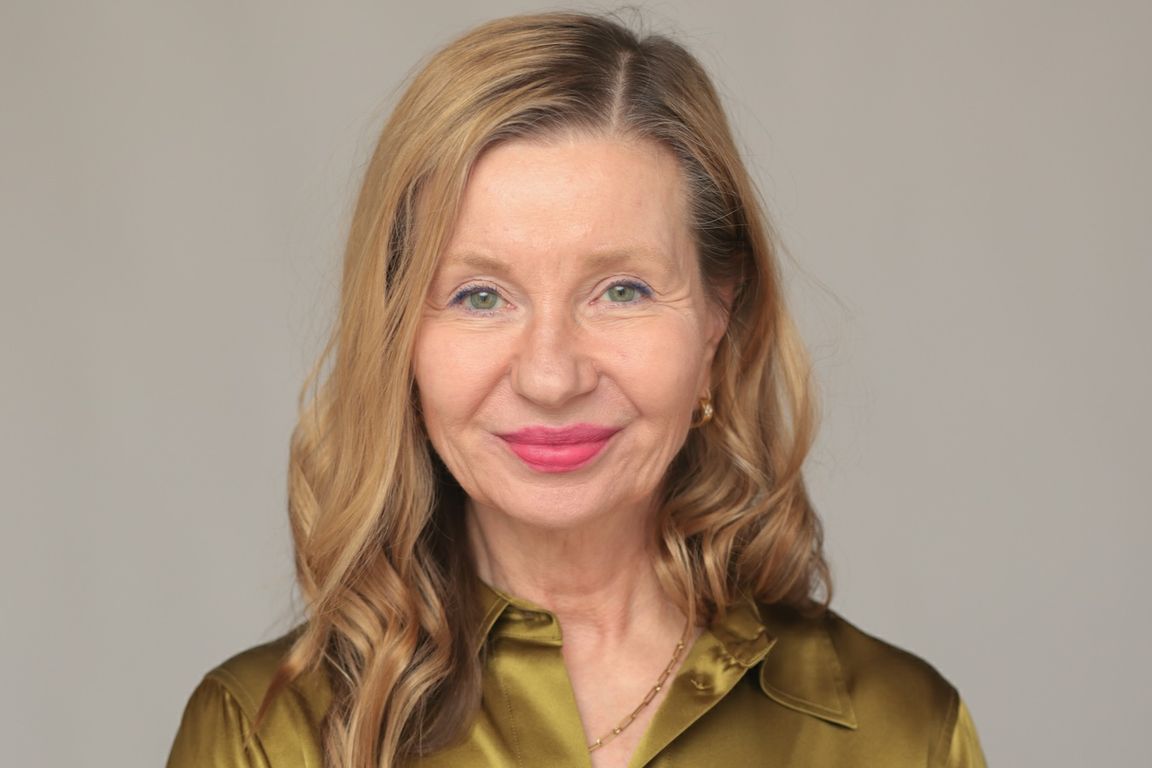
In an alternate world, Anne Andrews might be a CIA agent. But in this one, she’s an interdisciplinary UCLA scientist breaking new ground, measuring chemicals in the brain and body.
Andrews’ first foray into graduate education was to Washington, D.C., to study Russian. She found a mismatch between her love of Russian literature and the program’s focus on translation and entree into intelligence careers. This drove her to the first of a few major divergences — pursuing her other longtime passion for chemistry.
“They say chemists are either makers — synthesizing compounds — or measurers. I’m a measurer,” said Andrews, a professor of psychiatry and behavioral sciences at the David Geffen School of Medicine at UCLA and a member of the California NanoSystems Institute at UCLA, or CNSI. “Everything I do, I’m thinking about precision and how to design an experiment. Even when I’m cooking or baking, I want to make data-inspired decisions.”
Andrews’ journey led her to make key discoveries about the chemical messengers in our bodies, such as hormones and neurotransmitters, that mediate our experience of the world, with key aid from federal funding. A couple of “left turns” later, and she’s now a startup founder. She and her colleagues at FemSync are adapting their technology for measuring biochemicals in sweat into a wearable device. It may bring a never-before-seen precision to monitoring hormonal variations that drive ovulation or menopause.
“I had no aspirations of being an entrepreneur,” said Andrews, also a professor of chemistry and biochemistry at the UCLA College and of bioengineering at the UCLA Samueli School of Engineering. “We started thinking about giving people information about their bodies that can empower them, and that set me on the path. I was a little reluctant, but it felt like it had to be done.”
Interrogating the brain’s chemical messengers
When Andrews rerouted her career into science, she took a job in industry and pursued a master’s degree at night. Thanks to a U.S. Department of Education fellowship, she quit her day job and threw herself into doctoral coursework at American University and research at the National Institute of Mental Health, where she began investigating serotonin.
“From there, it was true love,” Andrews said.
After NIMH, she joined the faculty at her undergraduate alma mater, Penn State. There, she launched her research mission to develop and advance methods for measuring brain chemicals related to anxiety and stress.
Andrews’ success led to new methods for monitoring multiple neurochemicals simultaneously, a necessity for understanding how they synergize to encode information.
“Neurotransmitters don’t operate in isolation,” she said. “For instance, dopamine does not, by itself, encode pleasure and reward, despite what we hear from the popular press. That’s not how brains work; it’s more about a wide variety of neurochemicals all layered on top of one another.”
Investment that leads to innovation
The National Institutes of Health and National Science Foundation provided early support for her vision: deploying small strands of synthetic DNA to recognize chemical messengers, along with miniature transistors to convert recognition events into electrical signals.
To bring the vision to fruition, she forged a collaboration that she considers another of her life’s left turns: working with nanoscientist Paul S. Weiss, then a Penn State colleague and now a UCLA distinguished professor and holder of a UC Presidential Chair. In addition to advancing the research, the scientific partnership became personal, leading to their marriage in 2005.
Courtesy of Anne Andrews
Anne Andrews with her husband, Paul Weiss, a nanoscientist and distinguished professor at UCLA
After relocating to UCLA in 2009, Andrews received a prestigious NIH Director’s Transformative Research Award. With that backing, she and collaborators at UCLA and beyond showed that their sensors could overcome the challenge of the tech-hostile conditions within the body — warm, wet, salty and rich in charged particles.
“The NIH grant allowed us to build a large team of talented scientists and trainees and to move swiftly,” Andrews said. “Without those resources, we wouldn’t be where we are today.”
A further advance in 2022 unveiled smartwatch technology that samples sweat on the skin to measure cortisol, a stress hormone. This became the foundation for the technology that FemSync is commercializing.
A vision for personalized health monitoring
Today, the only ways to assess hormonal health directly are urine or blood tests. The patch being developed at FemSync, worn on the skin for a month at a time, will noninvasively measure estrogen, progesterone, luteinizing hormone and other hormones twice daily and transmit the measurements to a smartphone via Bluetooth.
The data will provide insights about symptoms and other patterns associated with menstrual cycles, fertility, hormonal treatments, menopause and the earlier, poorly understood changes seen in perimenopause. Users could then take action based on previously unavailable clues from their own biology.
“We want to provide high-quality information enabling users to make data-informed decisions for life,” Andrews said. “It’s not so important where you are as an average in a population, but rather where you are as an individual today and over time.”
For instance, being able to measure the hormones that drive ovulation could help users, whether their goals are to get pregnant or avoid pregnancy. Or an individual could match stages of the menstrual cycle to symptoms that arise, such as severe cramping, headaches, back pain or diarrhea, in order to predict problems and adjust plans ahead of time.
Courtesy of Anne Andrews
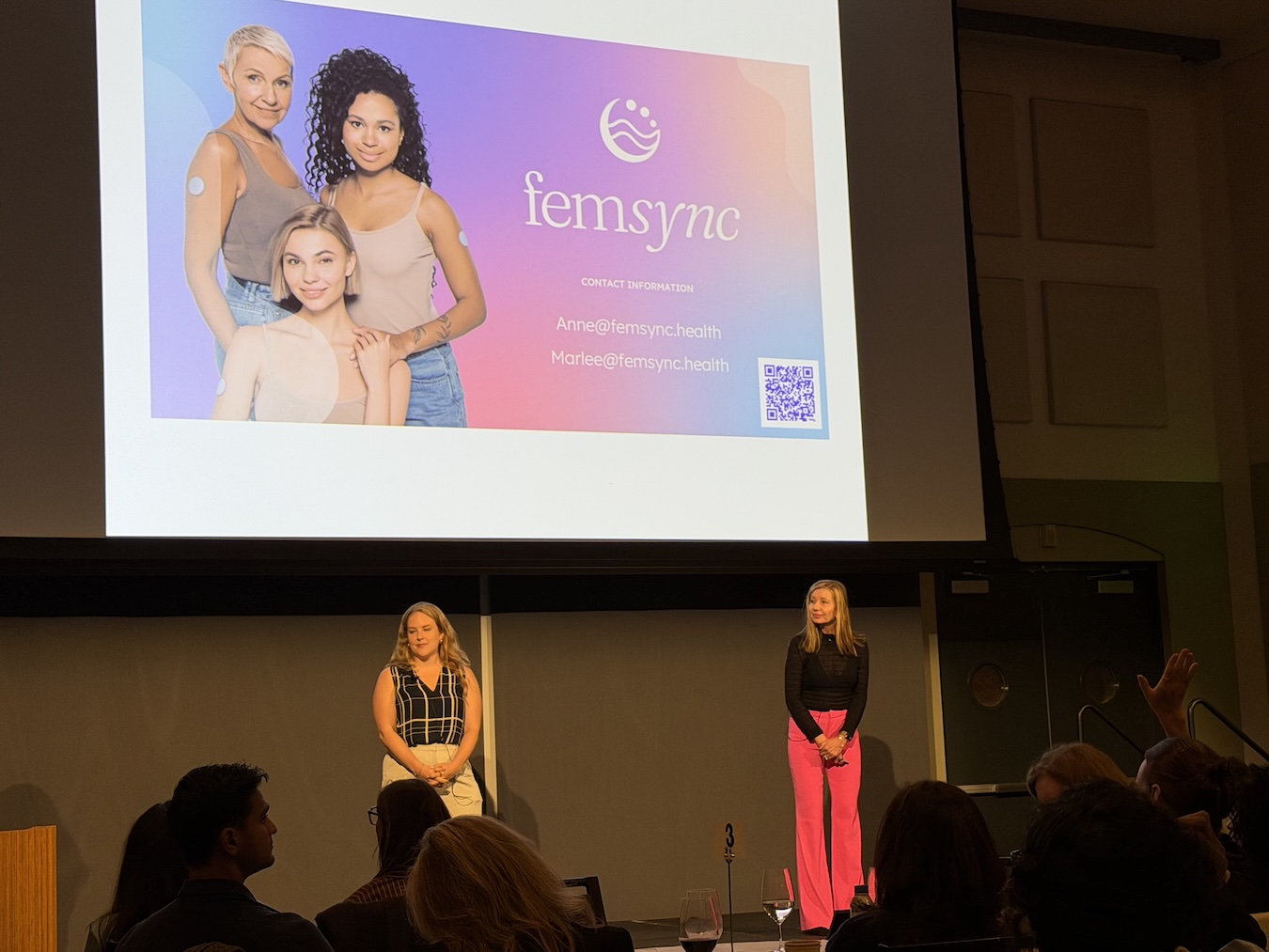
Anne Andrews (right) and Marlee Goldstein, co-founder and CEO of FemSync, during a presentation.
The company has gained steam with wins in pitch competitions, including the UCLA Innovation Fund, a program of the UCLA Technology Development Group and the LA Women Founders Network. In addition to an initial product for health and wellness, Andrews aims to seek Food and Drug Administration approval for the patch as a medical device.
“You could think about detecting polycystic ovary syndrome, which affects fertility but on average takes seven years to diagnose,” she said. “Some may be delaying pregnancy, not knowing that something is going on in their bodies that will interfere with those plans. Our sensor could give them a clearer picture to help them make informed choices.”
The right campus for collaboration and commercialization
Meanwhile, Andrews’ lab is expanding its portfolio of measurable neurotransmitters, hormones and other biochemicals. In addition to taxpayer investment, the environment at UCLA has accelerated her progress.
It’s no surprise that working across fields would be important for a scientist associated with three different UCLA schools, plus CNSI, the Semel Institute for Neuroscience and Human Behavior at UCLA and the UCLA Hatos Center for Neuropharmacology. Naturally, Andrews has benefited from the ease of partnering with campus experts in distant disciplines.
“Interdisciplinarity is one of the strengths of UCLA,” she said. “Many UCLA research groups collaborate across medicine, science and engineering, as well as in the arts and business. The more intractable problems call for holistic thinking. Nature doesn’t divide itself into physics, chemistry, biology and other traditional disciplines. That’s just how we organize knowledge in a way we can teach and understand.”
Andrews has gained much from UCLA’s innovation-oriented ecosystem and state-of-the-art facilities. She’s grateful for the Technology Development Group’s support, as well as connections with experienced founders through CNSI’s entrepreneurship and commercialization programming. As FemSync refines its product, the team fabricates its tiny transistors at the UCLA NanoLab, run by CNSI and UCLA Samueli.
“CSNI has been foundational to our work,” Andrews said. “It’s a hub that brings together interdisciplinary expertise, and it houses enabling facilities, with scientists who train all generations of my students on essential tools.”
From her vantage in the early days of moving her inventions toward the market, where they can do the most good, Andrews can’t predict the next major pivot in her journey. But she stays ready.
“I’ve learned to be open when the universe, or serendipity, points me to a different path,” she said. “I’ve made three left turns so far. If you make four, you’ve gone full circle.”
Source link
