

Epic cinema lives and dies on direction. These are movies that demand scale: vast landscapes, sweeping narratives, and characters caught in the machinery of history. However, scale alone is never enough. A good director needs to balance the spectacle with emotion and personal stakes, all while keeping the thousand moving parts from collapsing into chaos.
With that in mind, this list looks at the most masterfully told epic movies, from the elemental immersion of Saving Private Ryan to the monumental stillness of Lawrence of Arabia.
10
‘The Last Duel’ (2021)
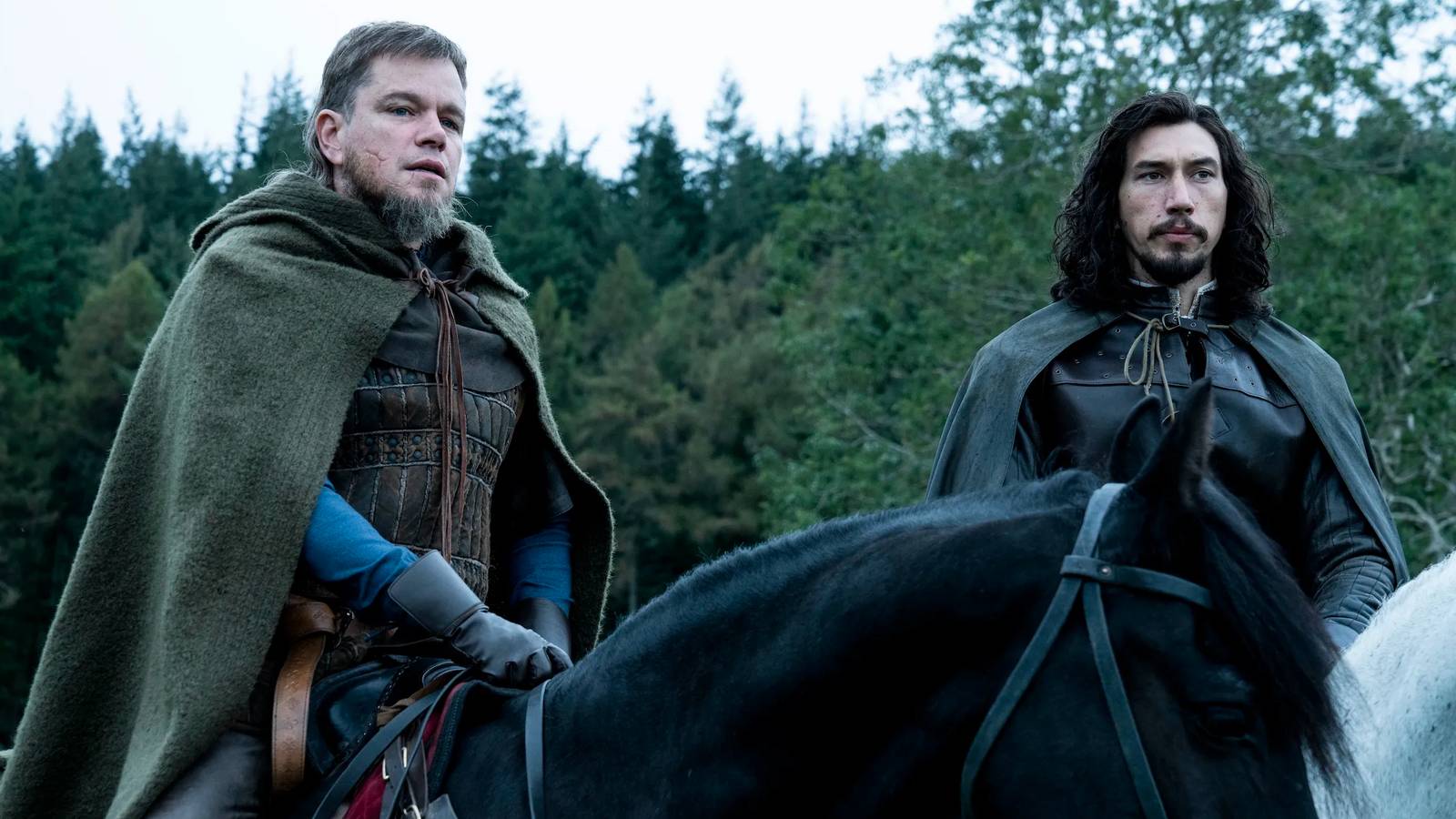
“The truth does not change… no matter who tells it.” This Ridley Scott outing was a box office bomb, but it’s actually a very solid movie. Set in medieval France, The Last Duel features Matt Damon as a knight who challenges his former friend (Adam Driver) to a judicial duel after accusing him of assaulting his wife (Jodie Comer). The story is told from three different perspectives, each offering a conflicting version of events: Rashomon with shields and long-swords.
The triptych structure could easily feel repetitive, but Scott uses subtle shifts in tone, framing, and performance to differentiate each perspective. Refreshingly, the historical setting is rendered with a grounded realism, avoiding romanticism in favor of grit and texture. Scott avoids the glossy, overproduced look that plagues many historical films. Interiors are dim, lit by fire and shadow. Costumes feel worn, lived-in, and functional rather than decorative.
9
‘Braveheart’ (1995)

“They may take our lives… but they’ll never take our freedom!” While it admittedly plays fast and loose with the facts, Braveheart still succeeds as a rousing, high-energy historical war flick. Mel Gibson turns in a fittingly larger-than-life performance as William Wallace, who leads a rebellion against English rule in medieval Scotland. The director-star sells the character’s transformation from farmer to symbol of resistance, an arc of love, loss, vengeance, and ultimately sacrifice.
Beneath the historical drama trappings, this movie has the spirit of Mad Max. In particular, Gibson deserves props for the way he handles the big battle sequences. They’re intense and chaotic, but also clear: you always understand where you are, who is winning, and why it matters. The camera moves between wide shots and brutal close-ups, creating a rhythm that keeps the action both coherent and visceral.
8
‘Silence’ (2016)

“I pray… but I’m lost.” Shifting gears entirely, we have this philosophical, meditative epic from Scorsese, one of his finest statements on belief and doubt. In Silence, two Jesuit priests (Andrew Garfield and Adam Driver) travel to Japan to find their mentor (Ciarán Hinds) and spread Christianity, only to encounter intense persecution and a crisis of faith that challenges everything they believe. Although the story and themes are sweeping, the direction is restrained, allowing moments of stillness to carry as much weight as its more dramatic sequences.
Marty’s storytelling here is remarkably disciplined, a total commitment to tone, theme, and interior experience. Scorsese avoids the visceral, kinetic style he used in films like Goodfellas or even Gangs of New York. Instead, violence is often static, prolonged, and genuinely uncomfortable. In other words, the suffering in Silence is brutal, but never sensationalized.
7
‘The Last Emperor’ (1987)

“I was born to be an emperor… but I never chose it.” The Last Emperor is one of the most ambitious movies by Bernardo Bertolucci, director of Last Tango in Paris and The Dreamers. It charts the life of China’s final emperor (John Lone), from his childhood ascension to the throne through his eventual fall and imprisonment. Through him, it serves as a broader chronicle of the nation’s transformation. Few movies so masterfully merge personal narrative with historical sweep.
The Last Emperor moves across decades without losing its sense of continuity, using visual motifs to connect different phases of the protagonist’s life. The use of color is especially deliberate and effective. The early imperial world is drenched in golds and reds, symbols of authority, tradition, and illusion. But as Pu Yi’s life shifts, the palette drains into grays and muted tones, reflecting loss, disillusionment, and political reality.
6
‘Ben-Hur’ (1959)

“We keep you alive… to serve this ship.” In Ben-Hur, a Jewish prince (Charlton Heston) is betrayed by his Roman friend (Stephen Boyd) and enslaved, eventually rising through hardship to seek revenge and redemption against the backdrop of the Roman Empire. It’s an archetypal tale of treachery and retribution, and director William Wyler gives it a grand aesthetic treatment to match. Indeed, at the time, Ben-Hur was the most expensive movie ever made.
The production was truly enormous: massive sets, detailed costumes, thousands of extras, sprawling sequences. The most famous of them, the chariot race, was groundbreaking for the 1950s, requiring a full year of prep and 5 weeks of shooting. However, Wyler’s direction never lets it become overwhelming. Even the biggest and most intense scenes are legible. He also keeps the characters front and center, so they’re never overshadowed by the spectacle.
5
‘Saving Private Ryan’ (1998)

“Earn this.” Steven Spielberg scaled the war genre’s heights with this classic, recreating World War II in immersive and vivid detail. The plot is straightforward but compelling: a group of American soldiers are sent behind enemy lines during World War II to retrieve a paratrooper (Matt Damon) whose brothers have all been killed in action. As they move through war-torn France, the mission becomes as much about survival as it is about duty.
However, the storytelling is bold and confident, combining technical innovation with emotional clarity. You see in microcosm in the opening D-Day sequence, frequently cited as the most realistic depiction of combat ever filmed. Spielberg plunges us into the mayhem through the use of handheld cameras, desaturated color, rapid but coherent editing, and fragmented sound design. These techniques force us to really feel the terror and confusion.
4
‘Gladiator’ (2000)

“Are you not entertained?” Gladiator is the apotheosis of the sword-and-sandal genre, dusting off old tropes and giving them their greatest expression. It helps that Russell Crowe is so commanding as Maximus Decimus Meridius, a betrayed Roman general forced into slavery only to rise through the ranks of the gladiatorial arena, seeking revenge against the emperor (Joaquin Phoenix) who destroyed his life. As he gains fame, his fight becomes something larger than personal vengeance.
Along the way, Scott contrasts two striking worlds: the raw, muddy brutality of the provinces and the polished, decaying grandeur of Rome. Like Braveheart, Gladiator commits fully to its tone. It’s dramatic, emotional, even operatic, but never ironic. Likewise, it grounds all the historical spectacle in a single character’s perspective. Blockbuster action sequences are anchored by the star’s three-dimensional, believable performance.
3
‘Apocalypse Now’ (1979)

“I love the smell of napalm in the morning.” This film was so ambitious and challenging that the production almost broke the cast and crew, so it’s truly remarkable that the finished product came out as well as it did. Here, Francis Ford Coppola transplants Joseph Conrad‘s Heart of Darkness to the jungles of Vietnam, where a U.S. Army officer (Martin Sheen) is sent on a mission to assassinate a rogue colonel (Marlon Brando). That plot becomes a full-on descent into madness.
The early scenes feel grounded, the mid-film becomes chaotic and disorienting, and then the final act feels mythic and dreamlike. Everything is cranked to the max: we get a big cast of colorful characters, visceral combat scenes, massive explosions, quotable dialogue, and helicopter assaults set to Wagner. Through all this, Apocalypse Now turns war into a psychological and philosophical journey.
2
‘Seven Samurai’ (1954)

“Again we are defeated… the farmers have won.” Akira Kurosawa‘s direction of Seven Samurai was so forward-thinking and skillful that it immediately spawned a legion of copycats, not least The Magnificent Seven. The movie starts with a simple premise but builds it into something iconic. A group of ronin are hired by a village to defend it from bandits. They prepare for the inevitable attack, unexpectedly forming bonds with the villagers and confronting their own place in the world.
The film’s structure is meticulous, building from character introduction to training to final confrontation with a sense of inevitability. Each character is given space to develop, making the stakes feel personal. All this culminates in a legendary battle sequence, which remains one of the most dynamic in movie history. Every element of it works in complete harmony, from the blocking and editing to the performances and cinematography.
1
‘Lawrence of Arabia’ (1962)

“Nothing is written.” All these decades later, Lawrence of Arabia is still the blueprint for epic filmmaking. David Lean‘s magnum opus tells the story of the famous British officer (Peter O’Toole) sent to the Arabian Peninsula during World War I, where he becomes deeply involved in the Arab revolt against the Ottoman Empire. There, his influence rapidly grows, but so does his internal conflict. In other words, this is simultaneously a colossal historical odyssey and a piercing character study.
Rather than being a stable protagonist, Lawrence is depicted as a man constantly reshaping himself. The film’s aesthetics complement this. Transitions are often conceptual rather than literal (like the famous match cut from flame to sunrise), reinforcing the idea that this is not just a story but a myth being constructed. Likewise, the desert backdrop becomes a kind of character in its own right, vast and empty, hypnotic and inscrutable.
Source link
