


Read the executive summary
Introduction and summary
The cost of health care per person in the United States is nearly twice as high as in peer countries—even though utilization of health care is lower in the United States.1 This juxtaposition means that excessive medical prices are driving the high and rising cost of health care.
The average family premium for employer coverage now stands at about $27,000 annually, with families contributing an average of $6,850.2 The average employee premium contribution has increased by 23 percent over the past five years—about the same rate as the total premium.3 Over the past decade, with the exceptions of 2021 and 2022, growth in employer premiums has outstripped growth in both inflation and wages.4 The cost to employers has become so burdensome that the percentage of smaller firms offering coverage has plummeted from 67 percent to 59 percent over the past five years.5
Because workers’ total compensation includes wages and health benefits, employers pass on increases in health care costs in the form of lower wages. Over the past decade, the growth in health care costs has dampened wages by nearly 10 percent.6 Because the employer premium contribution is fixed at the same level for lower-wage and higher-wage workers, it costs more for employers to hire and employ lower-wage workers. As a result, the rising cost of premiums is a leading driver of labor market inequality.7
Rising health care costs are also increasing deductibles and other costs that people pay out of pocket. Over the past decade, the percentage of covered workers with a deductible of $2,000 or more has spiked from 19 percent to 34 percent.8 In ACA markets, the average deductible for standard (“silver”) plans has increased by 73 percent over the past decade to about $5,300.9 The lack of transparency in the prices that providers charge also harms consumers and is a barrier to employers seeking the most cost-effective care for their employees.
Not surprisingly, Americans feel the heavy burden of health care costs. Nearly half of adults say it is difficult to afford health care costs, nearly one-third say their family “had problems paying for care” in the past year, and one-third say they “skipped or delayed getting care” they needed in the past year due to cost.10 Health care costs in the country are simply too high.
The astronomical and rising cost of health care in America is at a breaking point. In this report, the Center for American Progress proposes bold actions to:
- Limit excessive premium increases, decreasing average premiums by $415 for individuals in 14 states and by $1,156 for family employer coverage in 11 states.
- Lower deductibles by reducing outlier hospital prices, cutting average employer deductibles in half in concentrated markets, and lowering average family premiums for employer coverage by $1,308 per year by 2032.
- Prevent price gouging by health insurance companies, reducing average premiums by up to $132 per enrollee per year for a total of about $6 billion per year.
- Ban and replace prior authorization.
This reform agenda is designed as a “bill of rights” to ban abuses that deny care, lower deductibles, and stop premium shocks—in other words, to respond to the growing feeling that health insurance costs too much and offers too little value or protection. A key theme of this report is that markets in health care are highly concentrated, driving up medical prices and premiums.11 Excessive rent seeking by some health insurance companies and large hospitals fuels higher costs and slows wage growth. Because mass consolidation of health insurance companies, pharmacy benefit managers (PBMs), and providers has already occurred—and reversing it would be difficult, especially in the near term—the reforms that CAP proposes are necessary to bring down health care costs.
It is important to note that health care and prices have long been regulated. About half of all health care spending is by the federal and state governments.12 The Medicare and Medicaid programs set all prices and payments for doctors, hospitals, and private plans that participate in the programs. In private health insurance markets, as discussed in detail below, governments review premium rate increases and cap profits and administrative costs. The federal government regulates premiums (“community rating” limits markups based on health and age); plan designs (“actuarial value” sets the combination of deductibles, copays, and other cost-sharing); benefits (the essential benefits that must be covered and the preventive benefits that must be covered without cost-sharing); hospital prices for “surprise” bills and transparency of hospital prices; and the community benefit that hospitals must provide. In short, policymakers have long recognized that health care markets are so different in kind from other markets that regulation is necessary to ensure both quality and access.
The health law scholar Nicholas Bagley, in his historical review of health care regulation, observes that decades of laws “stand as a rejection of the premise that the market will adequately meet the public need for accessible, fairly priced health care.”13 He concludes that “public debate remains much too dismissive of a mode of regulation, deeply rooted in the American tradition, that has long been used to tame the unruly market for health care.”
This report recognizes that healthy regulation is critical to creating downward pressure on costs and aligning incentives toward less, not more, burden to consumers. The public is clamoring for lower costs now. For many years, the debate in much of health care policy has focused on various forms of coverage and financing such as a public option versus a single-payer system. However, these broader systemic reforms could not be implemented for several years. For instance, the Affordable Care Act (ACA) marketplaces launched four years after enactment, and the rollout was plagued by glitches. In 2024, 92 percent of Americans had health insurance;14 the cost of health care is their top economic anxiety, and after costs, they rank prior authorization as the “single biggest burden” in accessing health care.15 The reform agenda proposed by CAP in this report is designed to deliver immediate relief on the top concerns people have with their health insurance until broader reforms can be implemented. It is similar in nature to Medicare prescription drug negotiation, which is highly popular and delivers near-term relief.
The new proposals in this report are not exhaustive. In particular, CAP supports reforms to expand and strengthen Medicare prescription drug negotiation, such as expanding the number of drugs subject to negotiation to at least 50 drugs per year and incorporating international pricing into the negotiation. CAP also supports banning excessive markups charged by PBMs and extending caps on drug costs, the price of insulin, and drug price inflation to commercial insurance. In future work, CAP plans to propose additional reforms focused on the cost of prescription drugs and the supply of medical providers.
CAP has also proposed and continues to support the federal government offering a Medicare plan to individuals and employers.16 This Medicare plan could pay hospitals at 200 percent of Medicare rates; physicians at the median of commercial prices, about 130 percent of Medicare rates;17 and Medicare-negotiated prices for prescription drugs. Like Medicare, the plan would cap drug price inflation. Many consumers want the choice of a trusted provider with zero profit incentive, the lowest possible overhead, and even lower hospital prices and premiums.
These proposals are even more important because the Trump administration is making health care much less affordable. Last year, the Trump administration and Republican majorities in Congress slashed Medicaid by nearly $1 trillion, which will increase the number of uninsured by an estimated 10 million people and force them to pay out of pocket or go without care.18 That will mean people will pay much more for their care. The administration and the Republican majorities also chose not to extend ACA enhanced premium tax credits, doubling average premiums and increasing the number of uninsured by about 4 million people.19 The premium shock for about 22 million Americans who receive ACA tax credits is just a glimpse of the affordability crisis Americans are enduring.20
Limit excessive premium increases
States have long reviewed health insurance premium increases to protect consumers from both excessive premiums and inadequate premiums that could result in insolvency. However, state reviews were an extreme patchwork both in their authorities and in their resources to conduct independent actuarial analyses.21
The ACA attempted to solve this problem, requiring the U.S. Department of Health and Human Services (HHS) to review “unreasonable” premium increases in states that do not have “effective” premium rate review.22 Currently, HHS defines “unreasonable” premium increases as those at or exceeding 15 percent and has deemed all states “effective” except for Oklahoma, Tennessee, and Wyoming.23
This approach has not been strong enough. First, 15 percent is an arbitrary and very high threshold for review.24 Second, many state reviews have been deemed “effective” when they are not in fact effective, as discussed below. Third, HHS only has authority to publicly shame health insurance companies with unjustified premium increases; it cannot disapprove or modify premium increases.
Even so, the ACA policy did help moderate premiums. After full implementation of the ACA, premium rate review reduced average premium increases by about 2 percentage points.25 The number of proposed premium increases above 10 percent and approved premium increases above 10 percent both fell substantially.26 These results clearly demonstrate that health insurance companies inflate premiums and that premium rate review is a powerful tool to lower premiums.
However, substantial variation remains across states in whether, and by how much, their review reduced proposed premiums.27 States with “prior approval” authority—those that can disapprove proposed premiums before they go into effect—have meaningfully lower premiums than states without prior approval.28
Even if HHS deems state reviews “effective,” several weaknesses exist in the review process of many states. First, many states lack prior approval authority, particularly for plans offered to large employers, as shown in Table 1.
TABLE 1

Second, even states that have the authority to approve or disapprove premiums may not have the authority to modify proposed premiums.
A shift in burden of proof
CAP proposes that premium increases that exceed medical trend—the growth in the cost of treating patients from year to year29—be presumed to be excessive. The measure of medical trend should be determined by the Office of the Actuary (OACT) in the Centers for Medicare and Medicaid Services (CMS). For instance, OACT annually updates a projection of private health insurance spending per enrollee.30 The one-year projection for this figure has been very accurate historically—within 0.3 percentage points of the actual growth rate.31 OACT could adjust these data to determine the medical trend benchmark and then adjust the benchmark by state based on data on the variation in state spending per enrollee.
Even if premium increases are presumed to be excessive, health insurance companies would have the opportunity to justify them by publicly submitting actuarial analyses that are certified to be independent. OACT should review the submission, together with its own analysis, to determine whether the proposed premium increase is justified. Premium increases that are found to be excessive should be modified, lowering premiums for consumers. The OACT review would not preempt state reviews but would serve as a backstop, and it may even prompt states to strengthen their reviews.
Importantly, the experience with ACA premium rate review—in which proposed premium increases fell dramatically—suggests that this policy would significantly reduce premiums even before any OACT review. Merely shifting the burden of proof to health insurance companies can effectively dampen inflated premiums while allowing for premium increases that are actuarially justified.
For 2025, OACT projected an increase in private health insurance spending per enrollee of 6.7 percent.32 In ACA markets, 14 states had premium increases above this benchmark in 2025, with an average premium increase of 11.1 percent.33 If these premium increases were in fact unjustified, this review policy would have reduced average premiums by $415 in those 14 states.34
Similarly, the impact of this policy on employer-sponsored health insurance plans can be estimated using 2024 data, the most recent available. For 2024, OACT projected an increase in employer-sponsored insurance spending per enrollee of 8.6 percent.35 For employers that offered insurance company plans, family premium increases exceeded this benchmark in 11 states, with an average premium increase of 14.1 percent.36 If these premium increases were in fact unjustified, this review policy would have reduced average family premiums by $1,156 in those 11 states.37
Lower deductibles by reducing outlier hospital prices
The average deductible for single-employer coverage is $1,886 for all employers and $2,631 for small employers with fewer than 200 workers, and deductibles have spiked under the Trump administration.38 The only way to lower these deductibles without increasing premiums significantly is to reduce the underlying cost of care.
Hospital costs account for nearly 40 percent of private health insurance spending and are the main driver of increases in insurer costs.39 From 2022 to 2024, hospital costs accounted for 40 percent of the total increase in health care costs, a much larger share than physician services and prescription drugs.40
Commercial insurers and employers pay hospitals, on average, about 2.5 times Medicare rates41—much higher than those paid by private insurers in other countries.42 Commercial hospital prices also vary widely both across and within markets, suggesting widespread market failure.43 For instance, in the San Francisco metro area, prices for cesarean section delivery vary from about $15,000 to about $40,000.44 In fact, hospital markets have become highly concentrated, and this concentration has increased prices substantially.45 In concentrated hospital markets, higher prices do not translate to higher quality of care.46 The totality of evidence, amassed from multiple studies over decades, is clear: Some large hospitals use market power to charge monopolistic prices and engage in price gouging, resulting in excess margins, higher premiums, higher deductibles, and higher out-of-pocket costs for patients. Costs also rise to spend the excess revenue: According to one study, hospitals’ nonlabor administrative costs are roughly double their direct patient care costs—which represents a sizable opportunity for greater efficiency.47
In the absence of effective antitrust enforcement to prevent hospital concentration, several states have acted to cap hospital prices.48 For instance, in Indiana, the Republican governor recently implemented a cap on the prices of large nonprofit hospitals at the statewide average, roughly 250 percent of Medicare rates.49
Beginning in 2010, Rhode Island implemented an “affordability standard” as part of its premium rate review. Under this standard, the state reviews hospital prices that factor into proposed premium increases. For approval, hospital price increases may not exceed inflation plus 1 percentage point.50 This affordability standard has been highly effective, reducing average hospital prices by 9 percent and average premiums by $1,000 per year.51 Although the affordability standard applies only to health insurance companies, the lower hospital prices spilled over into hospital contracts with self-insured employers.52
The advantage of the Rhode Island approach is that it integrates review of hospital prices with review of premiums. This linkage ensures that hospital cost savings are fully passed through to consumers and provides a strong enforcement mechanism.
A focus on outliers and above-average prices
CAP proposes legislation to limit hospital prices in concentrated markets so that prices cannot exceed three times the Medicare rates. Because commercial hospital prices average about 250 percent of Medicare rates, this cap would focus on outliers at the top of the price distribution. In focusing on outliers, this cap is not nearly as aggressive as the statewide average cap enacted in Indiana.
Importantly, the cap would also apply to the prices that hospitals charge employers that self-insure—meaning they pay workers’ health claims directly rather than offer an insurance company’s plan. Research indicates that hospital prices for self-insured employers are higher than for insurance company plans.53 Under CAP’s proposal, employers would not need to rely on an insurer middleman to negotiate down excessive hospital prices.
Plans should be required to return their savings from the cap to workers in the form of lower deductibles.54 For the average employer plan in concentrated markets, CAP conservatively estimates an average deductible reduction of $933—cutting the current average deductible in about half. (see Appendix for methodology) In cases where a plan’s deductible is less than the required reduction, the plan should reduce premiums after zeroing out the deductible.
After this downward adjustment, increases in deductibles and copays should be limited to OACT’s measure of medical trend. Last year, Massachusetts similarly took action to limit increases in deductibles and copays to medical inflation.55 For several years, the Massachusetts Health Connector (the state’s ACA marketplace) has also limited deductible increases to a measure of health care inflation.56
CAP also proposes limiting the growth in hospital prices for hospitals with prices above the statewide median. This cap should be inflation plus 1 percentage point—the same as in Rhode Island—but applied only to hospitals with above-median prices. Because this cap would apply to price growth, it would account for the need for higher price levels for high-cost procedures. At the top end, the outlier cap at 300 percent of Medicare rates would grow even more slowly because it would be linked to Medicare’s price inflation.
Hospitals with prices above the caps should be subject to loss of tax-exempt status (in the case of most hospitals, which are nonprofit) and financial penalties (in the case of for-profit hospitals), with HHS enforcement. In addition, premium increases that are presumed to be excessive because they exceed medical trend should be evaluated by OACT to determine whether the hospital prices incorporated into rate filings adhere to the caps.
Using health care price transparency data from the RAND Corporation, CAP estimates that the cap on hospital price growth would reduce average family premiums for employer coverage by $1,308 per year by 2032 in concentrated markets. (see Appendix for methodology) This premium reduction would grow much larger over time.
Prevent price gouging by health insurance companies
Health insurance markets are highly concentrated: The average market share of the largest insurer in each state is about two-thirds for employer markets and 53 percent for the individual market.57 All health insurance markets are categorized as “highly concentrated” under Department of Justice and Federal Trade Commission guidelines.58 Premiums are higher in concentrated health insurance markets.59 Because barriers to entry are high, market competition cannot exert pressure to discipline administrative costs or premiums.
Historically, state regulators have sought to ensure that consumers are getting value for their premium dollar through medical loss ratios (MLRs). MLRs require health insurance companies to spend a minimum percentage of premium revenue on medical care and, conversely, limit profits and administrative costs as a percentage of premium revenue. Because MLRs varied substantially across states, the ACA set uniform standards and minimum percentages.60 If an insurer does not spend the required minimum on medical care, it must rebate the excess profits to enrollees. In this way, the MLR seeks to ensure that premiums are efficiently priced to pay for health care and healthy profits, rather than excess profits at the expense of consumers.
However, health insurance companies have evaded and abused these rules. When insurers increase both spending and premiums, they can increase their profits.61 Consider an insurer that charges a $5,000 premium for single coverage and spends $4,000 per person on medical care. Its MLR would be 80 percent—barely meeting the required minimum. Suppose the insurer increases both premiums and spending to $6,000 and $4,800, respectively. The MLR would still be 80 percent—but the insurer has managed to boost its profits.
As a result, insurers are insensitive to increases in provider prices—higher prices translate to higher premiums and higher profits. The Congressional Budget Office observed that “an insurer that kept its loss ratio equal to the required minimum could pay higher prices to providers, raise its premiums, and realize additional profits.”62 Economic analysis finds that insurers have in fact been gaming the rules and undermining the original intent to lower premiums.63
To more effectively realize the MLR’s intent to lower premiums, the limit on profits64 and administrative costs should be decoupled from an insurer’s spending and premiums—so that an insurer cannot boost profits by increasing spending and premiums. Instead, insurers would need to compete by lowering premiums, negotiating lower provider prices, and providing quality services that attract enrollment. This limit could be structured either as a cap per enrollee or as a percentage of average premiums for a market. As under the MLR, health insurance companies with profits and administrative costs that exceed the cap should be required to provide premium rebates to consumers.
The cap should be anchored to the gross margin—premiums minus claims, or profits plus administrative costs—of the Federal Employees Health Benefits program (FEHB), which offers private health insurance plans to federal workers, retired members of Congress, the president and vice president, and White House staff. FEHB is much more efficient than other commercial insurance because it negotiates lower premiums and has much lower administrative costs. Over the past decade, its average gross margin was only 40 percent of the average gross margin of commercial insurance.65 This efficiency is even more impressive considering that the FEHB risk pool includes retirees and skews much older than other industries or the broader labor force.66
However, it would be difficult for commercial insurance to match FEHB administrative efficiency. For instance, FEHB does not need to spend as much on marketing because the available options are presented to a captive audience. To isolate FEHB pricing and bargaining efficiency, CAP removed its administrative costs from the average gross margin and added the administrative costs of commercial insurance. The resulting gross margin would be the FEHB efficiency benchmark. If this benchmark had been the cap on commercial insurance companies’ profits and administrative costs over the past decade, an average of $132 per year would have been returned to each enrollee in the form of rebates or lower premiums, totaling about $6 billion annually.
CAP proposes adding a buffer to the benchmark, at least initially, and increasing the benchmark for the individual and small employer markets.67 As inflated administrative costs are also reduced over time, insurers will have more room under the cap, which does not account for FEHB administrative efficiencies. In essence, this proposal ensures that consumers receive value for their premium dollar comparable to what federal workers, retired members of Congress, the president and vice president, and White House staff receive.
Exclude pricing markups by subsidiaries
In recent years, major health insurance companies have accelerated consolidation and vertical integration, buying up providers, pharmacies, and PBMs.68 This integration means that the parent company earns a substantial portion of its revenue by paying itself. For instance, UnitedHealth Group’s internal revenue from paying itself exceeds 50 percent of premium revenue.69
With this structure, the parent company can charge its insurer inflated payments for drugs or physician services that count as medical spending, shifting profits from the health insurance ledger to other subsidiaries. The rapidly growing share of parent company revenue from internal business—financed by premiums—illustrates “how self-dealing has become central to insurers’ business models.”70
Consider the following example: An independent cardiology practice charges an insurer $100 for a test. If that same cardiology practice were acquired by the insurer, the parent company could charge its insurer $200 for the exact same test. This inflated price boosts the insurer’s spending and premiums and patients’ out-of-pocket costs. The extra $100 flows to the subsidiary, boosting the parent company’s profits.
Short of breaking up these massive conglomerates, policymakers can ensure that internal pricing markups for subsidiaries, known as “transfer pricing,” do not increase premiums. Internal pricing markups should not be counted as expenses that are deducted from premium revenue for the purposes of determining profits. CMS, which has started to probe vertical integration,71 should determine industry benchmarks from the pricing of independent providers. Parent companies could still charge and pay payments that exceed the benchmark, but the excess should not be counted for purposes of the cap on profits and administrative costs.
In the example above, if the parent company charges its insurer $200, the insurer could count only $100 as an expense that reduces the insurer’s profit, so profit subject to the cap would be higher. If this profit exceeds the cap, the insurer would be required to issue premium rebates to consumers.
Ultimately, in the same way that the Glass-Steagall Act separated commercial from investment banking,72 health insurance companies should be prohibited from owning providers, pharmacies, and PBMs. CAP supports the recent bipartisan legislation sponsored by Sens. Elizabeth Warren (D-MA) and Josh Hawley (R-MO) to break up health insurance companies.73 This separation is the only way to remove inherent conflicts of interest and self-dealing. For instance, Arkansas recently passed the first law barring PBMs from owning pharmacies.74 However, this policy could take years to wind through the courts and unwind the conglomerates; in the near term, internal pricing benchmarks and premium rebates can provide relief to consumers.
Prevent health insurance companies from price gouging employers and workers
About two-thirds of covered workers are enrolled in employer plans in which the employer self-insures rather than offering an insurance company’s plan.75 These employers contract with a third-party administrator (TPA) to administer the plan, including to process claims. Health insurance companies often act as TPAs through administrative services only (ASO) contracts. These contracts are a growing part of health insurance companies’ business: Enrollment in ASO plans is nearly four times the enrollment in health insurance companies’ own insurance plans.76
The ASO business is highly concentrated. The top three ASO insurers—Elevance, Cigna, and CVS—account for more than 60 percent of all ASO enrollees.77 The ASO business is also highly lucrative: For the top three ASO insurers, profits from their ASO business are nearly five times the profits from their own insurance plans.78 There is wide variation in ASO fees per enrollee, ranging from about $165 at the 25th percentile to $218 for the top three insurers and $345 for other insurers at the 75th percentile.79 At the upper end of the distribution, the profit per enrollee ranges from $40, the median for the top three ASO insurers, to about $150.80 This reported profit likely significantly understates actual profit, as ASO insurers reap profits from a host of other fees, rebates, and other compensation.81
Because the ACA’s medical loss ratio does not apply to ASO insurers or self-insured employer plans, there is no regulation of this growing market. To prevent health insurance companies from shifting profits from their insurance plan business to their ASO business, CAP proposes extending the cap on profits to ASO insurers. ASO insurers should be required to rebate any excess profits to employers, which should pass the rebates on to their workers.
This cap should also be anchored to profits for FEHB, which averaged $35 per enrollee over the past decade.82 Arguably, this benchmark is overly generous because unlike FEHB insurers, ASO insurers do not bear risk; employers pay unexpected costs. The benchmark is slightly lower than the reported median profit of $40 per enrollee for the top three ASO insurers and is in the upper half of the distribution for other insurers.83
ASO insurers should also be required to pass through to employers all savings from fees, rebates, and other discounts associated with the employer plan. For instance, the recently enacted Consolidated Appropriations Act mandated that PBMs pass through 100 percent of fees, rebates, and discounts for prescription drugs.84 In addition, as above, ASO insurers that are vertically integrated should exclude internal pricing markups that would otherwise reduce reported profits. For revenue, ASO insurers should count not only their direct administrative fee but also all other related fees and compensation.
For many employers whose ASO insurers are at the upper end of the distribution of reported profits, savings could be up to $115 per worker.85 As discussed above, considering the many profit sources of ASO insurers that are currently opaque, the savings per worker would likely be much higher.
Ban and replace prior authorization
Prior to the ACA, health insurance companies discriminated against sick people by denying them coverage altogether. The ACA banned this practice, requiring “guaranteed issue” of coverage regardless of health status. While not as harmful as denying coverage altogether, health insurance companies can still discriminate against sick people by requiring prior authorization of claims—approval before a clinician may provide care—and by denying claims.
It is time to build on the ACA’s protections and ban this form of health discrimination. Covering the claims of people who are sick is the reason that health insurance exists. Health insurance companies should not be in the business of making medical decisions, yet prior authorization delegates critical medical decisions to corporate bureaucrats, profit-driven vendors, and automated systems.
Prior authorization was originally designed as a limited tool focused on high-cost inpatient admissions.86 But today, prior authorization applies broadly across inpatient care, outpatient care, imaging, procedures, and prescription drugs.87 Half of insured adults “say they have had to get a prior authorization in the past 2 years,” and 3 in 10 say their health insurance company has denied or delayed care in the past two years.88
Prior authorization has become a blanket hurdle to care and is often wasteful, burdensome, and outdated. In Medicare Advantage, where data are publicly reported, about 95 percent of prior authorization claims are ultimately approved, suggesting that the vast majority of prior authorizations are unnecessary.89 Physician practices complete an average of 39 prior authorizations per physician per week, which consumes nearly two business days per week for doctors and staff.90 Only 35 percent of prior authorizations are fully electronic, with many insurers still relying on phone, email, or even fax.91
Prior authorization is also often arbitrary, relying on criteria that often are not evidence-based and that vary substantially within and across insurers. Nearly 1 in 3 physicians report that prior authorization criteria are rarely or never evidence-based.92 An analysis of the provider manuals of four large insurers found wide variation in prior authorization rules, including nearly fourfold variation in the number of services subject to prior authorization, and concluded, “The manuals contain duplicated, ambiguous, and contradictory guidelines.”93 To make matters worse, only 16 percent of physicians report that prior authorization reviewers have “appropriate qualifications.”94
The arbitrariness of prior authorizations, and their delays in care, harms patients and increases downstream costs. A recent systematic review of 25 studies found that prior authorization is associated with worsening disease, hospitalizations that would have been preventable, longer hospital stays, and lower rates of survival.95 More than 1 in 4 physicians report that prior authorization has caused “a serious adverse event,” including hospitalization, disability, or even death.96
Prior authorization can increase health care costs
Although the health insurance industry claims that prior authorization is an effective tool to reduce costs, many studies find that it actually increases costs:
- Health care costs were higher for enrollees who needed type 2 diabetes medication subject to prior authorization but never received it.97
- Medicaid enrollees who were denied prescription drugs had a higher risk of emergency department visits and hospitalizations within 60 days of denial.98 Net total medical spending increases ranged from $624 to $3,016 per member per year.99
- For Medicare beneficiaries with opioid use disorder, removing prior authorization for buprenorphine/naloxone reduced inpatient admissions and emergency department visits.100
- Prior authorization caused delays in care for inflammatory bowel disease, increasing health care utilization within 180 days by 12.9 percent.101
- For patients with acute myocardial infarction, removing prior authorization for medication significantly reduced readmissions, repeat percutaneous coronary intervention, and coronary artery bypass surgery within one year.102
- For outpatient venous procedures, the administrative costs of prior authorization exceeded the savings from denials.103
Although the justification for prior authorization is to lower costs, it actually fuels administrative costs for both insurers and physicians and is the largest source of excess health care costs in the United States.104 Prior authorization costs, on average, $40 to $50 per submission for insurers and $20 to $30 per submission for providers.105 For prior authorizations for drugs, insurers spend about $6 billion and physicians spend about $27 billion on administrative costs each year.106 The cost to physicians of interacting with insurers averages about $68,000 per physician per year.107
A new framework to manage utilization
CAP proposes a ban on prior authorization and its associated claims denials. To ensure that physicians do not overuse costly—and in some cases, harmful—care that departs from clinical guidelines, CAP proposes replacing prior authorization with independent clinical review.
To be certified to conduct independent clinical review, a review organization must meet stringent conflict of interest standards and use qualified clinical professionals.108 For this review, insurers and review organizations must use secure, standardized electronic transmissions.
Importantly, independent clinical review must be grounded in evidence-based clinical guidelines and “appropriate use criteria”—the specific, scenario-based standards that medical specialty societies have already developed to identify appropriate and inappropriate care.109 The American Medical Association, or another physician organization, should aggregate these guidelines and criteria into evidence-based review criteria. The physician organization should also develop a clinical decision support tool—software that physicians could voluntarily query at the point of care to check whether a planned test, procedure, or treatment aligns with evidence-based criteria.
For costly and widely overused services, insurers may submit claims for independent clinical review before they are paid. In general, this list should be determined through analysis of the service categories for which prior authorization is currently effective in reducing costs. The list should include the services for which Original Medicare conducts prior authorizations110 and high-cost prescription drugs, particularly specialty drugs—providing an incentive for drug manufacturers to lower their prices. The review must be grounded in the evidence-based review criteria, and review organizations must render a decision within 48 hours.
All other routine, emergency, and essential care should not be subject to this pre-review. For instance, Massachusetts recently announced that prior authorization will be eliminated for emergency and urgent care, primary care, chronic care, preventive care, and other services.111
For services that are not costly and widely overused, any independent clinical review should occur after claims have been paid and care has been delivered. When a provider deviates from the evidence-based review criteria, insurers could refer the provider for independent clinical review of future claims. Once on notice upon referral, the provider can be expected to improve adherence to the criteria. If not, the provider would be required to accept reduced payment for claims paid after the referral that do not follow the criteria.
CAP also proposes requiring developers of electronic health records (EHRs), as a condition of HHS certification, to embed EHRs with clinical decision support based on the evidence-based review criteria. Although Congress tried to implement clinical decision support in Medicare for advanced imaging, the effort failed because the requirements were placed on physicians rather than vendors.112 Real-time clinical decision support as an alternative to prior authorization is highly effective in reducing costs. For instance, real-time clinical decision support using evidence-based clinical guidelines reduced costs for chemotherapy drugs by 9 percent in one year, compared with an increase of 10 percent regionally.113 Similarly, clinical decision support at the point of care is highly effective in increasing appropriate and reducing inappropriate imaging.114
Hospitals should also institute internal reviews for procedures that are not ordered through EHRs. These reviews should include peer benchmarking that informs physicians of their practice patterns relative to those of their peers, which is highly effective in reducing overuse of low-value services. For instance, measurement of overutilization and feedback substantially reduces overuse of CT scans in emergency departments.115 For skin cancer surgeons, performance reports benchmarked to their peers nationally reduce overuse and significantly reduce costs.116
By replacing prior authorization with independent clinical review, evidence-based criteria, real-time clinical decision support, and peer benchmarking, CAP expects that utilization will be better managed so that costs do not increase. At the same time, the administrative costs of prior authorization would decline significantly.
Conclusion
Health insurance companies exist as risk-bearing entities that pool risk, form provider networks, charge premiums to cover claims and reserves, and pay out claims. They have strayed far from this purpose. Some outlier hospitals, too, have exploited market power at the expense of patients. The reforms in this report are necessary to reclaim value and lower costs for the American people. The summary table below shows the range of benefits that is possible in terms of lowering deductibles and premiums.
TABLE 2
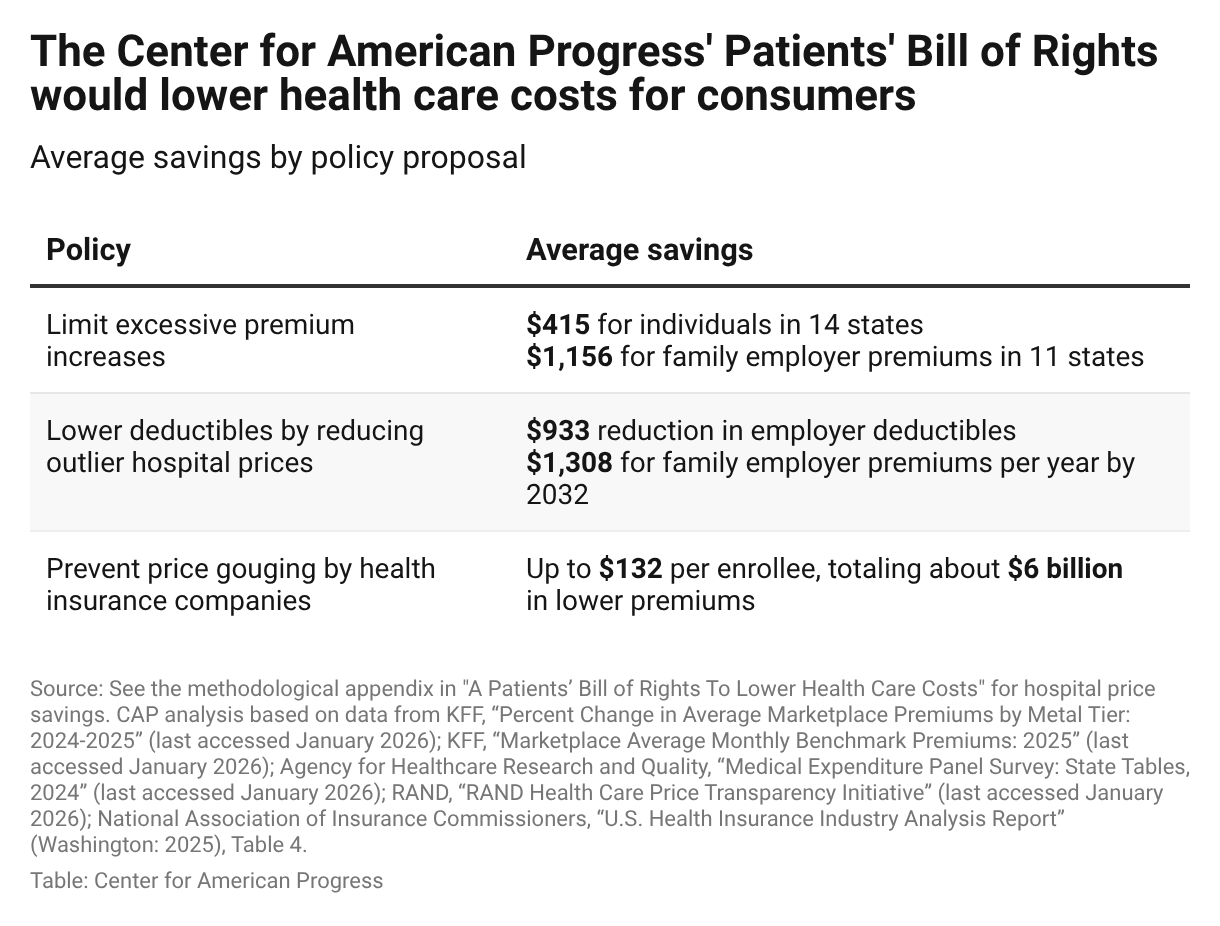
In the year ahead, the Center for American Progress will build upon this reform agenda to propose additional reforms that reduce prescription drug costs.
Appendix: Methodology for hospital price savings
CAP used data collected through the RAND Health Care Price Transparency Initiative. The data include private hospital price and spending information for about 3,000 hospitals for employer-sponsored plans from 2020 through 2022.117 For hospitals with inpatient and outpatient prices above 300 percent of Medicare rates, CAP calculated the percentage reduction in prices down to the 300 percent cap. CAP researchers then proportionally reduced each hospital’s inpatient and outpatient spending. Summed across all hospitals in the sample, the total reduction in hospital spending is 3.55 percent. The CAP report’s authors assume that this sample and resulting percentage reduction are nationally representative.
Nationally, hospital spending accounts for 37.3 percent of private health insurance spending.118 Applying the 3.55 percent reduction to this share translates to a 1.32 percent reduction in private health insurance spending.
This estimate reflects the average effect across all plans, diluted by plans that have few or no hospital prices above the cap. To estimate the concentrated impact for plans affected by the cap, the authors isolated the hospital spending reduction among hospitals affected by the cap, which is 12.71 percent. Applying this reduction to the hospital share of total spending (37.3 percent) translates to a 4.74 percent reduction in private health insurance spending.
This figure assumes that all of a plan’s hospital spending occurs at a hospital with prices above the cap. More realistically, if half of a plan’s hospital spending occurs at hospitals with prices above the cap, the percentage reduction in total spending would be 2.37 percent.
This 2.37 percent reduction in plan spending from the 300 percent cap would correspond with a change in actuarial value (the percentage of total costs paid by the plan) of 1.94 percentage points for a plan with an actuarial value of 80 percent (a reasonable approximation for employer plans).119 Milliman estimates that a deductible decrease of $1,000 would increase actuarial value by 2.08 percentage points for a plan with an actuarial value of 80 percent.120 The Milliman estimate translates to a deductible decrease of $481 per point of actuarial value, or a deductible decrease of $933 for the 1.94 points of financial headroom.
For all hospitals, authors projected spending with the 300 percent cap through 2032 using projected growth in private health insurance spending on hospital care.121 For hospitals with prices above the median 250 percent of Medicare rates, authors projected spending with the 300 percent cap through 2032 using the Congressional Budget Office’s projected growth in the consumer price index, plus 1 percentage point.122 By 2032, the incremental hospital spending reduction from the growth cap alone would be 10.32 percent. Because the hospital share of total spending is projected to be 34.4 percent,123 the reduction in total spending would be 3.55 percent. Projecting the average family premium for employer coverage to 2032,124 the reduction would be $1,308 by 2032.
Source link
