A seat on Trump’s “Board of Peace” costs $1 billion. Guess who gets the money.
Sign up for the Slatest to get the most insightful analysis, criticism, and advice out there, delivered to your inbox daily.
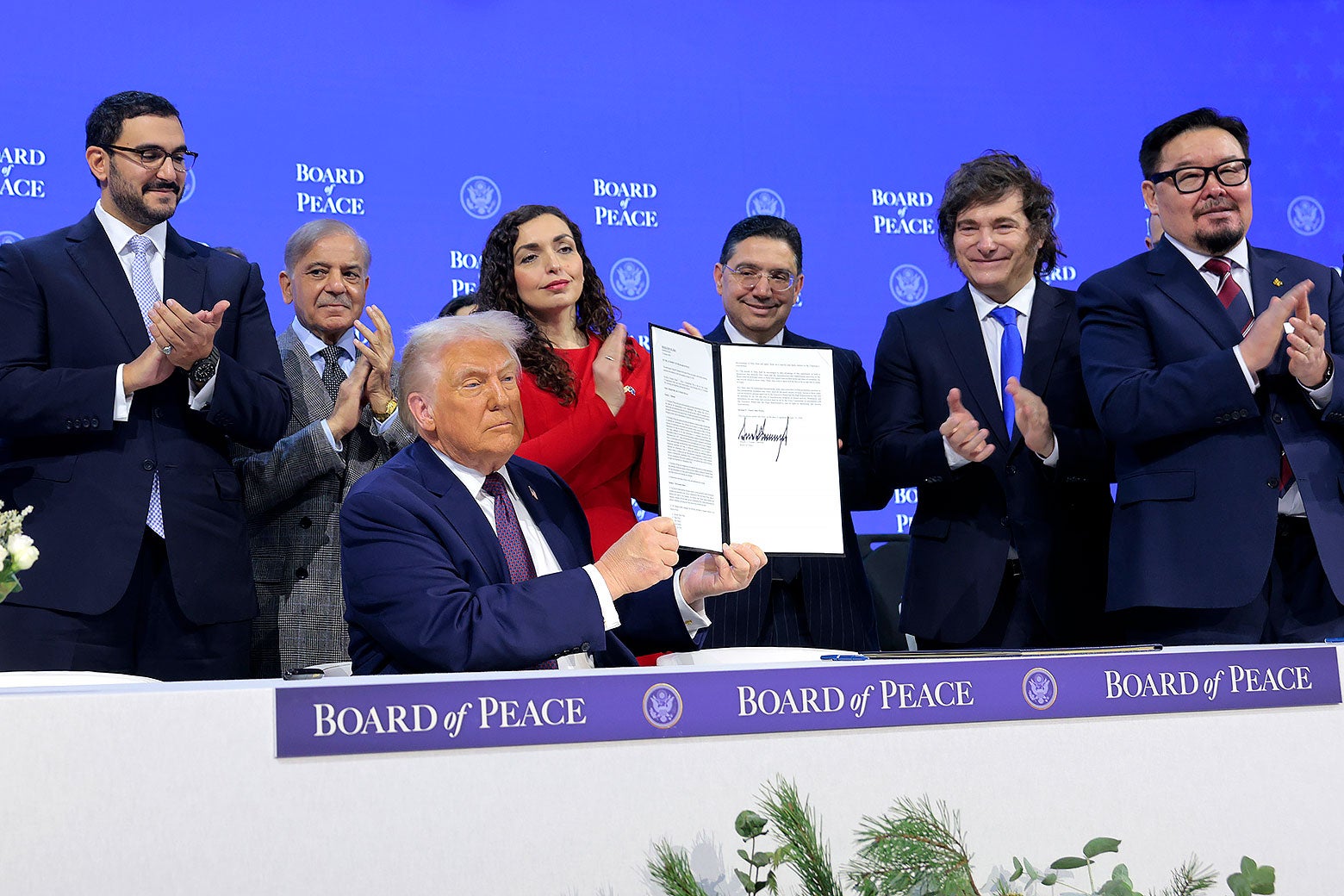
The big question about President Donald Trump’s Board of Peace—which he formally announced while at the World Economic Forum in Davos, Switzerland, last week—is whether it’s a scam, a delusion, or both.
Trump first mentioned a Board of Peace in September during the signing of a ceasefire accord for Israel’s war in Gaza. The idea was that the board would be the forum where Israel, the Palestinian Authority, and other Middle East countries discuss political reforms, reconstruction, and other issues relating to security and long-term peace in Gaza. Trump would chair the board—a role that he improbably insisted wasn’t his idea, but the plan made some sense, given that Trump played a major role in prodding the parties to sign the ceasefire.
However, in the months since, Trump’s vision of the board has—like much else about his presidency—swelled with self-aggrandizement. The board’s charter—which he hasn’t publicized but which the Times of Israel obtained and published—doesn’t mention Gaza at all. Rather, the document states that the board will seek “to promote stability, restore dependable and lawful governance, and secure enduring peace in areas affected or threatened by conflict”—seeming to indicate any sort of conflict, anywhere on earth.
The members on the board will consist of whichever heads of state the chairman, Donald Trump, chooses to invite. Their terms of membership will last three years, unless they pay the board $1 billion, which would buy them lifetime tenure. (Trump is designated as chairman for as long as he likes, certainly beyond the remaining three years of his presidency, gratis.)
The board will decide policies and declare resolutions by majority vote, but the chairman (read: Trump) gets veto power; he can also initiate measures unilaterally, eject members, and choose his own successor.
In other words, the Board of Peace marks yet another episode in Trump’s massive meandering ego trip. More than that, its charter, laid out in formal legalese, is sheer fantasy. It is no surprise that most of the heads of state whom he invited to join, notably those with proven interest in peace and “lawful governance,” have declined.
The naysayers include France, Germany, Greece, Italy, Norway, Slovenia, Sweden, Ukraine, and the United Kingdom—in short, many of our leading allies. Trump retracted his invitation to Canada after its prime minister, Mark Carney, delivered a much-lauded speech at Davos calling on middle-sized countries to avoid unfair pressures from larger powers by banding together. (Trump’s retraction, which he posted on social media, bolsters the impression that this is all about Trump, not world peace.)
Those who have said they will join include Argentina, Albania, Armenia, Azerbaijan, Bahrain, Belarus, Bulgaria, Cambodia, Egypt, El Salvador, Hungary, Indonesia, Israel, Jordan, Kazakhstan, Kuwait, Kosovo, Morocco, Mongolia, Pakistan, Paraguay, Qatar, Saudi Arabia, Turkey, the United Arab Emirates, Uzbekistan, and Vietnam. None of them are members of the U.N. Security Council (which Trump preposterously hopes to supplant), only a few practice “lawful governance,” and even fewer have any experience at seriously mediating conflict. It is not known whether any of them have been foolish enough to pony up the $1 billion initiation fee—nor has Trump or anyone else said who would control this slush fund. (Want to take a guess?)
The leaders of China, India, and Russia are among those who haven’t yet responded. This is no surprise. These are regional, aspiringly global powers who have a serious (if, in some cases, disruptive) interest in matters of war and peace. And they must know that Trump’s Board of Peace is not serious.
In his gushing invitation letter, Trump declared that his goal is to “bring together a distinguished group of nations ready to shoulder the noble responsibility of building LASTING PEACE.” In his snitty retraction letter to Prime Minister Carney, he brayed that Canada would thereby be excluded from “what will be the most prestigious Board of Leaders ever assembled at any time.”
If Trump believes his own hype (always an uncertainty), he reveals here once again that he has no idea what peace, especially “LASTING PEACE,” requires. To the extent Trump currently has the power to elicit feigned respect and sometimes reluctant obedience from other world leaders, it’s because he is president of the United States—meaning that he can exert the tremendous leverage of the world’s main currency and most powerful military.
Once his term in the Oval Office ends in three years, no leader would have any reason to pay him the slightest attention or courtesy. No leaders embroiled in conflict would welcome the mediation of his so-called Board of Peace, much less follow its orders.
Maybe some leaders would consent to a meeting if the board really were composed of “the most prestigious” peacemakers. But look at who, according to a statement from the White House, is on the group’s “founding” executive board: Trump’s globe-trotting emissary, Steve Witkoff, and son-in-law Jared Kushner (whose efforts to end Russia’s war on Ukraine have been especially aimless); Marc Rowan (a billionaire financier who has led Trump’s political pressure campaigns on American universities); Robert Gabriel (a former producer of Laura Ingraham’s TV show who is now Trump’s deputy national security adviser); Secretary of State Marco Rubio (whose influence will fade along with Trump’s at the end of this administration, at least if he remains under his post-presidential thumb); Sir Tony Blair (whose record as Britain’s prime minister still makes many in the Middle East shudder); and Ajay Banga, president of the World Bank.
Banga is an interesting choice: He was nominated to the World Bank by President Joe Biden, he advised Vice President Kamala Harris’ 2024 campaign, and he knows something about world politics. The others, once untethered from a sitting American president, would have no authority in making peace whatsoever.
Even with the power of the White House and the imprimatur of a U.N. Security Council resolution, Trump’s current Board of Peace has been unable to make headway on molding long-term peace in Gaza, the one conflict it was created to help solve. (The Security Council limited the board’s authority solely to rebuilding Gaza and set it to expire at the end of 2027.) The idea that it can roam the globe on its own, ending wars with no base of power or authority, is risible.
If the next president is a Democrat, one of their first tasks will probably be to order the words “Donald J. Trump” to be removed from the august wall of the Kennedy Center. There will, however, be no need to worry about dismantling, or doing anything about, the Trump Board of Peace; it will quickly collapse of its own accord.