

Alex Honnold is climbing Taipei 101 live on Netflix. Is that harder than El Capitan?
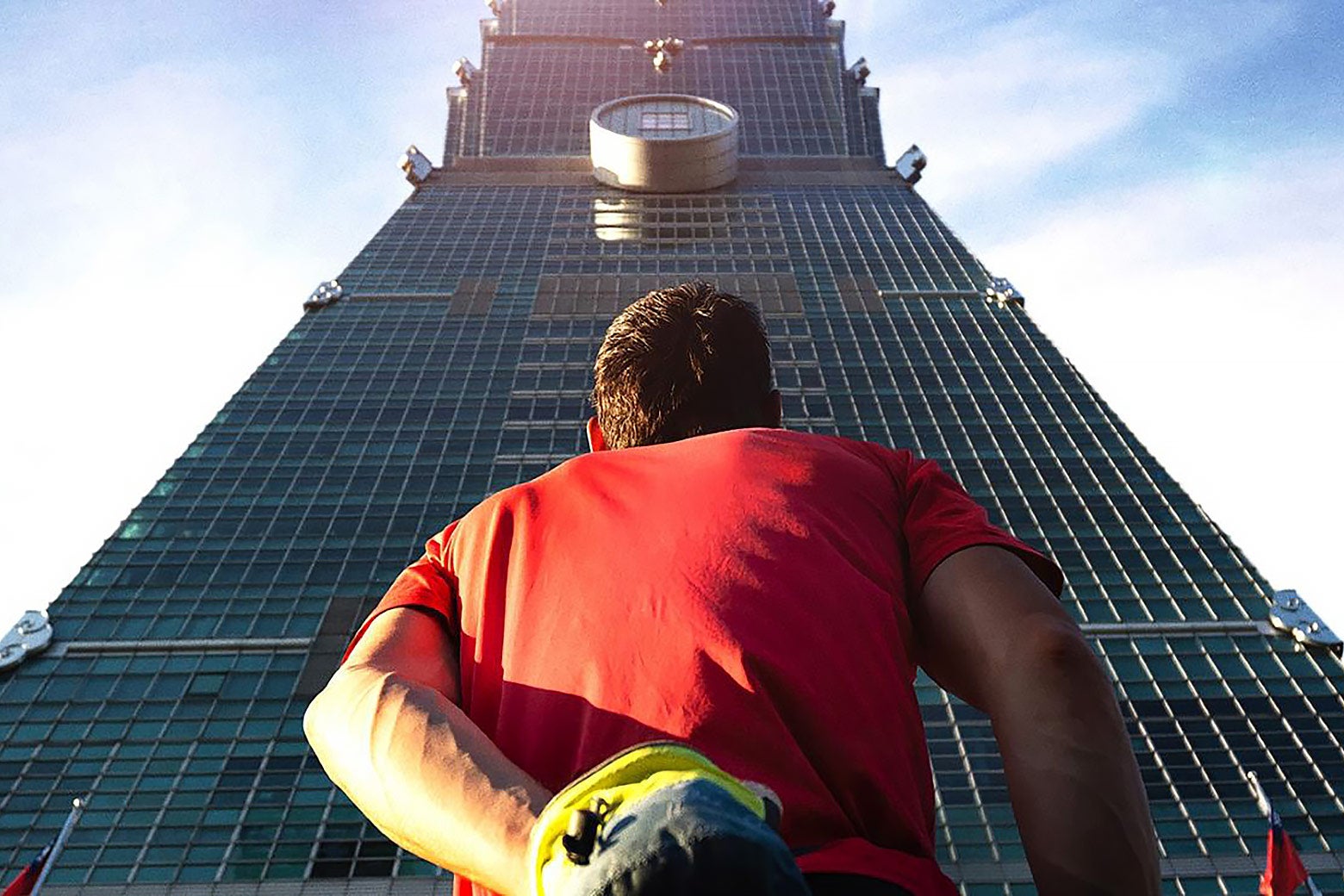
On Friday, Alex Honnold—a world-renowned climber and one of Earth’s most fascinatingly fearless people—is scheduled to climb Taipei 101, the 101-story skyscraper that’s one of the world’s tallest buildings, and he’s going to do it without the assistance of any ropes, harnesses, or safety nets. The proceedings will be broadcast live on Netflix, and the broadcaster has leaned heavily into the lurid stakes. A promotional clip for the special makes the point that Honnold is the father of two young children and that if anything goes wrong during this ascent, he is surely going to die. In that sense, Netflix is betting the house on airing a remarkable athletic achievement, rather than a horrific tragedy.
Honnold is no stranger to those risks. His unassisted ascent of El Capitan was the subject of the Oscar-winning 2018 documentary Free Solo, which interrogated the climber’s curious relationship with mortality. At this point, I think many people tuning in to Netflix to watch the man do what he loves have made peace with the fact that this 40-year-old is never going to change and would probably be doing this whether or not the cameras were rolling. (At least, that’s what I’ve been telling myself.) Still, I’ve harbored a few basic questions about the climb before the big day—questions that I think a lot of my fellow laymen are asking. Seriously, how hard is it to climb a skyscraper?
To be clear, I know the answer is unbelievably hard. But again, Honnold is a legendary athlete who has conquered some of the most dangerous rock walls in the world. How does that compare to a human-made high-rise of glass and steel? Constructed from a blueprint? With balconies, railings, and windowpanes? Is this perhaps less of a challenge than the rugged, uncompromising granite that Honnold has previously clung to for dear life? This is why I reached out to Noah Kane, a Colorado-based climber who has summited cliffs, buildings, and every other formation under the sun—all of which is documented on his 680,000-subscriber-strong YouTube channel. He provided some useful context for what we can expect to see on Friday, though it might not make your palms any less sweaty. This interview has been edited and condensed for clarity.
Slate: First things first. What’s the deal with urban climbing? Is this something a lot of people do? Are people climbing buildings all the time?
Noah Kane: There’s been some prominent urban climbers throughout the years. Alain Robert, better known as the French Spider-Man, is probably the most prominent of the bunch. [Editor’s note: Robert himself climbed Taipei 101 back in 2004, though he did it with a top rope, at the request of Taiwan’s government.] But, yeah, urban climbing is kind of this weird grandchild in the climbing community. Not a lot of people do it, but the people who do are really psyched.
OK, let’s get to the main question here. Is it harder to climb up a rock wall or a building? I am almost certain that the answer is some form of “It depends.”
You’re right! It totally depends. I mean, some buildings are made of solid glass, with no ridges or seams. You’d never be able to climb that unless you had Tom Cruise’s gloves from Mission: Impossible. Maybe, instead, we should zoom in and talk about the experience of climbing Taipei 101 specifically, from what I’ve heard.
Please do!
OK, so from what I hear, to climb Taipei 101, you’re basically doing the same three moves over and over again. It’s two easy moves, and one kinda hard move. And in some interpretations of difficulty, that is more difficult because you’re working the same muscles, which could get tired. Maybe that makes it more challenging than climbing a rock wall, which, by its nature, is going to be more varied.
Right, because obviously a rock wall isn’t going to be totally uniform. There’s a lot more problem-solving at hand.
Yes. I mean, there are some exceptions to that rule. Crack climbing, where you’re scaling a parallel fissure in a wall, is basically going to require you to be doing some repetitive movements. But in general, climbing a natural rock face is more dynamic than that. The difficulty comes from all the different moves you have to do and being able to solve the puzzles that pop up. It’s more taxing for the mind.
Do you know what three moves Honnold will be doing on Taipei 101?
I don’t have a ton of insight on that, but I think the hard move is going to involve his feet, rather than his hands. I’m not 100 percent sure about this, but I think there are some sections where he’s going to have to smear his foot on the glass of the building. In moments like that, you have to trust the texture of your foot, rather than a solid edge.
That does sound pretty daunting.
Yeah. I’ve done a very limited amount of building climbing myself, but those seem to be the more cruxy moments of the medium, just trusting the glass with your climbing shoe. [Editor’s note: Cruxy is a term climbers use to describe the most difficult part of an ascent.] There are a couple clips of Alain Robert slipping on a building. He doesn’t fall, but his foot slips off the glass, and his heart flutters for a second.
I would also imagine that, given that we’re talking about private property, there probably isn’t the same amount of scholarship on different urban climbing routes versus scaling something like El Capitan, which thousands of climbers have done.
Yeah, but you can find some good knowledge here and there. There’s this website called Mountain Project, where people publish climbing routes. You’ll find an occasional building route there. It’ll point you to a location in the middle of Denver, and you’re like, What’s that? And it’s a concrete parking lot. But yes, given its illicit nature, I think people are a lot less willing to advertise those climbs.
So you’re planning on watching Honnold climb Taipei 101. Are you nervous for him?
I am, but I’d be more nervous watching him scale a rock wall. I think there’s more risk to that. Obviously the consequences are equally high if something goes wrong, but again—since it’s those same three moves over and over again—the only thing I could see going wrong is if he gets tired. He’s not going to mess up the sequence after doing it 20 times in a row.
And also if there’s some bad weather. That’s the other risk factor.
Yeah, if it’s raining, obviously it’s a no-go. And it looks like there’s eight different parts of the route where Honnold could bail if some bad weather rolls in. I would also add that Taiwan is a very humid place, and usually in rock climbing you want a low-humidity environment, but with climbing glass and metal, you actually want a little more humidity. It helps the rubber in your shoes and helps you stick a little bit better.
There’s been a lot of talk about the ethics of broadcasting a sporting event where the stakes are such that if something goes wrong, Honnold might die. What do you make of that debate?
It’s an interesting conversation to have. There’s always a healthy discourse about it in the climbing community, between the purists and the professionals who understand that to make a career in climbing or to publicize the sport, events like this can be positive. I’d put myself in the latter category. I recognize that there is a balance between commercializing the sport and staying true to your values. I’ve got nothing but respect for Honnold, and I think this special is going to be pretty cool. I trust him to put the sport out there in a good way. I mean, he’s been doing that for 15 years.
