

When a group of state leaders toured the University of Tennessee Health Sciences’ Memphis campus recently, the elevator they were taking to the College of Medicine on the 10th floor of the 910 Madison Building stalled during the descent.
The brief malfunction was evidence of what students, faculty, staff, alumni, and partners know — the building that houses Tennessee’s only statewide public academic medical school is past its prime.
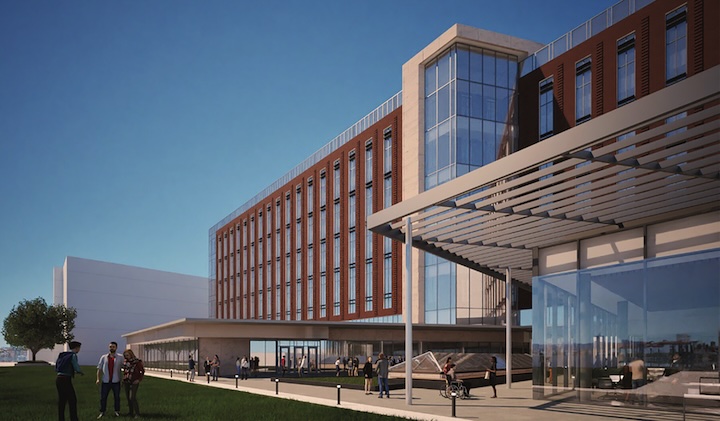
A new $350 million building is proposed for the Memphis campus to house the College of Medicine and serve as a hub for training future health care professionals to practice collaborative, state-of-the-art care.
Appropriately named the College of Medicine Interdisciplinary Building (COMIB), it represents “an investment for Tennessee,” said Executive Vice Chancellor and Chief Operating Officer Raaj Kurapati, who is leading the project.
“This is an investment in continuing to meet the significant deficit in physicians and physician assistants in the state of Tennessee, with projections suggesting that there will be a need for 6,000 additional physicians in the state by 2030.” Additionally, demand for interdisciplinary roles is expected to grow, such as nurse anesthetists by 40% and physician assistants by 28%.
The Big Impact
Initial planning aims to optimize workspace, allow for growth and increased public-private partnerships, and facilitate more internal and external collaborations.
The proposed building allows room to expand the medicine class from 175 to 225 per cohort. There will also be space for the Physician Assistant Program to grow from 30 to 60 students a year.
New technology will facilitate interdisciplinary training. A specialty simulation space will allow for collaborative disaster and emergency response training, as well as other scenarios that demand health care providers in different fields to work together seamlessly. The building will also provide a hub for telehealth training in multiple fields.
State-of-the-art technology will support an increase in the use of online educational opportunities for the College of Medicine and other colleges and allow for eventual increases in the number of academic certificate programs and enrollment in those programs.
The building is expected to enhance the university’s response to rural health care challenges in Tennessee, expanding medical education, rural health training, and multidisciplinary team care.
Once constructed, the new facility will enable the university to graduate an additional 1,450 health care professionals practicing in various fields over its first five years of operation.
Today
Currently, the College of Medicine is housed in the 910 Madison Building, which along with the 920 and 930 Madison Buildings comprise the Madison Plaza complex on the south side of Madison Avenue. Built in the 1960s as hospital and hotel space, the complex was donated to the university by Baptist Health Care System when it reduced its footprint in downtown Memphis.
“Our folks have done a commendable job over the years at trying to make the best use of that space to accommodate our colleges,” Kurapati said. “The space was not built to accommodate the needs of learning, to accommodate teaching, to accommodate clinical support and service for an academic setting.”
 news.uthsc.edu/wp-content/uploads/sites/4/2026/02/251002_InterdisciplinaryBuildingModel_JJ_45-1.jpg?resize=1024%2C683&ssl=1″ alt=”” class=”wp-image-78042″ srcset=”https://i0.wp.com/news.uthsc.edu/wp-content/uploads/sites/4/2026/02/251002_InterdisciplinaryBuildingModel_JJ_45-1-scaled.jpg?resize=1024%2C683&ssl=1 1024w, https://i0.wp.com/news.uthsc.edu/wp-content/uploads/sites/4/2026/02/251002_InterdisciplinaryBuildingModel_JJ_45-1-scaled.jpg?resize=300%2C200&ssl=1 300w, https://i0.wp.com/news.uthsc.edu/wp-content/uploads/sites/4/2026/02/251002_InterdisciplinaryBuildingModel_JJ_45-1-scaled.jpg?resize=768%2C512&ssl=1 768w, https://i0.wp.com/news.uthsc.edu/wp-content/uploads/sites/4/2026/02/251002_InterdisciplinaryBuildingModel_JJ_45-1-scaled.jpg?resize=1536%2C1024&ssl=1 1536w, https://i0.wp.com/news.uthsc.edu/wp-content/uploads/sites/4/2026/02/251002_InterdisciplinaryBuildingModel_JJ_45-1-scaled.jpg?resize=2048%2C1365&ssl=1 2048w, https://i0.wp.com/news.uthsc.edu/wp-content/uploads/sites/4/2026/02/251002_InterdisciplinaryBuildingModel_JJ_45-1-scaled.jpg?resize=640%2C427&ssl=1 640w, https://i0.wp.com/news.uthsc.edu/wp-content/uploads/sites/4/2026/02/251002_InterdisciplinaryBuildingModel_JJ_45-1-scaled.jpg?resize=1200%2C800&ssl=1 1200w, https://i0.wp.com/news.uthsc.edu/wp-content/uploads/sites/4/2026/02/251002_InterdisciplinaryBuildingModel_JJ_45-1-scaled.jpg?resize=1920%2C1280&ssl=1 1920w” sizes=”(max-width: 639px) 98vw, (max-width: 1199px) 64vw, 770px”/>
The new building would be situated across from the Madison Plaza between the College of Pharmacy Building at 881 Madison and the old Holiday Inn at the corner of Madison and Pauline Street, which is in the final stage of demolition.
“We have a home for the College of Nursing, we have a home for the College of Pharmacy, we have a home for the College of Dentistry,” Kurapati continued. “Our largest college is the College of Medicine, and we don’t have a home for them that’s specifically dedicated to them.”
A Brighter Future
The project is the UT System’s No. 1 capital priority for 2026, recognizing UT Health Sciences’ statewide vision to improve overall health in Tennessee, which currently ranks near the bottom for health outcomes. Funding for the building was also included in Governor Bill Lee’s proposed budget for Tennessee.
UT Health Sciences leaders have expressed deep gratitude for both measures of support, reminding the UTHS community that the proposed project remains at the beginning—not the end—of the legislative process.
University leaders have been making the case for the new building with state government and legislative leaders, business and community leaders, and friends and supporters of the university, presenting the current state of the College of Medicine space versus that of the college’s competitors for faculty and students.
“This building is not only about ensuring that we have the type of spaces that our students deserve, modern learning environments, appropriate technology incorporated into the dynamic didactic and clinical settings that our students should rightfully have access to, but it’s also about ensuring that we’re able to stay current with the competition,” Kurapati said. “We are significantly behind the competition when it comes to the type of facilities that are out there and available currently to students seeking to pursue a career in medicine.”
“This is an investment in the state of Tennessee, as while UT Health Sciences’ home campus is in Memphis, it carries out a statewide mission through campuses in Chattanooga, Nashville, Knoxville, and nearly 800 clinical sites across the state,” Kurapati said.
news.uthsc.edu/wp-content/uploads/sites/4/2026/02/Building-3-copy.jpg?resize=720%2C421&ssl=1″ alt=”” class=”wp-image-78043″ style=”aspect-ratio:1.7102772519763947;width:794px;height:auto” srcset=”https://i0.wp.com/news.uthsc.edu/wp-content/uploads/sites/4/2026/02/Building-3-copy.jpg?w=720&ssl=1 720w, https://i0.wp.com/news.uthsc.edu/wp-content/uploads/sites/4/2026/02/Building-3-copy.jpg?resize=300%2C175&ssl=1 300w, https://i0.wp.com/news.uthsc.edu/wp-content/uploads/sites/4/2026/02/Building-3-copy.jpg?resize=640%2C374&ssl=1 640w” sizes=”(max-width: 639px) 98vw, (max-width: 1199px) 64vw, 720px”/>A strategic space inventory of the campus was done prior to the initial programming for the building to determine how it could support the current campus infrastructure and meet future needs.
HOK, a global design, architecture, engineering, and planning firm, conducted the inventory and designed the programming for the proposed building.
In August, the state approved the university’s spending up to $10 million to allow for planning and design of the building.
The university has selected brg3s architects, a Memphis-based firm with a long history in health care, to design the building and work in collaboration with HOK.
If the funding for the project is provided in the state budget, the university is working to position itself to begin construction in the late summer of 2026.
“I think this is one of those landmark events at a college of medicine,” said UT Health Sciences’ College of Medicine Executive Dean Michael Hocker, MD. “Thanks to the state-of-the-art technology, we’ll be able to expand interprofessional education, which is really how we practice medicine.”
The Numbers
$350 million
275,000 to 300,000 Sq. ft.
175 to 225: Expansion of annual medicine cohort
30 to 60: Expansion of annual physician assistant cohort
1,450: Additional health care professionals graduate in first five years of operation
16,935 sq. ft.: Public spaces (including lobby, wellness/quiet rooms, interdisciplinary health commons, student study rooms, seminar rooms)
38,300 sq. ft.: Academic and support spaces (flexible configuration to meet cohort needs)
17,000 sq. ft.: Interdisciplinary space (digital health and innovation space, specialty simulation area, external partnership space, health incubator, and technology innovation lab)
Tentative timeline if funded: Construction starting in late summer 2026 and completion in mid-2029.
This story appeared first in the Winter issue of Medicine magazine. To learn more about this proposed project and how you can support it, contact Kelly Davis, executive director of development, at kdavis@uthsc.edu.
Related
news.uthsc.edu/an-investment-in-tennessee-proposed-medicine-building-stands-to-improve-health-care-in-tenn/”>Source link
