

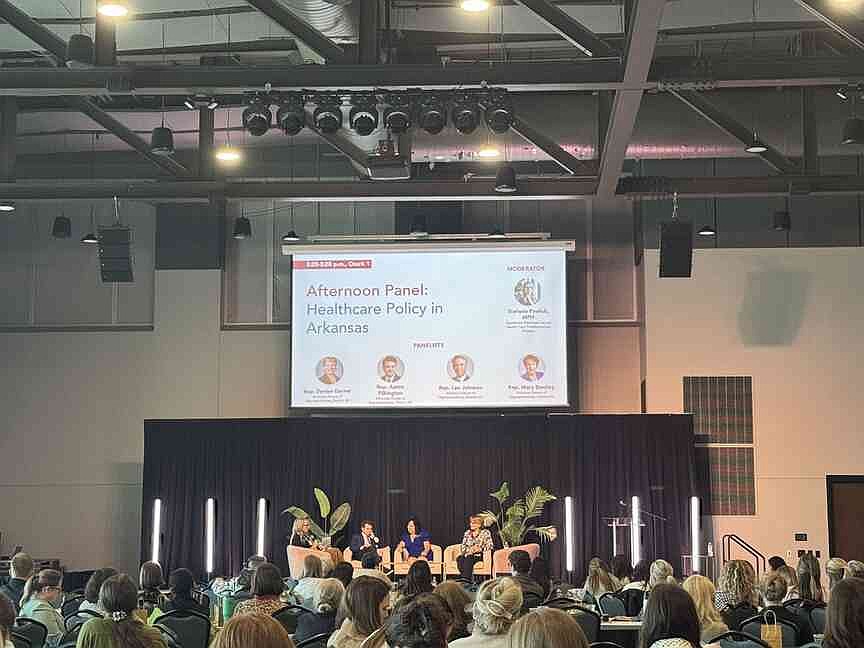
FAYETTEVILLE — Health care workers are the foot soldiers in the battle to improve care in Arkansas, and legislators need their input to make sure state policies and programs are having the most impact, according to state Rep. Aaron Pilkington.
Providers should be inviting legislators to their facilities, hospitals, clinics and so on to show them what is being done there, Pilkington, R-Clarksville, said.
“If we’re going to improve maternal health, improve mental health, improve health all around, we need your help,” Pilkington told those attending the recent Northwest Arkansas Health Summit in Fayetteville.
State Rep. Denise Garner, D-Fayetteville, agreed. A big part of legislators’ jobs is trying to educate both providers and the general public about what their legislators are doing, how they’re doing it and why. Another part is receiving feedback on the policies and programs they are passing and seeking to have implemented, she said.
“We don’t know what’s broken unless you tell us,” Garner said. “When you tell us something that’s not working, then we can come back and try to fix it.”
In order for improvement to happen via legislation, providers need to foster relationships with their legislators, state Rep. Mary Bentley, R-Perryville, said.
“Our greatest ideas come from people that are actually working day to day in health care,” Bentley said.
Some policies have already been enacted, and now they just need to be properly implemented, Pilkington said.
As an example, he mentioned the Healthy Moms Healthy Babies Act, which he said needs to be more integrated into rural health care.
Gov. Sarah Huckabee Sanders issued an executive order in March 2024 establishing the Arkansas Strategic Committee for Maternal Health in Arkansas in an effort to expand maternal health services. The Community Clinic served on a subcommittee of that group and suggested things like the expansion of Medicaid coverage for doulas and community health workers and creating midwifery education programs, according to a news release from the clinic.
Lawmakers later approved and Sanders signed the Healthy Moms, Healthy Babies Act into law in February 2025, which aimed to provide more efficient Medicaid enrollment for pregnant women and allowed insurance coverage for doula and midwifery services.
Pilkington said one barrier to these things being implemented in rural health care systems could be providers just trying to keep their head above water. With all that each individual hospital or clinic has to deal with on a daily basis, providers may not have time to even educate themselves on new policies, let alone put them into action, he said.
According to a newsletter penned by Garner and hosted on the Arkansas House of Representatives website, about 45% of the state’s population — roughly 1.3 million people — live in rural areas, and 63 of 75 counties qualify as fully rural for federal program purposes.
Many residents travel 25 to 35 miles to reach a hospital or specialty clinic, the newsletter states. Nearly half of rural hospitals in the state are considered vulnerable to closure, and workforce shortages continue to strain providers. Rural communities also face higher rates of chronic disease, lower median incomes and greater reliance on public insurance coverage.
SEEKING A TRANSFORMATION
During the summit, Stefanie Pawluk of the Northwest Arkansas Council’s Health Care Transformation Division asked legislators what they hope to see from the Arkansas Rural Health Transformation Program.
Arkansas received approximately $208.8 million in late December as its first installment from the Rural Health Transformation Program. The program was established by the One Big Beautiful Bill Act signed by President Donald Trump in July for the federal fiscal year that began Oct. 1. The state’s portion of funding is slightly higher than the initial $200 million it requested in October.
All 50 states received $100 million as a fixed funding amount, plus a varying level of additional assistance based on an internal formula involving factors such as rural population, proportion of health facilities in rural areas and situations of certain hospitals, according to the federal Centers for Medicare and Medicaid Services. Rural Health Transformation Program payouts are scheduled to be distributed over a five-year period, with relative state-level amounts possibly shifting year-to-year.
Pilkington said he hopes to see new ideas and processes submitted to the rural transformation program put into place as well as sustainability and return on investment.
“Rural health care is broken in Arkansas,” Pilkington said. “So we’ve got to be really inventive if we’re going to figure our way out of this.”
The exciting part of something like the Arkansas Rural Health Transformation Program is that providers get to be inventive and be a laboratory for how to improve health care, he added.
Bentley said she’s excited to see more from programs already in use, like the University of Arkansas for Medical Sciences Institute for Community Health Innovation Food is Medicine program. She said getting Arkansans more educated about healthy eating and addressing issues like diabetes is an important part of improving health in Arkansas.
“We don’t have a health care system; we have a sick care system,” Garner added. “So we’ve got to get back to health care and making sure that folks understand what healthy lifestyle really is.”
Garner said one of the things that’s exciting to her is the rural health program being a collaborative regional effort. She said not only are health care providers across the state patient-centered, but they’re looking at ways they can work together.
The more stakeholders they have at the table, the better their decisions, she added.
A WORKFORCE MINDSET
Bentley said some policies in the works are centered around workforce. She’s hoping to see money spent on proper training for health care workers and more residencies open up in the state for students graduating so they’re more likely to stay in the state and fill out the workforce here.
Bentley said she has already passed legislation working with the Arkansas Healthcare Association to allow certified nursing assistant’s to earn as they learn to acquire a certified medication assistants and then a licensed practical nurse or LPN degree.
Act 672 of 2023, also known as the Earn-to-Learn Act, passed in April of 2023. It established nursing “earn-to-learn” programs to authorize a nursing student to earn direct patient care clinical credit hours for working in a health care facility in certain jobs.
According to a 2023 report by the Arkansas Center for Health Improvement, the number of medical school graduates in Arkansas has surpassed the number of residency slots each year since 2021.
In 2023, the state had 356 residency slots available, while a total of 401 students graduated from Arkansas’ three medical schools, the report found.
In the center’s latest study in March, it found a total of 972 newly licensed physicians in Arkansas reported completing their residency between 2021 and 2025, and 562 of those physicians completed their residency in Arkansas. Overall, 308 physicians had both residency training and medical school education in Arkansas, the study states.
According to data from this year’s UAMS match day for medical students, Dr. Becky Latch, associate dean of student affairs at the university’s College of Medicine, said during a ceremony at the Benton Event Center that 47% of 164 UAMS seniors were entering a primary care field, such as pediatrics, family medicine or OB-GYN medicine. The remainder were going into more specialized areas.
According to Latch, about 45% of the students will be completing their residencies in Arkansas.
Just over half of UAMS students — 55% — matched with hospitals or clinics outside the Natural State, the same percentage as last year. Their journeys will continue in places as far as Hawaii, Massachusetts and Minnesota.
This coverage was made possible by donations to the Northwest Arkansas Democrat-Gazette Community Journalism Project. Jada Robison can be reached by email at [email protected].
news/2026/apr/11/arkansas-legislators-seek-input-from-health-care/”>Source link
