

Astronomers Capture Two Giant Planets Forming in Real Time Around Distant Star
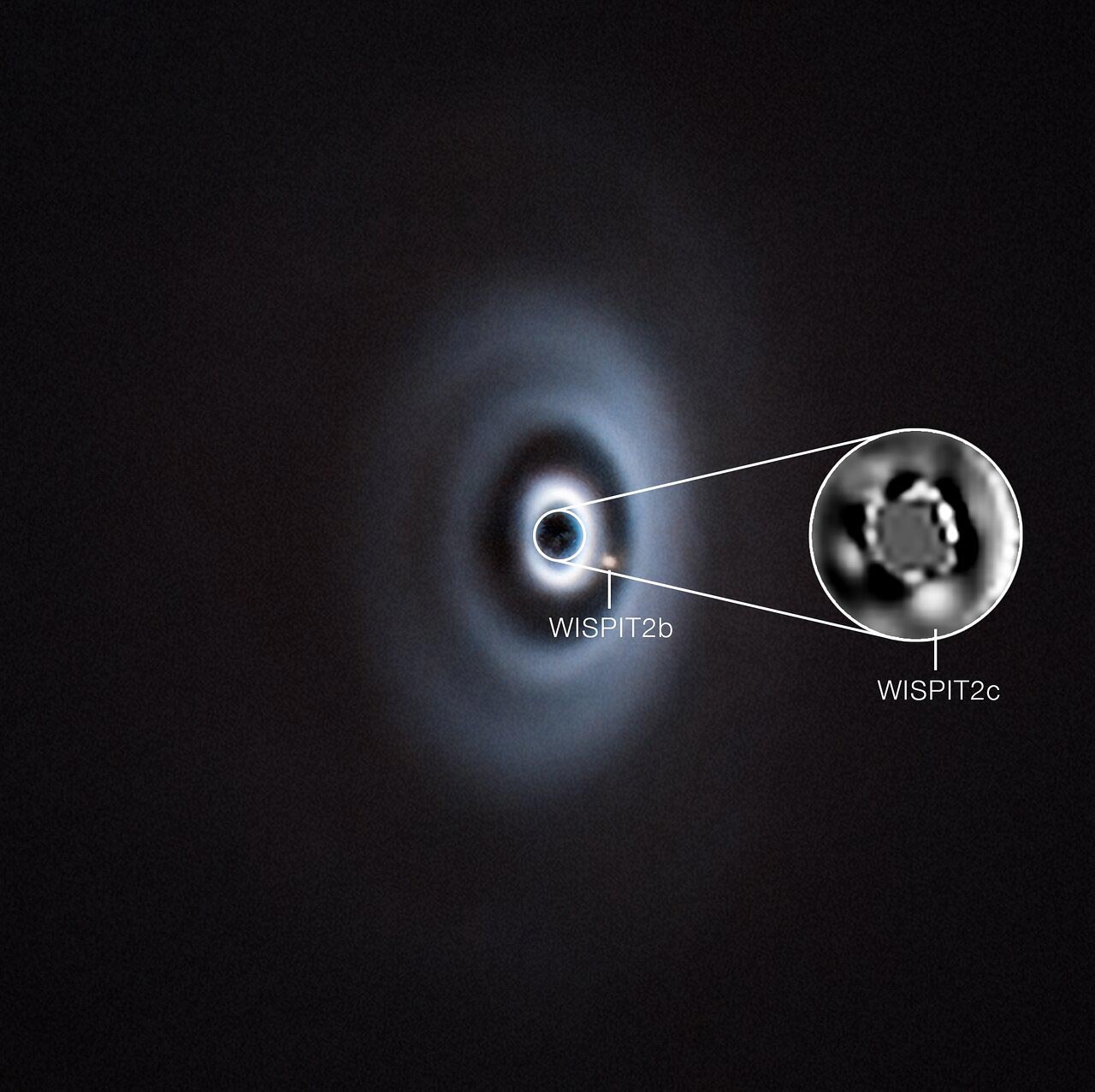
Astronomers have spotted two giant planets forming around a young star—offering a stunning glimpse of how our Solar System may have begun.
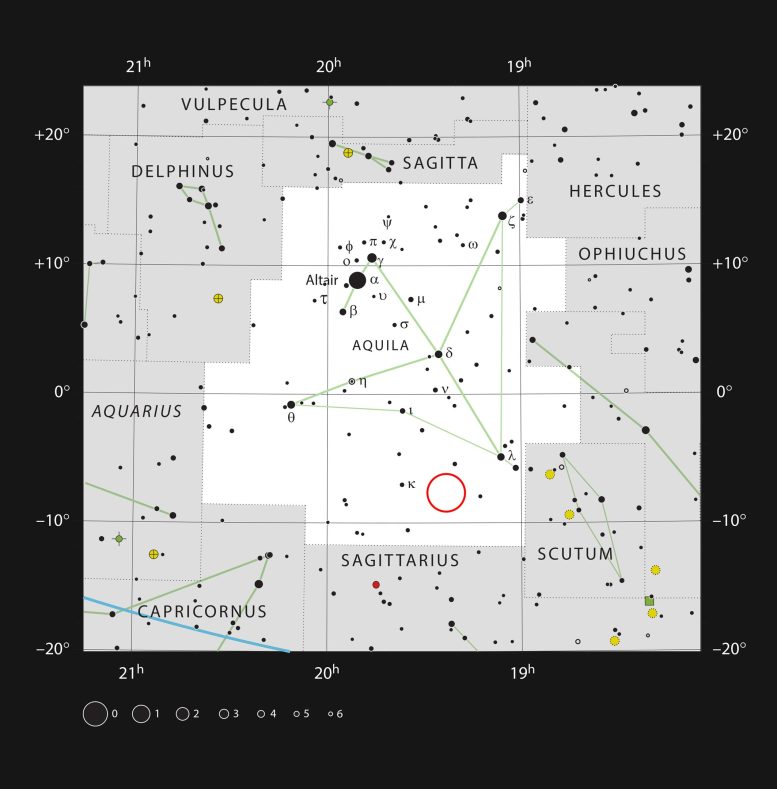
Astronomers have identified two planets in the process of forming within the disc of gas and dust surrounding a young star called WISPIT 2. One planet had been spotted earlier, and new observations using telescopes from the European Southern Observatory (ESO) have now confirmed a second. The structure of the surrounding disc, marked by distinct features, suggests this system may resemble an early version of our own Solar System.
“WISPIT 2 is the best look into our own past that we have to date,” says Chloe Lawlor, PhD student at the University of Galway, Ireland, and lead author of the study published today (March 24) in The Astrophysical Journal Letters.
Rare System Reveals Multiple Planets in Formation
This is only the second known system, after PDS 70, where astronomers have directly observed two planets forming around the same star. WISPIT 2 stands out because its planet-forming disc is especially large and shows clear rings and gaps. According to Lawlor, “These structures suggest that more planets are currently forming, which we will eventually detect.”
“WISPIT 2 gives us a critical laboratory not just to observe the formation of a single planet but an entire planetary system,” says Christian Ginski, study co-author and researcher at the University of Galway. Observing systems like this helps scientists piece together how young planetary systems grow and eventually resemble mature systems like our own.
Giant Planets WISPIT 2b and 2c Confirmed
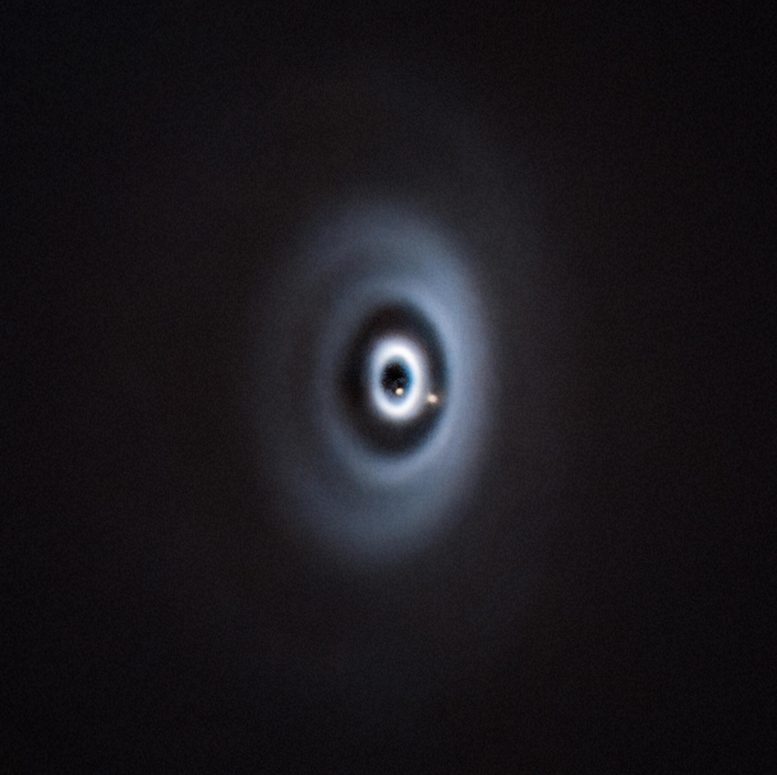
The first planet discovered in this system, WISPIT 2b, was reported last year. It has nearly five times the mass of Jupiter and orbits its star at a distance about 60 times greater than the distance between Earth and the Sun. “This detection of a new world in formation really showed the amazing potential of our current instrumentation,” said Richelle van Capelleveen, PhD student at Leiden Observatory, the Netherlands, and leader of the earlier study.
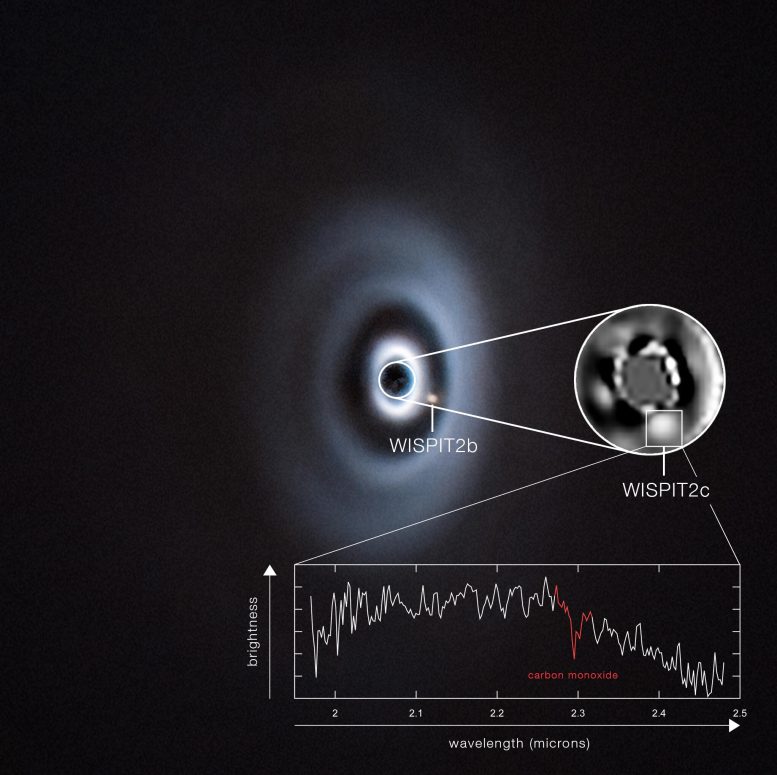
After astronomers noticed another object close to the star,[1] they used ESO’s Very Large Telescope (VLT) and the VLT Interferometer (VLTI) to confirm it was also a planet. This second world, WISPIT 2c, orbits much closer to the star, about four times nearer than WISPIT 2b, and has roughly double its mass. Both planets are gas giants, similar to Jupiter and the other outer planets in our Solar System.
Advanced ESO Instruments Enable Discovery
To verify WISPIT 2c, researchers used the SPHERE instrument on ESO’s VLT to capture direct images. They then relied on the GRAVITY+ instrument on the VLTI to confirm the object’s planetary nature. “Critically, our study made use of the recent upgrade to GRAVITY+ without which we would not have been able to get such a clear detection of the planet so close to its star,” says Guillaume Bourdarot, study co-author and researcher at the Max Planck Institute for Extraterrestrial Physics, Garching, Germany.
This video zooms into WISPIT 2, a young star surrounded by a disc of gas and dust where at least two planets are being born.
Disc Gaps and Rings Reveal Planet Formation
Both planets sit within clearly defined gaps in the disc that surrounds WISPIT 2. These gaps form as material in the disc gathers together under gravity, gradually building up into a developing planet. As the forming planet pulls in nearby material, it leaves behind a gap, while the remaining dust and gas create ring-like patterns around it.
Possible Third Planet May Be Forming
Beyond the two known gaps, astronomers have also identified a smaller gap farther out in the disc. “We suspect there may be a third planet carving out this gap,” says Lawlor, “potentially of Saturn mass owing to the gap’s being much narrower and shallower.” Researchers hope to study the system further, and Ginski notes that “with ESO’s upcoming Extremely Large Telescope, we may be able to directly image such a planet.”
Notes
- The first hints of the presence of a second planet came from observations made with the University of Arizona’s MagAO-X on the 6.5-metre Magellan Telescopes in Chile and the University of Virginia’s LMIRcam on the Large Binocular Telescope Interferometer in the USA.
Reference: 24 March 2026, The Astrophysical Journal Letters.
DOI: 10.3847/2041-8213/ae4b3b
The team is composed of C. Lawlor (School of Natural Sciences, Centre for Astronomy and Ryan Institute, University of Galway, Ireland [Galway]), R. F. van Capelleveen (Leiden Observatory, Leiden University,The Netherlands [Leiden]), G. Bourdarot (Max Planck Institute for Extraterrestrial Physics, Garching, Germany [MPE]), C. Ginski (Galway and Center for Astronomical Adaptive Optics, Department of Astronomy, University of Arizona, Tucson, USA [CAAO]), M. A. Kenworthy (Leiden), T. Stolker (Leiden), L. Close (CAAO), A. J. Bohn (Leiden), F. Eisenhauer (MPE and Department of Physics, Technical University of Munich, Garching, Germany), P. Garcia (Faculdade de Engenharia, Universidade do Porto, Portugal and CENTRA – Centro de Astrofísica e Gravitação, IST, Universidade de Lisboa, Portugal), S. F. Honig (School of Physics and Astronomy, University of Southampton, United Kingdom), J. Kammerer (European Southern Observatory, Garching Germany), L. Kreidberg (Max Planck Institute for Astronomy, Heidelberg, Germany), S. Lacour (LIRA, Observatoire de Paris, Université PSL, CNRS, Sorbonne Université, Université de Paris, Meudon, France), J.-B. Le Bouquin (Univ. Grenoble Alpes, CNRS, IPAG, Grenoble, France), E. Mamajek (Jet Propulsion Laboratory, California Institute of Technology, Pasadena, California, USA), M. Nowak (LIRA), T. Paumard (LIRA), C. Straubmeier (1st Institute of Physics, University of Cologne, Germany), N. van der Marel (Leiden) and the exoGRAVITY Collaboration.
Never miss a breakthrough: Join the SciTechDaily newsletter.
Follow us on Google and Google News.
Source link