

Astronomers Detect Strange “Chirp” From a Supernova, Revealing Hidden Physics
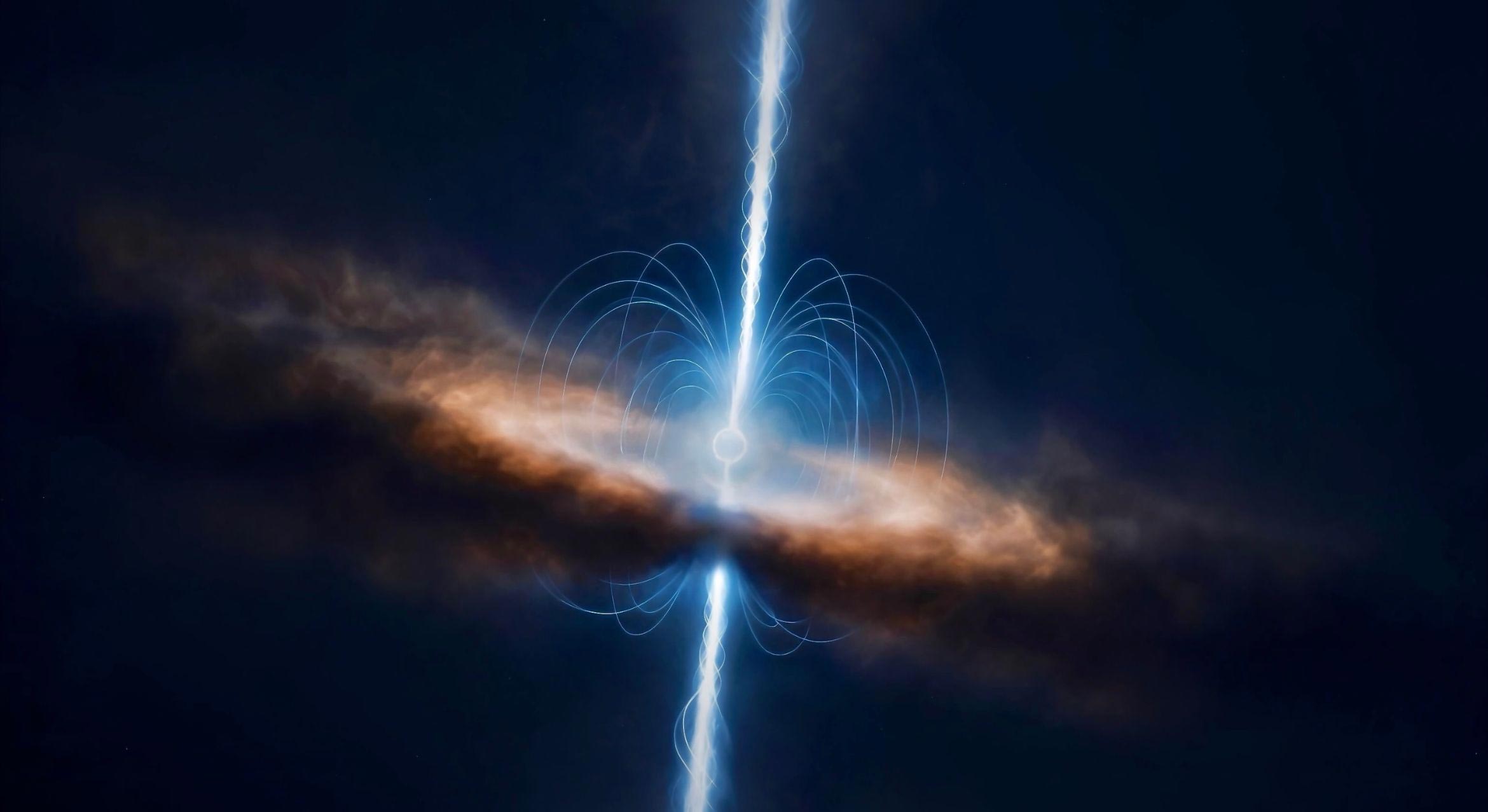
Astronomers studying a distant superluminous supernova uncovered a strange pattern hidden in its light: a rapidly accelerating “chirp.”
For decades, astronomers have used distant supernova explosions as cosmic beacons to study fundamental physics and measure properties of the universe. While examining one such event, Joseph Farah, a fifth-year graduate student at UC Santa Barbara, noticed something unusual. The light from the explosion appeared to produce a “chirp.”
In a study published in the journal Nature, Farah and an international team of researchers report the discovery of an unusual superluminous supernova called SN 2024afav. The team includes Farah’s advisor Andy Howell, who leads the supernova research group at Las Cumbres Observatory (LCO). The strange behavior of this explosion has provided strong evidence supporting a long-proposed explanation for how massive stars die. By applying ideas from general relativity to the violent collapse of a massive star, the researchers developed a model that accounts for the unusual patterns seen in these exceptionally bright explosions.
The mystery of the bumps
When a massive star runs out of nuclear fuel, its core collapses under its own gravity, and the star explodes as a supernova. Most supernovae brighten and fade in a smooth and predictable pattern.
Some rare explosions, however, shine 10 to 100 times brighter than typical supernovae. Known as superluminous supernovae, these powerful events still puzzle astronomers because their energy source remains uncertain. Their light curves often contain strange fluctuations, brief increases in brightness that appear as bumps and hint at complex processes inside the expanding debris.
Scientists have suggested two main explanations. One possibility is that the energy comes from within the explosion. In this scenario, the collapsing core forms a neutron star, an extremely dense stellar remnant that pumps energy into the expanding material, boosting the brightness.
Another explanation involves interactions outside the star. The outward-moving shock wave from the supernova may collide with shells of gas surrounding the star. When the blast wave strikes this material, it can briefly make the supernova shine brighter.
Astronomers at LCO closely monitored SN 2024afav, located about one billion light-years from Earth. Their observations revealed a series of repeating brightness fluctuations.
Farah realized the pattern was not random. The bumps followed a smooth repeating cycle, and the time between them was rapidly shrinking. For the first time, astronomers had seen a supernova produce a quasi-periodic signal whose frequency increased over time, creating a “chirp” similar to gravitational wave signals produced when black holes merge.
“There was just no existing model that could explain a pattern of bumps that get faster in time,” said Farah. “I started thinking about ways this could happen, because the signal seemed too structured to be due to random interactions.”
A magnetar under the hood
Farah’s breakthrough thinking came from an unlikely source: a General Relativity class he was auditing at the time with leading relativist and UCSB Professor Gary Horowitz. Farah hypothesized that the supernova had left behind a magnetar, a rapidly spinning neutron star with a massive magnetic field. In the existing theory, a magnetar can power a supernova like a battery, pumping in energy from within, leading to an ultra-bright and smooth rise and fall. But this theory can’t explain the bumps, which could be caused by anything from interactions with surrounding material to unexplained deviations in the power output of the magnetar.
According to Farah’s model, some material from the explosion fell back toward the magnetar, forming a tilted accretion disk. Because of a General Relativity effect known as Lense-Thirring precession, the fabric of space-time itself is twisted by the spinning magnetar, causing the disk to wobble. As the disk precessed, it periodically blocked and reflected light from the magnetar, turning the whole system into a strobing cosmic lighthouse. The precession timescale decreases with the radius of the disk; so as the disk slides inward towards the magnetar, the disk wobbles faster, creating the “chirp” observed by telescopes on Earth.
Lense-Thirring precession isn’t the only effect that can make a disk wobble. Working with theorist Logan Prust (a former postdoctoral scholar at UCSB’s Kavli Institute for Theoretical Physics), Farah and his team investigated several alternatives. What makes SN 2024afav unique — and a particularly effective test bed for these theories — is that any model needs to explain both the period and the period rate-of-change observed in the data. “We tested several ideas, including purely Newtonian effects and precession driven by the magnetar’s magnetic fields, but only Lense-Thirring precession matched the timing perfectly,” Farah explained. “It is the first time General Relativity has been invoked to describe the mechanics of a supernova.”
A Victory for Global Observation
The discovery was a “mad dash” involving a global network of telescopes. While the ATLAS survey discovered the initial flash in December 2024, the LCO in Goleta played a pivotal role, tracking the event for over 200 days. During this extended campaign, the team took maximal advantage of the full suite of LCO’s instruments and ability to near-continuously survey any target. Observation parameters were adjusted on-the-fly to capture even the faintest bumps in SN 2024afav’s evolution.
“This is a major victory for LCO,” said Farah. “The uniquely pristine and high-cadence LCO data allowed us to predict future bumps, and the ability to dynamically adjust the campaign on a dime let us check our predictions in real-time. When the predictions started coming true, we knew we were watching something special.”
The paper is being hailed as a breakthrough for two reasons. As the first observed “chirp” in a supernova, it identifies a new class of observational phenomena in exploding stars. It also provides the first unambiguous confirmation of the magnetar model for superluminous supernovae, transforming the model from one of several competing hypotheses into an observationally confirmed mechanism.
The Next Frontier
Farah, who is set to defend his Ph.D. thesis at UCSB this May, will continue his work as a Miller Fellow of the Miller Institute for Basic Science at UC Berkeley, working alongside Professor Dan Kasen — the physicist who originally proposed the magnetar model.
Farah’s advisor, Andy Howell, emphasized the importance of the breakthrough: “I was part of the discovery of superluminous supernovae almost 20 years ago, and at first we didn’t know what they were. Then the magnetar model was developed and it seemed like it could explain the astounding energies needed, but not the bumps.
“Now, I think Joseph has found the smoking gun,” Howell continued, “and he’s tied the bumps into the magnetar model, and explained everything with the best-tested theory in astrophysics – General Relativity. It is incredibly elegant.”
Farah expects to find dozens more of these “chirping” supernovae as the Vera C. Rubin Observatory in Chile prepares to come online and begin the most comprehensive survey of the night sky. The new facility will produce 10 terabytes of data every night throughout a ten-year initiative. “This is the most exciting thing I have ever had the privilege to be a part of. This is the science I dreamed of as a kid,” Farah said. “It’s the universe telling us out loud and in our face that we don’t fully understand it yet, and challenging us to explain it.”
Reference: “Lense–Thirring precessing magnetar engine drives a superluminous supernova” by Joseph R. Farah, Logan J. Prust, D. Andrew Howell, Yuan Qi Ni, Curtis McCully, Moira Andrews, Harsh Kumar, Daichi Hiramatsu, Sebastian Gomez, Kathryn Wynn, Alexei V. Filippenko, K. Azalee Bostroem, Edo Berger and Peter Blanchard, 11 March 2026, Nature.
DOI: 10.1038/s41586-026-10151-0
Never miss a breakthrough: Join the SciTechDaily newsletter.
Follow us on Google and Google News.
Source link
