

Berlin still shivering amid power outage – DW – 01/05/2026
This year will be ‘decisive’ for security, German foreign minister says
2026 is a “decisive” year for European security, German Foreign Minister Johann Wadephul says.
His comment came during a trip to Lithuania — his first trip of the year — chosen as a show of solidarity with one of NATO’s eastern flank members, where the threat posed by Russia to the alliance is palpable.
Germany has been setting up a permanent brigade there, a historic first for the Bundeswehr. It is expected to be ready by 2027.
Wadephul restated German Chancellor Friedrich Merz’s phrase that “Vilnius’ security is Berlin’s security” and stressed the “need for Europe to show Russia that we’re capable of defending ourselves.”
But there are also fears that European security is being tested from the other side, with Donald Trump saying the US “has to have” Greenland for its own security.
Wadephul was clear that Greenland is part of Denmark and thus part of NATO at a press conference in the Lithuanian capital, where the US actions in Venezuela over the weekend took center stage. Wadephul’s counterpart Kestutis Budrys also expressed solidarity with Denmark.
Defense and sovereignty will also been on the agenda at Tuesday’s “Coalition of the Willing” meeting in Paris where European leaders will discuss the next steps in support of Ukraine.
https://p.dw.com/p/56MkP
January 5, 2026
Police find license plates with possible link to Christmas bank heist
German police in the western state of North Rhine-Westphalia believe they may have found the license plates belonging to the getaway cars used in an audacious bank heist at the end of last year.
The robbery — one of three that happened in the same state over several days — saw individuals break into a Sparkasse bank in the town of Buer, close to the city of Gelsenkirchen, and make off with millions of euros taken from safety deposit boxes.
The incident took place over the Christmas holidays while the bank branch was closed, so the exact timing is still unclear and investigators believe the robbery may have occurred over several days.
It wasn’t until December 29 that police discovered a large hole drilled into the banks’ vault where 3,250 safety deposit boxes had been opened and emptied.
Security footage from an adjacent parking garage showed three individuals wearing black balaclavas. Police have released images of a black Audi RS 6 and a white Mercedes Citan van believed to be the getaway vehicles.
Both vehicles had been fitted with fake license plates. However, police now say that a 27-year-old man has come forward after finding two license plates that had been abandoned outside Dortmund railway station on Sunday.
Police believe these may be the original plates and are probing their authenticity.
https://p.dw.com/p/56MhV
January 5, 2026
Germany to host North Sea wind energy summit
German Chancellor Friedrich Merz is set to host leaders from several neighboring countries in the northern German city of Hamburg on January 26 for a summit on expanding wind farms in the North Sea.
Leaders from Belgium, Denmark, France, Britain, Ireland, Luxembourg, the Netherlands and Norway have been invited to what will be the third summit of this type.
Representatives from the EU as well as Iceland and NATO are expected to also join.
Following on from the 2023 summit held in Belgium, this year’s event aims to push ahead with the expansion of offshore wind energy parks with interconnected infrastructure to allow for cross-border electricity trading and transport.
The aim is to turn the North Sea into the “green power station” of Europe.
However, two German wind power areas put up for tender in August have not yet received a single bid. Businesses have argued that the risks are too high.
https://p.dw.com/p/56MZT
January 5, 2026
Germany condemns Medvedev comments on abducting Chancellor Merz
Germany strongly condemned claims made by former Russian President Dmitry Medvedev, who suggested ChancellorFriedrich Merz might be kidnapped in a similar style to the US capture of Venezuelanleader Nicolas Maduro.
“We condemn such threats in the strongest possible terms,” deputy government spokesman Sebastian Hille said in Berlin.
According to Hille, the officers safeguarding Merz’s security are “among the best in the world,” and the German government does not think there is a need to increase security arrangements around the German leader.
Medvedev gave Merz as an example of a world leader that could be abducted in a similar fashion to Maduro.
https://p.dw.com/p/56MSm
January 5, 2026
NATO could discuss protecting Greenland, says German FM
German Foreign Minister Johann Wadephul has responded to renewed threats by US President Donald Trump to take over Greenland by stressing that the Arctic island belongs to NATO member Denmark and is thus entitled to protection by the Western military alliance.
Speaking to reporters in Lithuania, Wadephul said that “since Denmark is a member of NATO, Greenland will, in principle, also be subject to NATO defense.”
“And if there are further requirements to strengthen defense efforts concerning Greenland, then we will have to discuss this within the framework of the alliance,” he added, without elaborating on what such discussions would be about.
Trump has repeatedly said he wants to take over Greenland for reasons of US security, and on Sunday reiterated in an interview with The Atlantic magazine: “We do need Greenland, absolutely. We need it for
defense.”
A majority of Greenlanders, while backing eventual independence from Denmark, is against the island becoming part of the US.
https://p.dw.com/p/56Lfo
January 5, 2026
Just 1 in 5 in Germany uses AI regularly at work
Although almost two-thirds of employees in Germany have already used artificial intelligence (AI) tools for their work, most of them only occasionally employ the modern technology, a study has shown.
AI was used on a regular basis at work only by one in five employees, according to the study carried out by the Munich-based ifo Institute along with other research bodies.
Just a third of AI users had access to such tools through their employers, with the other two-thirds turning to them at their own initiative, said Oliver Schlenker, the deputy head of the Ludwig Erhard ifo Center for Social Market Economy.
But Schlenker said employees had reported that when companies did provide AI services, it was accompanied by a higher frequency of use, more offers of further training and higher production rates.
If companies do make use of AI, it likely involves more complex and expensive applications of the technology, such as diagnostic tools and language or image processing, the study shows.
However, easily accessible text tools such as ChatGPT or translation apps were the most popular, being employed by 80% of AI users.
https://p.dw.com/p/56LPk
January 5, 2026
Burning smell causes unscheduled landing in Munich
An Air France aircraft flying to Paris from the Lebanese capital, Beirut, landed in the southern German city of Munich on Sunday evening after a smell of burning was detected on board, an airport spokesman said on Monday.
He said there were no injuries and that the plane was able to roll to its parking position under its own power after touching down at 8:19 p.m. (1919 GMT).
The cause of the burning smell was not immediately clear.
The aircraft was still in Munich as of Monday morning, with the spokesman saying that the airline would now take care of the matter.
https://p.dw.com/p/56LB0
January 5, 2026
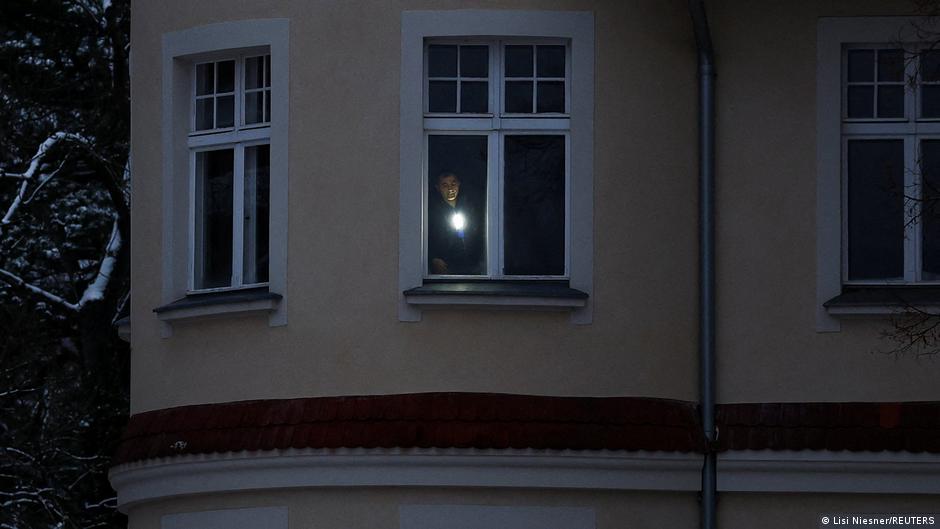
Thousands of Berlin residents remain without power as snow covers capital
Thousands of residents in southwest Berlin are still without electricity and heating amid freezing temperatures after a weekend attack on a cable bridge caused a power outage.
Some 14,000 of the some 45,000 households initially affected have had their power restored, but provider Stromnetz Berlin said it might take until Thursday for complete coverage to return.
Some schools and kindergartens in the area remained closed on what is the first school day after the Christmas holidays.
Hospitals used emergency generators to be able to continue operations and have since seen their power restored, but many care homes remain affected.
Aid organizations and the fire brigade have set up shelters for those in need.
Some 2,200 businesses were also hit, of which some 500 are back on the grid.
Authorities have said a letter of responsibility posted online following the attack appears to be authentic.
A left-wing group that calls itself the Vulkangruppe (Volcano Group) said in the letter that the aim of the attack was to target the fossil fuel industry.
It said the attack “resulted in power outages in the more affluent districts of Wannsee, Zehlendorf and Nikolassee.”
“We apologize to the less affluent residents of southwest Berlin,” the letter added.
https://p.dw.com/p/56KoP
January 5, 2026
Alcohol in Germany comes cheap
Alchoholic beverages are cheaper in Germany than any other EU country except Italy, figures from the Federal Statistical Office (Destatis) released on Monday for “Dry January” show.
In October 2025, alcohol prices in Germany were 14% below the EU average, with only those in Italy being lower, at 19% below the average.
Finland had by far the highest prices, with alcoholic drinks costing 110% more than the EU average.
The rate of alcohol consumption in Germany remains high, with 11.2 liters (0.32 gallons) of pure alcohol drunk per person aged 15 or more in 2022, according to the World Health Organization.
This is, however, a drop from the 12.1 liters per person consumed 10 years earlier, and put Germany in 9th position in a list of the heaviest drinkers in the EU in 2022, along with France and Portugal.
Heading that list by far was Romania, with a per capita annual consumption of 17.1 liters of pure alcohol.
But while Germany may be one of the cheapest places n the EU to buy alcoholic drinks, that is not the case for soft drinks, which cost 2% above the EU average.
This still compares quite favorably with Latvia, which has a high sugar tax and where nonalcoholic drinks are a whole 46% over the EU average.
https://p.dw.com/p/56L5I
January 5, 2026
Wadephul in Lithuania to talk Ukraine
German Foreign Minister Johann Wadephul is kicking off his schedule of official trips in 2026 on Monday with a visit to NATO and EU partner Lithuania.
Speaking before his departure, Wadephul said Europe had to “meet the threat posed by Russia with firm European solidarity.”
He said it was vital “that we are prepared to defend ourselves and our freedom more independently.”
Both Germany and Lithuania are in agreement that only resolute action would help deter Russia from its current course of constant escalation, Wadephul said.
He said the German government was working together with Lithuania and other NATO partners and EU member states to this end, including by stepping up patrols over the Baltic Sea, being more alert and investing in more robust infrastructure.
According to Wadephul, both Germany and Lithuania are united by their determined support for Ukraine, “particularly during this possibly decisive phase of international efforts to end Russia’s war of aggression.”
During his visit to Vilnius, Wadephul is scheduled to hold talks with Lithuanian Prime Minister Inga Ruginiene and Foreign Minister Kestutis Budrys on Ukraine, the defense of NATO’s eastern flank and the fight against hybrid threats such as cyberattacks and disinformation.
Wadephul also intends to visit the 45th Panzer (Tank) Brigade of the German Bundeswehr in Nemencine near Vilnius, which has been deployed to NATO’s eastern flank to help counter the threat of Russian territorial aggression.
https://p.dw.com/p/56KiO
January 5, 2026
Solar power on the up in Germany
Solar power in Germany generated 18% of domestic electricity production in 2025, up from 14% in 2024, the German Solar Industry Association (BSW) said on Monday.
Photovoltaic power thus accounted for more electricity than lignite-fired plants, which generated some 14%, and natural gas, which accounted for 16%, the association said.
The figures are based on data from the Fraunhofer Institute for Solar Energy Systems.
Germany’s largest source of electricity remained wind power, which accounted for 27% of domestic production.
In 2025, the 5.5 million installed photovoltaic systems in Germany produced a record some 87 terawatt hours of electricity, 15 terawatt hours more than in 2024, according to preliminary annual figures.
However, the BSW said that despite the increase in solar power production, the rate of growth in the sector in Germany in 2025 was insufficient for the country to meet its legally binding targets for 2030.
https://p.dw.com/p/56KUt
Welcome to our coverage
Guten Tag from the DW newsroom in Bonn!
As a cold, wintry spell continues to grip Germany, all sympathies must go to the many Berlin residents who are still without power two days after a suspected arson attack on a cable bridge.
In better electricity news, solar energy production is on the rise — but still more is needed if Germany is to reach legally binding climate targets.
And as Russia continues its invasion of Ukraine, Germany’s foreign minister, Johann Wadephul, is to discuss support for Kyiv and ways of combating Moscow’s hybrid warfare with officials in Lithuania.
DW will be keeping you up to date with all the latest topics concerning Germany as 2026 gets underway.
https://p.dw.com/p/56Kha
Source link
