

Caviar bumps, cost jumps: US consumers on how they’re dining in Trump’s economy | Food
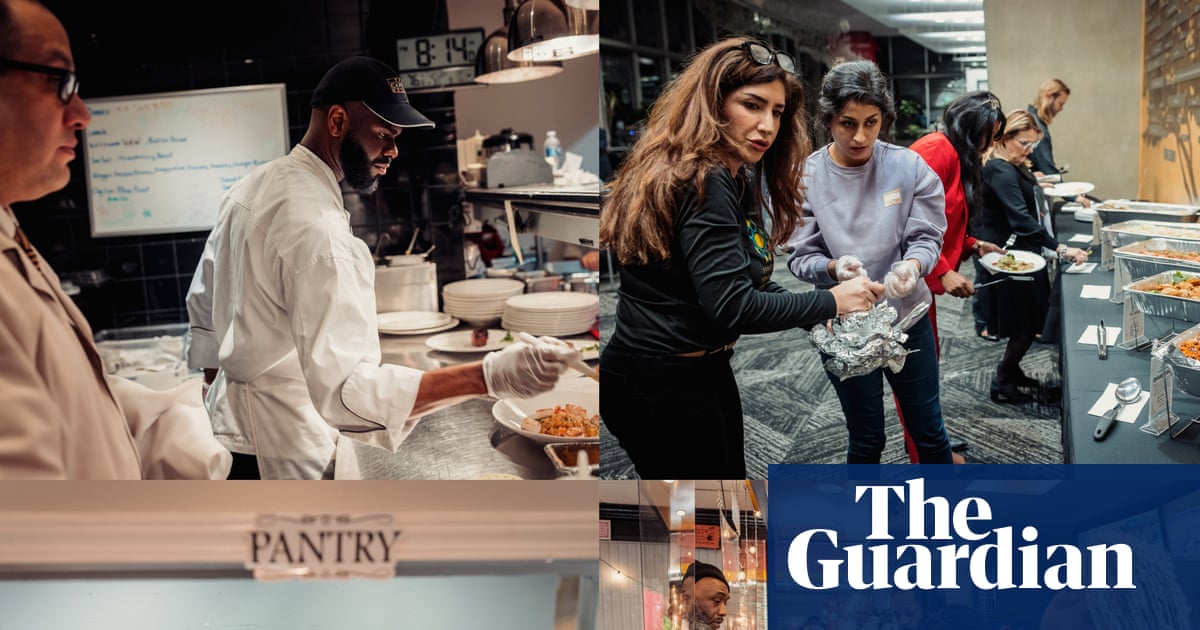
On a Tuesday in December, a Guardian reporter and photographer set out around Atlanta to ask people how they felt about food, 11 months into Donald Trump’s second administration. We asked people from widely different socioeconomic conditions – from those who were wondering where their next meal might come from to those who spend more in a month on food than an average family spends on a mortgage.
Here is what we found.
Sabrina Carter hasn’t been to a “real” restaurant in at least a year. “I don’t receive but $24 a month in food stamps. And, you know, it runs out real quick,” she said. She lives alone. When she splurges, it’s on cereal or maybe a granola bar.
Tuesday afternoon, she went to Area in Need Missionary House in Riverdale, Georgia, to pick up a basket from its pantry.
Also there was Erica Barker, who has been looking for work for a year after losing her job with a contractor to DeKalb county’s watershed department. Her visit to the pantry was her first, she said. Barker is trying to take care of a daughter and grandson, without benefits. Together, they’re spending between $200 and $300 a week. “We only do dinner. We have a lot of noodles in the house.”
It is the judgement of the people who come for help that galls her, she said.
“You never know what a person is going through when they walk through these doors,” said Stephanie Jordan, the executive director of the non-profit. “That’s why it’s so important to treat people with respect.”
The food pantry’s costs are climbing, Jordan said. “Last year, we were seeing roughly 280 people a month. Now we are seeing over 500 a month.” The floodgates opened when food benefits under the Supplemental Nutrition Assistance Program (Snap) went into hiatus during the federal government shutdown. Demand hasn’t receded.
“It’s not over. We are seeing that in our budget right now. We’re spending more money than we ever have on food, because that’s the need now,” she said.
Costs per unit are up 30%, and with the higher demand, Jordan said she has started to borrow from its housing support budget. “We didn’t know that this was coming.”
The last year has been filled with uncertainty, Carter said. “It’s been kind of shaky. Up and down, back and forth. It’s not a good feeling.”
Tuesday morning, Yolanda Thomas was looking for Minute Maid juice in a Kroger grocery store in south DeKalb county, Georgia, and looking for a job. She had been in Atlanta for less than a month. Tax officials sold her home in New York for missed payments, she said. She is waiting for the proceeds of the sale to land in her accounts as she stays with family and restarts her life.
She is now spending between $400 and $500 a month on food for herself and her husband, she said. “That would get most of everything we needed.”
But things are going to be tight, and even though DeKalb county is less expensive than Roscoe, New York, public support works very differently. “Since I’ve come here, I have no insurance. I need to get a job here to get that.”
Atlanta demands hustle. Carl Hilton described half a dozen enterprises he was working on, from a CBD business to his janitorial service. He’s tightening his belt. “Like this morning – bacon and eggs. Grits. Normally it would cost $6 or $7. This morning it was 20 bucks.” He spends “well over” $500 a month on food.
Atlanta is a town for foodies, though, Hilton said. He does not compromise on his exploration of it. “The food scene is big. I love it. Me and my lady look up different food and hit different places every week. I like to change my palate a lot.”
A year ago, chef Nizakat Noori was not thinking about what might happen if the government decided she should be deported back to Afghanistan. Food occupied her mind: the dream of opening a restaurant, taking care of her four children and trying to get her oldest, rapidly Americanizing daughter to eat more of her cooking – other than kebabs. Everyone loves kebabs.
Noori wants to open a restaurant in Atlanta “with my kids helping me”, she said. “Like a family business.”
She found herself on Tuesday night catering a meal through the Chef’s Club, an entrepreneurship program of the Refugee Women’s Network. The juxtaposition of three former refugees of Middle East conflict hustling to prepare a catered meal for a conference by the Foundation for Economic Education, a libertarian economic thinktank, was almost as delicious as the food.
The food business is tough, but the program offers great food at competitive prices, and an appealing social mission, said Marmar Stewart, entrepreneurship development coordinator of the Refugee Women’s Network. “We’re doing very well. From 23 chefs, I went up to 50 chefs. We have chefs from Afghanistan, Syria, Somalia, Ethiopia, Congo, Ukraine, you name it.” Catering is booked solid, she said.
Noori was married at 13. Her first child was born when she was 14. She’s 29 and the mother of four children. She drives now. The state department’s “re-evaluation” of refugees following the murder of a national guard member in DC by a man from Afghanistan is no abstraction to her. She’s been in the United States for six years. Her country is not safe, she said.
She sends some of the money she makes cooking dishes of chicken kabob and eggplant and kabuli pulao – a kind of pilaf – back to family in Afghanistan, she said. Prices have been a challenge. The cost of ingredients is up about 30%, she said. But there can be no substitutes in her cooking. She is not just selling food – she’s selling authenticity, and to compromise that would lose what’s special, she said.
“I don’t want to change my seasonings. I don’t want to change my taste. But I have to work. I have to sell my food. My family waits for my help every month. I need money for them.”
Stacie Simmonss, who teaches autistic children, was bringing lunch back to school from Fork in the Road, a funky neighborhood restaurant in Tucker, Georgia, built in a former Wendy’s building. The corpse of a closed McDonald’s rests across the street. The setting is a metaphor for what’s happening to food in the middle of the market in Atlanta and the US.
Simmonss paid $64 for five meals. “They give an abundance of food. Here I know I’m going to get a quality meal that is price-efficient.”
Fork in the Road has lines on a Friday night. Tuesdays are busy because they’re closed Monday and regulars need their fix. They don’t advertise. They don’t do DoorDash. They don’t have a social media presence. Everything is about word of mouth, customer service, and price for quality. A burger and fries there is about the same as a fast-food place today. The average ticket is around $13 a plate.
People come for the shellfish plates, said Justin Blake Johnson, the restaurant’s general manager. “Crawfish tails, oysters, scallops and shrimp, and you get a side dish with it. It’s not fast food, you know. It’s more like food for your soul.”
Power outlets rise from the sides of high-backed booths, fit for charging laptops. Their customers come from the office buildings and the nearby neighborhoods in north Decatur. It is a mix of working-class people and professionals. Trucks from the county water department filled the parking lot.
“We’ve raised our prices, maybe a dollar, on a couple of items on the menu maybe a year ago, Johnson said. “But for the most part we’re really cost-effective.” They’re looking to open a second location.
Ameerah DeChabert, a film professional in Atlanta, dashed into a Whole Foods for some rice and a salmon filet on Tuesday afternoon. The movie business is famously feast or famine. Dechabert said she spends about $1,000 a month on food, but she’s trying to be more careful since it looks like famine is coming for the industry.
“If you go on the Georgia film website, a lot of the productions there are productions that have happened – even premiered at this point – but they still have them up as in production. So that’s how you know there are fewer productions happening.”
The Buckhead Whole Foods parking lot is still full of Volvos and Range Rovers and the odd Cybertruck. A parade of sharply dressed people exit with armfuls of freshly cut flowers. Dechabert said she is shopping week by week, just as things are needed.
“I’m still young. There are people that have families, so I know a lot of people that have adjusted their lifestyles because of lack of work, obviously, and so even coming to Whole Foods, I’m like: ‘Should I have come?’”
Broader trends haven’t entirely escaped the well-to-do. The Capital Grille, a high-end steakhouse central to high society in Atlanta’s Buckhead neighborhood, sits in the heart of the city’s show opulence. Doctors and lawyers mingle with actors and laid-off CDC workers at a classic 1930s bar fit for a movie set.
There is space to sit on a Tuesday night.
“A majority of our restaurants are down in sales by a lot, even though we’ve had price increases like every other restaurant has. Residential guests are not dining out as much as they used to,” said Sara Soendergaard, an assistant general manager.
Soendergaard, speaking solely from her personal observations, draws a distinction between people who come for a $300 steak dinner because they live nearby, and people who are eating on the company dime.
The Capital Grille has gone through three price increases this year, reflecting the escalating price of a super-premium cut of beef. There is no room for compromise on quality – consistent excellence is the brand. She expects another round of increases. “I think it’s not because people aren’t spending money, but people are a lot more cautious about where they spend their money. So we constantly tell our team, you have to make them see the value in that $300.”
The Capital Grille’s private rooms are booked through December, she said. “They’re all businesses. You have dermatologists and pharmaceuticals. And you know, Christmas parties.”
Some people are still plainly spending wild amounts of money to eat.
“I really don’t shop for food. I just order out,” said Rosby Cobb, a drone pilot and entertainment professional from midtown Atlanta. Food tends to spoil in his house. He lives alone, and other than making a run for his grandmother, he doesn’t grocery shop. He spends $600 a week on food service and restaurants, he said. “I stay in midtown, so the prices there are way higher,” he said. “Eggs are like $14.”
“I would say if there’s any product that’s really kind of blown up in the past year or two … it’s sturgeon caviar.”
Andre Melchionda, the founder of Arrivato Imports, was talking about caviar bumps.
“You’re seeing all these trends of caviar stuffed all over the martinis and caviar on tater tots and caviar sandwiches,” he said. Melchionda’s market is the Michelin-starred restaurant scene in Atlanta, sourcing wagyu beef, extra-virgin olive oil, truffles and caviar.
“Caviar events have been a big thing this year, where people will put a few grams on a spoon or however they’re doing it,” he said. “That’s probably one of the trendier things of the year I would say, is the caviar bump.
“I think most places are probably charging $15 for a bump, so still getting that touch of luxury and quality but at a much more approachable price point.”
Melchionda’s business is growing, he said. Tariffs have had an impact on costs, however. “We’re definitely getting hit with them, especially from Europe. We’re getting 15% on all imported goods, so it’s certainly impacting us. We’re having to increase some pricing here and there and pass it along.
“Whether we eat some of it or pass it along – we talk to suppliers and see if there’s anything we can do there but, it’s an industry-wide thing … we just have to get a little bit more dialed in.”
Less affluent people may be cutting back. Melchionda isn’t seeing it in his market.
“There’s about 1% that doesn’t really slow down,” he said. “Because at the end of the day, that 1% doesn’t really feel it when everyone else does, and their eating habits don’t really change. You’re still getting all of these corporate accounts going into restaurants and doing buyouts and getting these client dinners where they’re going all out for it.
“The middle-upper class is still doing it, maybe a little bit less frequently. But the upper 1, 2, 3%: they’re still going to go out with friends and are having amazing dinners.”
Source link
