

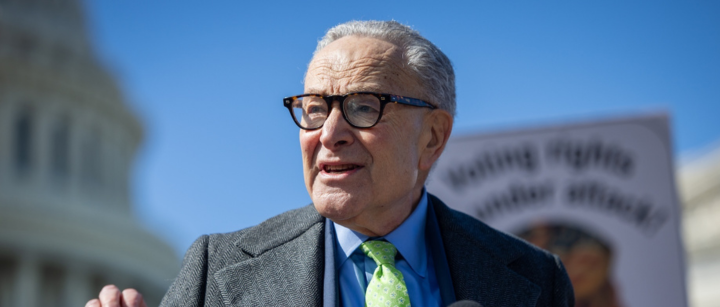
Senate Minority Leader Chuck Schumer has said the SAVE America Act “could disenfranchise over 20 million American citizens,” while Republicans dispute that the voter registration and ID bill would block any legitimate voters. Election experts say the bill, which isn’t expected to pass, would make it difficult for some unknown number of voters to register and cast a vote.
At times, Schumer has used more definitive language about the bill’s impact, saying that “more than 20 million legitimate people … will not be able to vote under this law” or that it “would disenfranchise tens of millions of people.”
Walter Olson, a senior fellow at the Cato Institute’s Robert A. Levy Center for Constitutional Studies, told us the legislation wouldn’t meet the dictionary definition of “disenfranchise,” which is to “deprive a person of the right to vote.” But it would, as described by Democratic Sen. Patty Murray, “‘make it harder and more expensive for [many people] to [register and] vote,’” Olson said in an email. “That extra hassle and expense would mean that some citizens eligible to register and vote will in practice not complete the needed process even though the bill does not take away their legal right to register or to vote.
“How many eligible people will fail to complete the process? Any estimate is guesswork at this stage in part because it depends on factors that the bill itself leaves unspecified,” he said.
Schumer’s 20 million figure comes from an estimate of the number of voting age Americans who don’t have easy access to citizenship documents that the bill would require to register to vote. According to a 2023 survey by New York University’s Brennan Center for Justice and other groups, more than 9% of Americans of voting age, or 21.3 million people, wouldn’t be able to “quickly find” documents such as a passport, birth certificate or naturalization papers if they “had to show it tomorrow.” More than 3.8 million of those people don’t have those documents, the survey found.
That doesn’t mean that at least some of those Americans couldn’t obtain or find proof of citizenship in order to register to vote under the legislation. But some could find the process too onerous to complete, experts say. Under the bill, citizenship documents also would need to be presented in person to an election official if registering to vote for the first time or reregistering after moving, changing one’s name or making other changes to voter registration.
Eliza Sweren-Becker, deputy director of the voting rights and elections program at the Brennan Center for Justice, told us that “it’s definitely safe to say that millions of Americans would be blocked from voting” by the bill’s registration requirements, among other provisions. She noted that tens of millions of Americans register or update their registrations in the two years before elections. More than 103 million did so in the two years before the 2024 election, according to survey reports by the U.S. Election Assistance Commission.
“As many as 21 million could be stopped from voting” under the SAVE America Act, she said, because they lack ready access to a passport, birth certificate or naturalization document required under the bill for voter registration.
Schumer has repeatedly used the 20 million estimate, adding that these voters could be purged from the voter rolls and not know about it until they showed up to vote, at times linking this to a requirement under the bill for states to use a Department of Homeland Security database to remove noncitizens. “Our objection is it’s a voter suppression bill. Twenty million, maybe more people, when they show up to vote … will be told, you’re off the rolls. That’s the problem with the bill,” Schumer said in a March 17 press conference.
On the Senate floor the same day, the Democratic leader said, “It could purge millions of American citizens from the voter rolls through a screening algorithm designed by Elon Musk’s DOGE squad. It could disenfranchise over 20 million American citizens.”
The DHS database is known to have wrongly flagged as noncitizens some Americans who are, in fact, citizens. But the extent of those flaws is unclear — as is how voters might be notified and purged from voter rolls under the legislation.
Republican Sen. John Cornyn objected to Schumer’s remarks. On the Senate floor on March 19, Cornyn said that Schumer’s “general argument that American citizens would be denied the opportunity to vote is patently false. Thirty-eight states, including states like Georgia and Rhode Island, currently represented by Democrats, require voter ID. Are those States suppressing the vote? Is the minority leader suggesting that 38 out of our 50 states are actively engaged in voter suppression? Well, that is preposterous on its face.”
“So the idea that the SAVE America Act will disenfranchise legitimate voters is a bald-faced—well, let me try to be generous. It is not true, and he knows it,” Cornyn said, adding that Schumer was telling “people who may not be informed about the details of this that we are trying to take away their right to vote.”
Cornyn is nearly correct on the number: 36 states have some form of voter ID laws. But the requirements in the bill before the Senate are “stricter” than most of those state laws, according to the National Conference of State Legislatures.
We’ll explain what the bill would require for registering and casting votes, and how this could affect voters. (For more, see our article “Q&A on the SAVE America Act.”)
The SAVE America Act passed the House in February, and the Senate began debate on the bill on March 17. Similar legislation in recent years has failed to pass the Senate. A proposed Senate amendment would impose more restrictions on voting by mail, eliminating universal mail-in voting and only allowing mail ballots in certain cases, such as illness or disability, travel, or military service. Here, we describe the bill as it passed the House.
Registering to Vote
Republicans say the bill is needed to prevent noncitizens from voting in federal elections, though election experts say, and state audits have shown, this is rare.
Current federal law requires those registering to vote to attest that they are citizens under penalty of perjury. The SAVE America Act would require documentary proof, presented in person to election officials, for those registering or reregistering to vote.
This would happen “any time you conduct what we call a registration transaction, which usually comes from a life event, a move or a change of name,” David Becker, founder and executive director of the nonpartisan Center for Election Innovation & Research, which works with election officials throughout the country, said in a March 18 media briefing.
For most people, this would likely mean showing a U.S. passport or a certified birth certificate along with a driver’s license or government-issued photo ID. As we’ve explained, the bill stipulates elements the birth certificate must have, such as a government seal.
Some voters could prove citizenship with other documents. A REAL ID driver’s license doesn’t typically show citizenship, but five states issue REAL IDs that do. Also acceptable under the bill: a military ID and service record that says the person was born in the U.S., or a government-issued photo ID that shows a U.S. birthplace. Those with government-issued photo IDs that don’t indicate citizenship would also need either the certified birth certificate or a hospital birth record, adoption decree, a consular birth report, a naturalization certificate, or an American Indian card with the classification “KIC,” which designates U.S. citizenship for Mexican-born members of the Kickapoo tribes of Texas and Oklahoma.
As we said, surveys show millions of Americans could have trouble producing the proper citizenship documents. In addition to the 2023 survey Schumer has cited, the Bipartisan Policy Center, in analyzing the 2024 Survey on the Performance of American Elections, found that 12% of registered voters, the equivalent of 28.4 million citizens of voting age, lacked either a valid passport or a birth certificate they could easily find along with a valid government-issued photo ID.
For those who do have the proper documents, the requirement to show them “in person” could dissuade others from registering to vote. The bill says that people registering by mail won’t be registered unless they present “documentary proof of United States citizenship in person to the office of the appropriate election official.”
Sweren-Becker said that this in-person requirement would be “especially hard” for “working parents, people with disabilities, elderly voters, voters who live in rural areas.”
The bill calls for states to make unspecified “reasonable accommodations” for people with disabilities.
Republican Sen. Mike Lee said on the Senate floor on March 19 that claims about the legislation disenfranchising voters were wrong. “Ideally” Americans have the proper documents, he said, but “even if you do not have a single shred of documentation as to your citizenship — you can’t find it, it burned down, whatever it is — all you have to do is swear an affidavit.”
“The state is in a very good position to track down the details of the affidavit and easily confirm or refute what the person says,” Lee said.
The bill does provide a process for those who don’t have the required documents. It says: “Subject to any relevant guidance adopted by the Election Assistance Commission, each State shall establish a process under which an applicant who cannot provide documentary proof of United States citizenship … may, if the applicant signs an attestation under penalty of perjury that the applicant is a citizen of the United States and eligible to vote in elections for Federal office, submit such other evidence to the appropriate State or local official demonstrating that the applicant is a citizen of the United States and such official shall make a determination as to whether the applicant has sufficiently established United States citizenship for purposes of registering to vote in elections for Federal office in the State.”
The election official making that determination also would need to sign an affidavit “swearing or affirming the applicant sufficiently established United States citizenship for purposes of registering to vote.”
There’s a similar process for people whose names differ from their documents, such as married women who changed their names. They can provide “additional documentation” on the name discrepancy or sign an affidavit.
Olson said there’s uncertainty about these alternative methods of citizenship verification. Will they “be relatively easy and generous, accepting common sorts of documents and an uncomplicated sworn statement that most eligible persons will feel comfortable signing?” he asked.
States’ procedures will be governed by guidance from the Election Assistance Commission, the bill says, an independent agency that has two commissioners appointed by Trump and two appointed by former President Barack Obama.
“In short, we aren’t going to find out what the bill does on many key questions until after we pass it into law and the EAC begins issuing guidance,” Olson said. “One of the reasons I am critical of the bill is that I don’t believe we should be asked to take it on faith that the EAC will issue practical guidance in good faith. If the EAC is going to issue guidance that causes an uproar because it sets requirements many legitimate voters cannot meet, we should know that now, not later.”
Sweren-Becker said that the affidavit method “is only available if a state or local election official deems that the registered has sufficiently established U.S. citizenship … so it leaves an enormous amount of discretion in local and state election officials’ hands.” The bill also would impose criminal penalties and civil liability on election officials who register someone “who fails to present documentary proof of United States citizenship,” the legislation says. “So in practice,” she said, election officials “will face a lot of pressure to construe it [the affidavit method] very, very, very narrowly out of rightful concern about their own liability,” Sweren-Becker said.
Becker, in the March 18 briefing, said the legislation “would incredibly negatively impact voters across the political spectrum. … I don’t think there’s anyone who can say definitively, if this were to pass, which party would be hurt more by it,” he said. “I think it’s highly likely that Republicans would likely be more hurt” than Democratic voters, “because a lot of the voters who have difficulty digging up their documentary proof of citizenship are Republicans.”
Casting a Vote
In pushing back on Schumer’s comments about disenfranchisement, Cornyn spoke about the bill’s photo ID requirements for casting a vote. “Thirty-eight states, including states like Georgia and Rhode Island, currently represented by Democrats, require voter ID,” he said.
As we said, 36 states do have some form of voter ID laws, but the SAVE America Act is “stricter” than most of them, according to the National Conference of State Legislatures.
The Republican bill would require “a valid physical photo identification” in order to cast a ballot in person. Those voting by mail would need to submit a copy of a photo ID, or the last four numbers of their Social Security number and an affidavit saying that they couldn’t obtain a copy of their ID.
A valid photo ID under the bill includes: a state-issued driver’s license or ID card issued by the motor vehicle agency that includes a photo and expiration date, a U.S. passport, a military ID, or a photo ID issued by a tribal government that includes an expiration date. There are exceptions for overseas uniformed services members and those who have the right to vote absentee via the Voting Accessibility for the Elderly and Handicapped Act.
The NCSL said most states’ laws are less strict. “Currently, each state determines the types of ID acceptable to vote, and that often includes student IDs, hunting and fishing licenses or other state-specific identification cards,” it said in a post on its website updated in March.
Thirteen states also accept non-photo identification, such as a bank statement. NCSL classified 10 of the voter ID states as having “strict photo ID” laws.
Georgia is one of them, but it still accepts a broader range of documents than the SAVE America Act would. Georgia accepts a student ID from a public college in the state, an expired state driver’s license, an employee photo ID from a government entity, or a free voter ID card issued by the state, among other documents, the Georgia Secretary of State’s office explains. To get an absentee ballot, a voter submits the number on a driver’s license or state-issued ID card, or a photo or copy of another listed ID, or a document that shows a name and address, such as a utility bill, bank statement or paycheck.
NCSL puts Rhode Island in its “non-strict photo ID” category, along with 13 other states. Rhode Island also issues free voter ID cards and accepts “ID issued by a U.S. educational institution,” the state Board of Elections says. No ID is required to cast a ballot by mail.
When we asked Cornyn’s office about his comments, a spokesperson pointed to some of his other remarks, including a March 19 post on X, which said: “These tactics are nothing more than fearmongering by Dems who are objecting to this because they want to make it easier for people to cheat. In a country with citizens bright enough to put a man on the moon and to build the strongest, most powerful military & the greatest economy the world has ever known, Americans are smart enough and capable enough to be able to locate their driver’s license when they cast a ballot and to establish their citizenship in order to qualify to vote. Any suggestion to the contrary is ridiculous.”
Purging Voter Rolls
Schumer also objected to the bill’s provision requiring states to submit their voter rolls to DHS’ Systematic Alien Verification for Entitlements program and remove noncitizens from their rolls. The legislation “could purge millions of American citizens from the voter rolls,” Schumer said in the March 17 press conference. He later added: “Our objection is it’s a voter suppression bill. Twenty million, maybe more people, when they show up to vote … will be told, you’re off the rolls.”
On the Senate floor that same day, he repeated the idea that people could be removed from voter rolls and not know about it until they try to cast a vote. “The way this works, you don’t have to be notified if you’re kicked off the rolls. You show up on Election Day and they say, ‘We’re sorry Mr. Smith, Ms. Jones, you’re not on the rolls anymore.’ And then they make it impossible to re-register. Certainly, on that day you lose your right to vote,” the senator said.
In March 15 remarks, he said the bill’s requirements for states to use the DHS system “will purge tens of millions of people from the voter rolls. Once purged, you don’t even know it.”
There are a couple of provisions regarding purging voters. The first requires states to use the DHS system “for the purposes of identifying individuals who are not citizens of the United States and taking the necessary steps to remove such individuals who are not citizens from the official list, after notice is given to such individuals and such individuals are given the opportunity to provide documentary proof of United States citizenship.” As we’ve explained, the DHS system has been shown to have flaws and has wrongly identified people as being noncitizens.
When we asked Schumer’s office about the language in the bill, a spokesperson said the bill included “a requirement that they [voters] be told they have been flagged,” but no requirements about what form the notice would take or the “length of time” people would be given to respond. And there’s “no language in the bill about notice to the voter that they have been purged,” the spokesperson said.
The bill doesn’t provide more details on how states should give “notice” and an opportunity to dispute incorrect information before removing people from the rolls; nor does it say people should be notified again before being purged.
There’s another provision in the bill that says states could remove someone “at any time.” It says: “A State shall remove an individual who is not a citizen of the United States from the official list of eligible voters for elections for Federal office held in the State at any time upon receipt of documentation or verified information that a registrant is not a United States citizen.” That provision doesn’t say anything about a notice given before removing someone.
Election experts told us there’s ambiguity in the bill regarding these provisions. We reached out to the offices of Sen. Lee and Rep. Chip Roy, the authors of the legislation, about this issue, but we haven’t yet received a response.
“[I]t’s not obvious that all of the ways people will be removed from the rolls will be subject by the SAVE Act to notice and an opportunity to respond,” Justin Levitt, a professor of constitutional law at Loyola Marymount University’s law school, told us in an email. “I’d think there are constitutional protections that would kick in, but they’re not explicit in the statute, and that’d take someone litigating.” Levitt, who briefly was a White House senior policy adviser on voting rights during the Biden administration, said the bill “seems to contemplate at least some people being kicked off the rolls without being told,” though this could be a mistake in the drafting of the bill.
“As for how many, it’s a question I can’t answer,” he said, explaining that it depends on the accuracy of the SAVE database and how the process of comparing voter rolls works.
Olson told us that the provision on using the DHS SAVE system “appears to establish protections (notification and a chance to contest removal by supplying documents)” for voters flagged for removal under that system. But “some other persons removed from the voter rolls may not have rights to notification and challenge unless their states have separately legislated to provide such rights,” he said, pointing to the provision on states removing noncitizens “at any time.”
“So far as I can tell, this means that anyone, including the federal government or some private person or group, can send ‘documentation or verified information’ to a state that a certain person, or a list of persons, on its voter rolls are not U.S. citizens. The state then ‘shall’ remove them,” Olson said. “So long as this is not being done by the method carved out for the SAVE database and its intersection with state voter rolls in federal possession, I don’t see where the bill provides any assurance of notification.”
Sweren-Becker had the same reading of the bill. “Absolutely, I think that the second provision … indicates that people could be removed, but on the basis that something has flagged them as a noncitizen, without notice to the voter or an opportunity to provide evidence of their citizenship,” she told us. “And it is also important to note that it is very unclear what ‘documentation or verified information’ means” and from what sources. “I think there’s a risk that election officials may receive, essentially, purge lists generated by activist groups who are not doing careful list matching.”
As for how many legitimate voters could be removed from voter rolls through this process, “I don’t know how to hazard a guess there,” Sweren-Becker said, noting that “shoddy” purge lists by activist groups have listed thousands of people.
Schumer, however, has gone as far as saying that, under the bill, 20 million could be wrongly purged without knowing they were removed from the voter rolls. But that figure comes from the estimate of those lacking easy access to a passport, birth certificate or naturalization papers. It’s not an estimate of voters who could be purged without their knowledge.
Editor’s note: FactCheck.org does not accept advertising. We rely on grants and individual donations from people like you. Please consider a donation. Credit card donations may be made through our “Donate” page. If you prefer to give by check, send to: FactCheck.org, Annenberg Public Policy Center, P.O. Box 58100, Philadelphia, PA 19102.
Source link
