

“Crazy Dice” Help Scientists Prove Only One 150-Year-Old Theory About Randomness Works

A new mathematical investigation challenges long-held assumptions about how to model randomness.
At any given moment, countless molecules are moving unpredictably through the air around you. Physicists rely on a principle called the Boltzmann distribution to make sense of this apparent randomness. Instead of tracking the exact position of each particle, this law describes the probability that a system will be in a particular state.
This approach makes it possible to understand large systems even when individual motions are impossible to predict. A useful comparison is rolling a die: while each roll is uncertain, repeated rolls reveal a consistent pattern of probabilities.
A universal rule for randomness
First formulated in the late 19th century by Austrian physicist and mathematician Ludwig Boltzmann, this principle remains widely used across many disciplines today. Beyond physics, it appears in fields such as artificial intelligence and economics, where it is known as the multinomial logit model.
In new work, economists have revisited this foundational concept and reached an unexpected conclusion. Their analysis shows that the Boltzmann distribution is uniquely suited to describing systems that are independent, meaning systems in which different components do not influence each other.
The study, published in Mathematische Annalen, was conducted by Omer Tamuz, a professor of economics and mathematics at Caltech, and Fedor Sandomirskiy, a former Caltech postdoc who is now an assistant professor of economics at Princeton University. Both researchers bring training in physics to their work.
“This is an example of how abstract mathematical thinking can bridge different fields—in this case, linking ideas from economic theory to physics,” Tamuz says. “Caltech’s interdisciplinary environment fosters discoveries like this.”

Why independence matters in models
A key issue explored in the research is how to model independent behavior. For example, an economist studying how people choose between two cereal brands would want to avoid models that produce unrealistic links. If the model suggested that cereal preferences depend on unrelated choices, such as which dish soap someone buys or what color shirt they wear, it would clearly be flawed.
“We would rather not track extra choices that seem irrelevant, like which soap the shopper picked in another aisle,” Tamuz says. “We ask the question: When would including that seemingly unrelated choice leave the model’s prediction unchanged?”
While the Boltzmann distribution already satisfies this requirement, Tamuz and Sandomirskiy wanted to know whether any other theories could do the same.
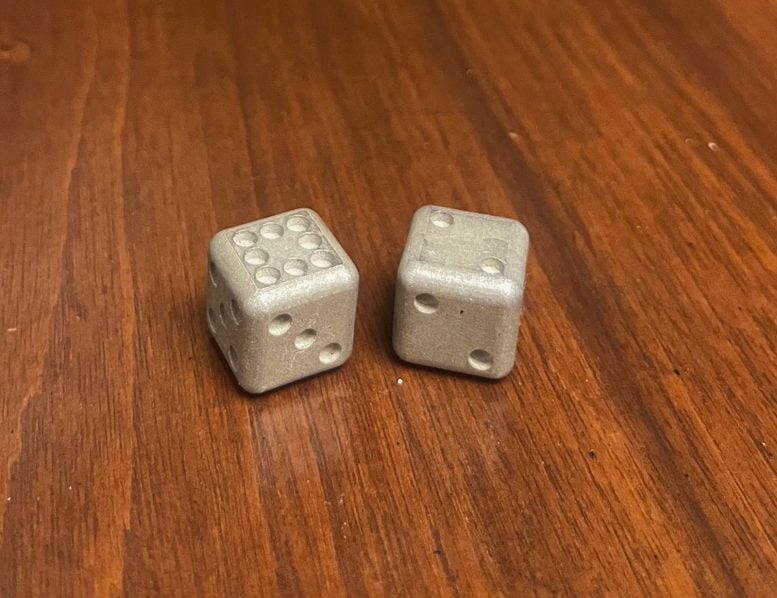
“Everybody uses the same theory,” Tamuz said. “But which other theories have this nice property that correctly maintains the lack of connection between the unrelated behaviors? Should we use those theories instead? If there are such theories, they might be useful in both economics and physics. If there are not, then we would learn that the Boltzmann distribution is the only physical theory that is not nonsensical and that multinomial logit is the only economic model that predicts independent choices in unrelated situations.”
Dice reveal the mathematics of independence
To explore whether other mathematical frameworks could describe independent systems, the economists designed new ways to test the underlying logic. Tamuz often explains their approach using dice. A single die produces unpredictable results, with outcomes ranging from 1 to 6. While any individual roll is uncertain, repeating the experiment many times reveals a stable pattern, with each number appearing about one sixth of the time. This pattern represents the probability distribution of a single die.

When two dice are rolled together and their totals are recorded, a different distribution appears. Some outcomes are rarer than others. For instance, a total of 2 occurs only when both dice land on 1, giving a probability of 1 out of 36. By contrast, a total of 8 can be formed in five different ways, resulting in a probability of 5 out of 36. Crucially, the result of one die does not influence the other. These are independent systems. In the earlier example, one die represents a cereal choice and the other represents a dish soap choice, and neither decision should affect the other.
To push this idea further, the researchers introduced an unusual pair of dice known as Sicherman dice, created in 1977 by puzzle designer Col. George Sicherman. Tamuz, who keeps a set of these dice on his desk, points out that their faces contain unconventional numbers. One die is labeled 1, 3, 4, 5, 6, 8, while the other shows 1, 2, 2, 3, 3, and 4. Despite their unusual design, when both dice are rolled, and only the total is recorded, the results match those produced by standard dice. For example, the chance of rolling a 2 remains 1 out of 36, and the chance of rolling an 8 remains 5 out of 36. In other words, the distribution of sums is identical.
This property gave Tamuz and Sandomirskiy a powerful testing tool. They compared how different mathematical theories handled both standard dice and these unconventional dice. If a theory produced the same distribution of sums for both, it successfully preserved independence. If it generated different results, it implied a false connection between unrelated systems and therefore failed.
Polynomial proof settles the question
To broaden their search for valid alternatives, the economists looked for more examples of unconventional dice beyond the original Sicherman pair. Each new example provided another way to evaluate competing theories. Because there are infinitely many possible mathematical models, they constructed a matching set of infinitely many theoretical dice pairs.
By systematically testing these cases, they ultimately produced a proof that eliminated every alternative. Their result shows that the long-established Boltzmann distribution, relied on across science for more than a century, is the only framework that consistently works.
From a mathematical perspective, the entire problem can be expressed using polynomials, functions such as f(x)=x + 3x² + x³ that are commonly introduced in algebra. Every probability distribution discussed, whether based on Boltzmann’s formulation or a competing theory, can be written in this form.
For instance, the first Sicherman die, with sides 1, 3, 4, 5, 6, 8, corresponds to f(x) = x1 + x3 + x4 + x5 + x6 + x8. The second die, with sides 1, 2, 2, 3, 3, 4, corresponds to g(x) = x1 + 2x2 + 2x3 + x4. Multiplying these expressions, f(x) · g(x), produces another polynomial that represents the distribution of their summed outcomes.
This result matches the distribution obtained from two standard dice, each described by h(x) = x1 + x2 + x3 + x4 + x5 + x6, meaning that h(x) · h(x) gives the same combined distribution as f(x) · g(x).
This relationship captures the idea that the systems are independent of one another. Reaching the final conclusion required new mathematical insights into how these polynomial representations behave.
“We didn’t know what to expect when we started this,” Sandomirskiy says. “We were intrigued by these paradoxical predictions and wondered what it meant for a theory to not have any. In the end, we learned that it means that it has to be Boltzmann’s theory. We found a new angle on a concept that has been a textbook staple for over a century.”
Reference: “On the origin of the Boltzmann distribution” by Fedor Sandomirskiy, and Omer Tamuz, 17 August 2025, Mathematische Annalen.
DOI: 10.1007/s00208-025-03263-x
The study was funded by the National Science Foundation.
Never miss a breakthrough: Join the SciTechDaily newsletter.
Follow us on Google and Google News.
Source link
