

Deadlock over Iran’s nuclear program and the Strait of Hormuz cripples peace efforts : NPR
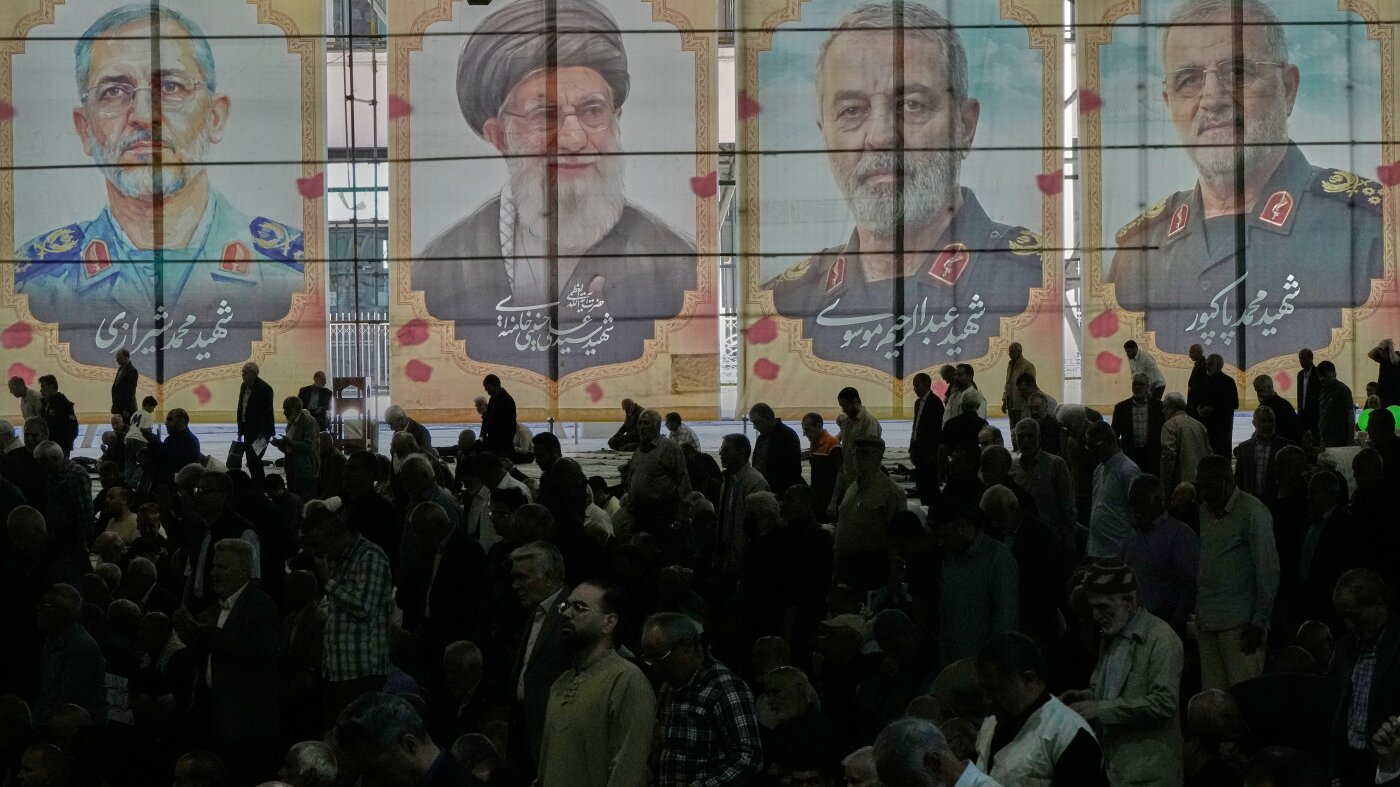
Iranian worshippers perform their Friday prayers under the portraits of the late Iranian Supreme Leader Ayatollah Ali Khamenei (second left) and top military officials who were killed during the U.S.-Israel campaign, at the Tehran University campus, in Tehran, Iran, on April 24.
Vahid Salemi/AP
hide caption
toggle caption
Vahid Salemi/AP
Two months after the U.S. and Israel launched the war on Iran, efforts to negotiate a deal with the Iranians appear deadlocked, dampening hopes of ending a conflict that killed thousands of people and disrupted global energy supplies.
In one of his latest online missives, President Trump said Tuesday his administration was informed by Iran it wants the Strait of Hormuz opened urgently.
“Iran has just informed us that they are in a ‘State of Collapse,'” Trump wrote. “They want us to ‘Open the Hormuz Strait,’ as soon as possible, as they try to figure out their leadership situation (Which I believe they will be able to do!).”
It was not clear if he was referring to an Iranian proposal, which the White House said President Trump and his national security team were reviewing on Monday. The Associated Press reported that Iran offered to open the Strait of Hormuz if the U.S. lifts its naval blockade, but it wants to postpone nuclear negotiations for a later stage.
In a sign of the ongoing standoff in the strategic strait, a U.S. guided-missile destroyer blocked an Iranian oil tanker from sailing to an Iranian port, the U.S. Central Command said on social media on Monday.

In Lebanon, the U.S.-brokered ceasefire to pause the fighting between Israel and the Iran-backed militant group Hezbollah looks increasingly fragile. Israel has carried out widespread strikes in the southern Lebanon and Hezbollah has fired several drones at Israeli troops.
And in a separate major shock to the oil industry amid the turmoil, the United Arab Emirates announced it is leaving OPEC, the group of oil-producing countries, after nearly 60 years of membership.
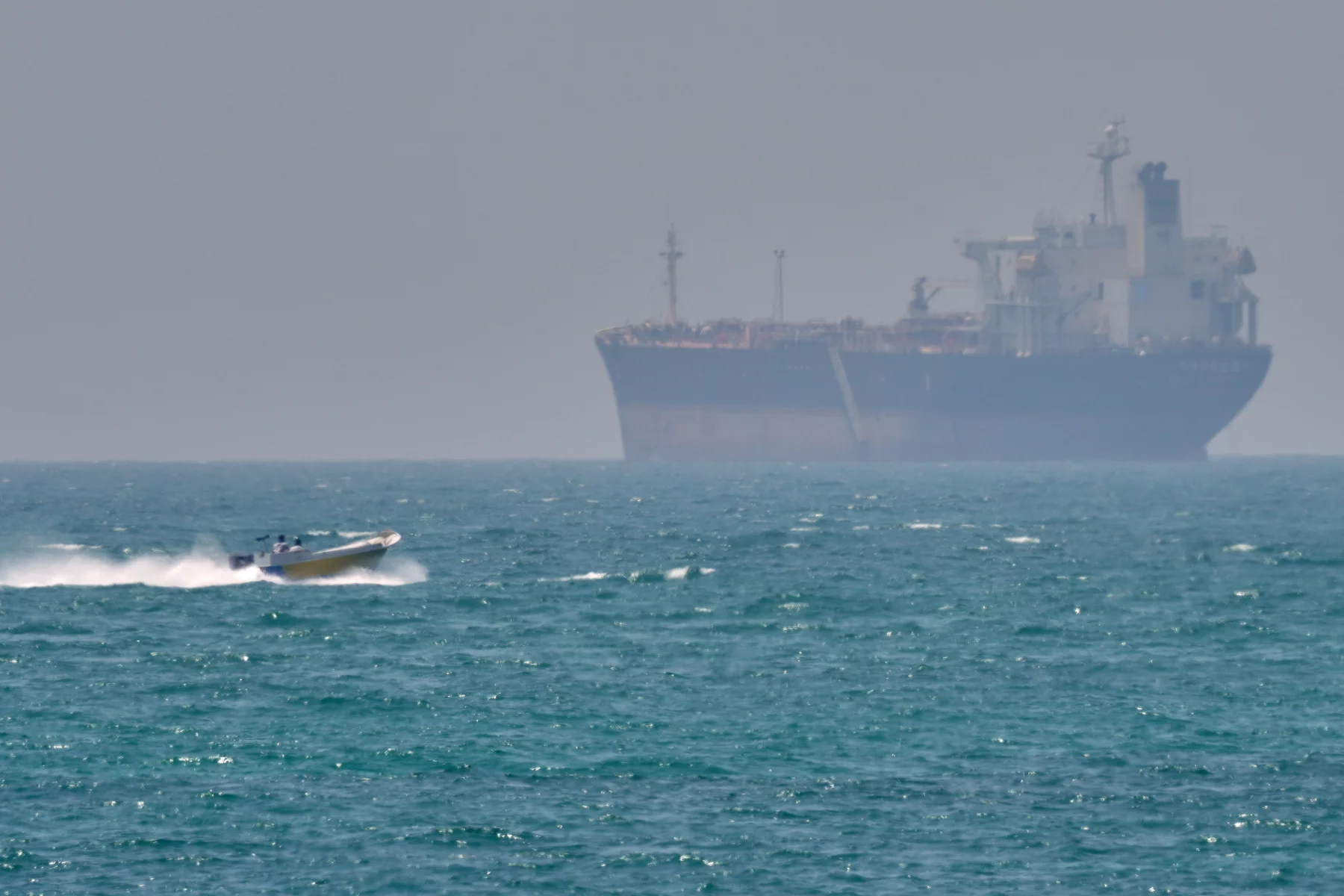
A boat sails past a tanker anchored on the Strait of Hormuz off the coast Qeshm island, Iran, April 18.
Asghar Besharati/AP
hide caption
toggle caption
Asghar Besharati/AP
Here are further developments in the Middle East conflict:
Marco Rubio on Iran | Lebanon | Israel-Iran | International reactions | Iraq’s new prime minister
Rubio says Iran’s attempt to control the Strait of Hormuz can’t be tolerated
Speaking to Fox News on Monday, U.S. Secretary of State Marco Rubio said the latest proposal by Iran was “better than what we thought they were going to submit.” But he said leadership in Iran was “deeply fractured,” complicating efforts to negotiate an end to the war.
Rubio indicated that no progress had been made on the U.S. demand for Iran to give up its nuclear ambition.
“That fundamental issue still has to be confronted. That still remains the core issue here,” Rubio said in the interview.
“We can’t let them get away with it,” he said. “They’re very experienced negotiators, and we have to ensure that any deal that is made, any agreement that is made, is one that definitively prevents them from sprinting towards a nuclear weapon at any point.”
Rubio also spoke against Iran’s attempt to control the Strait of Hormuz, the key waterway through which about 20% of the world’s oil and liquefied natural gas normally passes, primarily from Gulf countries to markets in Asia.
“They cannot normalize nor can we tolerate them trying to normalize a system in which the Iranians decide who gets to use an international waterway and how much you have to pay them to use it,” he said.
Traffic has largely been at a standstill in the Strait of Hormuz since Iran moved to exert its control over the strait in retaliation for U.S. and Israeli strikes. The U.S. has also imposed a naval blockade on Iranian ports, in a move aimed at increasing economic pressure on Iran to agree to Washington’s terms for an end to the war.
Rubio’s comments came amid Iran’s diplomatic outreach to Russia, a strategic partner, as Iranian officials sought to gain political leverage and foreign support. Iran’s foreign minister, Abbas Araghchi, met on Monday with Russian President Vladimir Putin, who expressed his support for Iran in its war with the U.S. and Israel.
Israel and Hezbollah trade fire
The ceasefire between Israel and Hezbollah in Lebanon appears to be fraying as peace talks between the U.S. and Iran remained in flux.

Israel has carried out widespread strikes in Lebanon’s south as Hezbollah has fired several drones at Israeli troops.
Israeli military spokesperson Avichay Adraee said Tuesday Israel used 450 tons of explosives to destroy two underground tunnels used by Hezbollah.
Almost two weeks ago, the Israeli and Lebanese governments, with U.S. mediation, agreed on a ceasefire that they said would pause the fighting between Israeli forces and Hezbollah. Israel has stopped its strikes on areas around Beirut. But elsewhere in Lebanon, attacks have been ramping up from both sides. In southern Lebanon, many residents have had to evacuate their homes again.
Iran has previously demanded that Israel stop its attacks in Lebanon as a condition to continue negotiating with the U.S.
Israel wants to “finish the job” in Iran
Israeli officials say the country is prepared to move ahead with defeating Iran, amid the teetering U.S.-Iran negotiation process.
“ We’ve degraded the regime significantly, but we have to finish the job. Either by means of negotiations or by other means,” Ophir Falk, a foreign policy adviser to Israeli Prime Minister Benjamin Netanyahu, told NPR on Tuesday.
He echoed the Trump administration’s assessment that confusion over who is calling the shots in Tehran has impeded progress for talks.
“ We’ve taken out most of the regime’s first- and second-tier leadership, and now the negotiation is being led by D-League team that I’m not sure has authorization or the ability to make decisions,” Falk said.
Falk previously told NPR’s All Things Considered Israel wanted to remove the “existential threat” posed by Iran’s regime by creating the conditions for Iranians to topple it, as well as and decimate its military capabilities. He said negotiations were a valid alternative and those methods “are not mutually exclusive.”
Last week, Israeli Defense Minister Israel Katz said the country was waiting for Washington’s approval to resume fighting in Iran and to kill Iranian Supreme Leader Mojtaba Khamenei and other potential leaders. Joint Israeli-U.S. attacks killed Ayatollah Ali Khamenei, the father of the current supreme leader, at the start of the war.
“We are awaiting a green light from the United States, first and foremost to complete the elimination of the Khamenei lineage — the architect of the plan to destroy Israel — and the successive replacements within the leadership of Iran’s terror regime,” Katz said in a video posted online by Israel’s i24News.
He added Israel was ready “to push Iran back into a dark age, by striking key energy and power facilities, and crippling its national economic infrastructure.”
International backlash over the war in Iran
The prolonged blockade of the Strait of Hormuz is drawing increased criticism from world leaders, with some scrambling to deal with growing public discontent over high fuel prices that have pushed up living costs.
German Chancellor Friedrich Merz blasted the U.S. administration on Monday for lacking a strategy in its war with Iran.
“The Iranians are clearly stronger than expected and the Americans clearly have no truly convincing strategy in the negotiations either,” Merz told a student forum in the German town of Marsberg on Monday, according to Germany’s DPA news agency. “The problem with conflicts like this is always: you don’t just have to get in, you have to get out again.”
He said, “the Iranians are obviously negotiating very skillfully — or simply very skillfully not negotiating.”

In this photo released by Tasnim News Agency, Revolutionary Guard Navy armed men climb aboard the cargo ship MSC Francesca during what state media described as the seizure of one of two vessels accused of violations in the Strait of Hormuz, on April 21.
Meysam Mirzadeh/Tasnim News Agency/AP
hide caption
toggle caption
Meysam Mirzadeh/Tasnim News Agency/AP
“An entire nation is being humiliated by the Iranian leadership, especially by these so-called Revolutionary Guards,” he added, according to Reuters.
President Trump reacted on Tuesday by dismissing Merz’s comments.
“The Chancellor of Germany, Friedrich Merz, thinks it’s OK for Iran to have a Nuclear Weapon. He doesn’t know what he’s talking about! If Iran had a Nuclear Weapon, the whole World would be held hostage. I am doing something with Iran, right now, that other Nations, or Presidents, should have done long ago. No wonder Germany is doing so poorly, both Economically, and otherwise!” Trump wrote online.
His comments came as Bahrain, a U.S. ally and one of the Gulf countries that had its oil refineries attacked by Iranian drones, convened a high-level meeting at the United Nations to demand that Iran reopens the Strait of Hormuz.
While most of the countries sided with Bahrain’s call, Russian and Chinese representatives blamed the blockade on the U.S. and Israeli strikes on Iran. The Bahrain-sponsored statement did not mention the U.S. blockade of the passage.
Australia’s foreign minister, Penny Wong, began a diplomatic tour in Japan, China and South Korea to discuss “shared energy security” amid growing concerns of export controls by Asian countries.
“Of course I’m concerned about what is happening in the Strait of Hormuz and what’s happening in terms of Australia’s supplies. We are all concerned, which is why we are making sure we engage with the countries of the region,” she said Monday.
She said that Australia and the countries in the region, which get 80% of their oil supply through the Strait of Hormuz, have been “disproportionately affected.”
Iraqi leaders agree on a new prime minister
Iraqi political leaders have agreed on a new prime minister months after an election.
The prime minister designate, Ali al-Zaidi, a banker, is a political newcomer.
Zaidi is seen as a compromise candidate after President Trump rejected an Iran-backed former prime minister, Nouri al-Maliki, to lead the country.
The U.S. controls Iraq’s supply of dollars and has used that as leverage.
Zaidi is a controversial pick who still faces hurdles before taking the job.
He headed an Iraqi bank that was among a group of financial institutions denied access to dollars two years ago, through the Iraqi banking system, due to concerns of money being channeled to Iran.
The Iraqi parliament has a month to approve Zaidi’s cabinet and program for him to form a government.
Kat Lonsdorf in Beirut, Jane Arraf in Amman, Jordan, Daniel Estrin in Tel Aviv, Israel, and Tina Kraja and Alex Leff in Washington, D.C., contributed reporting to this story.
Source link
