

Europe on high alert in the face of Trump’s strategic onslaught | International
Europe has entered a new state of alert in the face of increasingly explicit signs that the United States not only no longer wants to bear the burden of guaranteeing the continent’s security, but is also displaying open hostility in areas that go beyond simple economic and technological competition and touch the deepest core of strategic and security issues.
Donald Trump recently asserted that his country needs Greenland — an autonomous territory belonging to Denmark, a NATO ally — for “national security,” a day after U.S. forces staged an incursion into Venezuela, during which Nicolás Maduro was captured and transported to New York. “For the United States to secure the Arctic region, to protect and defend NATO and NATO interests, obviously, Greenland should be part of the United States,” Stephen Miller, the White House deputy chief of staff, said during a subsequent interview with CNN.
At the beginning of December, Washington published its new National Security Strategy, in which it launches an explicit attack on the EU, describing it as an entity that “undermines political liberty” and promotes “censorship of free speech and suppression of political opposition,” while promising to “cultivate resistance to Europe’s current trajectory within European nations,” which means a campaign of support for European nationalist forces that seek to dismantle the community integration project and harassment of those who promote them.
Another serious example of hostility surfaced in late December, with the sanctions imposed by Washington on former European Commissioner Thierry Breton — former head of technology regulations on online content moderation and hate speech — and on leaders of organizations that combat illegal and extremist content. This is yet another pressure tactic by Washington to get Brussels to soften its rules for American companies and to benefit the tech oligarchs who are now part of the Trumpian ecosystem.
The U.S. initiative, while not binding on sitting political leaders, is “extremely serious,” says a senior EU source. “It is further proof that Washington sees Europe as a colony, wants to maintain its subservience, and will do everything possible to impose its rules here,” says the source, who spoke on condition of anonymity to discuss this highly sensitive matter.
These episodes exemplify a hostile attitude from the U.S. toward Western Europe unseen since the end of World War II. There are others, ranging from threats or insinuations of withdrawing the security umbrella that covers NATO allies — an organization to which the U.S. contributes not only vast capabilities and irreplaceable leadership, but also the crucial issue of nuclear deterrence — to the trade war.
“They want to destroy us”
“As far as Europe is concerned, Trump and his administration have shown great consistency and predictability: they want to destroy us,” warns Nathalie Tocci, director of the Istituto Affari Internazionali. “Today, the United States considers liberal democracy and European integration to be adversaries.”
It’s not all bad news coming out of Washington for Europe. Last month, Congress approved a 2026 budget for the Pentagon that includes measures that break with Trump’s policies and seek to solidify the security relationship with Europe. The legislation includes, albeit meager, aid for Ukraine — $800 million spread over two years — and, most importantly, provisions to limit the Secretary of Defense’s ability to reduce U.S. troop numbers in Europe to fewer than 76,000 (a deployment estimated at around 84,000 earlier this year by the Council on Foreign Relations). It also prohibits the head of the U.S. European Command from relinquishing the title of Supreme Allied Commander of NATO.
This piece of legislation shows that within the American political establishment — as well as the military — there remains broad consensus on the strategic importance of maintaining a strong security relationship with Europe. However, unlike during Trump’s first term, these positions are not represented in his administration.
In light of these events, even the most pro-NATO European countries are reassessing their strategies, understanding the profound risk of relying on U.S. support. In December, Denmark’s military intelligence services defined the U.S., for the first time, as a potential threat to its national security. “The United States uses economic power, including in the form of threats of high tariffs, to enforce its will and no longer excludes the use of military force, even against allies,” its report emphasized.
In the wake of the U.S. operation in Venezuela, European leaders issued a statement urging Washington to respect Greenland’s integrity. “Unfortunately, I think the American president should be taken seriously when he says he wants Greenland,” Danish Prime Minister Mette Frederiksen said last Monday. “But I will also make it clear that if the U.S. chooses to attack another NATO country militarily, then everything stops, including NATO and thus the security that has been established since the end of the Second World War.”
If the hostility of the United States is compounded by the activities of a Russia that continues its aggression against Ukraine and deepens its sabotage actions in Europe, the perception of risk increases.
Dependency
The key factor driving Europe’s state of alert is its heavy reliance on the U.S. for security. This has a direct impact on its capacity for independent self-defense and an indirect effect on shaping Europe’s position across the entire spectrum of its relations with Washington.
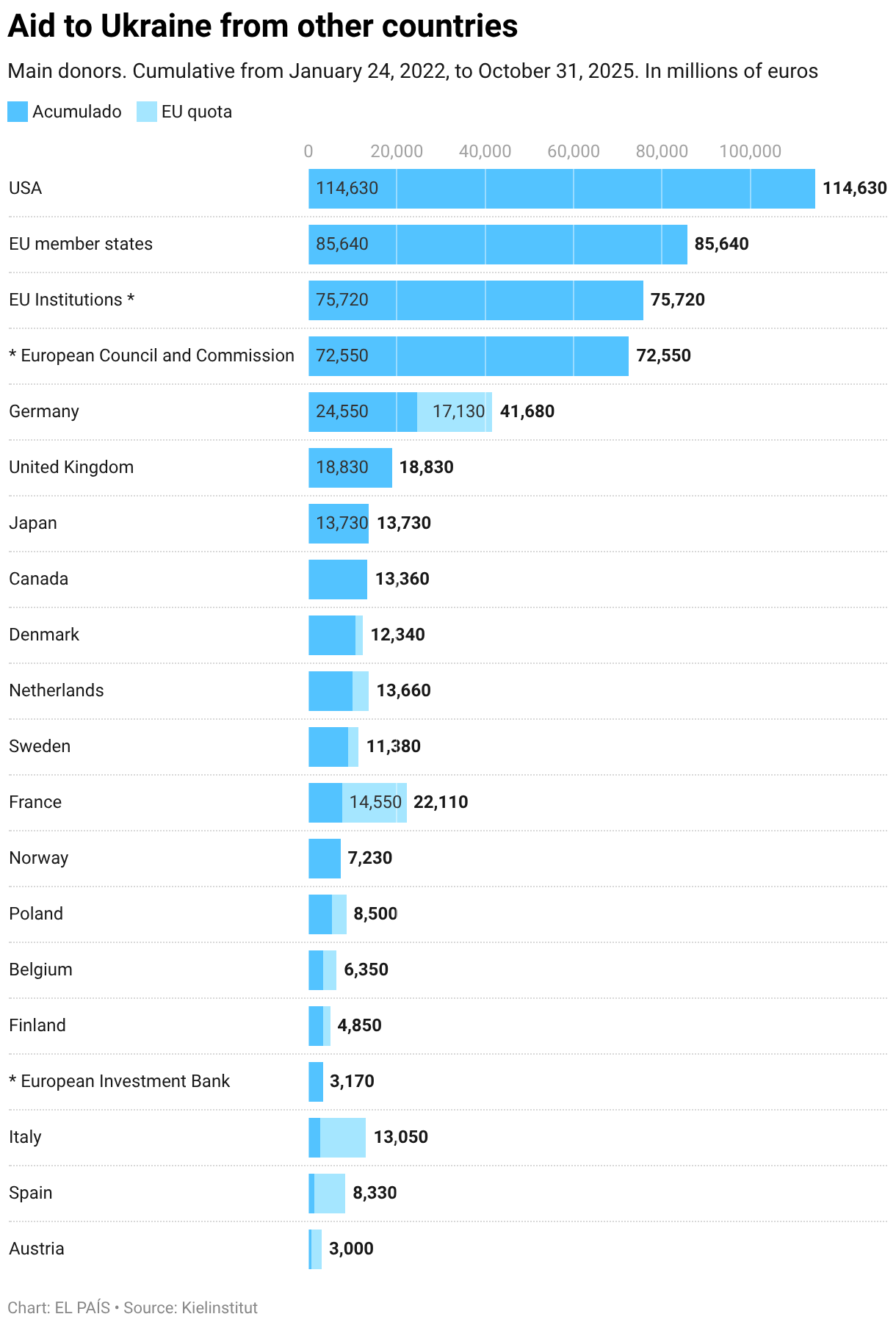
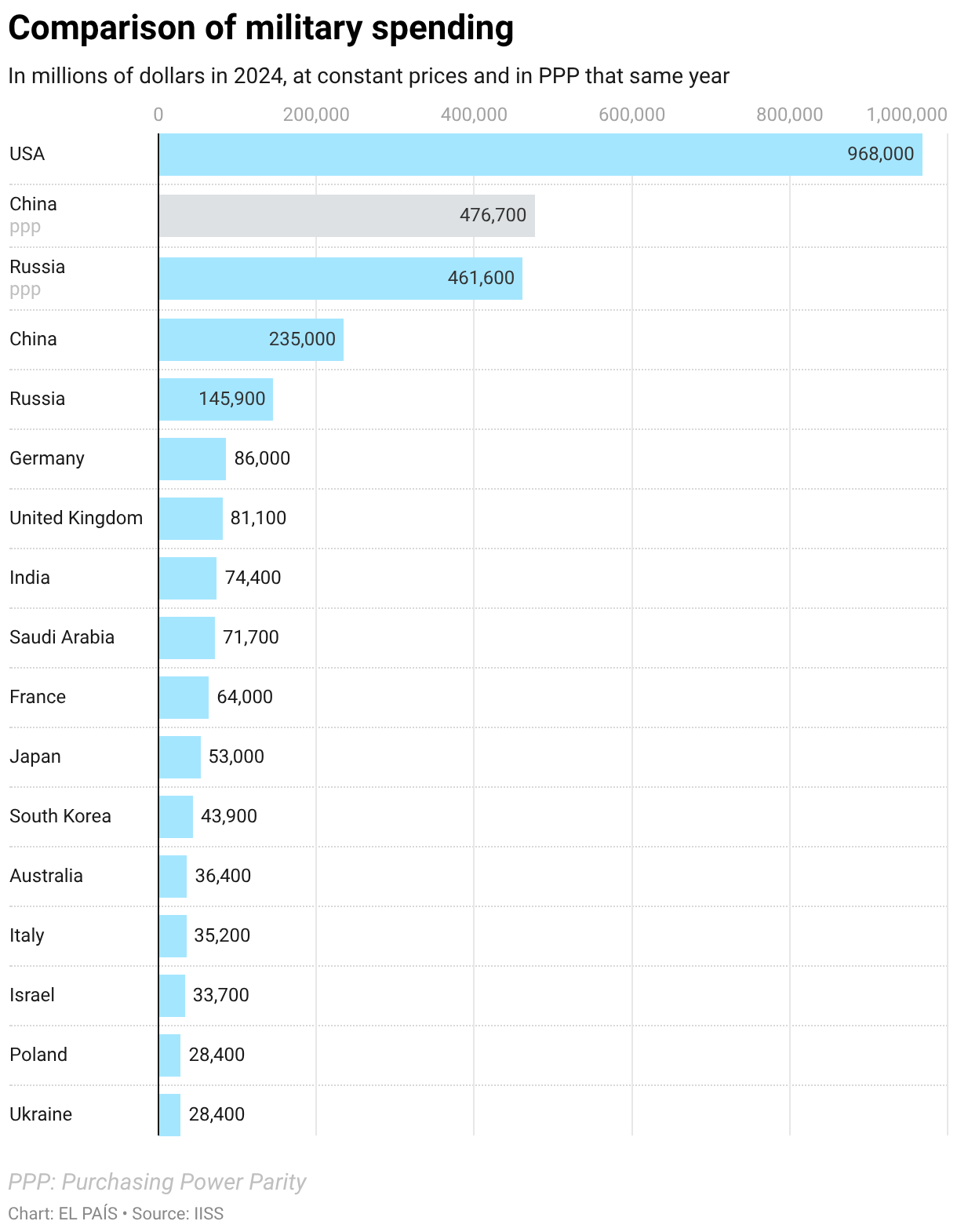
EU countries invest a considerable amount in defense — approximately €380 billion ($447 billion) in 2025, a figure higher than that of China or Russia in nominal terms — although not if calculated in purchasing power parity.
However, that figure is misleading, as it does not translate into a truly deterrent, autonomous defensive capability. Among other reasons, this is because Europe depends on the U.S. for key operational aspects, and because the total expenditure on paper ignores a reality marked by national fragmentation. The only effective coordinating body is NATO, dominated by Washington.
The dependencies are both quantitative — with limitations in arsenals and industrial production capacity— and qualitative.
A report by the International Institute for Strategic Studies concludes that Europeans are dependent on the U.S. for key activities such as intelligence, surveillance, and reconnaissance, for which they lack sufficient air and space assets. Other hardware deficits include inadequate air defenses and long-range missile capabilities. In the software arena, for example, Europe lacks sovereign cloud computing capabilities. With regards to nuclear weapons, two countries possess the capability (France and the U.K.), but their arsenals are far smaller than those of Russia and the U.S.
In a clear symptom of the connection between Washington’s political and cultural attack on Europe and the issue of defense, U.S. Vice President J.D. Vance said in a recent interview: “France and the U.K. have nuclear weapons. If they allow themselves to be overwhelmed with very destructive moral ideas, then you allow nuclear weapons to fall in the hands of people who can actually cause very, very serious harm to the U.S.”
In this context of American disengagement and weariness, an exclusive report by Reuters in early December sparked alarm. According to the report, Washington wants Europe to take over most of the continent’s conventional defense capabilities by 2027, an extremely early date for matters of this magnitude. The message, according to the report, was conveyed to several European delegations by Pentagon representatives at a meeting in the U.S. capital.
The 2027 deadline has been met with dismay in some circles. However, the U.S. has not formally or informally informed all its allies of this intention, according to NATO sources. Furthermore, these same sources say that it is “highly unlikely” that this transfer will happen in the short term. Within the military alliance, there is a tendency to avoid political discussions and to seek distance from the noise and pronouncements of the Trump administration. It’s as if addressing the issue would accelerate a divorce that could change NATO forever.
Another report from the International Institute for Strategic Studies estimates that to replace the conventional capabilities — that is, excluding nuclear ones — that the U.S. has allocated to the Euro-Atlantic scenario, European states would need to invest around $1 trillion above current investments to cover a 25-year defense cycle.
Jamie Shea, a researcher at the think tank Friends of Europe and a senior NATO official until 2018, argues that it is unrealistic for Europeans to be self-sufficient in terms of capabilities, defense spending, and nuclear deterrence. “Europe has an interest in retaining as much U.S. capability as possible in Europe and NATO for as long as possible to allow for a more strategic and military transition. But it must maintain this effort even if the U.S. posture becomes less hostile,” he asserts. “The old Cold War U.S. is not coming back,” Shea stresses. “Europe must have a clear strategy and the resources to achieve credible self-defense by 2030.”
Luis Simón, director of the Brussels office of the Elcano Institute, believes that a reduction in U.S. capabilities and presence in Europe is very likely, as Washington wants to focus on other scenarios, but he does not believe it will be total.
“Today, Europeans are not in a position to maintain a command structure with all that it entails, and they won’t be in a position to do so for the next five or even 10 years. They lack the technical capacity, and no state has the political legitimacy to replace the U.S.,” says Simón. “So, if it isn’t done in a coordinated and structured way, with the U.S. leading the charge and maintaining command positions within the NATO structure, it would surely be a chaotic and divisive process, which could lead to fragmentation and a command and deterrence structure in Europe centered around subregional groups,” notes the expert, who is also a professor at the Vrije Universiteit Brussel.
“The underlying issue is that the U.S. wants Europeans to take charge of their defense, but the Trump administration has opted for a very ideological strategy that wants a divided Europe, dominated by nationalist forces, thus hindering the development of capabilities at a European scale, under the EU umbrella or as a European pillar within NATO,” says Pol Morillas, director of the CIDOB think tank.
This political attitude, this hostility, also casts a shadow over Europe’s weaponry. The specter of the “kill switch” — mechanisms by which the manufacturer can remotely disable the system — is haunting the sector. Even without total inoperability, the mere interruption of software updates can severely impair the operational capabilities of key assets such as F-35 fighter jets or European naval vessels operating with the Aegis system.
This concern arises in an unfavorable context. Data compiled by Juan Mejino-López and Guntram B. Wolff of the Bruegel Institute show an increase in purchases from the U.S. in recent years. European NATO countries spent 50% of their military equipment investment on purchases from the U.S. in the 2022-24 period, compared to 28% in the 2019-21 period.
“This makes sense considering the threat situation in Europe and the war in Ukraine. A significant portion of purchases are directed to the American defense industry because there is limited production capacity in Europe,” says Mejino-López. “The problem is that in a context where you see signs of hostility from the Washington administration every month or even every week, this dependence comes at a very high price when it comes to decision-making, as we have seen with the trade agreement,” the expert says.
But the path to overcoming this dependency is hampered not only by ideological resistance from nationalists, but also by minor albeit serious clashes of national interests. Morillas — author of In the Senior Citizens’ Playground: Europe Facing a Hostile World (Debate) — points, for example, to the failure to get the FCAS project off the ground, a new-generation fighter jet system that Dassault, Airbus, and Indra were supposed to develop, but which is languishing due to the power struggle between France and Germany.
Progress
All of this does not mean that Europe is not making significant progress. EU military spending has risen from €260 billion ($304 billion) in 2022, the year of Russia’s major invasion of Ukraine, to €380 billion ($445 billion) this year. Many countries have introduced new mechanisms to increase their troop numbers. The 27 member states have agreed to use the significant instrument of common borrowing both for the SAFE program, which aims to finance coordinated arms projects, and to provide financial stability to Ukraine, and have agreed on an escape clause in the fiscal stability pact regarding military spending.
Likewise, the industrial sector has taken steps in recent years toward increasing production capacity, while on the political front a core of European countries has formed an informal council that has gained a certain degree of influence in the negotiations related to Ukraine.
Several analysts believe that to move forward, it is necessary to abandon systems that require unanimity and instead form coalitions of volunteers. “It’s the only way I see possible, to do it outside of established structures, outside of discussions requiring unanimity,” says Morillas. “That ties in closely with the pragmatic federalism that Mario Draghi talks about,” the expert points out.
The loan recently granted to Ukraine through the issuance of eurobonds without the participation of Hungary, the Czech Republic, and Slovakia is an example.
As a top priority to reduce dependencies and this enormous vulnerability, Europe should try to replace the 20,000 troops the United States deployed at the start of the Ukraine crisis, who will most likely be withdrawn (Washington has already pulled some from Romania), emphasizes a report from the Belfer Center at Harvard University, coordinated by researcher Daniela Schwarzer. “An alliance that remains overly dependent on Washington faces the risk of fracturing. A Europe that remains without adequate defense could suffer a military defeat, dealing a blow to security and prosperity on both sides of the Atlantic,” it states.
Sign up for our weekly newsletter to get more English-language news coverage from EL PAÍS USA Edition
Source link
