

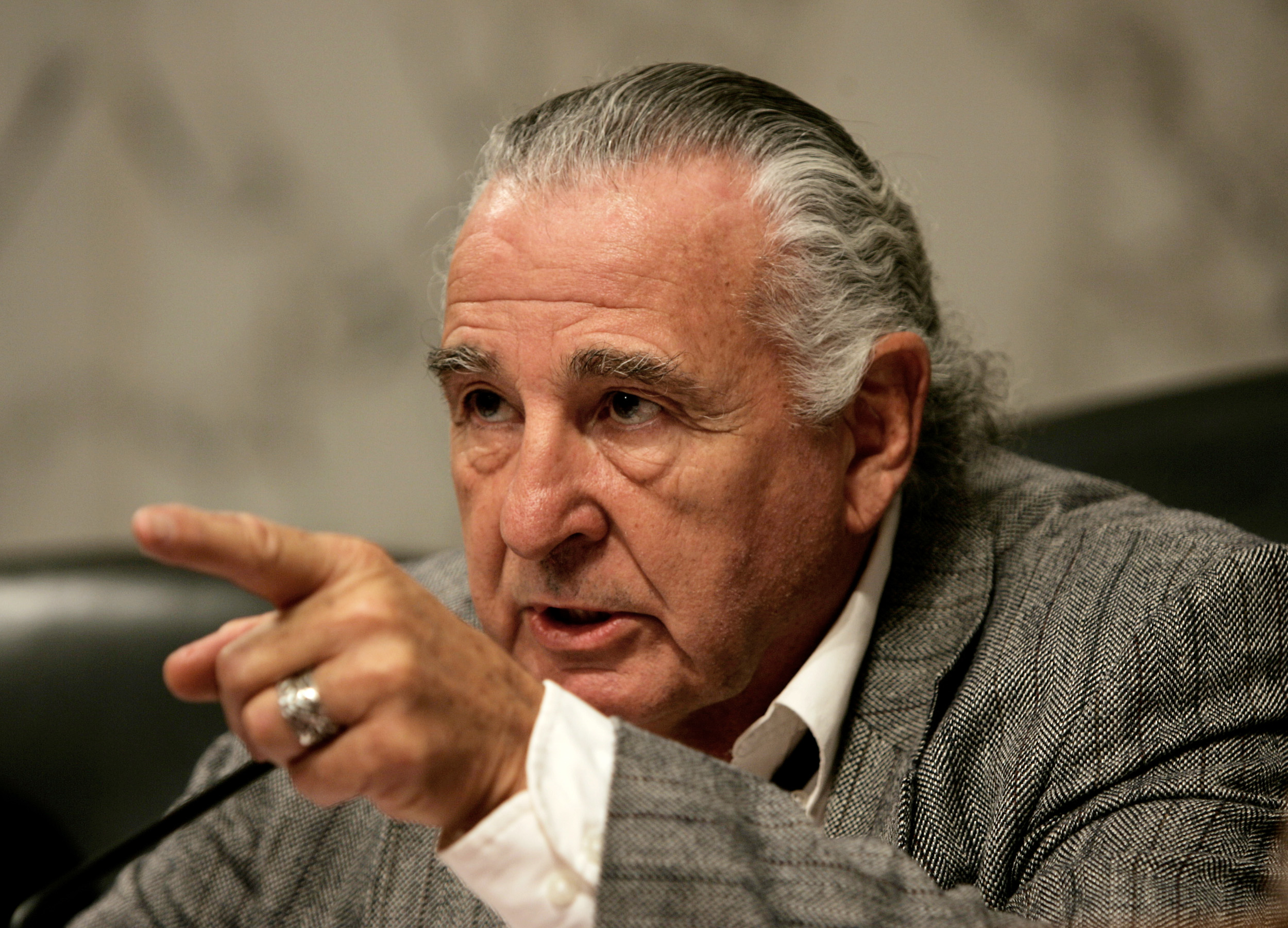
Former U.S. Sen. Ben Nighthorse Campbell, a fixture of Western Colorado politics for decades, died Tuesday of natural causes surrounded by his family, his daughter Shanan Campbell confirmed.
Campbell represented Colorado in the Senate for two terms after serving in the House of Representatives and the state legislature.
He was 92.
Campbell is best known for his long political career, but held many other notable roles, including as a member of the U.S. Air Force and the U.S. Olympic Team.
From 1983 to 1986, Campbell served in the Colorado state legislature, followed by three terms in the U.S. House of Representatives. Then, he was elected to the U.S. Senate in 1992, where he changed his party affiliation to Republican from Democrat in 1995.
He served as chair of the Committee on Indian Affairs until the end of his second term in January 2005.
Campbell was the first Native American to chair the committee and the only Native American to serve in the Senate during his two terms.
A member of the Northern Cheyenne tribe, Campbell stumbled into his political career almost by chance, said former Colorado GOP Chairman Dick Wadhams, who ran the organization from 2007 to 2011.
Wadhams said Campbell walked into a Democratic meeting in Durango and walked out as a nominee for state representative.
Campbell recalled the meeting in July during an interview with The Colorado Sun at his dining room table with his wife, Linda, at their ranch near Ignacio.
“They asked, this guy said, ‘I’m busy,’ this one said, ‘I’m sick,’ that one said, ‘I can’t do it,’ so I wasn’t their best choice, I was the only one left,” Campbell said.
Wadhams credits Campbell’s interesting life story and likeability for his successful political career spanning both parties.
“When Ben Campbell entered a room, you knew he was there,” Wadhams said. “He just had a huge presence. He just was the kind of guy that people found interesting and unique.”
Campbell served as honorary chair of the Sand Creek Massacre Foundation and is credited with helping get the Sand Creek Massacre site added as a unit of the National Park system. Campbell said his Northern Cheyenne ancestors were among more than 150 Native Americans, mostly women, children and elderly men, killed by U.S. soldiers while camped under a flag of truce on Nov. 29, 1864, known as the Sand Creek Massacre.
Campbell was born in Auburn, California, on April 13, 1933. His mother was a Portuguese immigrant, and his father was a member of the Northern Cheyenne tribe.
Campbell quit high school to join the Air Force, where he got his GED and served from 1951 to 1953, stationed in Korea. He attained the rank of airman second class.
He attended San Jose State College in California, where he received a degree in physical education in 1957.
Campbell met his wife, Linda, in 1966 when they worked for the same California school district, where Campbell taught physical education. The school asked Campbell to teach a judo class so PE teachers would know what it was, and Linda enrolled.
They married after just a few months of dating and were married for 59 years. They had two children, Colin Campbell and Shanan Campbell, and four grandchildren. Campbell’s daughter said the family will be making a formal statement Wednesday.
Sold it all for a chance at the Olympics
When Campbell found out in 1960 that judo was going to be included in the 1964 Tokyo Olympics, he jumped at the chance to compete.
“I sold every damn thing I owned and I moved to Tokyo,” Campbell said during the recent Colorado Sun interview.
He enrolled at Meiji University in Tokyo as a research student. In 1963, he won a gold medal in judo at the Pan-American Games in São Paulo, Brazil. At the 1964 Olympics, Campbell suffered an injury and did not place. Campbell went on to coach the U.S. National Judo Team.
As a child, Campbell started to make jewelry when he was just 9 years old by flattening coins on Southern Pacific Railway tracks between Reno and Sacramento and fishing trinkets out of the local dump to hang on necklaces. He honed the skills as an adult, becoming an award winning jewelry designer.
In a 2019 interview with Rocky Mountain PBS, Shanan described her dad’s work as “his passion, his love and his outlet.
“I can show you his jewelry and explain to you what phase of his life he was in,” she said. “It is almost like a journal. Nothing in his life is done haphazardly. Everything is done with clear intent.”

Campbell and Linda bought a ranch on the Southern Ute reservation in 1978 where they raised horses and Campbell launched his political career.
In Congress, Campbell stood out for his bipartisanship and his looks. He often sported cowboy boots, a bolo tie and a ponytail.
Former U.S. Sen. Hank Brown, a Republican who served Colorado alongside Campbell, said Campbell “did a great job in capturing the spirit of Colorado and representing it.”
“He was enormously straightforward and honest,” Brown said.
Brown remembers in the early 1990s when he was Colorado’s Republican senator and Campbell was the state’s Democratic senator, Brown invited Campbell to attend a Fourth of July celebration in Greeley and stay at his home. Brown agreed to let Campbell bring his horse and keep it in the backyard.
When Brown woke up the next morning, he looked out the window and saw Ben and Linda already outside shoveling manure.
“We were just great friends,” he said. “He had the kind of integrity that people would hope members of the Senate would have.”
Brown called Campbell’s change in political party an “act of conscience” as opposed to a political move.
During Campbell’s time in the Senate, he became more estranged from the Democratic Party in part because he thought Republicans were doing more for Native Americans.
“I kept voting with those darn Republicans, so I changed parties,” he told Rocky Mountain PBS in 2019.

Campbell saw one of his longest-championed endeavors come to fruition last spring, when the Southern Ute tribe was finally able to draw water from the controversial federal Animas-La Plata project.
First authorized in 1968, it took until 2011 to fill Lake Nighthorse, the main feature of a heavily scaled-down federal water project located just south of Durango named for Campbell. It then took 14 more years for a tribe to be able to use a small slice of its water, overcoming tough battles with environmentalists who opposed the project.
Campbell, during an interview with The Sun in July, implored water managers to focus on more ways to reuse water.
“We’ve got to find better ways of using what we have,” he said. “Not producing more water that doesn’t exist.”
During his tenure in Washington, Campbell said he focused most on water, public lands, education, law enforcement and Native American issues.

The work he valued most included getting funding for bulletproof vests for police officers, he told the Rocky Mountain PBS crew. Pundits groused that the work was not “major.”
“Well tell that to the mother of some cop whose life was saved by a bulletproof vest,” he said. “That was a damn important bill.”
After leaving Washington, he worked as a lobbyist, founding his own firm and lobbying on behalf of the Indian Gaming Association.
But above all other work, he said, he was proudest of getting the National Museum of the American Indian built on the National Mall.
“If I ever wanted to be remembered for one single thing above all others,” he said, “it would be that museum — because I am a firm believer that you can’t have a good future unless you learn from the past.”
Colorado Sun staff writer Shannon Mullane contributed to this story.
Source link
