

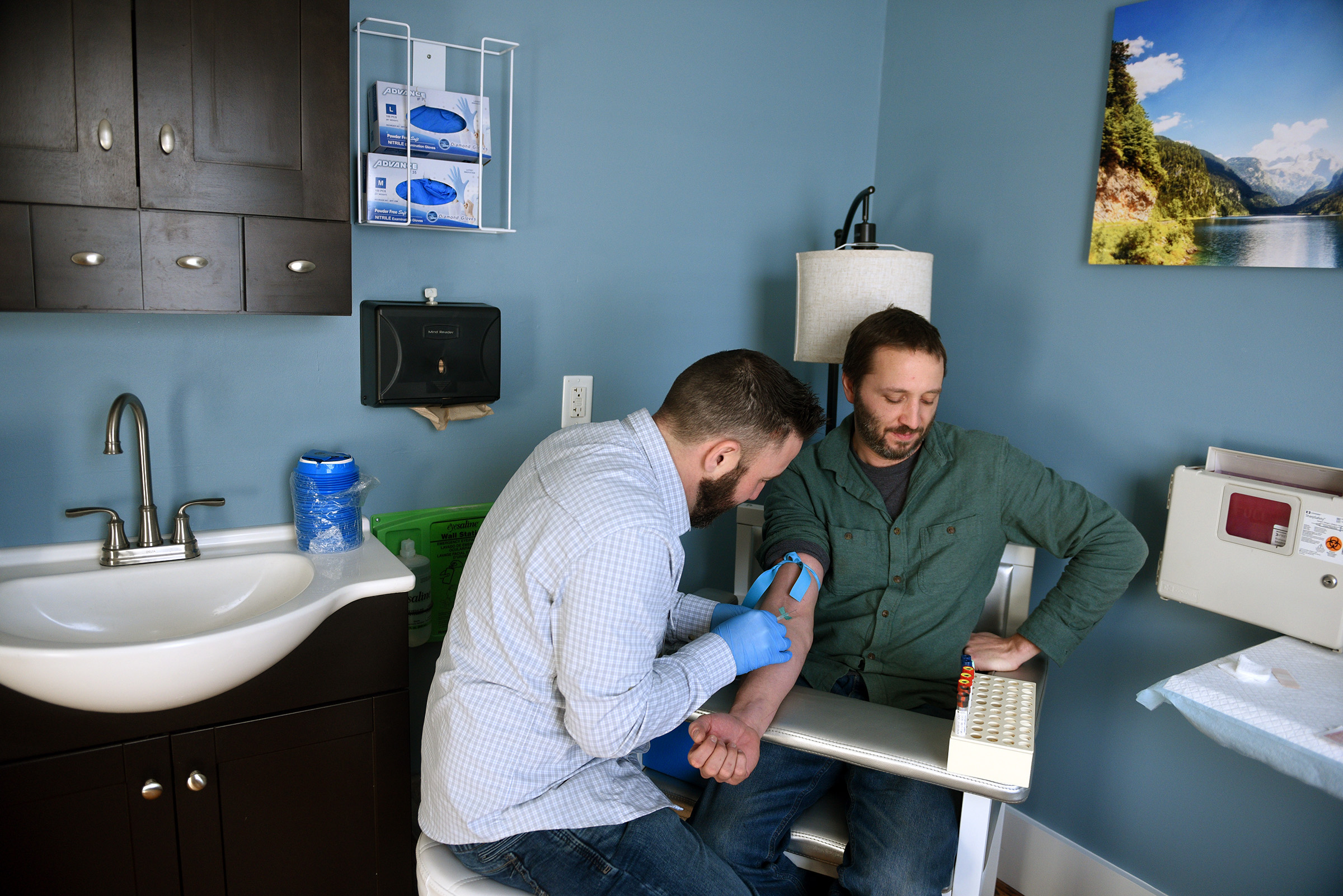
WEST LEBANON — Growing up on a dairy farm in Corinth, Seth Osgood, his mom and three siblings all had digestive issues.
“We were one of those families, unfortunately, where we had to scout out the bathrooms when we were on vacation,” Osgood said in an interview at his West Lebanon office last week. “…It was pretty brutal, but that was our norm.”
It wasn’t until Osgood was finishing up school to become a nurse practitioner that his mother found functional medicine which offered a solution to the long-term problem.
JENNIFER HAUCK / Valley News
Osgood, who now lives in Norwich, made lifestyle changes like his mom had, including shifting his diet “pretty dramatically.”
“Lo and behold, my symptoms completely resolved,” Osgood said.
Today, Osgood’s IBS is under control without medication and he owns and operates Grassroots Functional Medicine in West Lebanon. The clinic opened in 2017 and moved to its current location at 89 South Main Street in April 2025.
Osgood, a doctor of nursing practice, is one of at least six medical providers in the Upper Valley specifically working in functional medicine.
“In general, functional medicine practitioners try to take the 30,000-foot view and say where can we pull a little thread here that’s kind of connecting a lot of this,” Court Vreeland, a board certified chiropractic neurologist who sees patients at the Vreeland Clinic in White River Junction, said last week.

JENNIFER HAUCK / Valley News
Vreeland started working under his father at the Vreeland Clinic in 2006 and took over the practice in 2011. In addition to his chiropractic background, he has a master’s degree in human nutrition and learned from his father how to incorporate functional medicine into his work.
The majority of Vreeland’s patients come in with a particular concern that he addresses and then works with them to create a “runway” of lifestyle changes to “optimize for the things that (they) want to be doing from a physical standpoint and from a life standpoint.”
Individualized care
Generally, signing up with a functional medicine clinician involves meeting the provider, running through an extensive health history and completing an, often sizable, panel of lab testing.
At Grassroots Functional Medicine the basic lab panel includes over 120 blood work tests. It looks at markings including vitamin and nutrient levels, indicators for autoimmune and heart diseases, metabolic profile, thyroid, organ function, hormones and immune function.
Patients at Grassroots Functional Medicine have to commit to seeing the practitioner for eight months to a year after their first consultation. Initial lab testing can cost between $1,200 and $2,000, according to the website.
Functional medicine is not typically covered by insurance and most clinics are direct pay only and will give clients a “superbill” so they can seek some reimbursement.
The cost for the whole program “is individualized based on a patient’s specific needs,” Danica Griffin, the practice’s marketing manager, said Monday.
The provider uses patients’ test results and exams to build a plan with the patient that looks at their diet, potentially introducing dietary supplements, stress levels and other lifestyle indicators such as sleep and exercise routines.
“It’s not woo-woo or magic, it’s just giving the body what it needs because our environment’s working against us,” Osgood said.
A return to ‘wholeness’
Functional medicine is growing in the Upper Valley, providers say, with many patients “seeking” a more holistic form of care, said Audrey Lohr, an advanced practice registered nurse who owns Flora Primary Care in White River Junction.
Many patients who seek out functional medicine have chronic illnesses or problems they are looking to solve, providers say. A smaller contingent are looking to optimize their health.

JENNIFER HAUCK / Valley News
Kathy Washburn, of Orford, has been seeing Osgood for three years. In traditional medicine, “I felt like I just handed the keys over to the castle and had blind faith that these humans had my best interest in mind.”
At her first appointment with Osgood, Washburn said she spent about two hours going through her medical history.
“They are interested in understanding the whole story, not just the piece of or the symptoms of it,” Washburn said. “They’re trying to help you back to your own wholeness.”
Washburn got into functional medicine after she was diagnosed with cancer 23 years ago. She appreciates that Osgood is “always on the cutting edge” of new wellness technology.
In addition to the core functional medicine program, the clinic offers alternative treatments at an added cost.
These treatments include a cold plunge, zero gravity massage, red-light therapy, infrared sauna, hyperbaric oxygen therapy, IV infusions and metabolic testing. Members who are not patients can pay between $349 and $549 a month for “unlimited access” to the clinic’s other treatments.
“You can do these other things again to help you realize that you are part of your own health care,” Washburn said. “It’s almost like a shift in power so you empower yourself to feel good.”
Washburn pays $229 a month for a maintenance membership at Grassroots Functional Medicine and opts to do a panel of lab testing once or twice a year for around $580 per panel. Every six months or so, she spends about $500 on supplements.
She acknowledges that functional medicine is expensive. But, she said, traditional health care is also very expensive. Last year, Washburn wound up in the intensive care unit and had to pay out her $7,000 health insurance deductible for the four-day stay.
“There is no free health care and there is a cost to not taking care of yourself,” Washburn said.
Mike Mann, of Bradford, Vt., started seeing Osgood after having a heart attack and four-way bypass surgery in 2023.
Even before the heart attack, Mann was interested in using holistic practices to manage his cholesterol. Traditional medications such as statins, commonly used to lower cholesterol levels, left him feeling sick.
Since starting at Grassroots, Mann said he has used supplements and a new diet to bring down his cholesterol and blood pressure. He’s not currently taking any medications.
“It’s a different belief,” Mann said. “Is it perfect? No, and I don’t look at it that way. I listen to my doctor and I listen to my holistic doctor and I do which one I think is going to work best for me.”
After starting the supplements, Mann’s cholesterol and blood pressure levels dropped and he was able to follow a cardiologist’s recommendations to come off some of his medications. He has opted on his own to stop taking statins because of the side effects, but said he is likely to get some push back from his doctors for that choice.
Under Osgood’s guidance, Mann has cut out dairy, gluten, refined sugar, alcohol and, after completing an allergy panel, nightshades such as tomatoes.
Mann takes 10 supplements that he buys from Grassroots for $300 a month, including a garlic pill, magnesium and cholestoff, a supplement containing phytosterols that are naturally found in plants and reduce cholesterol. All three aim to support heart health.
Growing knowledge base
Both Lohr and Osgood are certified in functional medicine through the Institute for Functional Medicine, IFM, which Lohr said “gives us this really robust background in understanding which of these supplements and herbs have been well-researched and shown to be effective.”
The Institute for Functional Medicine is a Washington-state based nonprofit that provides certification in functional medicine to health care providers including doctors, nurses and nutrition professionals.
The multi-year training program requires providers to train and prove their competency in a series of areas through an exam. Skills assessed include how to identify and evaluate root causes and factors impacting patient health, how to complete and evaluate exams and lab testing, and how to create and explain plans to address the root causes of patients’ health concerns.
Dr. Elizabeth Bradley is also certified through the IFM and sees patients remotely from her home in Lyme. Before her home practice, she was the medical director of the Cleveland Clinic Center for Functional Medicine and is board certified in internal medicine.
Over her 30 years in medicine, Bradley said functional medicine “has definitely taken hold as people become more and more knowledgeable” about it.
Since it was created in 2001, the Institute for Functional Medicine has certified over 3,000 medical providers in the field. Other institutions also train and certify providers.
Recently, Bradley has worked with many long-COVID patients who are using nutritional and lifestyle changes to boost their immune systems and reduce symptoms.
But the reception to functional medicine hasn’t been all positive.
In a June 2025 report from McGill University’s Office for Science and Society, Science Communicator Jonathan Jarry warned that functional medicine focuses on testing for as many issues as possible in order to find something wrong and recommending supplements accordingly. Doing so, Jarry writes, convinces patients that there is something wrong with them and encourages them to continue seeing the provider and purchasing supplements.
Like other providers, Bradley said functional medicine can be met with skepticism.
One factor, Bradley said, is there is very little research that specifically uses the terminology “functional medicine.” Instead, she said providers and institutions have used relevant research that focuses on different parts of functional medicine, such as the effects of certain supplements.
“People want to see research,” Bradley said.
‘Systems-based’ approach
Many of the functional medicine providers in the Upper Valley prefer to work with a patient’s primary care physician or other specialists to deliver safe care, they said.
“I really think that people do the best when they have a full team, because I think there’s really things that we do very well and there are things that my medical counterparts do very well,” Vreeland said.
Lohr combines functional medicine with primary care at her practice in White River Junction and patients can choose how much they want functional medicine to be incorporated into their care.
Lohr considers functional medicine a “framework for systems-based thinking” and prefers to focus “as much as we can” on whole foods and food education over supplements, though she will prescribe them sometimes.
“I want to equip people with tools for the long term, I’m not trying to put them on a bunch of supplements so they’re just propped up,” Lohr said.
Source link
