

Global Collaboration Unearths the Secrets of the Ancient City of Sardis
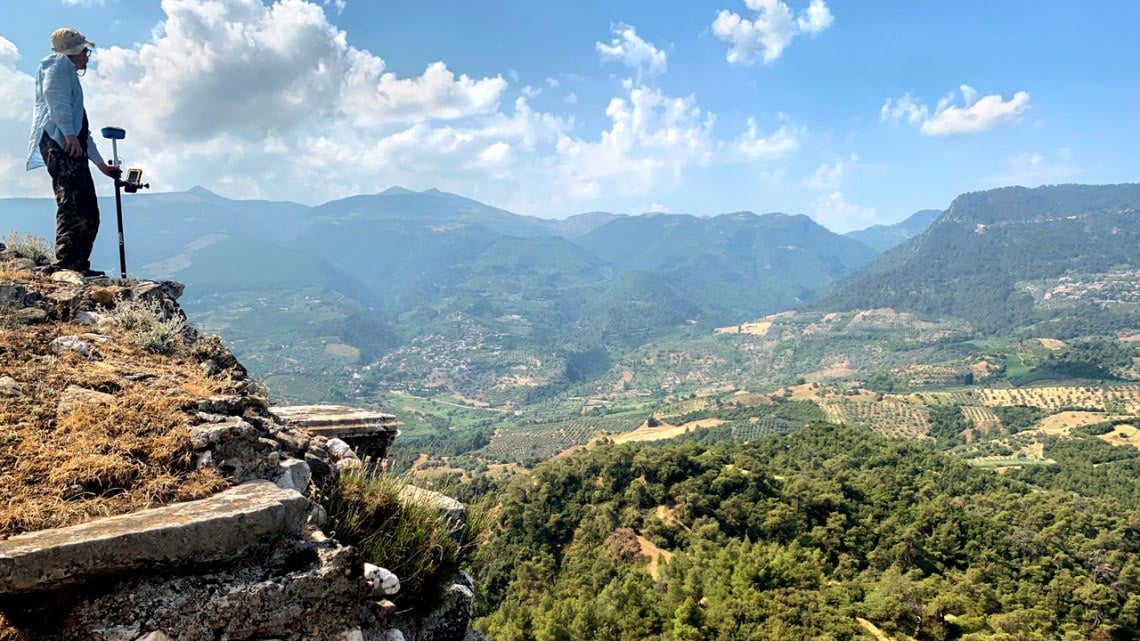
Long-term excavation at Sardis continues to reveal its rich past. Collaboration and continuity are key to protecting and understanding the ancient city.
Spanning eras from the Greeks and Romans to the Ottoman Empire, Sardis in western Turkey has experienced continual cultural change. In contrast, archaeological research at the site has remained steady. Since 1958, the Harvard-Cornell Exploration of Ancient Sardis has carried out uninterrupted excavation, making it one of the longest-running institutional digs in the region.
“It’s really important that it has institutional continuity,” said Benjamin Anderson, associate professor of history of art and visual studies in the College of Arts and Sciences. “Many of us know and have been mentored by colleagues of the previous generation of excavators. As a result, it’s one of the few long-term archaeological projects in the region that has generated a critical mass of data.”
In recent years, Anderson has focused his work on documenting the city’s acropolis, which played a central role during the Byzantine era after the Roman period.
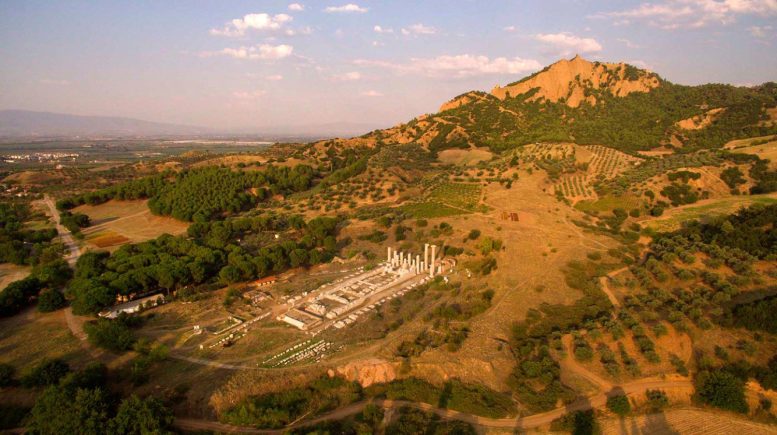
“This is a city that shows up in lots of ancient historical sources,” he said. “But now, just in the last 75 years or so, we have the possibility of telling that story, also, through what the project has found archaeologically.”
This summer, the site received official recognition as a UNESCO World Heritage site, an achievement made possible by both the excavation team and the strong support of the local community.
“The opportunity to really start understanding a culture through the material remains is pretty unusual, and it requires that kind of long-term commitment,” Anderson said. “That’s also what’s being celebrated by the World Heritage designation by UNESCO. This project has always been distinguished from the very beginning by a desire to communicate results and to make their work legible to tourists and to locals and all manner of different audiences.”
Historical significance and cultural layers of the ancient city
Sardis served as the capital of the Iron Age kingdom of Lydia, positioned between the Mediterranean Sea and the Anatolian plateau. It was “a place of cultural encounter between the East and West,” said Annetta Alexandridis, associate professor of the history of art and classics in A&S.
The Lydian period holds particular importance for historians and archaeologists. The Lydians are credited with creating the first known coinage, and their ruler, King Croesus, was famously considered the richest man of his time. The Lydian empire later fell to Alexander the Great, and the city eventually became part of the Roman Empire, followed by the Byzantine and Ottoman empires.
“Because it was not overbuilt by a modern city – it’s only a little village – Sardis gives you a really long history, from the Bronze Age, third millennium BCE, to basically today,” Alexandridis said. “These layers are all there, and make it sometimes difficult to excavate, because they are not clearly stratified. They interfere with each other, but, in a way, it’s an ongoing history, and that makes it so fascinating for us.”
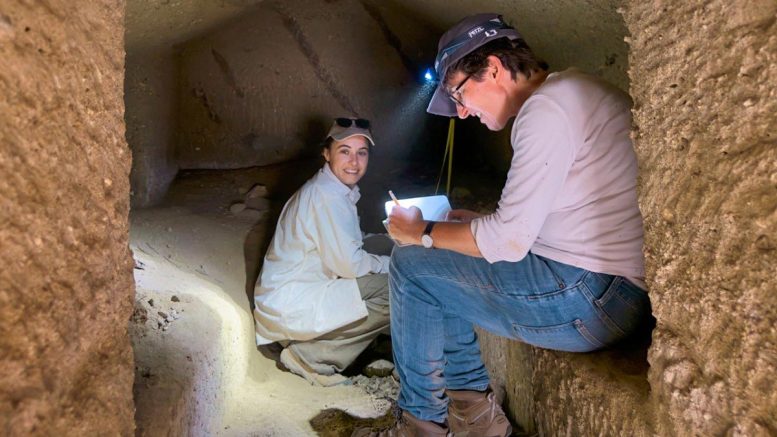
As associate director of the project, Alexandridis studies Roman funerary practices at Sardis and is currently surveying all of the city’s cemeteries. Many of these burial grounds remain poorly documented, unlike the Bin Tepe cemetery, located about 10 kilometers north of Sardis, which includes some of the largest known tumuli, or burial mounds.
Sardis has also shaped the development of American archaeology. The first modern excavation, led by the American Society for the Excavation of Sardis in the early 20th century, was described by Alexandridis as “a really large-scale exploitation.” Although the Temple of Artemis and the necropolis were uncovered, numerous artifacts were damaged, lost, or transported to the United States under questionable circumstances, including a massive column now displayed at the Metropolitan Museum of Art. These early excavations ended during the Greco-Turkish war in the early 1920s, and over time, some of the displaced artifacts were returned to Turkey.
“It’s one of the first cases where we can see the whole discussion about restitution of antiquities that were illegally exported, until some were returned to Turkey,” Alexandridis said. “It has all of these broader issues of how to deal with cultural heritage from a not only preservation or scholarly point of view, but also political and legal, and of the question of stewardship and responsibility for culture in the past.”
Cornell and Harvard’s collaborative excavation legacy
The partnership between Cornell and Harvard began in 1958, led by Harvard archaeologist George M. A. Hanfmann and Cornell architect Henry Detweiler from the College of Architecture, Art and Planning, who focused on documenting historic buildings.
“If you went to Sardis in 1950, there were a few things kind of sticking up above ground, but there was nothing really to see, per se,” Anderson said. “The architects were the first generation of Cornellians who were there, and the project really committed to taking what they’d excavated responsibly, supplementing it through newly manufactured pieces, and presenting a total experience of the structure, instead of just producing a drawing and putting it in a publication.”
During the 1950s and 1960s, the team reconstructed a vast bath-gymnasium complex and what was then the largest known synagogue in the ancient world. These ambitious restorations were groundbreaking at the time and later influenced preservation efforts at other archaeological sites.
Over the decades, excavations uncovered mud brick city walls, the acropolis, a garbage pit dating to the Persian period, evidence of gold refining, an ancient marketplace, and, more recently, a sanctuary plaza that required 15 years of careful excavation.
Training, fieldwork, and local expertise at Sardis
Today, the project is based at the Harvard Art Museums and includes partnerships with Turkish institutions and several U.S. universities, including the University of Wisconsin, Madison, and the University of California, Berkeley. Cornell’s primary role now involves sending graduate students and, increasingly, undergraduates in archaeology and anthropology to Sardis for 10-week summer field seasons.
Students work either in a depot, where artifacts are cataloged and entered into a database, or in the field overseeing excavation trenches. Most of the recovered items are ceramics, described by Anderson as “broken pots,” but each fragment contributes to reconstructing the site’s long history.
Sardis sits on an alluvial plain made of deep layers of silt, so excavation trenches resemble vertical shafts that can reach depths of up to 12 meters. “Quite terrifying in their own right,” Anderson said.
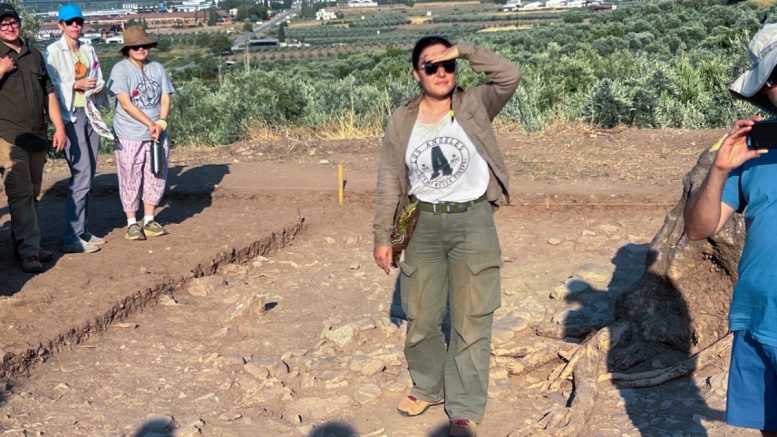
“Local workers, who are already trained, gradually remove the soil, and the students are there observing, documenting, taking notes, asking questions, determining when they need to stop and call in maybe the director or an associate director to take a look at what’s coming up, when they should take a photograph, when they should bring in the architects to make a state drawing of a particular moment,” Anderson said.
According to Anderson, Sardis is one of three excavation projects worldwide that “most people who go on to a career in classical archaeology in the U.S. have been through.”
The Harvard-Cornell team collaborates with specialists from multiple disciplines across the globe, and more than half of the researchers and students involved are Turkish. Local participation remains central to the project’s approach.
“A topic that regularly accompanies what we are doing is how are we doing it? How do we include local expertise?” Alexandridis said.
In recent years, women from the Sardis region have joined men in both excavation and restoration efforts, expanding community involvement at the site.
Local perspectives, heritage protection, and the impact of UNESCO recognition
Leyla Uğurer, now a doctoral student in the history of art and archaeology, grew up in the Sardis area. She first studied English and literature at Istanbul University before turning to classical archaeology.
“To learn archaeology, you have to work at the site as well,” she said.
Beginning in 2022, she conducted surveys of rock-cut tombs spanning from the Lydian to the Roman periods and continued this work over three summers. This year, she supervised the excavation of a late Roman site.
Her experience at Sardis ultimately led her to pursue a Ph.D. at Cornell, where she works with Alexandridis, whose research interests align with her own focus on funerary art. Such material reveals not only beliefs about death and the afterlife but also insights into daily life and social values.
Sardis once stood along “one of the most important trade roads in the ancient world,” where the first coin was minted and Alexander the Great paid a visit, Uğurer said. “You were raised there, so you have the same culture going on in you and around you. I remember looking at archaeologists when I was a child and admiring them. To be familiar with those archaeological works going on also helps you understand the archaeological importance more.”
Inclusion on the UNESCO World Heritage list has strengthened local pride and international visibility. It also brings tangible advantages.
“As a local, I can say it is very important,” she said. “First of all, now it is known worldwide and because of UNESCO, there can maybe be more funding for the excavation, also people, more tourists, and more research. People will know the area much better, and there will be more protection.”
Modern challenges: site vulnerability, looting, and long-term stewardship
That protection is urgently needed. The landscape is vulnerable to environmental damage, and agricultural activity has destroyed numerous tumuli. Looting has escalated dramatically, with treasure hunters using dynamite, bulldozers, and sometimes weapons to target burial mounds, according to Alexandridis.
Although much has already been uncovered, Sardis continues to reveal its story gradually.
“This is why the long-term commitment is so important,” Anderson said. “One season’s work, you’ll learn how to do the thing, but you’re not necessarily going to find something that will be especially significant for the history of the site, until maybe 10 years later, you find something else a little bit further away, and the pieces start to add up.”
Never miss a breakthrough: Join the SciTechDaily newsletter.
Follow us on Google and Google News.
Source link
