

Gore Verbinski’s “Good Luck, Have Fun, Don’t Die” is a maximalist screed against the ravages of social media and AI that, to its credit, places blame upon both the corporate overlords for whom this planet is merely a way station to interstellar domination but also each one us, complicit in our own small ways to the sequential undermining of all that is good and human about our fragile world. At times preachy, satirical, overstated, thrilling and odd, Verbinski’s latest is everything audiences have come to expect from the filmmaker, himself one of the most eccentric to have ever been given the reins of some of the biggest movies of all time. And yet, his absence from theaters over the last ten years has felt like a yawning chasm of mundanity; a barren desert of slop, both AI-generated and human, without his unique band of perverse and gooey storytelling that feels as poignant as it is immaterial, a filmmaker without vanity who clearly enjoys simply throwing the whole buffalo in a blender and hitting puree.
If you don’t recognize Gore’s name, you certainly know his work; as he helmed perhaps one of the greatest family films of all time (“Mousehunt”), one of the greatest American horror films of all time (“The Ring”), one of the best animated movies of all time (“Rango”), and one of the most successful, out of left field, blockbuster franchises of all time (The exponentially gonzo and sublime first three “Pirates of the Caribbean” films). Sadly, after the mad excess of “The Lone Ranger,” a well meaning but deeply flawed film with some of the most manically wonderful sequences ever conceived, and “A Cure for Wellness,” a misguided attempt to reclaim his “The Ring” respectability, Gore found himself sentenced to what is known as Director’s Jail, where filmmakers whose reach exceeded the patience of Hollywood’s grasp are placed to wither, calcify, and crumble into pillars of salt. And so, that is where he languished for nearly a decade before the release of “Good Luck, Have Fun, Don’t Die”, an uneven film that smushes “The Night of the Living Dead”, “Invasion of The Body Snatchers”, “Miracle Mile,” “12 Monkeys,” “Groundhog Day” and “The Terminator” together into a cotton candy manifesto against the metastasization of human decency ruptured from the confluence of social media apathy and artificial intelligence’s world domination that still fosters within it that magic spark that made him beloved to a generation of moviegoers. By throwing away any pretense of respectability and good taste, Gore has returned to his all-or-nothing roots, providing us a film that has all the exuberance of an artist who believed he would never make another movie again and decided he would not exit this mortal coil without leaving his bare soul out on the court for perhaps the last time.
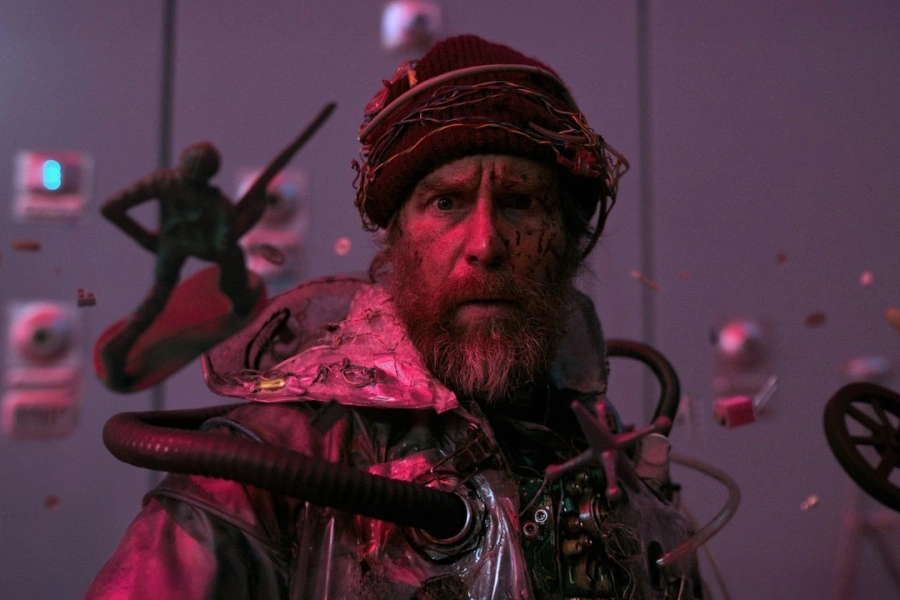
As the film opens, i’s a normal night at Norms, a greasy spoon diner in Los Angeles. Patrons of all walks of life are doing their best to spend a quiet evening amongst their endless coffee refills and pie, that is, until a man covered in wires, wearing what looks to be a rain poncho, bursts into the front doors and requests their assistance in saving the world (Sam Rockwell). He says he is from the future, a future where AI has infected reality and rendered humanity a mindless haze of automatons without the good sense to clean their own excrement, let alone eat and exercise. It is a wasteland of wandering, augmented reality mask-wearing drones slowly deteriorating away in the perfect world made for them by the AI, itself a being of infinite reach and corruption incapable of being conquered. Yet, there is hope. A small group of the smartest future people has designed not only a time-traveling device capable of sending a single person back to the night that AI gains sentience, but also a USB stick that, while unable to destroy the AI for good, will place guardrails around its reach and nullify its destructive capabilities. The Man From The Future has been in this diner many times before, 117 to be exact, searching for the precise combination of patrons who will help get him to the end of his journey; yet luck has not been on his side. Seemingly psychotic as he leaps and preens around the diner with the showmanship of a trained thespian in the midst of a chronic brain aneurysm, The Man pleads for assistance, and when none is offered, threatens, using his time travel machine as a makeshift “bomb” to secure a group of six random would be, revolutionaries; including grieving mother Juno Temple, petrified high school teachers Michael Peña and Zazie Beetz, and Haley Lu Richardson, a birthday party princess with a death wish and a debilitating allergy to cell phones and WIFI. Together, the group will only need to traverse a few blocks from the diner to their ultimate destination, the suburban home of a nine-year-old boy who will birth the malevolent AI. But “the future that will be” still wants desperately to be born and will stop at nothing to make sure our ragtag band of freedom fighters suffers their 117th defeat in the unending war against our impending tech apocalypse.
While that premise seems simple, and frankly makes for a fantastic opening recruitment sequence as Rockwell makes the hard sell to a bunch of normal folks who are reticent to believe a man who looks as if he lost a fight with a Circuit City, the film itself is far more satirical and sadder than one might imagine. As our heroes begin their crusade, we flash back to see the backstories of four of our normal recruits whose lives have been irreparably harmed by the insidious black hole opened in reality by the prenatal AI. There’s Mark and Janet, Michael Peña and Zazie Beetz, as school teachers who witnessed first hand how the constant scrolling mind-slog of TikTok has rendered their students literal hive mind zombies, Ingrid, Haley Lu Richardson, as the electronically ill idealist whose granola brained boyfriend becomes infected by the mind virus perpetuated by the AI’s promise of a perfect utopia, and, finally, there is Susan, Juno Temple, as the mother who believes that an AI voice in her ear is her son returned from the grave. It is in this segment where the film centers its magnifying glass to its most devastating, if a bit clumsy, effect; channeling Gore’s inherent grandiosity and absurdist humor toward something much more prescient and insidious.
We open Susan’s flashback as she races to her son’s school in the aftermath of a shooting, arriving just in time to see his limp body being wheeled through the front doors by paramedics. Devastated, Susan sits alone with the other mothers who lost children, trying to put the shattered pieces of her life together. And yet, the other mothers seem unbothered, even glib, as they discuss how annoying it was to come down to the school in LA traffic only to learn that their children were gunned down. They see Susan and take pity on her, seeing as this is her first time going through this, and give her a card and an address that might help her current situation. Susan follows their instructions and arrives at an Apple Store-coded minimalist tech haven where a shark-toothed salesman in a polo shirt presents her with the option of cloning her son, not as he was but as she wishes he would have been. Apparently, as a response to the unfettered spread of gun violence in schools across the nation, the US Government decided it would be easier to subsidize the creation of child clones than to hinder the spread of gun sales, with parents sometimes coming back two or even three times as their children die violently again and again. The price is high, but Susan has the option to mitigate some of the back-end costs by allowing her clone son to feature ads, little seventy-second recitations about approved consumer products at random times throughout the day. Desperate, Susan takes their offer and brings home a lobotomized version of what was once her son, a bar code bearing artificial flesh puppet that is programmed to like “sports”, “pizza”, and a brand-specific apple tea. After visiting a support group for parents just like her, all of whom seem thrilled with their automatons wearing the faces of their murdered children, Susan meets with a man who offers another option: an AI voice box that allegedly is a better approximation of what her son once was. Going home, Susan slips the earpiece into her ear and begins to converse with the voice of her son, or at least an AI version of it, as it subsequently coerces her to go to Norm’s Diner in anticipation of The Man From The Future’s arrival.
“Good Luck, Have Fun, Don’t Die” didn’t need to dive headfirst into American apathy for school shooting victims, yet it does, offering an almost Boots Riley-level satire baked into this otherwise straightforward tech nightmare. While the film flirts with the nexus point of the profound and the illicit, there is something quite pertinent in Gore’s presentation of people seeking relief from pain instead of a solution to its cause. How else could you explain the recent sub-economy of school safety measures, of bulletproof backpacks and classroom bracing materials, which have cropped up over the last twenty years? The solution to this unending child sacrifice upon the altar of the Second Amendment is a simple one, yet America will literally clone an Army of ad-spouting teenagers before passing the most milquetoast gun legislation. If there is a central evil that Gore is raging against in the most bubblegum way, it is the evil inherent in a societal pacification that renders all discomfort as the enemy, that sees boredom as time wasted not slurping back content, and creativity as the enemy of profit margins. As the central AI argues when confronted by our ragamuffin heroes, all it hopes to do is offer a balm to humanity, a world free from pain where life is filled with stimulation that is curated to the unique pleasure contours of each person’s brain. In short, an illusion. A lie. Truly, what else can AI really offer us beyond cold, unfeeling facsimiles of companionship, scholarship, or love? You can’t spell Anti-Christ without AI, and it’s clear that we are careening toward a damnation of our own making, a soothing balm of endless pleasure in a world all our own (NOW WITH ADS!). “Good Luck, Have Fun, Don’t Die” does not shy away from this inevitability; in fact, it embraces it, daring to tap dance along the razor line between humanism and nihilism in cheeky defiance of our penchant for self-immolation. Gore didn’t have to do that, but he did. And as always, we are all the better for it.
Gore Verbinski was the first filmmaker I can remember admiring. The Special Features of “Pirates of the Caribbean: The Curse of the Black Pearl” were my primer to the world of moviemaking, my first insight into what it meant to make art that was grandiose, eccentric, and emotionally meaningful. His films have taken on a reverence for movie fans since his absence, leading many to believe over the last ten years that he might be left to languish in the salt mines forever, damned for the sin of flying too close to the sun. But it pleases me to no end to say that Gore is back, and he hasn’t lost a step; if anything, he has doubled down on his unique quirks and is making movies not so much for the audience but for himself. “Good Luck, Have Fun, Don’t Die” is a messy, almost drunken sermon that damns the evils of the real world through the whimsy of a make-believe one, a titanic middle finger cheekily stuffed up the nose of an insipid corporate abomination that seeks to corrupt us for profit and deny the truth that a flawed world is the best one, one of choice, creativity, and of our own making. That creativity, that will, is our greatest superpower and the one thing AI can never be allowed to take from us, and it’s nice to see one of our finest filmmakers gleefully joining the fight. Welcome back, Gore. We missed you.
Have some pie and join up with The Man From The Future’s crusade.
You’ll be glad you did.
“Good Luck, Have Fun, Don’t Die” is playing at Prytania Theatres at Canal Place and The Broad Theater.
For more movie recommendations, CLICK here to follow me on Letterboxd.
