

Groundbreaking 2D Nanomaterial Rolls Into a New Dimension

MXene nanoscrolls transform flat 2D materials into conductive 1D structures, unlocking advances in energy storage, sensing, wearables, and superconductivity.
Nearly 15 years after identifying a versatile two-dimensional conductive nanomaterial known as MXene, researchers at Drexel University have unveiled a method to create its one-dimensional counterpart, called the MXene nanoscroll. These newly engineered structures are about 100 times thinner than a human hair and offer even greater electrical conductivity than flat MXene sheets. The team believes their unique properties could enhance technologies such as energy storage systems, biosensors, and wearable electronics.
The results were recently published in the journal Advanced Materials and describe a scalable production technique that starts with conventional MXene flakes and transforms them into scrolls with tightly controlled shapes and chemical characteristics.
Tubular Geometry Unlocks Faster Ion Transport
“Two-dimensional morphology is very important in many applications. However, there are applications where 1D morphology is superior,” said Yury Gogotsi, PhD, Distinguished University and Bach professor in Drexel’s College of Engineering, who was a corresponding author of the paper. “It’s like comparing steel sheets to metal pipes or rebar. One needs sheets to make car bodies, but to pump water or reinforce concrete, long tubes or rods are needed.”
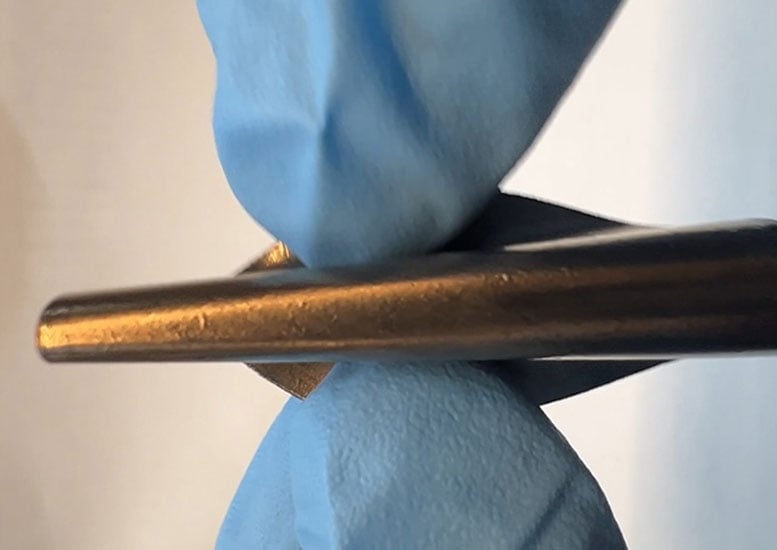
When flat MXene sheets are rolled into scrolls, the result is a hollow, tube-like material that is far smaller than everyday pipes but performs a similar role at the nanoscale. These structures can strengthen polymers or metals and guide ions through batteries or water desalination membranes with far less resistance.
“With standard 2D MXenes, the flakes lay flat on top of each other, which creates a confined-space and a difficult path for ions or molecules to navigate and move between the layers,” said Teng Zhang, PhD, a postdoctoral researcher in the College of Engineering, who was a co-author of the research. “By converting 2D nanosheets into 1D scrolls, we prevent this nano-confinement effect. The open, tubular geometry effectively creates ‘highways’ for rapid transport, allowing ions to move freely.”
Overcoming Graphene’s Limits with MXene Chemistry
Tube-like nanostructures made from graphene, such as carbon nanotubes and graphene nanoscrolls, are already well studied. However, producing comparable scrolls from MXenes has proven difficult. Despite MXenes offering more versatile chemistry, easier processing, and higher conductivity than graphene, earlier efforts often resulted in inconsistent or low-quality materials.
The process for making nanoscrolls begins with a multilayer MXene flake as its precursor. By strictly controlling the chemical environment, the researchers use water to alter the surface chemistry of the flakes. This creates an structural asymmetry, called a Janus reaction, that causes lattice strain within the layers of the flakes. Driven by the release of internal strain, the layers peel away and curl into tight tubular scrolls.
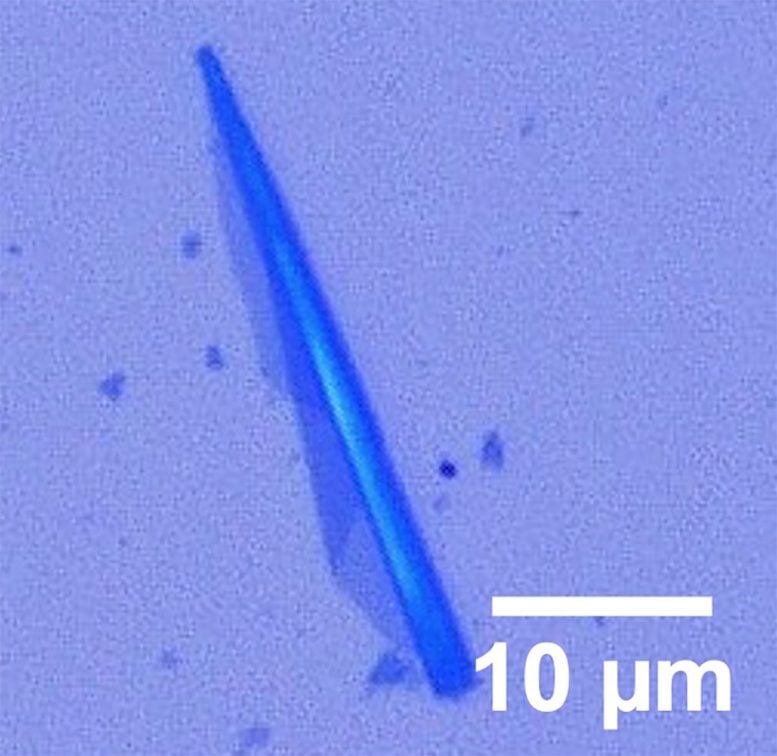
Using this approach, the researchers successfully produced nanoscrolls from six different MXenes, including two forms of titanium carbide along with niobium carbide, vanadium carbide, tantalum carbide, and titanium carbonitride. In each case, they were able to produce about 10 grams of material with consistent structure and tunable composition.
Enhanced Sensing and Composite Performance
Beyond conductivity and strength, the scroll geometry gives MXenes new functional advantages that are especially useful for sensing applications and advanced composites.
“In a standard stacked 2D structure, the active sites for molecular adsorption are often hidden between layers, making it difficult for molecules, especially large biomolecules to reach them,” Gogotsi said. “The open, hollow structure of the scroll solves this by allowing the analytes easy access to the MXene surface. Combining with the material’s high conductivity and mechanical stiffness, this ensures we get a strong, stable signal. Thus, we envision the use of scrolls in biosensing. The same accessible surface of conductive scrolls may be useful for gas sensors, electrochemical capacitors, and other devices that require access of ions and molecules to the surfaces.”
The researchers also see strong potential in wearable electronics, sometimes called ionotronic devices. MXene scrolls could reinforce soft polymers while simultaneously maintaining electrical conductivity. Their rigid shape allows them to embed securely within flexible materials, helping create stretchable composites that remain electrically connected during bending and movement.
Electric-Field Alignment for Functional Textiles
The researchers also found that in the solution, the orientation of the nanoscrolls can be controlled with an electric field. This discovery means they could easily be fabricated to align with the axis of fibers in a functional textile to produce a more durable, conductive coating.
“Imagine manipulating millions of tubules 100 times thinner than a human hair to make them build a wire or stand up vertically to make a brush,” Zhang said. “This is real nanotechnology, as we can manipulate matter at the nanoscale. It is also a critical development for functional textiles, as the scrolls could be incorporated as reinforcement materials in synthetic fibers.”
The team plans to further investigate this controllable behavior, along with the quantum properties of the nanoscrolls, including their ability to support superconductivity.
“Until now, superconductivity in this class of MXenes was limited to pressed pellets of particles and powders, having never been realized in solution-processed films with mechanical flexibility,” Gogotsi said. “By using niobium carbide scrolls, we observed the change of the material enough to enable superconductivity in free-standing, macroscopic films for the first time. The scrolling process introduces specific lattice strain and curvature that are absent in flat sheets. While the exact physical mechanism is still being explored, we hypothesize that this strain, combined with the continuous 1D structure, stabilizes the superconducting state.”
From Laboratory Curiosity to Practical Quantum Materials
Quantum effects in nanomaterials have attracted growing interest for their potential to advance computing and data storage. For the Drexel researchers, this work marks an important step in turning MXene superconductivity from a laboratory observation into a usable material property.
“Using the methods described in this paper, we can now process superconducting MXenes into flexible films, coatings, or wires at room temperature for potential superconducting interconnectors or quantum sensors,” Zhang said. “We expect many other interesting phenomena caused by scrolling and are going to study them.”
Reference: “Scalable Synthesis of MXene Scrolls” by Teng Zhang, Benjamin Chacon, Danzhen Zhang, Aidan Cotton, Yihui Zhang, Yuan Zhang, Stefano Ippolito, Francesca Urban, Tetiana Parker, Lingyi Bi, Kateryna Shevchuk, Kyle Matthews, Eric A. Stach and Yury Gogotsi, 22 January 2026, Advanced Materials.
DOI: 10.1002/adma.202521457
This research was supported by the U.S. Department of Energy and the National Science Foundation.
Never miss a breakthrough: Join the SciTechDaily newsletter.
Follow us on Google and Google News.
Source link
